1960 · Chrysler · United States
1960 Chrysler 300F: Ram Tubes, a French Gearbox and a Hardware Dealer at 144 mph
Unibody construction, a cross-ram 413 and four leather bucket seats defined the 300F; a handful of short-ram cars with French four-speeds swept the Daytona flying mile, though sources disagree on how many were built.
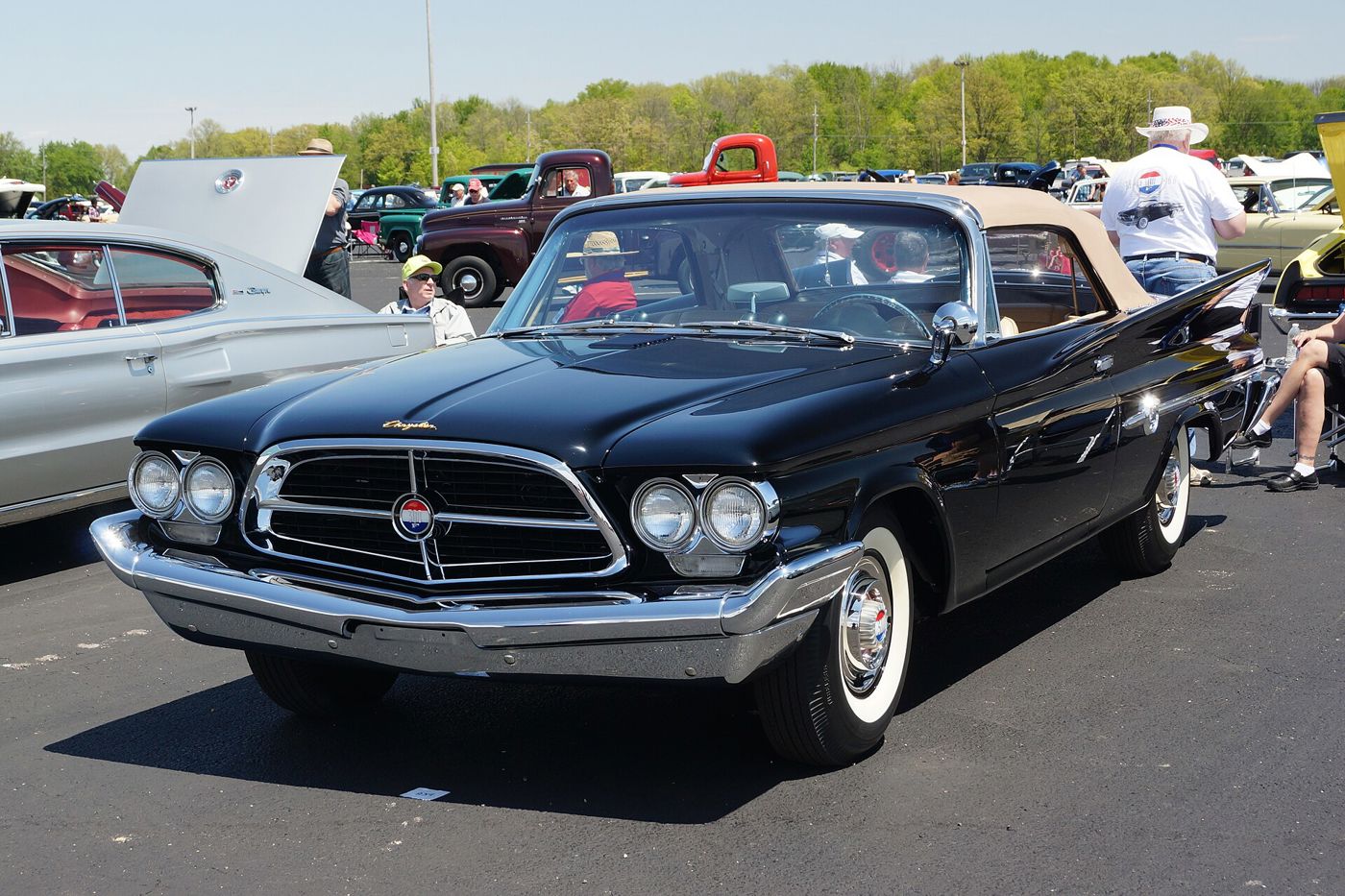

Toward the end of 1959, Chrysler engineer Burt Bouwkamp telephoned Gregg Ziegler, a hardware-store owner from Elgin, Illinois. Ziegler had been impressed enough by Chrysler's showing on the beach in 1956 to sell his Buick Century and buy a 300B. Now Chrysler was planning a full assault on the 1960 Daytona Speed Weeks and wanted him in it. Six 300Fs built in early November went to the engineering garage at Chrysler's Jefferson Avenue plant for 400-horsepower engines and heavy-duty four-speed transmissions made in France by Pont-a-Mousson. Ziegler and the other privateers paid full dealer price: about $6,800.1
On February 7, 1960, Ziegler ran the flying mile at a two-way average of 144.927 mph, and the six GT Specials finished first through sixth, at speeds from 141.50 to 144.9 mph. A standard 300F placed seventh. Mac's Motor City Garage spells the driver's name Zeigler. The 300B's record four years earlier had been 139.373 mph by the Chrysler 300 Club's figure. A letter car had once again gone to Daytona and come back the fastest thing in its class, this time with the factory's engineers openly behind it.1,2,3,4
The car underneath the record was new in structure. For 1960 every Chrysler except the Imperial went to unit-body construction, and the 300F was the first letter car without a traditional ladder frame. Exner's styling changed with it: fins canted outward and ending in points, boomerang taillamps, a simple two-bar grille carrying a red, white and blue 300F medallion, and a Flight Sweep deck lid stamped with a simulated spare tire. The 126-inch wheelbase stayed, and the car was 219.6 inches long and 79.7 inches wide, riding on 9.00 x 14 Blue Streak tires with white sidewalls.2,5
The engine was the other headline. The Hemi was gone, replaced by a 413-cubic-inch wedge on a 4.18-inch bore and 3.75-inch stroke, and Chrysler fed it through what it called Ram Induction. The idea was simple enough: two Carter four-barrels sat on opposite sides of the engine, on 30-inch tubes tuned so that pressure waves pushed extra air into the cylinders between roughly 3,000 and 4,000 rpm. The standard 300F engine, on 10.1:1 compression and hydraulic lifters, was rated at 375 horsepower at 5,000 rpm and 495 lb-ft at 2,800 rpm. The club likens the effect to supercharging in the middle of the rev range.5,2
The Daytona cars used the same idea cut short. The optional engine had 15-inch ram tubes, mechanical lifters, a longer 284-degree camshaft in place of the standard 268 degrees, and a rating of 400 horsepower at 5,200 rpm with 465 lb-ft at 3,600 rpm. The shorter tubes moved the tuned range toward 5,500 to 6,000 rpm, where a flying mile is won. Torque fell by 30 lb-ft on paper and peak power rose by 25 horsepower, a trade suited to a car meant to run flat out. Both ratings are manufacturer-published figures, and on what basis Chrysler rated them is not known.5
The gearbox came from further away. The Pont-a-Mousson four-speed had been made for the French Facel Vega luxury car, with ratios of 3.35, 1.96, 1.36 and 1.00, a 3.31 axle standard and ratios up to 3.73 available. The cars had to be modified to accept the four-speed, its clutch and a floor shift. The ordinary long-ram 300F had only the TorqueFlite three-speed automatic, geared 2.45, 1.45 and 1.00, and a 3.31 axle. A buyer walking into a showroom was, in practice, buying the automatic car; the French gearbox belonged to the handful built for the beach.2,5,1
Nobody agrees on how many beach cars there were. The club says at least eight short-ram cars were built, which it calls Gran Turismos, and that four of the eight remain. Over-Drive says 15 short-ram cars were produced, nine of them with the Pont-a-Mousson. Mac's reports that Chrysler said seven Specials were built, that others say six, and that still others say as many as 15. Sports Car Market estimates nine to 15. On the club's figures, eight cars were about 0.7 percent of the 1,212 300Fs; even the highest count, 15, is little more than one percent. Ziegler's own car is among the survivors. He sold it to Robert McAtee of Bloomington, Illinois, who kept it until his death in 2007, when it showed about 11,000 miles, and it sold at Gooding and Company's Amelia Island auction in March 2013 for $236,500.2,5,4,1
Inside, the 300F was built for four people rather than for a record. It had four individual tan leather bucket seats, the front pair on swivels, with a console running the full length of the car from dash to rear seat back, carrying the tachometer and the rear window switches. The AstraDome instrument cluster put a 150-mph speedometer and four gauges under a clear plastic dome lit electroluminescently. The car wore ten red, white and blue 300 emblems, and air conditioning, six-way power seats, a Sure-Grip differential and a power rear antenna were popular options. The paint list was short: Formal Black, Toreador Red, Alaskan White and Terracotta.5,2
It was also expensive, and few were sold. The hardtop cost $5,411 and the convertible $5,841. The club counts 964 hardtops and 248 convertibles, 1,212 in all; Over-Drive counts 969 hardtops and the same 248 convertibles, 1,217 in all, the figure Sports Car Market repeats. The convertible took about one sale in five on either count. Against the 1957 300C, which the club counts at 2,251, the 300F sold at a little over half the volume, even with a new structure and a new engine family.4,2,5,1
Chrysler kept the Daytona formula for one more year and made it simpler. The 1961 300G carried both 1960 engines at the same ratings, changed the standard axle from 3.31 to 3.23 for more top speed, and gave the 400-horsepower engine a new heavy-duty Chrysler three-speed manual in place of the expensive French four-speed. A GT 300G won the Daytona flying mile again, a stock 300G won the one-mile acceleration run, and production rose to 1,280 hardtops and 337 convertibles. The 300G was the last letter car with Exner's fins. The 300F's record belonged to a car its driver had bought at full dealer price.2,1
Fact sheet · 1960 · United States
The numbers
1960 Chrysler 300F: Unibody construction, a cross-ram 413 and four leather bucket seats defined the 300F; a handful of short-ram cars with French four-speeds swept the Daytona flying mile, though sources disagree on how many were built.
Figures may describe different groups of cars. Add rows together only when the note says they make up a total.
Key facts
Production
| What was counted | Built |
|---|---|
| Chrysler 300F, two-door hardtop2,3 300F · 2-door hardtop | 964 |
| Chrysler 300F, convertible2,5 300F · convertible | 248 |
| What was counted | Built |
|---|---|
| Chrysler 300F, all bodies6,7 300F | 1,212 |
| What was counted | Built |
|---|---|
| Chrysler 300F, 400 hp short-ram engine2,3 300F · 413 short-ram 2x4-bbl (400 hp) | 8 |
Prices when new
| Model | Price | Price type |
|---|---|---|
| Factory price, 300F two-door hardtop7 | $5,411 | Factory Price, 1960 model year |
| Factory price, 300F convertible7 | $5,841 | Factory Price, 1960 model year |
| Approximate price, 300F Special (400 hp, four-speed) hardtop8 | $6,800 | Basic price: $6800, 1960-06 |
Prices are the nominal dollars of the day, not adjusted for inflation.
Engines
| Engine | Factory rating | Availability | Built |
|---|---|---|---|
| 413 wedge V8, long-ram cross-ram, 375 hp5 413 cu in · 2 x 4-barrel on 30 in cross-ram manifold (Carter AFB 2930S) | 375 hp @ 5,000, 495 lb-ft @ 2,800 (manufacturer published) | standard | |
| 413 wedge V8, short-ram cross-ram, 400 hp5 413 cu in · 2 x 4-barrel on 15 in cross-ram manifold (Carter AFB 3084S) | 400 hp @ 5,200, 465 lb-ft @ 3,600 (manufacturer published) | optional | 82 |
Ratings are published figures, not dyno results. Gross and net ratings aren't directly comparable.
Transmissions
| Transmission | Availability | Built |
|---|---|---|
| TorqueFlite three-speed automatic (2.45 / 1.45 / 1.00)5 | standard | |
| Pont-a-Mousson four-speed manual (3.35 / 1.96 / 1.36 / 1.00)5,2 | short-ram 400 hp cars only | 95 |
Options and packages
| Option |
|---|
| 400 hp short-ram 413 high-performance engine (mechanical lifters, high-lift cam, headers, 15 in effective ram tubes)9,10 |
| Pont-a-Mousson four-speed manual transmission (imported from France)9,10 |
| Rear axle ratios 2.93, 3.15, 3.23, 3.54, 3.73 (3.31 standard, manual or automatic)10 |
| Air conditioner and heater10 |
| Heater only10 |
| Radio10 |
| Power antenna10 |
| Power seat10 |
| Rear window defroster10 |
| Remote-control outside mirror10 |
| Rear seat speaker10 |
Paint
| Code | Color |
|---|---|
BB-1 |
Formal Black5,11 |
PP-1 |
Toreador Red metallic5,11 |
WW-1 |
Alaskan White5,11 |
ZZ-1 |
Terracotta metallic5,11 |
Color names are the factory's. We don't show color swatches, because a screen color is no guide for a restoration.
Interiors
| Trim |
|---|
| Tan leather; four individual bucket seats with power swivel front seats; full-length console with tachometer5 |
| Beige perforated genuine leather over full-foam padding up to 4 in thick; four individually contoured seats, front pair swivel; center console about 11 in high in front tapering to about 6 in at the rear, with tachometer, four power-window buttons, ashtrays and lighters, front and rear armrests; looped-pile carpet; Panelescent astro-dome instrument lighting9 |
| Painted interior: lower and upper instrument panel, steering column cover and defrost outlets Saddle Beige gloss (Ditzler 21181); radio grille Black Frost metallic (9229); lower cowl side panels Black Frost semi-gloss on early cars, Saddle Beige semi-gloss on late cars11 |
Specifications
| Measure | Value | Applies to |
|---|---|---|
| Wheelbase5 | 126 in | all bodies |
| Overall length5,3 | 219.6 in | all bodies |
| Overall width5 | 79.7 in | all bodies |
| Overall height5 | 55.1 (hardtop) / 55.5 (convertible) in | by body |
| Tires5 | 9.00 x 14 Blue Streak, white sidewall | all bodies |
| Rear axle ratio5 | 3.31:1 standard with TorqueFlite; 2.93 to 3.73 listed with the four-speed | as listed |
| Curb weight / shipping weight, hardtop10 | 4,585 (2,464 front / 2,121 rear) / 4,435 (estimated) lb | 300F two-door hardtop (convertible listed without figures) |
| Overall width (factory)10,9 | 79.4 in | 300F |
| Engine detail, 375 hp9 | Hydraulic lifters; lift .430 / .430 in; duration 268 / 268 deg; overlap 48 deg; intake valve 2.08, exhaust 1.60 in; idle 725-750 rpm; 30 in ram tubes | standard 413 |
| Engine detail, 400 hp8 | Mechanical lifters; lift .449 intake / .454 exhaust; duration 284 deg; overlap 55 deg; internal dividers removed from the first 15 in of each 30 in ram tube; headers and 2½ in exhaust | optional short-ram 413 |
| Pont-a-Mousson four-speed ratios8 | 3.35 / 1.96 / 1.36 / 1.00 | four-speed cars |
| Construction12 | Unitized body, as on all 1960 Chrysler Corporation cars except Imperial; 7/8 in front stabilizer bar | 300F |
Period road tests
| Test | Car tested | Result |
|---|---|---|
| Hot Rod (Ray Brock), 1960-04120-60 mph | 300F two-door hardtop, 413 375 hp long-ram, TorqueFlite, power steering, brakes, seat, windows, radio, heater; 4,640 lb with full fuelAlso printed: 0-30 3.4 s; 30-60 passing 5.1 s; 50-80 passing 7.1 s | 7.4 s |
| Hot Rod (Ray Brock), 1960-0412Standing quarter mile | 300F hardtop, 375 hp, TorqueFlite | 16.0 s at 90.9 mph |
| Hot Rod (Ray Brock), 1960-0412Fuel economy, overall | 300F hardtop, 375 hp, TorqueFliteNearly 750 miles of test driving; best 12.5 at 65 mph cruising; worst 10.8 | 12 mpg |
| Motor Life, 1960-0680-60 mph | 300F Special two-door hardtop, 413 400 hp short-ram, Pont-a-Mousson four-speed, 3.31 axle (a duplicate of the Daytona record car apart from its 2.93 axle); test weight 4,712 lbAlso printed: 0-30 3.7 s, 0-45 4.9 s; 8-10 mpg | 7.2 s |
A road test result belongs to the one car that was tested, with its engine, gearing, tires, and conditions. It is not a figure for every car of the year.
Identification
- Series
- Series PC3-H, sharing the New Yorker platform.5
- Instrument panel
- AstraDome semi-circular domed instrument cluster.5
Where the sources disagree
Identification
Read a 1960 Chrysler VIN
The VIN decoder runs in your browser and never sends the VIN anywhere. How the factory numbered this year's cars:
Same model year
Also in 1960
- Ford Thunderbird The Square Bird's best year: 92,843 built, 11,860 of them convertibles, with a sliding sunroof hardtop added and the 430 still on the option list.
- Studebaker Hawk Renamed simply 'Hawk' and five months late because of steel shortages, the coupe got the 289 V8 back as its standard US engine. 4,507 were built.