1980 · Pontiac · United States
1980 Pontiac LeMans: a year of market-specific powertrains
By 1980 the LeMans's strongest listed engine was a 301 four-barrel with automatic only, and its sporting content had narrowed to a Rally handling package and rally gages.
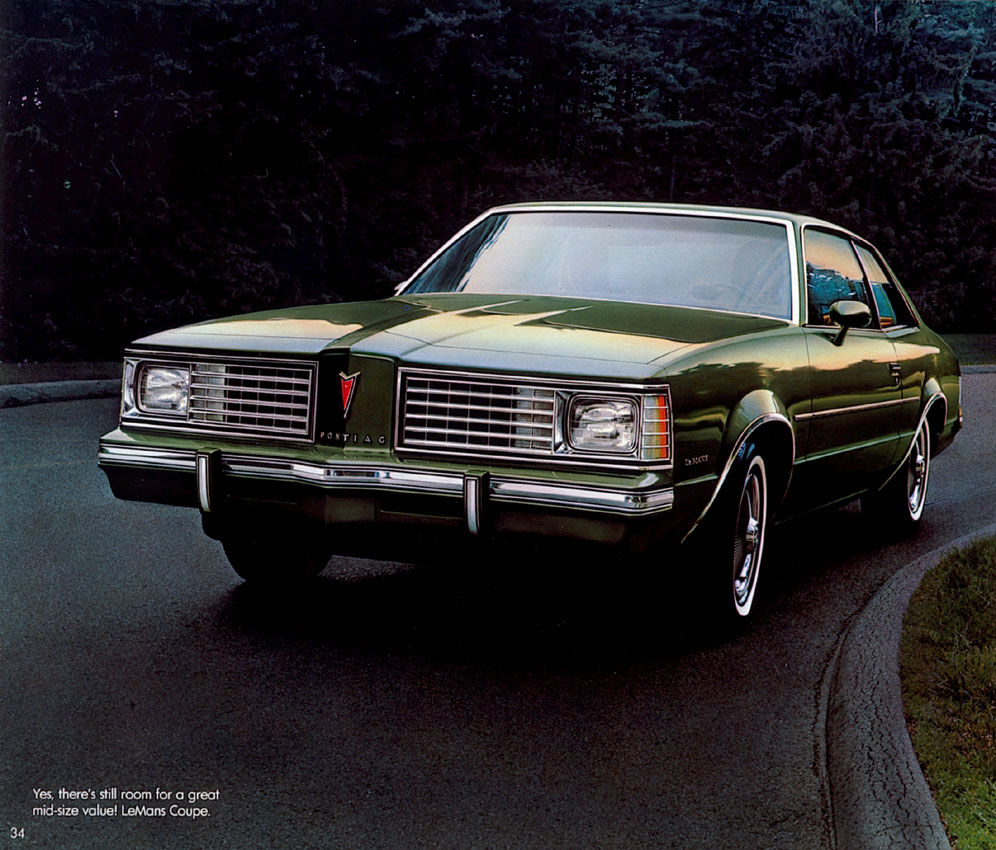
In 1980, where a LeMans was sold mattered as much as which engine its buyer chose. A Federal car started with Chevrolet’s 229-cubic-inch V6 and offered a floor-shift three-speed manual or automatic. California’s base car instead used Buick’s 231-cubic-inch V6 and an automatic. The V8 choices followed the same pattern: Pontiac’s 265 and 301 were offered for Federal cars, while California got Chevrolet’s 305. Every V8 was automatic-only. Rather than a single national engine ladder, Pontiac sold a lineup shaped by both equipment and market.
The five engine codes tell a broader story about who supplied Pontiac’s power in this model year. Chevrolet built the Federal base LC3 and the California LG4; Buick supplied the California LD5; Pontiac supplied the L55 and L37. The badges on the hood did not mean every engine under it came from Pontiac. Each engine was defined by its displacement, carburetion, builder, market and transmission. That detail matters because the same LeMans name could describe quite different mechanical combinations, depending on the buyer’s state and the engine the buyer selected, and the factory set firm boundaries between them.
The transmission choices had narrowed from the year before. In 1979 a Federal LeMans could still be ordered with a four-speed behind the 301 four-barrel. In 1980 the only manual was offered with the Federal 229 V6; choose a V8 and the automatic was the only transmission. The change is easy to miss when the engines are listed without their footnotes, but it changed what the car could be ordered as. Availability depended on both engine and market, so a general statement that the LeMans “had a manual” would leave out the important limit.
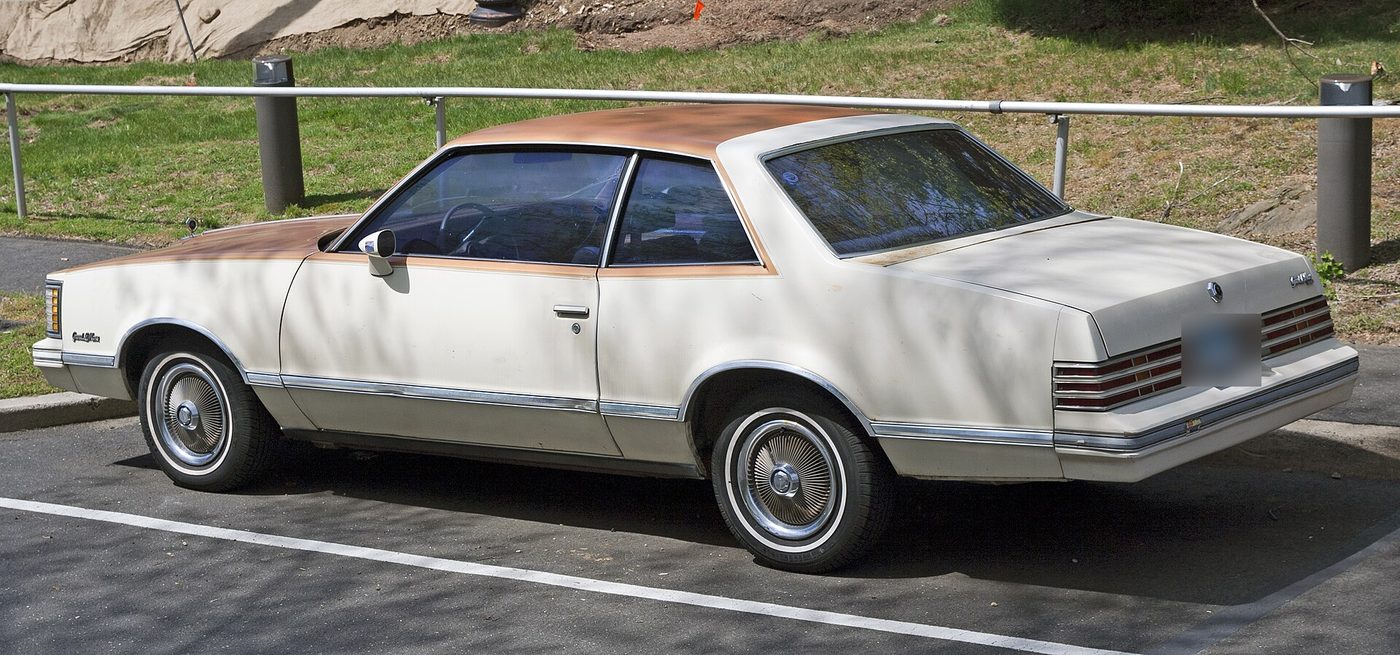

The line also offered several ways to use the LeMans body: a two-door coupe, a four-door sedan and a Safari wagon under the LeMans name, with a separate set of Grand LeMans bodies. Pontiac built 9,110 LeMans coupes, 20,485 LeMans sedans and 12,912 LeMans Safari wagons. Those are body-style totals for the three LeMans bodies, not a complete count of the LeMans family. The sedan led among the three, while the wagon remained a substantial part of the range. Without the Grand LeMans counts beside them, they do not make a total for the whole series.1
The price ladder made the engine choice unusually easy to compare. The V6 coupe listed at $5,274 and the V8 version at $5,454, a $180 difference before options. The sedan followed the same pattern: $5,377 for the V6 and $5,557 for the V8. The Safari listed at $5,861 with the V6 and $6,041 with the V8. These are nominal list prices, not modern values or transaction prices. Across all three bodies the V8 premium was the same, even though the engines and market rules behind the two choices were not identical.1
Pontiac kept a small measure of sporting character in the equipment list. The Rally handling package brought a larger front stabilizer bar, a rear stabilizer bar and specifically tuned suspension, paired with 205/70R14 steel-belted radial tires. Rally gages and an instrument-panel tachometer were available as well. Those features did not turn every LeMans into a performance model, and Pontiac did not claim that they did. They gave the buyer a way to order firmer chassis equipment and extra instrumentation on a line whose V8s were now tied to automatic transmissions.
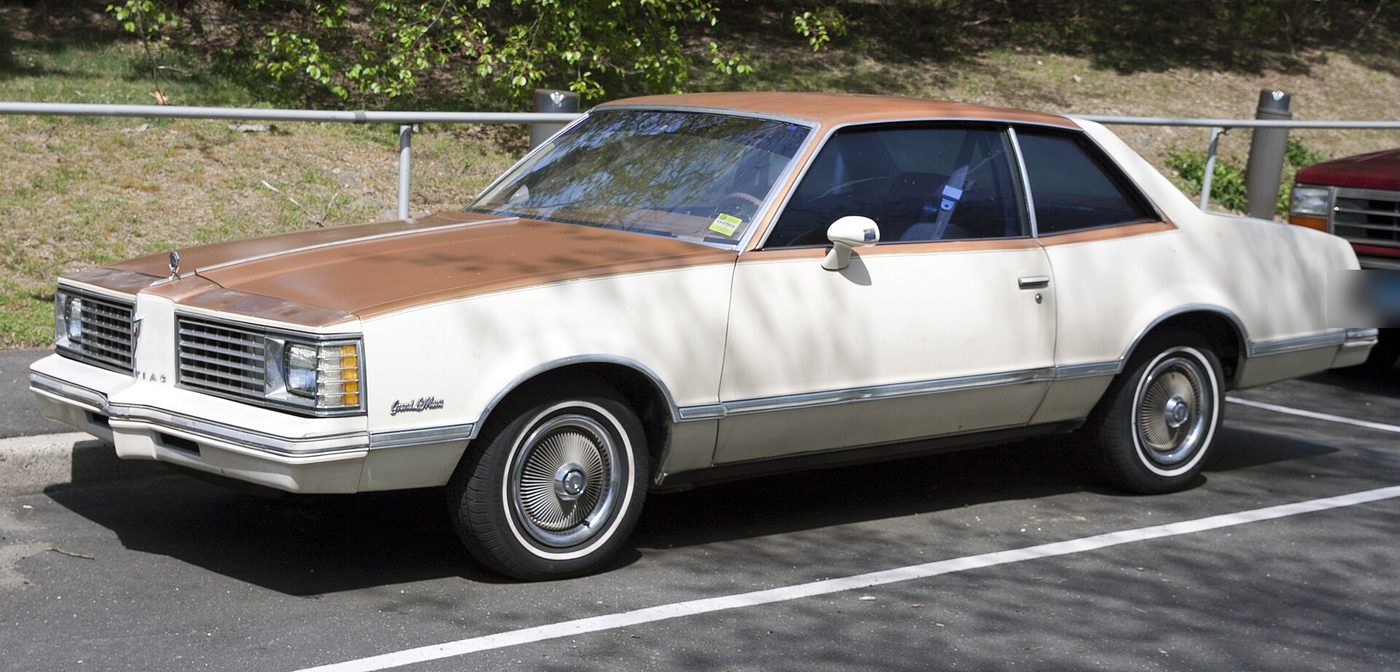

The interior and paint choices separated the more plainly equipped LeMans from the Grand LeMans. Seven interior trims were offered in distinct color combinations, including Dover II cloth for the LeMans in blue, camel tan and maroon. Grand LeMans buyers could choose richer trim, including Pompey-cloth bucket seats in four colors. Fourteen exterior colors were offered for the year, to be paired with those trims.
The LeMans sat in a familiar mid-size footprint: a 108.1-inch wheelbase, 198.6 inches long and 71.9 inches wide. It carried an 18.1-gallon fuel tank and 185/75R14 tires as standard. Buyers could select the wider 205/70R14 tire, which was required with the California 305 V8. That pairing ties the option list back to the powertrain chart: engine choice affected transmission and market availability, and the tire specification as well. Pontiac presented the car as a configurable range, with equipment rules linking the parts together.
Taken as a whole, the 1980 LeMans offered choices, but also firm limits. The Federal V6 could be ordered with a manual; the California V6 and every V8 could not. Pontiac’s 301 four-barrel was the strongest Federal engine offered, while California’s V8 was Chevrolet’s 305. Three body styles offered different kinds of space, and the repeated $180 V8 premium kept the price comparison consistent. The Rally package and gages added a sporting accent without changing those constraints. Market, engine, transmission, tire and body were all parts of one factory-defined order.1
The year leaves a specific picture of the 1980 offering: a market-sensitive powertrain chart, three distinct LeMans body choices with their own production counts, and a narrow but real set of handling and instrumentation options. The LeMans coupe, sedan and Safari wagon each had a clear place in that range, and the Grand LeMans bodies sat above them with richer trim.1
Fact sheet · 1980 · United States
The numbers
1980 Pontiac LeMans: By 1980 the LeMans's strongest listed engine was a 301 four-barrel with automatic only, and its sporting content had narrowed to a Rally handling package and rally gages.
Figures may describe different groups of cars. Add rows together only when the note says they make up a total.
Key facts
- No manual transmission was listed with any 1980 LeMans V8; the four-speed of 1979 no longer appears in the LeMans powertrain table.
Production
| What was counted | Count | Counted as |
|---|---|---|
| LeMans 2-door coupe (D27)1 LeMans · 2-door coupe (D27) Catalogue production total for the body style, all engines. | 9,110 | |
| LeMans 4-door sedan (D19)1 LeMans · 4-door sedan (D19) Catalogue production total for the body style, all engines. | 20,485 | |
| LeMans Safari wagon (D35)1 LeMans Safari · 4-door 2-seat wagon (D35) Catalogue production total for the body style, all engines. | 12,912 |
Prices when new
| Model | Price | Price type |
|---|---|---|
| Factory price, LeMans 2-door coupe (D27), V-61 | $5,274 | factory price, 1980 model year |
| Factory price, LeMans 2-door coupe (D27), V-81 | $5,454 | factory price, 1980 model year |
| Factory price, LeMans 4-door sedan (D19), V-61 | $5,377 | factory price, 1980 model year |
| Factory price, LeMans 4-door sedan (D19), V-81 | $5,557 | factory price, 1980 model year |
| Factory price, LeMans Safari wagon (D35), V-61 | $5,861 | factory price, 1980 model year |
| Factory price, LeMans Safari wagon (D35), V-81 | $6,041 | factory price, 1980 model year |
Prices are the nominal dollars of the day, not adjusted for inflation.
Engines
| Engine | Factory rating | Availability |
|---|---|---|
| LC3 · 3.8-litre (229) V6, 2-bbl (Chevrolet) 229 cu in · two-barrel | base, Federal; 3-speed manual (2.73 axle) or automatic (2.41) | |
| LD5 · 3.8-litre (231) V6, 2-bbl (Buick, C-4 electronically controlled spark and computer-controlled catalytic converter) 231 cu in · two-barrel | base, California; automatic (2.41, 3.08 available) | |
| L55 · 4.3-litre (265) V8, 2-bbl (Pontiac) 265 cu in · two-barrel | optional, Federal, automatic (2.29) | |
| L37 · 4.9-litre (301) V8, 4-bbl (Pontiac) 301 cu in · four-barrel | optional, Federal, automatic (2.14; 2.41 available) | |
| LG4 · 5.0-litre (305) V8, 4-bbl (Chevrolet) 305 cu in · four-barrel | optional, California, automatic (2.29; 2.73 available) |
Ratings are published figures, not dyno results. Gross and net ratings aren't directly comparable.
Transmissions
| Transmission | Availability |
|---|---|
| 3-speed manual, floor shift | base with the LC3 V6, Federal only |
| Automatic, column shift (floor shift with bucket seats) | all engines; the only transmission with V8s and in California |
Options and packages
| Code | Option |
|---|---|
| Rally handling package (larger front stabilizer bar, rear stabilizer bar, specifically tuned suspension; with 205/70R14 steel-belted radials) | |
| Rally gages and instrument-panel tachometer | |
| Cloth or vinyl bucket seats (Grand LeMans); console with bucket seats | |
| Power glass or metal sunroof (coupe only) | |
| Cast aluminum wheels; Rally IV wheels | |
W50RPO |
Two-tone paint treatment with paint-break stripe (LeMans and Grand LeMans coupe and sedan) |
| Trailer group, medium (not with V6) |
Paint
| Code | Color |
|---|---|
11 |
Cameo White |
15 |
Platinum |
19 |
Starlight Black |
21 |
Baniff Blue |
29 |
Nightwatch Blue |
44 |
Piedmont Green |
50 |
Mariposa Yellow |
59 |
Stetson Beige |
63 |
Fremont Gold |
69 |
Castilian Bronze |
75 |
Bordeaux Red |
76 |
Montreux Maroon |
77 |
Agate Red |
85 |
Richmond Gray |
Color names are the factory's. We don't show color swatches, because a screen color is no guide for a restoration.
Interiors
| Code | Trim |
|---|---|
26B2 |
LeMans standard full-width seat, Dover II cloth, blue (coupe and sedan) |
62B2 |
LeMans standard full-width seat, Dover II cloth, camel tan |
79B2 |
LeMans standard full-width seat, Dover II cloth, maroon |
26R2 |
LeMans extra-cost Sierra vinyl, blue |
62R2 |
LeMans extra-cost Sierra vinyl, camel tan |
79R2 |
LeMans extra-cost Sierra vinyl, maroon |
|
Grand LeMans extra-cost custom bucket seats, Pompey cloth: 19C1 black, 26C1 blue, 62C1 camel tan, 79C1 maroon (coupe and sedan) |
Specifications
| Measure | Value | Applies to |
|---|---|---|
| Wheelbase | 108.1 in | coupe and sedan (2745 mm) |
| Overall length | 198.6 in | coupe and sedan |
| Overall width | 71.9 in | coupe and sedan |
| Fuel tank | 18.1 US gal | LeMans (69 litres) |
| Standard tires | P185/75R14 black fiberglass-belted radial | LeMans and Grand LeMans (205/70R14 steel-belted available, required with 305 V8) |
Identification
- Engine building division in the order code
- Pontiac's 1980 catalog marks each LeMans engine with its builder: LC3 3.8 V6 by Chevrolet, LD5 3.8 V6 by Buick, L55 4.3 V8 and L37 4.9 V8 by Pontiac, LG4 5.0 V8 by Chevrolet.
Identification
Read a 1980 Pontiac VIN
The VIN decoder runs in your browser and never sends the VIN anywhere. How the factory numbered this year's cars:
Same model year
Also in 1980
- AMC AMX The last car to wear the AMX name: for 1980 the Spirit AMX lost its V8 option and ran only with the 258 six; 865 delivered.
- AMC Gremlin X and Spirit AMX The last car to wear the AMX name: for 1980 the Spirit AMX lost its V8 and ran only with the 258 six; 865 delivered.
- Buick Regal Turbo, Grand National and GNX Quad headlamps and an aluminum intake arrived, but turbo Sport Coupe production fell to 6,276.
- Buick Riviera Turbo S Type in its second year; totals agree at 48,621 but the S Type count does not.
- Chevrolet El Camino SS RPO Z15 Super Sport listed at $5,933.60; the 350 was gone and a 155 net hp 305 topped the list. 40,952 El Caminos built.
- Ford Thunderbird The downsized eighth-generation Thunderbird; the 302 V-8 with Automatic Overdrive was standard only on the Silver Anniversary.
- Mercury Capri RS and ASC/McLaren 79,984 Capris were produced; the Turbo RS listed at $6,935 with the 2.3 turbo four.
- Mercury Cougar A unitized-body XR-7, the only Cougar for 1980, with a 115-hp 255 V-8 standard; 58,028 built.
- Oldsmobile Cutlass, 4-4-2 and Hurst/Olds The 4-4-2 (W-30) was a $1,425 black-or-white option on the Cutlass Calais coupe with the Cutlass line's only 350 V-8, and the Standard Catalog counts 886 installed.
- Plymouth Road Runner The final year of the Road Runner name in Plymouth's catalog.
- Pontiac Firebird and Trans Am The Turbo Trans Am arrives: a turbocharged 301, an Indy 500 pace car, and 50,896 Trans Ams, every one an automatic.
- Pontiac Grand Prix Final SJ year by the compiled tables; 7,087 SJ built.