1955 · Chevrolet · United States
1955 Chevrolet Bel Air: Performance Hidden in a Full-Size Order Sheet
Chevrolet's new 265 V8 and the RPO 410 power package put real performance in an ordinary showroom, and the factory published two different ratings for the same engine.
United States · researched through July 26, 2026
Power-team selector
Choose the exact Bel Air
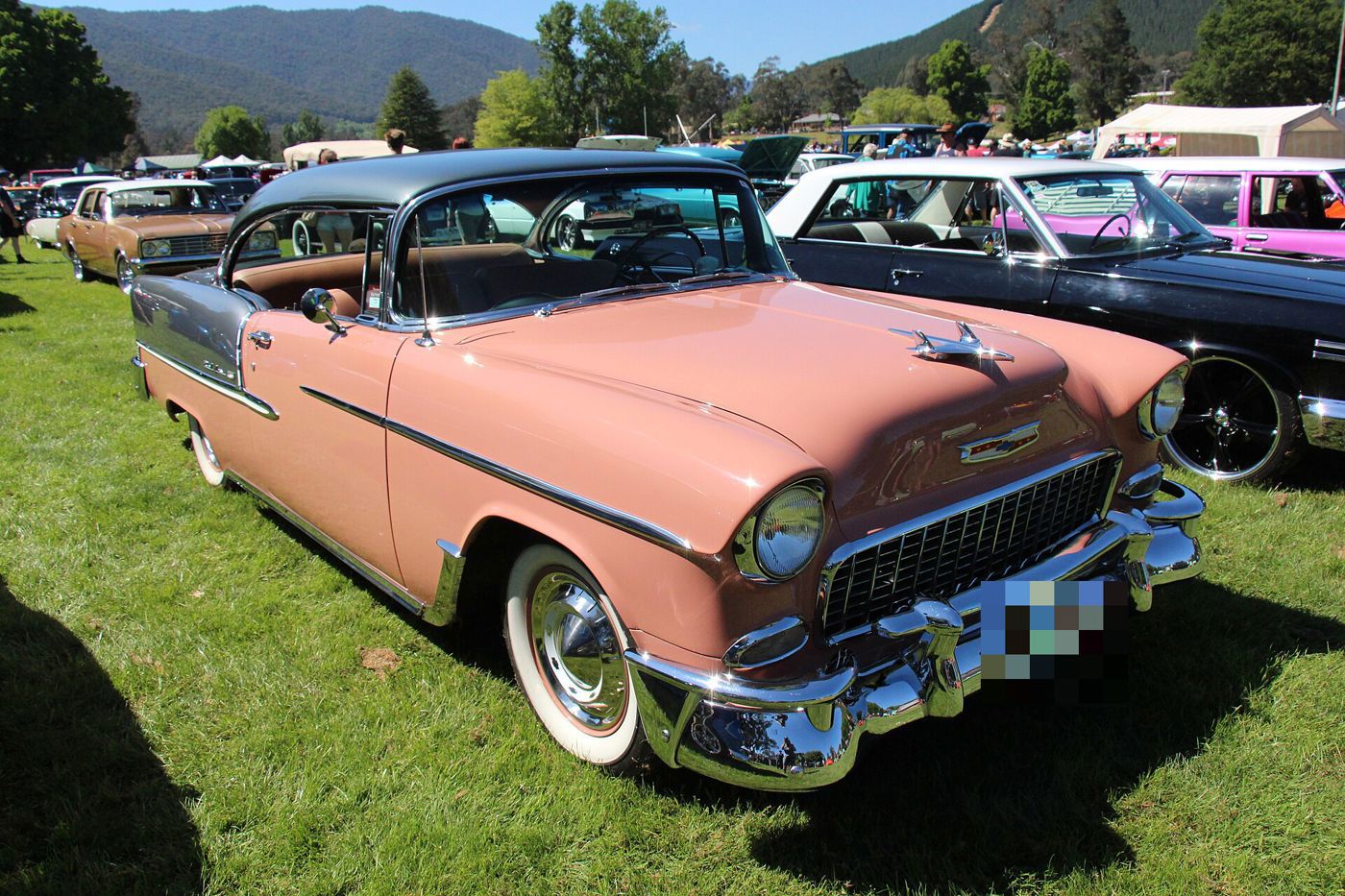
The 1955 Chevrolet engineering kit does not announce a new performance category with a dramatic name. It places the evidence in tables. A buyer could start with a six-passenger Bel Air Sport Coupe, model 2454, and order the new 265-cubic-inch V8 with a high-performance package. That quiet ordering logic is the point. Chevrolet was spreading useful performance through a mass-market full-size line rather than isolating it in one expensive special. The combination belongs among the muscle-car ancestors because an ordinary catalog body could be configured with a more serious engine, induction system, exhaust, axle, and manual transmission.
The 265 was Chevrolet’s first modern-era small-block V8, a milestone General Motors later described as bringing performance to mass-market cars and trucks. Its dimensions were compact and deliberate: a 3.75-inch bore, 3.00-inch stroke, and 8.0:1 compression. The Automotive Hall of Fame widely regards Chevrolet chief engineer Ed Cole as the father of the small-block, but the wording matters. A large engineering program cannot be reduced to one person. Cole’s leadership is part of the story, while design, development, testing, manufacturing, and launch remained collective work.
RPO 410 turned the new V8 into the selected comparison configuration. Chevrolet’s period sheets identify it as a power or high-performance package and connect it to a Carter WCFB 2351S four-barrel carburetor and dual exhaust. The engine-code table explicitly permits RPO 410 with a three-speed transmission, so the comparison does not invent a plausible combination from separate option lists. It records a factory-supported Bel Air Sport Coupe configuration: 265 V8, RPO 410, and three-speed manual, with a 3.70 conventional rear axle for that transmission.
Chevrolet did something unusually helpful for modern readers: it published gross and net values together and explained the tests. The RPO engine was rated at 180 gross horsepower at 4,600 rpm and 160 net horsepower at 4,200 rpm. Torque was 260 gross lb-ft at 2,800 rpm and 240 net lb-ft at 2,600 rpm. The gross test used dynamometer exhaust, no fan, a generator that was not charging, and optimum spark advance. The net simulation used regular mufflers and pipes, an operating fan, and automatic spark advance, although the generator still was not charging.
Those definitions make the Bel Air the teaching center of the 1955 comparison. Chrysler advertised brake horsepower without the same test explanation, while the Hudson service table supplied a horsepower figure without a gross-or-net label. It would be misleading to place 300, 180, 160, and 170 in one ranking as though they came from the same procedure. The Chevrolet record keeps both ratings visible. It does not choose whichever number makes a preferred argument, and it does not convert competitors’ values into imagined equivalents.
The source also contains a discrepancy that deserves a story rather than deletion. One revised option list names RPO 410 “Power Package” and separately names RPO 411 “Four Barrel Carburetor.” Elsewhere, the high-performance four-barrel and dual-exhaust arrangement is identified as RPO 410. The engine-code table independently secures the selected RPO 410 three-speed configuration, but the complete ordering relationship needs a dealer order guide or full application-and-weight schedule. The public page tells readers why the configuration is solid while leaving the broader ordering logic open.
RPO 450 is an even sharper warning. Later summaries sometimes use that number to support a late-season 195-horsepower engine revision. In the inspected Chevrolet kit, the regular-production-option list identifies RPO 450 as air conditioning. Its appearance in an engine-code table cannot transform it into a performance package. This release therefore bars RPO 450 as proof of the 195-horsepower story. A dated dealer bulletin or revised engine specification must establish that later engine, its timing, camshaft, model restrictions, and proper code independently.
Chevrolet’s racing display provides useful context with another boundary attached. GM Heritage holds a No. 92 NASCAR Chevrolet described as a re-creation of Herb Thomas’s Southern 500 winner. It uses the lighter 150 utility-sedan idea and a PowerPak small-block with dual exhaust. Because GM calls the car a re-creation, this page does too. It cannot authenticate each component of the original race car or turn the Bel Air street configuration into a competition machine. It does show how the new V8’s performance idea moved quickly from option sheet to stock-car narrative.
The same engine family also entered Corvette history in 1955, but Corvette remains outside this catalog. That division creates a useful contextual path rather than a content gap. VetteFacts’ 1955 Corvette page tells the sports-car side of the small-block’s arrival. Here, the focus stays on the larger consequence: Chevrolet could offer a V8 performance package in a full-size car bought from the ordinary passenger-car catalog. The two stories meet at the engine without making either site duplicate the other.
Body size reinforces that mass-market context. The Bel Air Sport Coupe rode a 115-inch wheelbase and measured 195.6 inches long, substantially shorter than the Chrysler 300 but still a full-size family car rather than a later compact pony car. Its hardtop roof, trim, and six-passenger designation made it socially different from a stripped racer. A customer selected performance within a car that could still serve ordinary life. That blend—common body, optional high-output engine, and recognizable package choices—would become central to the muscle era.
There are no period acceleration results in this release because no exact RPO 410 Bel Air Sport Coupe test has been attached with axle, tires, weight, weather, and method. Curb weight is also withheld rather than lifted from a multi-row table that may describe a different equipment combination. The absence is visible in the selector. A future period test can be added as a measured observation without being confused with factory nominal output, and without rewriting the underlying configuration.
The 1955 Chevrolet story is consequently less about a single heroic number than about distribution. Chrysler concentrated performance in a limited special. Hudson carried forward a famous high-torque six during a corporate transition. Chevrolet put a new short-stroke V8 and a documented power package into the broad full-size order system, then published enough test detail to show how its numbers were made. That is an ancestor story rooted not only in speed, but in the moment performance became a selectable part of ordinary American car buying.
Same model year
Also in 1955
- Chrysler 300 letter series Chrysler's February 1955 limited-production hardtop put a dual-four-barrel 331 Hemi rated at 300 hp into a leather-trimmed New Yorker-based coupe; club and fact-sheet lineages agree on 1,725 cars.
- Ford Thunderbird Ford planned 10,000 two-seat Thunderbirds and built 16,155, each with a 292 V-8 rated 193 hp with the manual gearbox and 198 hp with Ford-O-Matic.