1955 · Chrysler · United States
1955 Chrysler 300: A Brochure That Read Like a Race Prospectus
A 331-cubic-inch FirePower V8, 300 advertised horsepower, and heavy-duty chassis equipment made the 300 a showroom argument that Carl Kiekhaefer's racing team then made in public.
United States · researched through July 26, 2026
Power-team selector
Choose the exact 300
In February 1955 Chrysler printed a foldout for a car it called simply the Chrysler 300. The document is restrained by later muscle-car standards, yet nearly every line carries purpose. This was a limited-quantity Sports Coupe with leather upholstery and the dimensions of a large, expensive American car, but its equipment list reads like preparation for sustained speed. The brochure is the right place to begin because it captures the car before “letter series,” “C-300,” and “first muscle car” became retrospective labels. Chrysler was selling one unusual combination: luxury, a carefully modified engine, and chassis hardware intended to make the whole package credible.
The engine supplied the name and the headline. Chrysler’s FirePower V8 displaced 331.1 cubic inches and used hemispherical combustion chambers, two four-barrel carburetors, a special camshaft, adjustable valve gear, and dual exhaust. The company advertised 300 brake horsepower at 5,200 rpm from 8.5:1 compression. That is a period nominal rating, not a modern chassis measurement, and the brochure does not define a net basis. It belongs in a comparison exactly as Chrysler published it, with the measurement limitation attached. Turning the number into a modern equivalent would create precision the source never offered.
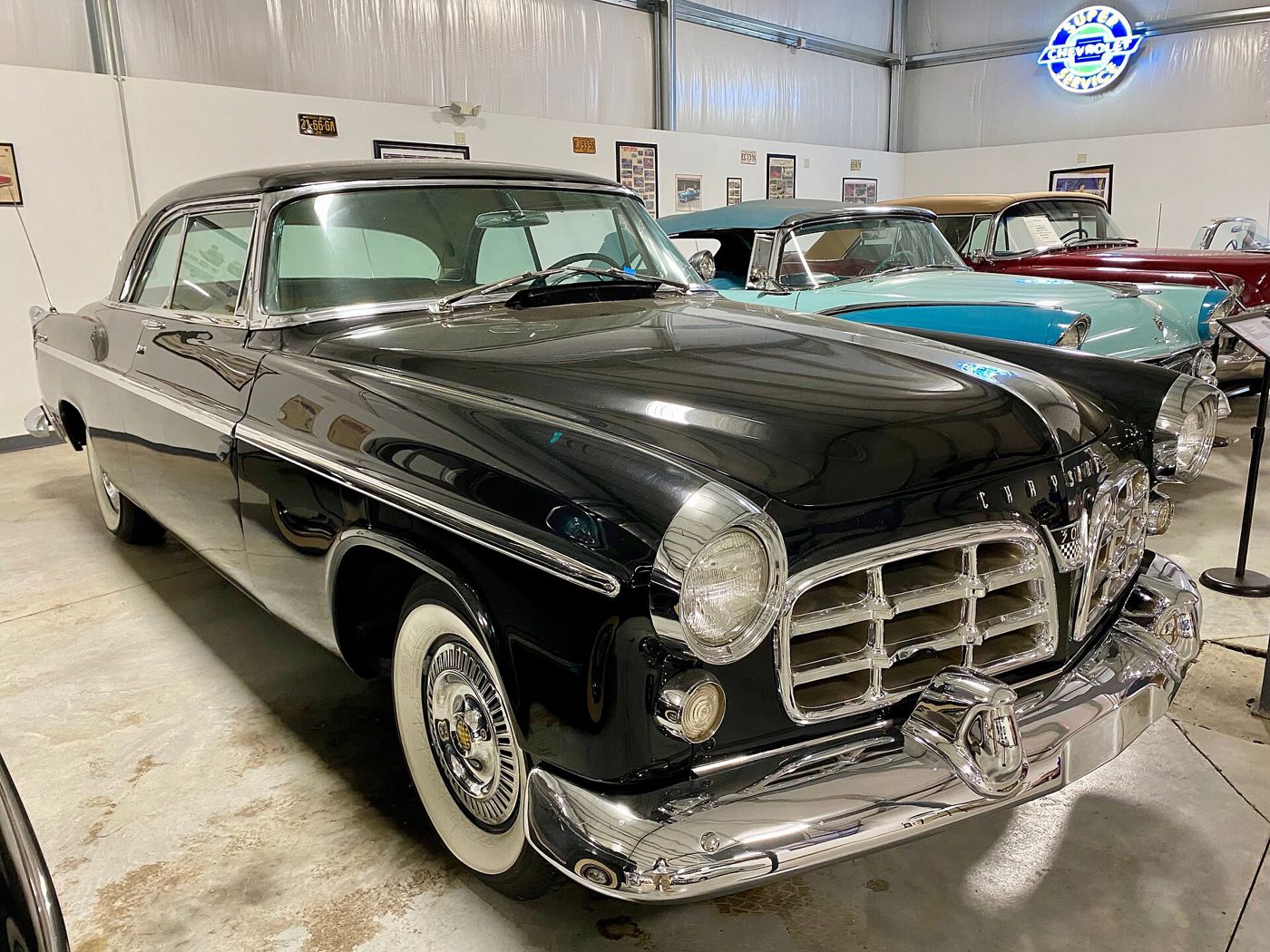
Chrysler did not stop at the engine. The brochure identifies heavy-duty shock absorbers, a lowered and strengthened suspension, power brakes, and axle choices ranging beyond the standard 3.36 ratio. Those details distinguish the 300 from a large coupe that merely received a powerful engine. The car’s 126-inch wheelbase and 218.8-inch length make its scale clear, but size did not cancel performance intent. Instead, the engineers treated the chassis as part of the power package. That integration is one reason the 300 belongs among the ancestors of later American muscle even though it does not fit every later definition.
Power reached the rear axle through what the brochure calls a “PowerFlite fully automatic Torque Converter.” The inspected artifact does not state the number of forward ratios, so this record refuses the familiar two-speed label until Chrysler owner or service literature supplies it. That may appear overly cautious for a widely known transmission, but the comparison is designed to expose evidence boundaries. A source-supported name with an unknown ratio count is more trustworthy than a complete-looking specification assembled from memory. The same rule leaves torque, exact curb weight, and matched period acceleration empty.
The car’s luxury matters as much as its missing fields. Leather, a broad body, and automatic transmission make the 300 different from the compact, manual-shift image later attached to muscle cars. That difference is not a reason to exclude it. It is the historical question. In 1955 Chrysler demonstrated that a manufacturer could concentrate its strongest advertised engine, altered suspension, braking equipment, visual identity, and premium interior in one production offering. Later cars would change the price point, body size, and transmission mix, but the idea of a named high-performance package was already visible.
Racing made the showroom argument harder to ignore. NASCAR’s history places Tim Flock with Carl Kiekhaefer’s new Chrysler effort in 1955 after an encounter at Daytona. Flock went on to win eighteen races and the championship. Those are driver-season results, not a production-car road test, and they do not belong in the street specification table. They belong in the story because they show how quickly the 300’s public identity became entangled with organized stock-car competition. The road car supplied the recognizable form; the team supplied preparation far beyond brochure equipment.
Kiekhaefer’s program also warns against easy totals. Institutional sources describe eighteen Flock wins in 1955, twenty-two wins in a stated 1956 Baker-and-Thompson scope, and fifty-two Chrysler-Dodge organization victories across two seasons. Those numbers answer different questions. None proves a 1955 Chrysler 300-only lifetime total, and The Henry Ford notes that the team did not assign victories to individual surviving chassis. The clean story is still impressive without arithmetic shortcuts: Flock won eighteen times in Kiekhaefer’s 1955 championship season, while broader team totals remain carefully scoped or withheld.
Production count presents another tempting shortcut. The figure 1,725 appears throughout respected Chrysler 300 club and specialist literature, but this pass did not inspect a Chrysler production ledger that establishes the number and its exact scope. The page therefore does not call it a factory count. A future revision can publish it with explicit specialist attribution after the underlying compilation is inspected, or replace it when a corporate schedule appears. Repetition is a useful research lead; it is not a substitute for provenance.
The name deserves similar restraint. The period cover says “The Chrysler 300.” Later histories commonly use C-300 to distinguish the first car from 1956’s 300-B and the letter series that followed. Nothing in the inspected brochure establishes the popular explanation that the C meant coupe. This page uses the period public name when discussing the artifact and recognizes C-300 only as later clarifying usage. The distinction preserves the way buyers first encountered the car instead of projecting a tidy naming system backward.
Was it the first muscle car? That depends on whether the definition requires a midsize body, a lower price, a manual transmission, mass availability, or simply a manufacturer-built high-performance derivative. FCA itself has called the 300 a muscle car before the term and has described it as the first mass-produced American car to reach 300 horsepower. Those are valuable corporate interpretations, not neutral measurements. This site calls the 300 a muscle-car ancestor and then shows the evidence: concentrated power, chassis changes, a named identity, limited availability, and racing consequence.
The comparison with Chevrolet and Hudson is deliberately uneven. Chrysler offered the most advertised horsepower of the three, but its rating basis differs from Chevrolet’s documented gross and net values, and Hudson’s service rating carries its own undefined basis. The 300 was longer and aimed higher in the market. Declaring a winner from those rows would flatten the history. The useful comparison asks how each company packaged performance and what it chose to document, leaving period test results blank until exact-configuration road tests can be attached.
The 1955 Chrysler 300 matters because the evidence is already dramatic without forcing it into a later mold. A luxury coupe carried a dual-four-barrel hemispherical V8, a strengthened and lowered chassis, serious brakes, and a name built around advertised output. Then a disciplined racing organization made that shape a championship symbol. The brochure and the racetrack tell related but distinct stories, and keeping them distinct makes the connection stronger. Chrysler had assembled a performance special whose influence can be explained rather than merely proclaimed.
Fact sheet · 1955 · United States
The numbers
1955 Chrysler 300 (C-300) — Chrysler's February 1955 limited-production hardtop put a dual-four-barrel 331 Hemi rated at 300 hp into a leather-trimmed New Yorker-based coupe; club and fact-sheet lineages agree on 1,725 cars.
Coverage: Partial — researched sections are shown; missing ones are not yet sourced. Researched through 2026-09-22.
Every figure is labeled with how sure we are. Reported means a manufacturer, registry, or reference figure we cite but have not reconciled against factory records ourselves. Disputed means credible sources disagree and both are shown. Rows are separately scoped; don't add them together unless the note says they make up a total.
Key facts
- Production: 1,725 two-door hardtops (club history; Over-Drive calls the same figure 'sold').1,2
- 331.1 cu in Hemi V8, two four-barrels, 300 hp at 5,200 rpm (published rating, basis not stated in the brochure).
- One exterior color only: code 30, Platinum.2
- Period magazines report the Daytona Beach flying mile won by Warren Koechling's 300 at an average of 127.580 mph; Mechanix Illustrated tested that car.3,4
- Over-Drive's 1955 option list marks air conditioning, backup lights, fog lights, outside mirror, spot lamps and two-tone paint as not available on the 300, and leather trim and PowerFlite as standard on it.2
Production
| What was counted | Count | Basis | Status |
|---|---|---|---|
| Chrysler 300, two-door hardtop1,5,2 300 (C-300) · 2-door hardtop · 331 Hemi 2x4-bbl · not stated The only body style. The club calls the figure production; Over-Drive says 'sold'. The two sources may share a lineage; no Chrysler production ledger was inspected. | 1,725 | built, model-year | Reported |
| What was counted | Count | Basis | Status |
|---|---|---|---|
| Chrysler 300 (C-300), all bodies6 300 (C-300) · not stated Stated total from the club's own registry table, which lists 0 convertibles for 1955. Same club lineage as the hardtop row above, not an independent confirmation; no Chrysler production ledger was inspected. | 1,725 | built, model-year | Reported |
The C-300 was a single body style with a single engine, so the body row and the total row are the same 1,725 cars; the total row is the club registry table's own Total column.
Over-Drive's 1955 production table prints the same 1,725 for body style 2-dr H.T. Cpe-6P (series C68-300) within a Chrysler total of 152,777; it is the same Over-Drive lineage as the fact sheet, not an independent confirmation.
Prices when new
| Model | Price | Basis |
|---|---|---|
| Factory price, 300 two-door hardtop coupe7 | $4,109 | 'Factory Price' column of a compiled production table (basis not further stated), 1955 model year |
| Price as tested, 300 hardtop coupe, PowerFlite3 | $4,055.25 | F.O.B. Detroit as printed in a period road test; the magazine adds $294.40 for power steering, heater and radio, 1955-05 |
| Power steering, heater and radio (combined add-on quoted with the test car price)3 | $294.40 | as printed in a period road test, F.O.B. Detroit, 1955-05 |
Prices are the nominal dollars of the day, not adjusted for inflation.
Engines
| Engine | Factory rating | Availability | Built |
|---|---|---|---|
| 331 FirePower Hemi V8, dual 4-bbl2 331.1 cu in · 2 x 4-barrel (Carter WCFB 2118S front, 2317S rear) | 300 hp @ 5,200, 345 lb-ft @ 3,200 (manufacturer published (basis not stated)) | standard | Not yet sourced |
Ratings are the manufacturer's advertised figures under the standard shown (SAE gross before 1972, SAE net after). They are not dyno results, and gross and net ratings can't be compared directly.
Transmissions
| Transmission | Availability | Built |
|---|---|---|
| PowerFlite automatic (1.72 / 1.00, reverse 2.39)2 | standard | Not yet sourced |
| Three-speed manual (2.57 / 1.83 / 1.00)2,5 | special order | Not yet sourced |
Options and packages
| Code | Option | Price | Installed |
|---|---|---|---|
|
Three-speed manual transmission2 | — | Not yet sourced |
|
Power steering8,3 | — | Not yet sourced |
|
Radio and heater3 | — | Not yet sourced |
|
Electric window lifts3 | — | Not yet sourced |
Paint
| Code | Color | Built |
|---|---|---|
30 |
Platinum2,9 | Not yet sourced |
01 |
Black9 | Not yet sourced |
25 |
Tango Red9 | Not yet sourced |
Color names are the factory's. We don't show color swatches, because a screen color is no guide for a restoration.
Interiors
| Code | Trim | Built |
|---|---|---|
|
Full leather interior2 | Not yet sourced |
|
Leather-upholstered front bench seat (no bucket seats offered); Auto Age describes the hide as natural cowhide8,4 | Not yet sourced |
|
Instrument panel painted Saddle Beige gloss (Ditzler 21181)9 | Not yet sourced |
Specifications
| Measure | Value | Applies to |
|---|---|---|
| Wheelbase2 | 126 in | 2-door hardtop |
| Overall length2 | 218.8 in | 2-door hardtop |
| Overall width2 | 79.1 in | 2-door hardtop |
| Overall height2 | 60.1 in | 2-door hardtop |
| Tires2 | 8.00 x 15 (8.20 x 15 with wire wheels) | 2-door hardtop |
| Rear axle ratio, PowerFlite2 | 3.54:1 standard; optional 3.07 to 6.17 | PowerFlite cars |
| Shipping weight7 | 4,005 lb | 2-door hardtop coupe |
| Weight as quoted to the press8 | 4,340 lb | early press car; Motor Life also reports 54 / 46 front / rear distribution |
| Dual exhaust diameter8 | 2 in | 300 engine (quarter-inch larger than New Yorker) |
| Speedometer calibration10 | 150 mph | 300 hardtop |
Period road tests
| Test | Car tested | Result |
|---|---|---|
| Popular Science (Devon Francis), 1955-04100-60 mph | 300 hardtop, 331 Hemi 2x4-bbl 300 hp, PowerFliteAverage of runs with and against the wind; speedometer read 59 at a true 60 | 9.9 s |
| Popular Science (Devon Francis), 1955-04100-40 mph | 300 hardtop, 331 Hemi 2x4-bbl 300 hp, PowerFlite | 6.5 s |
| Popular Science (Devon Francis), 1955-04100-80 mph | 300 hardtop, 331 Hemi 2x4-bbl 300 hp, PowerFlite | 18.4 s |
| Popular Science (Devon Francis), 1955-041040-60 mph | 300 hardtop, 331 Hemi 2x4-bbl 300 hp, PowerFliteAlso printed: 40-70 7.6 s, 40-80 12 s, 50-80 10 s | 4.4 s |
| Mechanix Illustrated (Tom McCahill), 1955-0530-60 mph | 300 hardtop coupe, PowerFlite (the Daytona flying-mile winner driven by Warren Koechling; no power steering)Printed as a range; tires at 55 psi competition pressure | 9.8-10 s |
| Mechanix Illustrated (Tom McCahill), 1955-0530-30 mph | 300 hardtop coupe, PowerFlite (Daytona flying-mile car)Also printed: 0-50 7.2 s | 4 s |
| Mechanix Illustrated (Tom McCahill), 1955-0530-90 mph | 300 hardtop coupe, PowerFlite (Daytona flying-mile car) | 16.9 s |
| Mechanix Illustrated (Tom McCahill), 1955-053Top speed | 300 hardtop coupe, PowerFlite (Daytona flying-mile car)As printed in the specification box; the text ties 130 mph to the Daytona runs | 130 mph |
| Auto Age, 1955-0740-60 mph | 300 hardtop, PowerFlite, no power steering, tires at 30 psiAverage of best runs started in Drive and shifted to Low at 40 mph; the first straight run took 10.5 s; cold, dry, brisk wind | 9.5 s |
| Auto Age, 1955-0740-30 mph | 300 hardtop, PowerFliteSame in Drive and Low | 3.9 s |
| Auto Age, 1955-0740-75 mph | 300 hardtop, PowerFliteAlso printed: 30-60 5.8 s; 60-75 6.0 s; top speed given only as '125 mph plus' (not measured) | 15 s |
A road test result belongs to the one car that was tested, with its engine, gearing, tires, and conditions. It is not a figure for every car of the year.
Identification
- Series
- Series C68-300; a sub-series of the Chrysler line, built only as a two-door hardtop.2
- Appearance
- Imperial-style grille on a New Yorker two-door body with Windsor rear quarters; minimal exterior trim with no hood ornament or side trim.5
Where the sources disagree
Overall length
The brochure figure is shown; the club's slightly different value is noted.
Exterior colors offered
All three are listed in the paint table with the club as the source for Black and Tango Red; neither source gives production by color.
Price of the 300 hardtop
Both prices are shown with their stated basis. Motor Life (May 1955) reported that no price had been decided at press time, and Auto Age reported a plan to sell at 'around $5,000'.
Same model year
Also in 1955
- Ford Thunderbird Ford planned 10,000 two-seat Thunderbirds and built 16,155, each with a 292 V-8 rated 193 hp with the manual gearbox and 198 hp with Ford-O-Matic.