1954 · Hudson · United States
1954 Hudson Hornet: The Last Step-Down Year, Built Into the Formation of AMC
The last step-down Hornet: a restyled body, a 160-hp base six, Twin-H and 7-X options, and a production end in October 1954 as Hudson merged into American Motors.
United States · researched through 2026-09-23
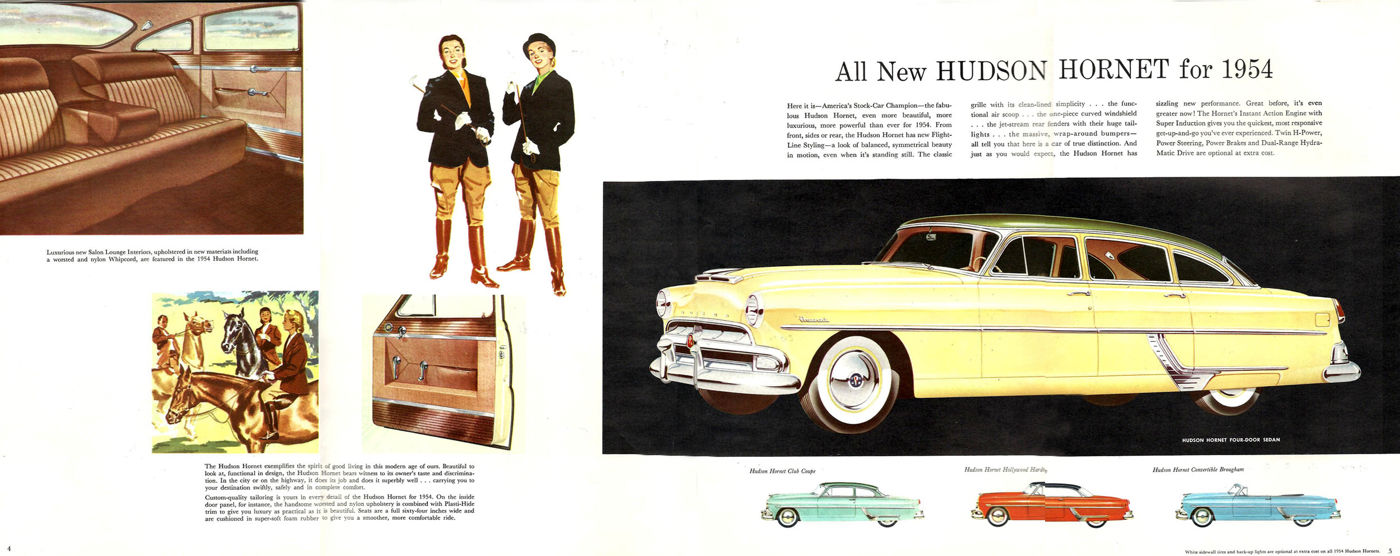
1954 was the last year for the step-down Hornet body, and the model year closed against a corporate backdrop bigger than any styling change: the Nash-Kelvinator merger that created American Motors was approved on January 14, 1954, while Hudson kept building Hornets on its own until October 30, 1954. Both the Hudson-Essex-Terraplane Club's compilation and Old Cars Weekly agree on 24,833 Hornets built for the year, though the two figures share the same Standard Catalog lineage rather than serving as independent confirmations of each other.1,2
The 308-cubic-inch six now spanned three states of tune: 160 horsepower at 3,800 rpm standard with the aluminum cylinder head and 7.5:1 compression, 170 horsepower with the $86 Twin H-Power dual-carburetor option, and 210 horsepower from the $385 7-X package, sold through Hudson's parts operation rather than as an ordinary factory option. A lower-priced Hornet Special series, 6D, arrived on March 19, 1954, running $115 to $140 below comparable full Hornets with the same Hornet engine but less brightwork, in four-door sedan, club sedan, and club coupe bodies; whether those Hornet Special cars sit inside the 24,833 total is not stated outright, though the club table's own serial examples for the Hornet column start including 6D cars from March 1954 onward, suggesting they do.2,1
Two separate figures disagree between Old Cars Weekly and Hudson's own 1954 brochure. The bore for the 308 six is given as 3-15/16 inches by Old Cars Weekly's specification block, but Hudson's own 1951 through 1953 price folders for the same displacement all state 3-13/16 inches, the figure this record treats as consistent with the stated 308-cubic-inch displacement even though no 1954-specific factory bore figure was found to confirm it directly. Overall length shows a starker gap: Old Cars Weekly gives 268-7/8 inches, roughly five feet longer than the 208-15/32 inches Hudson's own full-line brochure states, a difference large enough that the record treats the Old Cars Weekly figure as a probable typographical error and uses the factory brochure's number instead.2,3
On the track, Hudson closed out the step-down era with 17 wins in 36 NASCAR Grand National races and a third consecutive manufacturers' title, while Herb Thomas repeated as Southern 500 winner. Production ran unevenly through the model year, dipping to a low of 671 cars in February 1954 before climbing back to its highest single month, 3,001 cars, in October 1954, the very month the last step-down Hornet was built. The club table's approximate body counts show 244 Convertible Broughams and, marked with its own question mark, 1,263 Hollywood hardtops, both figures the source itself flags as uncertain rather than firm.2,4,1
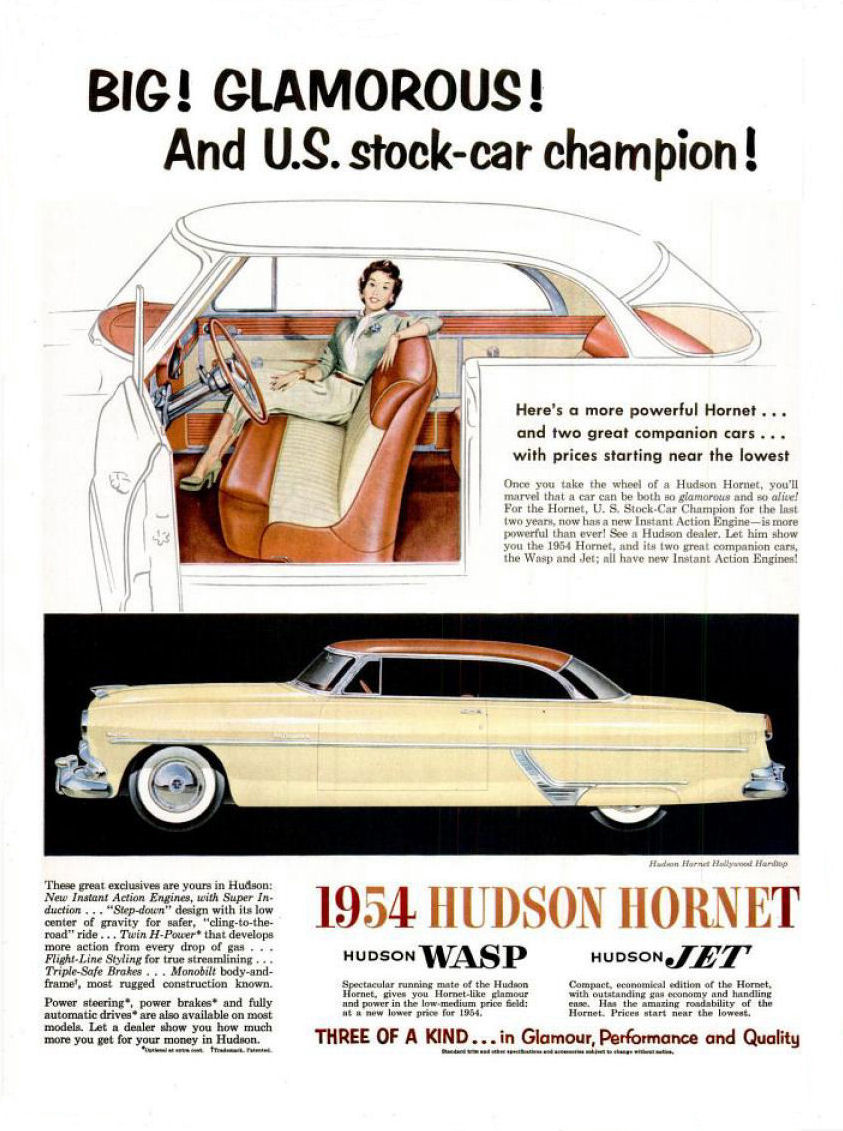
Pricing bracketed the 1954 line from the value-oriented Hornet Special, whose club sedan started at $2,571, up to the Convertible Brougham at $3,288, a roughly $717 spread across the year's body styles. Hudson dressed the Hollywood hardtop specifically with tri-color, no-extra-cost seat and headlining combinations in antique white Plasti-hide with red, blue, or green bolsters, while the Convertible Brougham offered genuine leather in blue, maroon, or green with Plasti-hide side trim, a reminder that even in its final step-down year Hudson kept differentiating its Hornet body styles by trim as much as by mechanical content.2
Fact sheet · 1954 · United States
The numbers
1954 Hudson Hornet — The last step-down Hornet: a restyled body, a 160-hp base six, Twin-H and 7-X options, and a production end in October 1954 as Hudson merged into American Motors.
Coverage: Partial — researched sections are shown; missing ones are not yet sourced. Researched through 2026-09-23.
Every figure is labeled with how sure we are. Reported means a manufacturer, registry, or reference figure we cite but have not reconciled against factory records ourselves. Disputed means credible sources disagree and both are shown. Rows are separately scoped; don't add them together unless the note says they make up a total.
Key facts
- 24,833 Hornets built for 1954.1,2
- 7-X engine: 210 hp, $385 option.2
- 17 NASCAR Grand National wins in 36 races.2
- The lower-priced Hornet Special appeared on 19 March 1954 at $115 to $140 below comparable Hornets, with the Hornet engine and less brightwork, in four-door sedan, club sedan and club coupe bodies.2
- Hudson's 1954 brochure rated the 308 at 160 hp with the standard aluminum head and 170 hp with Twin H-Power.
Production
| What was counted | Count | Basis | Status |
|---|---|---|---|
| Hornet, all bodies (series 7D)1,2 Hornet (incl. Hornet Special as reported) · 308 six · all production Neither source states whether Hornet Special cars are inside this total. | 24,833 | built, model-year | Reported |
| What was counted | Count | Basis | Status |
|---|---|---|---|
| Hornet built in August 19531 Hornet column (7D; the column also lists 6D Hornet Special serials) · all production | 917 | built, calendar month (August 1953) | Reported |
| Hornet built in September 19531 Hornet column (7D; the column also lists 6D Hornet Special serials) · all production | 2,272 | built, calendar month (September 1953) | Reported |
| Hornet built in October 19531 Hornet column (7D; the column also lists 6D Hornet Special serials) · all production | 1,715 | built, calendar month (October 1953) | Reported |
| Hornet built in November 19531 Hornet column (7D; the column also lists 6D Hornet Special serials) · all production | 2,488 | built, calendar month (November 1953) | Reported |
| Hornet built in December 19531 Hornet column (7D; the column also lists 6D Hornet Special serials) · all production | 1,539 | built, calendar month (December 1953) | Reported |
| Hornet built in January 19541 Hornet column (7D; the column also lists 6D Hornet Special serials) · all production | 790 | built, calendar month (January 1954) | Reported |
| Hornet built in February 19541 Hornet column (7D; the column also lists 6D Hornet Special serials) · all production | 671 | built, calendar month (February 1954) | Reported |
| Hornet built in March 19541 Hornet column (7D; the column also lists 6D Hornet Special serials) · all production | 1,511 | built, calendar month (March 1954) | Reported |
| Hornet built in April 19541 Hornet column (7D; the column also lists 6D Hornet Special serials) · all production | 980 | built, calendar month (April 1954) | Reported |
| Hornet built in May 19541 Hornet column (7D; the column also lists 6D Hornet Special serials) · all production | 1,045 | built, calendar month (May 1954) | Reported |
| Hornet built in June 19541 Hornet column (7D; the column also lists 6D Hornet Special serials) · all production | 2,092 | built, calendar month (June 1954) | Reported |
| Hornet built in July 19541 Hornet column (7D; the column also lists 6D Hornet Special serials) · all production | 1,725 | built, calendar month (July 1954) | Reported |
| Hornet built in August 19541 Hornet column (7D; the column also lists 6D Hornet Special serials) · all production | 1,934 | built, calendar month (August 1954) | Reported |
| Hornet built in September 19541 Hornet column (7D; the column also lists 6D Hornet Special serials) · all production | 2,153 | built, calendar month (September 1954) | Reported |
| Hornet built in October 19541 Hornet column (7D; the column also lists 6D Hornet Special serials) · all production | 3,001 | built, calendar month (October 1954) | Reported |
| What was counted | Count | Basis | Status |
|---|---|---|---|
| Hornet Convertible Brougham (approximate)1 Hornet (7D) · Convertible Brougham · all production The club table marks its convertible and Hollywood counts as approximate and states no method. | 244 | built, model-year | Estimate |
| Hornet Hollywood hardtop (approximate, queried by the source)1 Hornet (7D) · Hollywood hardtop · all production The source prints this figure with a question mark and labels the row approximate. | 1,263 | built, model-year | Estimate |
No firm body-style, engine or transmission split was found in an accessible source; the only body rows are the club table's approximate convertible and Hollywood counts. The 11,603 Wasp figure belongs to a different series and is not a Hornet row.
The calendar-month rows are the club table's monthly build counts for its HORNET column, August 1953 through October 1954; they sum to the 24,833 total. That column's example serial numbers include 6D (Hornet Special) cars from March 1954 on, so the total appears to include Hornet Specials, although the table does not say so in words.
The Hornet Special (series 6D) was introduced on 19 March 1954 in three bodies (four-door sedan, two-door club sedan, club coupe); no separate Hornet Special production figure was found.
Prices when new
| Model | Price | Basis |
|---|---|---|
| Hornet Special club sedan2 | $2,571 | base price as reported by Old Cars Weekly (basis not stated), 1954 model year |
| Hornet Convertible Brougham2 | $3,288 | base price as reported by Old Cars Weekly (basis not stated), 1954 model year |
Prices are the nominal dollars of the day, not adjusted for inflation.
Engines
| Engine | Factory rating | Availability | Built |
|---|---|---|---|
| 308 L-head six2 308 cu in · single carburetor | 160 hp @ 3,800 (period advertised rating; SAE basis not stated by source (gross era)) | standard | Not yet sourced |
| Twin-H Power · 308 L-head six, dual carburetors2 308 cu in · two carburetors, dual manifold | 170 hp (period advertised rating; SAE basis not stated by source (gross era)) | optional, $86 | Not yet sourced |
| 7-X · 308 L-head six, 7-X package2 308 cu in · two carburetors (with Twin-H) | 210 hp (rating as reported by Old Cars Weekly; basis not stated) | optional, $385 | Not yet sourced |
Ratings are the manufacturer's advertised figures under the standard shown (SAE gross before 1972, SAE net after). They are not dyno results, and gross and net ratings can't be compared directly.
Transmissions
| Transmission | Availability | Built |
|---|---|---|
| Three-speed synchromesh manual (column shift) | standard (4.09:1 axle; 4.55 special ratio available) | Not yet sourced |
| Overdrive | optional at extra cost (4.55 or 4.09:1 axle) | Not yet sourced |
| Dual-Range Hydra-Matic Drive | optional at extra cost (3.07:1 axle) | Not yet sourced |
Options and packages
| Code | Option | Price | Installed |
|---|---|---|---|
|
Twin H-Power (170 hp)2 | $86 | Not yet sourced |
|
7-X engine (through the parts operation; reported 210 hp)2 | $385 | Not yet sourced |
|
Power steering ('Perfected Power Steering') | — | Not yet sourced |
|
Power brakes ('Improved Power Brakes') | — | Not yet sourced |
|
Cast-iron cylinder head (7 to 1 compression) in place of the standard aluminum head | — | Not yet sourced |
|
White sidewall tires and back-up lights (extra cost on all 1954 Hornets) | — | Not yet sourced |
|
Long-range radio, Solex anti-glare glass, Weather-Control heating and ventilating system | — | Not yet sourced |
Interiors
| Code | Trim | Built |
|---|---|---|
|
Sedans and club coupes: 15 percent nylon worsted Bedford cloth with broadcloth bolsters and Plasti-hide trim, in brown, blue or green2 | Not yet sourced |
|
Hollywood hardtop: similarly toned snowflake-design nylon cord seats with Plasti-hide bolsters2 | Not yet sourced |
|
Hollywood hardtop, no extra cost: tri-color seat and headlining combinations of antique white Plasti-hide with red, blue or green bolsters2 | Not yet sourced |
|
Convertible Brougham: blue, maroon or green genuine leather with Plasti-hide side trim; tops in maroon, black or tan (recommended, not mandatory, combinations with body colors)2 | Not yet sourced |
|
Brochure description: 'Salon Lounge' interiors upholstered in worsted and nylon whipcord with Plasti-Hide trim | Not yet sourced |
|
Hornet Special: durable worsted check-weave upholstery with contrasting bolster cloth and leather-grained Plasti-Hide trim, in a choice of two color combinations | Not yet sourced |
Specifications
| Measure | Value | Applies to |
|---|---|---|
| Wheelbase2 | 124 in | Hornet |
| Front tread2 | 58.5 in | Hornet |
| Rear tread2 | 55.5 in | Hornet |
| Compression ratio2 | 7.5 :1 | 308 six as reported |
| Compression ratio, optional cast-iron head | 7 :1 | 308 six with cast-iron head |
| Carburetor2 | Carter two-barrel type WGD, model 2115S | 308 six, single carburetor |
| Valve lifters / main bearings2 | solid lifters; four main bearings | 308 six |
| Overall length | 208-15/32 in | Hornet |
| Overall width | 77-1/4 in | Hornet |
| Overall height, loaded | 60-3/8 in | Hornet |
| Maximum head room | 38-3/4 in | Hornet |
| Hip room / elbow room | hip room 64 front and rear; elbow room 66 front, 65 rear in | Hornet |
| Turning radius | 20 ft 5 in right; 21 ft 2 in left | Hornet |
| Standard tires | 7.10 x 15 (7.60 x 15 on the Convertible Brougham, optional on other Hornets) | Hornet |
| Rear axle ratios | 4.09:1 manual (4.55 special); 4.55 or 4.09 with overdrive; 3.07 with Hydra-Matic | Hornet |
Identification
- Series designation
- 1954 Hornets carry the 7D model designation; the serial plate is on the right front door hinge pillar.1
Where the sources disagree
Hornet 308 bore
- 3-15/16 in bore x 4-1/2 in stroke (Old Cars Weekly's 1954 specification block)2
- 3-13/16 in bore x 4-1/2 in stroke (Hudson's 1951, 1952 and 1953 price folders for the same 308 engine)3
No 1954 factory bore figure was found. The factory 3-13/16 in bore is the one consistent with the stated 308 cu in displacement; the page shows both and does not publish a 1954 bore as fact.
Hornet overall length
- 268-7/8 in (Old Cars Weekly)2
- 208-15/32 in (1954 Hudson full-line brochure)
The factory brochure figure is published; the Old Cars Weekly figure is shown as a probable typographical error, not used.