1949 · Oldsmobile · United States
1949 Oldsmobile Rocket 88: The Big Engine Goes in the Small Car
Oldsmobile's new overhead-valve Rocket V-8 in the lighter 76 body: 99,276 88s in the first year, and the car to beat in NASCAR's first season.
United States · researched through 2026-09-23
The Rocket V8 began on a draftsman's own time while General Motors stood still. Ate Up With Motor records that during the United Auto Workers strike that shut GM down from November 1945 to March 1946, Oldsmobile draftsman Gilbert Burrell worked privately on ideas for new cars and engines. About six weeks in, he showed his designs to chief engineer Jack Wolfram. Wolfram and general manager Sherrod Skinner judged them promising, set up an Advance Design Group to develop an overhead-valve V8 and put Burrell in charge. By July 1946 he was Oldsmobile's chief motor engineer. The engine that followed changed what an American family car could be expected to do.1
The science came from Charles Kettering, head of GM's research laboratories. His team had shown that raising compression could lift both power and fuel economy, by nearly 30 percent in Ate Up With Motor's account, and Oldsmobile's engineers wanted to call their engine the Kettering Engine until naming conventions ruled it out. The fuel was not ready for the idea. The first prototypes of November 1946 displaced 287 cubic inches, but because high-octane gasoline for truly high compression was not yet on sale, Burrell enlarged the production engine to 303.7 cubic inches and settled on a modest 7.25:1. Displacement bought what compression could not yet deliver.1
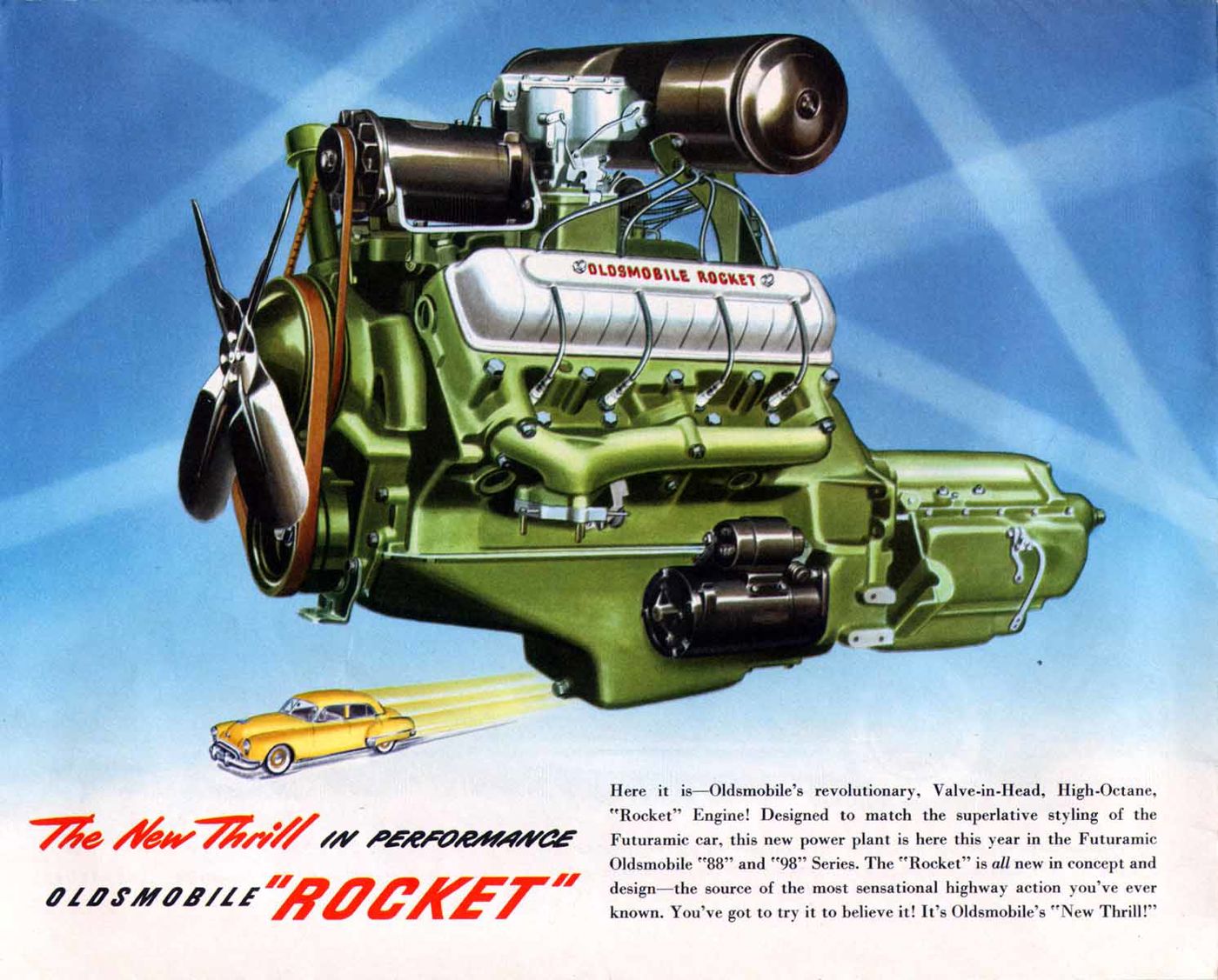
Oldsmobile was not alone, and not everyone at General Motors welcomed its work. Cadillac, the same history notes, had been developing a very similar overhead-valve engine since 1936, and it objected to Oldsmobile's program strongly enough that GM at first denied Oldsmobile's request for development funds. Whether ideas passed between the two teams is disputed. Both divisions nevertheless reached the 1949 model year with new overhead-valve V8s. Oldsmobile's version, the Rocket, measured 3.75 by 3.4375 inches, breathed through a Carter two-barrel carburetor, used hydraulic lifters and was rated at 135 horsepower at 3,600 rpm and 263 lb-ft at 1,800 rpm.1,2
The Rocket went first into the big car. The Series 98 introduced it, and the lighter Futuramic 76 kept its six-cylinder engine. Then came the question that made the 88. Ate Up With Motor credits Harold Metzel, then Oldsmobile's chief transmission engineer, with asking Skinner whether the division could sell the V8 in the 76, a combination the engineers had already been using as a test car. The answer was yes. The Futuramic 88 went on sale on February 6, 1949, exactly seven weeks after the 98, on the 76's 119.5-inch wheelbase and at 202 inches overall.1,2
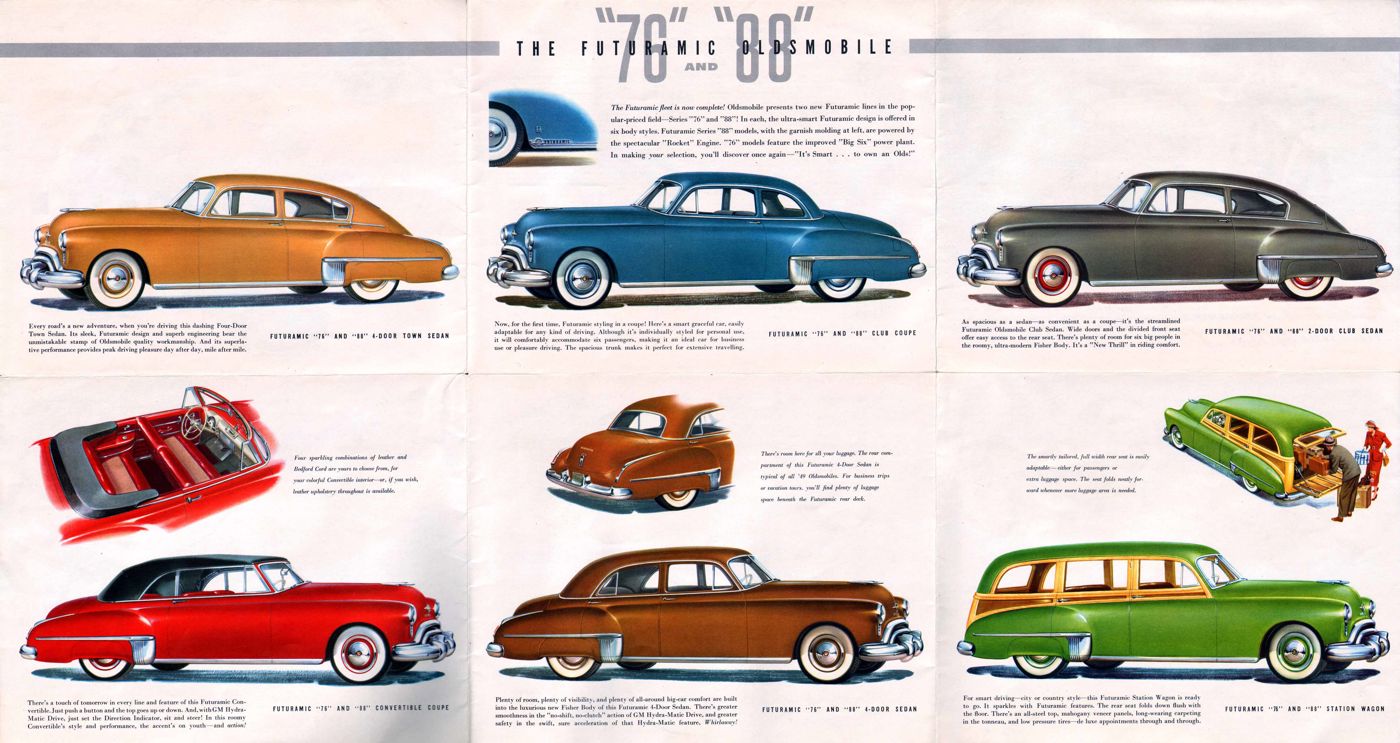
The buyer got the V8 with an automatic. Over-Drive's fact sheet lists Hydra-Matic as standard on the 88 and 98, and a $185 option on the six-cylinder 76, and Wikipedia says the V8 Oldsmobiles were automatic-only for 1949. The 88 used a 3.23 axle and 7.60 by 15 tires. It came in six bodies: the Club Sedan, the two-door and four-door sedans, the Town Sedan, the convertible coupe and a station wagon. Period prices are harder to pin down than usual, because the price and weight columns of the compiled 1949 table appear to have been swapped, so the 88's first-year list price is not reliably documented there.2,3
Late start and all, the 88 became Oldsmobile's biggest series in its first year. Over-Drive's table counts 99,276 Series 88 cars against 95,556 76s and 92,878 98s, 287,710 Oldsmobiles in all, so the 88 was about 34.5 percent of the division's output. Four-door sedans led with 46,386, nearly half the 88 total, followed by 28,707 Club Sedans, 11,561 two-door sedans, 5,833 Town Sedans, 5,434 convertibles and 1,355 wagons. Ate Up With Motor gives slightly different figures, 100,273 Series 88 cars from sales of about 294,000. The two lineages disagree by about one percent, and neither names the factory record behind it.2,1
What the car could do on the road is described by Ate Up With Motor in general terms: an 88 with Hydra-Matic could reach 60 mph in a bit over 12 seconds and top out at 97 mph. Those figures are not tied in that history to a named 1949 test, so they stand as characterization rather than measurement; a Motor Trend test it cites dates from July 1950, when the magazine recorded about 18.8 mpg at a steady 50 mph. Modest as they look now, those numbers came from a lighter car than the 98 that shared its engine, and that was the whole of the 88's argument.1
The racers noticed at once. NASCAR ran its first Strictly Stock season in 1949, and Wikipedia's season table lists eight races, five of them won by Oldsmobiles: Red Byron at the Daytona Beach Road Course on July 10 and at Martinsville on September 25, Bob Flock at Occoneechee Speedway on August 7 and at North Wilkesboro on October 16, and Curtis Turner at Langhorne on September 11. Byron, in an Oldsmobile, took the championship by 117.5 points over Lee Petty. Ate Up With Motor counts nine races and six Rocket 88 wins; sources disagree on the tally, but not on which make dominated.4,1
The following year widened the lead. Ate Up With Motor reports that 88s won 10 of the 19 Grand National races of 1950 and set a new speed record at Daytona. In May 1950 Hershel McGriff and Ray Elliott won the first Carrera Panamericana in an Oldsmobile 88, with other 88s fifth, sixth and seventh, and the same history says ten of the 13 88s entered finished. For the showroom, Oldsmobile made Hydra-Matic a $185 option on V8 cars for 1950 and offered a manual gearbox adapted from Cadillac's. The 1949 formula had become a racing car's specification.1,4,3
The name outran the car. In 1951 Jackie Brenston recorded 'Rocket 88,' with Ike Turner on piano, a record Ate Up With Motor notes is considered by some to be the first rock and roll song. Oldsmobile, meanwhile, moved the 88 to a larger body for 1951 and added the Super 88. The 1949 car's lasting contribution was arithmetic rather than style: take the most powerful engine the division makes and put it in the lightest body it sells. Pontiac would do the same with a Tempest fifteen years later and call it the GTO, but Oldsmobile had done the sum in 1949.1,3
Fact sheet · 1949 · United States
The numbers
1949 Oldsmobile Rocket 88 — Oldsmobile's new overhead-valve Rocket V-8 in the lighter 76 body: 99,276 88s in the first year, and the car to beat in NASCAR's first season.
Coverage: Partial — researched sections are shown; missing ones are not yet sourced. Researched through 2026-09-23.
Every figure is labeled with how sure we are. Reported means a manufacturer, registry, or reference figure we cite but have not reconciled against factory records ourselves. Disputed means credible sources disagree and both are shown. Rows are separately scoped; don't add them together unless the note says they make up a total.
Key facts
Production
| What was counted | Count | Basis | Status |
|---|---|---|---|
| Oldsmobile 88, all bodies2 88 · all bodies · Rocket 303 V-8 · not stated by source | 99,276 | built, model-year | Reported |
| What was counted | Count | Basis | Status |
|---|---|---|---|
| 88 2-door Club Sedan (49-3507)2 88 · 2-door Club Sedan · Rocket 303 V-8 · not stated by source | 28,707 | built, model-year | Reported |
| 88 4-door Town Sedan (49-3508)2 88 · 4-door Town Sedan · Rocket 303 V-8 · not stated by source | 5,833 | built, model-year | Reported |
| 88 2-door Sedan (49-3527)2 88 · 2-door Sedan · Rocket 303 V-8 · not stated by source | 11,561 | built, model-year | Reported |
| 88 4-door Sedan (49-3569)2 88 · 4-door Sedan · Rocket 303 V-8 · not stated by source | 46,386 | built, model-year | Reported |
| 88 2-door Convertible Coupe (49-3567X)2 88 · 2-door Convertible Coupe · Rocket 303 V-8 · not stated by source | 5,434 | built, model-year | Reported |
| 88 4-door Station Wagon (49-3561)2 88 · 4-door Station Wagon · Rocket 303 V-8 · not stated by source | 1,355 | built, model-year | Reported |
The six body rows are presented by the source as making up the 99,276 series total (they sum to it).
Prices and shipping weights in the source table appear transposed for 1949 and are not used.
Engines
| Engine | Factory rating | Availability | Built |
|---|---|---|---|
| Rocket V-82,5 303 cu in · Carter WGD two-barrel | 135 hp @ 3,600, 263 lb-ft @ 1,800 (SAE gross (period advertised)); 129 hp @ 3,600, 255 lb-ft @ 1,800 (AMA "with standard accessories" (fan, generator, starter, air cleaner, muffler, manifolds, fuel and water pumps)) | standard in 88 and 98 | Not yet sourced |
Ratings are the manufacturer's advertised figures under the standard shown (SAE gross before 1972, SAE net after). They are not dyno results, and gross and net ratings can't be compared directly.
Transmissions
| Transmission | Availability | Built |
|---|---|---|
| 4-speed Hydra-Matic automatic2,3 | standard on 88 (per Over-Drive); Wikipedia says V-8 Oldsmobiles were automatic-only in 1949 | Not yet sourced |
Options and packages
| Code | Option | Price | Installed |
|---|---|---|---|
|
Heavy-duty air cleaner2 | $4.40 | Not yet sourced |
|
Oil filter2 | $9 | Not yet sourced |
|
Auxiliary driving and fog lights2 | $19 | Not yet sourced |
|
Backup lights2 | $15 | Not yet sourced |
|
Cadet visor2 | $30 | Not yet sourced |
|
Condition-Air heater/defroster2 | $67 | Not yet sourced |
|
Exhaust extension2 | $2 | Not yet sourced |
|
Glove box light2 | $2 | Not yet sourced |
|
Hood ornament2 | $5 | Not yet sourced |
|
License plate frame2 | $2 | Not yet sourced |
|
Outside rearview mirror2 | $3 | Not yet sourced |
|
Spotlight2 | $26 | Not yet sourced |
|
Stainless steel wheel rings2 | $10 | Not yet sourced |
|
Standard radio2 | $88 | Not yet sourced |
|
Super DeLuxe radio2 | $96 | Not yet sourced |
|
Traffic light viewer2 | $5 | Not yet sourced |
|
Trunk light2 | $2 | Not yet sourced |
|
Turn signals2 | $21 | Not yet sourced |
|
Underhood light2 | $2 | Not yet sourced |
|
Vanity visor mirror2 | $2 | Not yet sourced |
|
Windshield washer2 | $9 | Not yet sourced |
Paint
| Code | Color | Built |
|---|---|---|
42 |
Garnet Maroon2 | Not yet sourced |
42C |
Chariot Red2 | Not yet sourced |
43 |
Tawnee Buff2 | Not yet sourced |
44 |
Crest Blue2 | Not yet sourced |
45 |
Serge Blue2 | Not yet sourced |
46 |
Praline Brown2 | Not yet sourced |
47 |
Silver Gray2 | Not yet sourced |
48 |
Metal Gray2 | Not yet sourced |
49 |
Ivy Green2 | Not yet sourced |
49C |
Seafoam Green2 | Not yet sourced |
Color names are the factory's. We don't show color swatches, because a screen color is no guide for a restoration.
Specifications
| Measure | Value | Applies to |
|---|---|---|
| Wheelbase2,3 | 119.5 in | 76 and 88 |
| Overall length2 | 202 in | 88 |
| Shipping weight, 88 Club Coupe5 | 3,534 lb | 88 Club Coupe |
| Shipping weight, 88 Club Sedan5 | 3,585 lb | 88 Club Sedan |
| Shipping weight, 88 Four-Door Sedan5 | 3,615 lb | 88 Four-Door Sedan |
| Shipping weight, 88 Town Sedan5 | 3,632 lb | 88 Town Sedan |
| Shipping weight, 88 Convertible Coupe5 | 3,863 lb | 88 Convertible Coupe |
| Shipping weight, 88 Station Wagon5 | 3,896 lb | 88 Station Wagon |
| Passenger capacity, 88 Station Wagon5 | 8 passengers | 88 Station Wagon |
| Trunk capacity5 | 10.46 cu ft | 88 four-door sedan |
| Front track2 | 57 in | 76 and 88 |
| Rear track2 | 59 in | 76 and 88 |
| Overall width2 | 73.188 in | 76 and 88 |
| Overall height2 | 63.597 in | 76 and 88 |
| Axle ratio2 | 3.23 (Hydra-Matic and manual) :1 | 88 |
| Tires2 | 7.60 x 15 | 88 and 98 |
| Taxable horsepower5 | 45 hp (taxable formula) | Rocket V-8 |
Where the sources disagree
Identification
Read a 1949 Oldsmobile VIN
The VIN decoder runs in your browser and never sends the VIN anywhere. How the factory numbered this year's cars: