1986 · Pontiac · United States
1986 Pontiac Grand Prix 2+2: Pontiac's Aero Coupe for NASCAR
The NASCAR-driven Grand Prix 2+2 with its bubble back window, in disputed numbers.
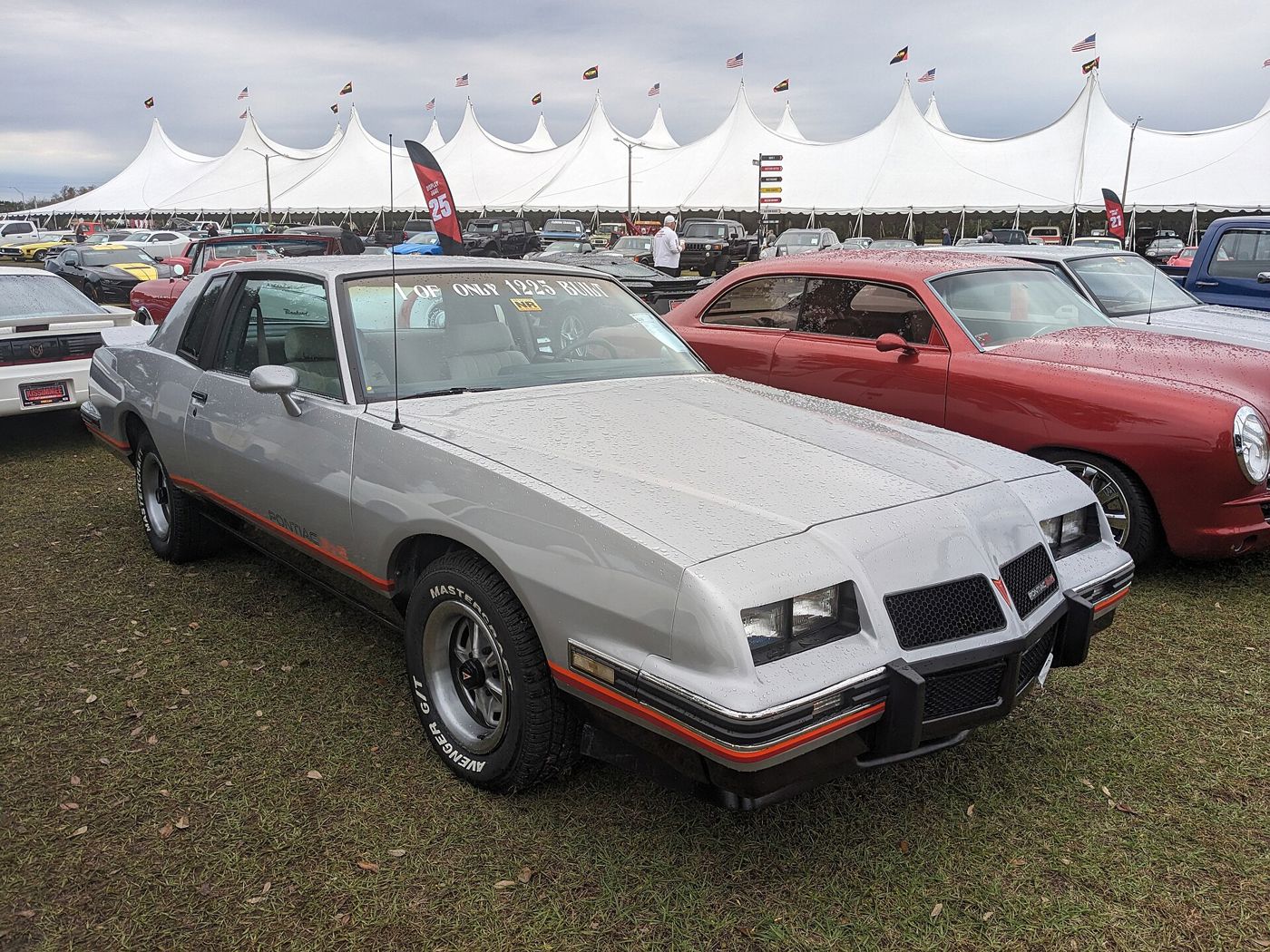

The 1986 Grand Prix 2+2 was Pontiac's answer to NASCAR's changing aero requirements. Its sloping rear window and urethane nose gave the G-body a more streamlined shape, and the package paired those changes with a Chevrolet 305 V-8 and four-speed automatic. Pontiac sold it alongside the regular J, LE and Brougham, creating the line's most distinctive model in years. The standard models kept their regular bodywork, making the aero treatment immediately recognizable in Pontiac showrooms. The 2+2 listed at $18,214, yet it had no body-style number of its own in the Series 2G production table.1,2
The regular range still used the 3.8-liter V-6, rated at 110 hp and 190 lb-ft and fed by a two-barrel carburetor, and offered a 4.3-liter V-6 and 5.0-liter V-8. Pontiac priced those trims from $10,259 for a V-6 J and $10,974 for a V-8 J, through $10,795 and $11,510 for the LE, to $11,579 and $12,294 for the Brougham. The 2+2 carried a separate factory price of $18,214, nearly $6,000 above the most expensive Brougham, and period retrospectives say dealers marked it up beyond that.1,3,2,4,5
Counts of the 2+2 vary by source. The Standard Catalog table gives 200 and says all were sold by dealers in the southeastern United States; a separate passage in the same catalog says 1,229 were made as 1986-1/2 models, plus four prototypes. Other retrospectives give about 1,200 and 1,225, figures that sit close to the catalog's 1,229. The 200 figure matches a NASCAR homologation minimum.1,4,2,3
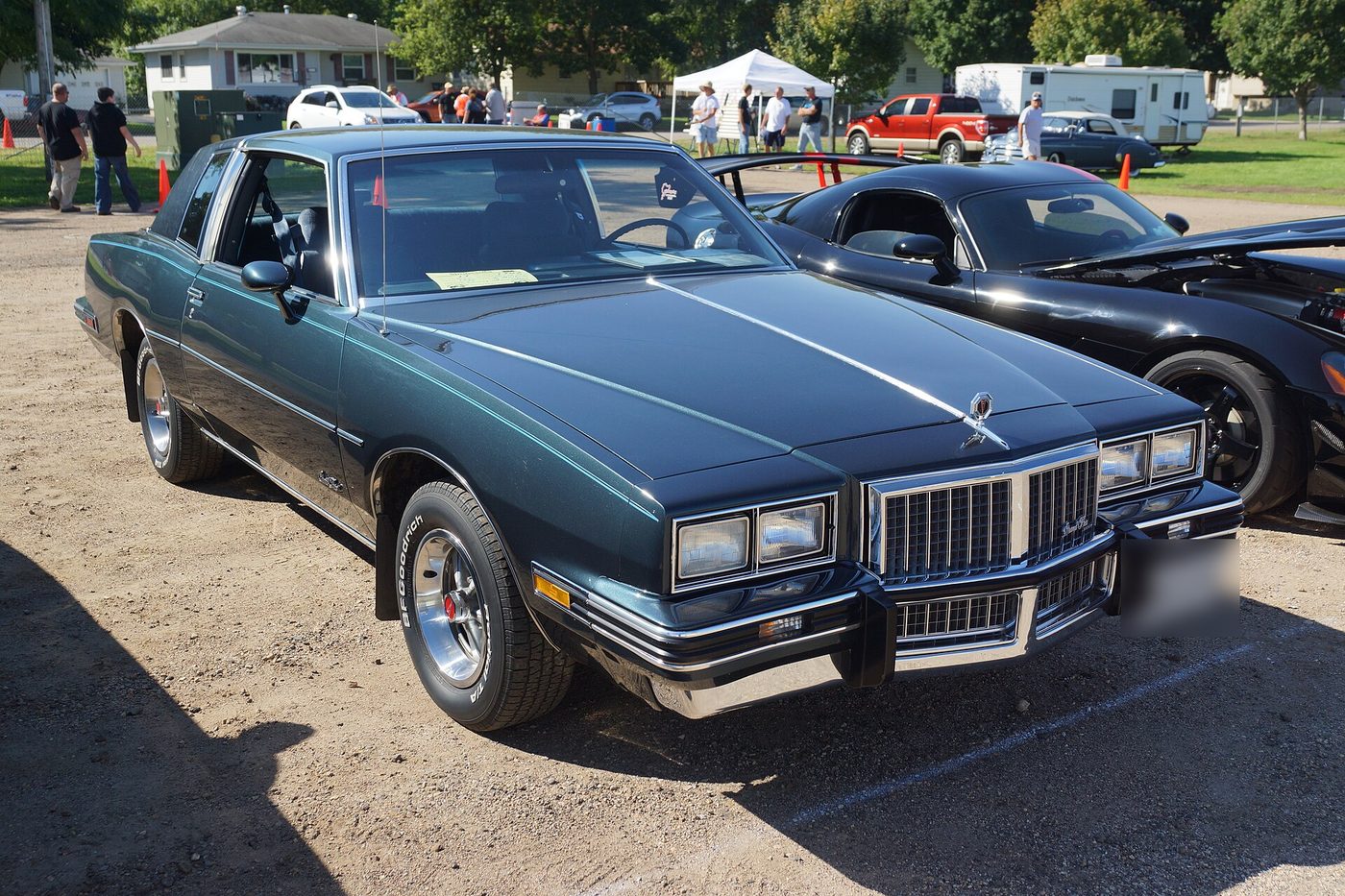

The 2+2's 305 rating varies by source. A compiled table gives 150 horsepower and 240 lb-ft for Grand Prix V-8s generally; other accounts and the catalog's 2+2 passage assign 165 and 245 to the special model. The 2+2 used a Turbo Hydra-matic 200-4R four-speed automatic, and the EPA certified the 5.0-liter 305 V-8 only with the four-speed. The 3.8 and 4.3 V-6s were certified with a three-speed automatic, and the 4.3 with a four-speed as well.1,5,2,3
Pontiac sold the 2+2 as a complete model, not a collection of separate options. Its aero nose and bubble-back rear glass marked it out from the standard coupe, and the package was aimed at creating the production basis for the NASCAR car. The 305 V-8 and four-speed automatic completed the mechanical combination. Retrospective accounts and the Standard Catalog both place the cars in dealerships across the southeastern United States.4
A compiled source gives 40,584 Grand Prix cars in all: 21,668 base models, 13,918 LEs, 4,798 Broughams and the 2+2 at the catalog's figure of 200. The base car was the most popular by far, more than half the total. The V-8 added $715 to each trim's price; the LE listed $536 above the J with either engine, and the Brougham $1,320 above it. Shipping weights for the V-6 cars ran from 3,161 pounds for the J and 3,178 for the LE to 3,201 for the Brougham, just 40 pounds more than the J. Pontiac listed the J as body J37, the LE as K37 and the Brougham as P37.4,1
Fact sheet · 1986 · United States
The numbers
1986 Pontiac Grand Prix: The NASCAR-driven Grand Prix 2+2 with its bubble back window, in disputed numbers.
Figures may describe different groups of cars. Add rows together only when the note says they make up a total.
Key facts
- How many 2+2s were built is disputed: the Standard Catalog gives 200, while two retrospectives give about 1,200 and 1,225.1,3,2
- The Standard Catalog of Pontiac gives the 2+2 a $18,214 factory price and a 165-hp, 245 lb-ft 305 V-8, and says dealers marked the few cars up.4
- Factory prices: $10,259 (V-6) or $10,974 (V-8) Grand Prix, $10,795 or $11,510 LE, $11,579 or $12,294 Brougham, $18,214 for the 2+2.4
- fueleconomy.gov lists four 1986 Grand Prix powertrains: 3.8 V-6 and 4.3 V-6 with a three-speed automatic, the 4.3 V-6 with a four-speed automatic, and the 5.0 V-8 with a four-speed automatic only.5
Production
| What was counted | Built |
|---|---|
| Base Hardtop1,4 Base Hardtop · 2-door | 21,668 |
| "LE" Hardtop1,4 "LE" Hardtop · 2-door | 13,918 |
| Brougham Hardtop1,4 Brougham Hardtop · 2-door | 4,798 |
| What was counted | Built |
|---|---|
| Grand Prix total1 | 40,584 |
Prices when new
| Model | Price | Price type |
|---|---|---|
| Grand Prix (J37), V-64 | $10,259 | factory price, 1986 model year |
| Grand Prix (J37), V-84 | $10,974 | factory price, 1986 model year |
| Grand Prix 2+2, V-84 | $18,214 | factory price, 1986 model year |
| Grand Prix LE (K37), V-64 | $10,795 | factory price, 1986 model year |
| Grand Prix LE (K37), V-84 | $11,510 | factory price, 1986 model year |
| Grand Prix Brougham (P37), V-64 | $11,579 | factory price, 1986 model year |
| Grand Prix Brougham (P37), V-84 | $12,294 | factory price, 1986 model year |
Prices are the nominal dollars of the day, not adjusted for inflation.
Engines
| Engine | Factory rating | Availability |
|---|---|---|
| 231 cid (3.8L) V61,5 231 cu in · 2-barrel | 110 hp, 190 lb-ft (SAE net (per source's note that post-1972 ratings are net)) | |
| 305 cid V8 (Chevrolet)1,5 305 cu in · 4-barrel | 150 hp, 240 lb-ft (SAE net (per source's note that post-1972 ratings are net)) | |
| 4.3 litre V-65 4.3 L | certified for the 1986 Grand Prix with 3-speed and 4-speed automatic |
Ratings are published figures, not dyno results. Gross and net ratings aren't directly comparable.
Transmissions
| Transmission | Availability |
|---|---|
| 200-4R · Turbo Hydra-matic 200-4R four-speed automatic2,3,5 | standard on 2+2 |
| Automatic 3-speed5 | with the 3.8 and 4.3 V-6 |
Options and packages
| Option | Price |
|---|---|
| Grand Prix 2+2: aerodynamic coupe for NASCAR homologation, 305 V-8, sold through dealers in the southeastern United States4 | $18,214 |
Specifications
| Measure | Value | Applies to |
|---|---|---|
| Shipping weight, V-64 | 3,161 lb | Grand Prix (J37) |
| Shipping weight, V-64 | 3,178 lb | Grand Prix LE (K37) |
| Shipping weight, V-64 | 3,201 lb | Grand Prix Brougham (P37) |
Identification
- Series and body
- Series 2G; body style J37 for the Grand Prix, K37 for the LE and P37 for the Brougham; the 2+2 row shows no body style number (N/A).4
Where the sources disagree
1986 Grand Prix 2+2 production
Identification
Read a 1986 Pontiac VIN
The VIN decoder runs in your browser and never sends the VIN anywhere. How the factory numbered this year's cars:
Same model year
Also in 1986
- Buick Regal Turbo, Grand National and GNX An air-to-air intercooler lifted the turbo 3.8 to 235 hp, and Grand National production jumped to 5,512 of 7,896 Regal T Types.
- Buick Riviera Downsized, unibody, transverse front drive; the T-Type now meant handling and trim, not a turbo (2,042 built).
- Chevrolet El Camino SS RPO Z15 SS Sport listed at $9,885.00, with the 305 V8 a $390.00 option; 16,229 El Caminos built.
- Chevrolet Monte Carlo SS The Aerocoupe appears: 200 cars for NASCAR eligibility, beside 41,164 notchback SS coupes.
- Ford Thunderbird The last Turbo Coupe before the 1987 reskin and intercooler; the catalog weighs it at 3,172 lb.
- Lincoln Mark VII LSC Renamed Lincoln Mark VII; the LSC gets a 200-hp sequentially injected 5.0 V8 while the diesel and the Versace edition are dropped.
- Mercury Capri RS and ASC/McLaren The last Capri: the 5.0L at $10,950 with a 200 bhp fuel-injected V8, and 115 ASC McLaren coupes and 194 convertibles.
- Mercury Cougar The five-speed manual became standard on the turbo XR-7 and the 5.0 V-8 reached 150 hp; 135,904 Cougars.
- Oldsmobile Cutlass, 4-4-2 and Hurst/Olds The W42 4-4-2 on the rear-drive Cutlass Supreme, with a 307 V-8 and a four-speed automatic.
- Pontiac Firebird and Trans Am The S/E's last year: 110,463 Firebirds, 48,870 Trans Ams.