People · Executive · Ford Division, Ford Motor Company, Chrysler Corporation
Lee Iacocca and the Committee Behind "His" Mustang
The popular story puts one man in the room deciding Ford needs a sporty compact and willing it into existence; the record names a committee, a design competition, and a specific rival engineer whose work Iacocca alone did not create.
Story reviewed September 27, 2026
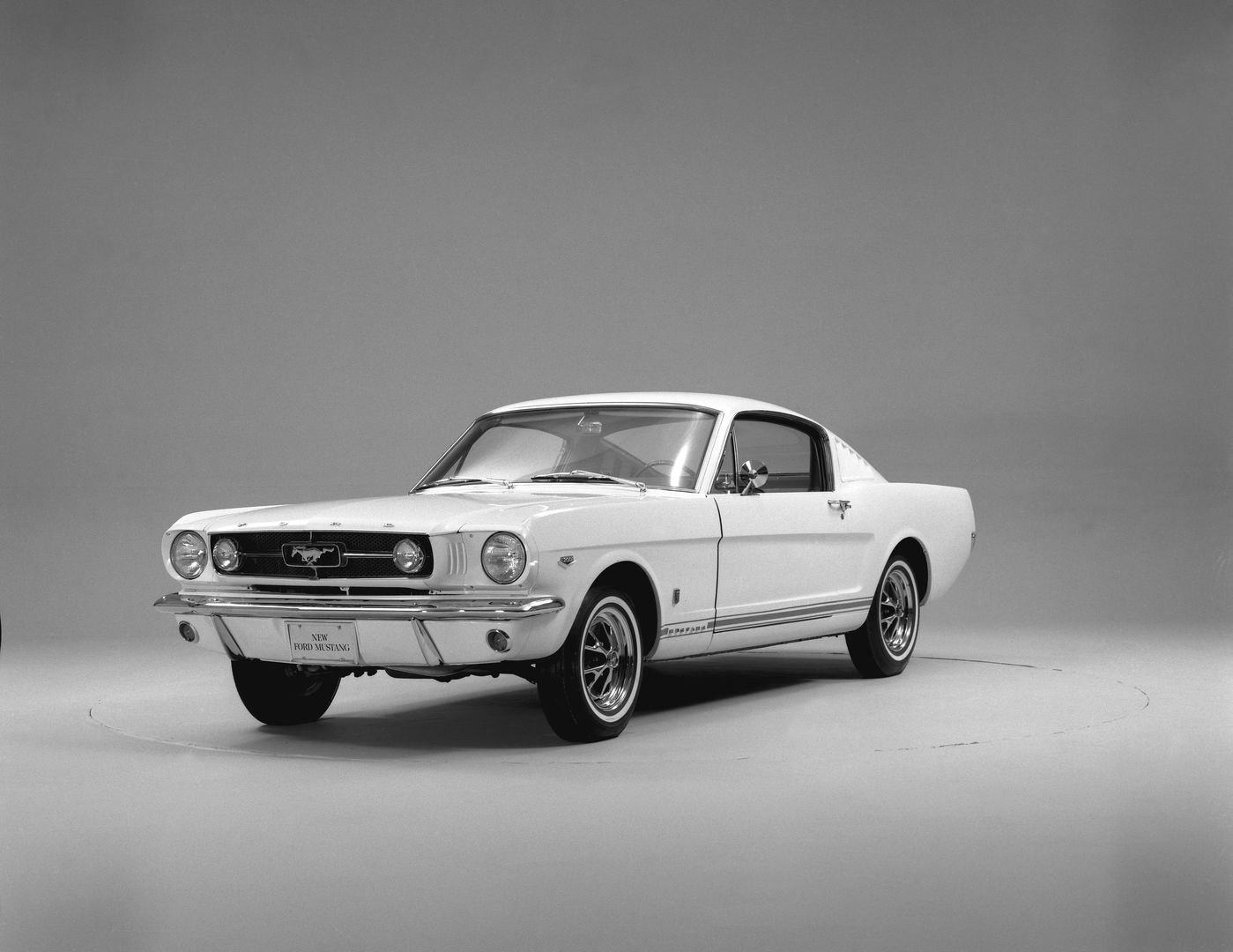
The popular version of the story puts one man in the room: Lee Iacocca decides Ford needs a sporty compact, wills it into existence over his bosses' objections, and drives off in the result. The record Ford Division's own participants left behind describes something narrower and, in its way, more interesting — a general manager who set the criteria, staged a competition, and did the selling, inside a structure of stylists, engineers, and product planners whose names rarely survive the shorthand. Iacocca's real contribution was real. It was also not solo.
Lido Anthony Iacocca was born October 15, 1924, in Allentown, Pennsylvania, to Italian immigrant parents. He earned an undergraduate degree from Lehigh University and a master's degree in engineering from Princeton before joining Ford Motor Company as an engineer. He did not stay in engineering long; his career moved through Ford's sales organization instead, and by November 10, 1960, at age 36, he had been named vice president and general manager of the Ford Division.
The Mustang did not start as a clean-sheet idea. Ford's initial plan borrowed Falcon underpinnings and a new small-block V-8, and product planner Dick Place is remembered describing the result bluntly: the Falcon "was not a sporty car and couldn't be made into one." Iacocca convened what came to be called the Fairlane Committee, meeting offsite at Dearborn's Fairlane Hotel with planners including Hal Sperlich, and the group settled on hard targets: no more than 180 inches long, 2,500 pounds, or $2,500, with a short deck, a long hood, four seats, and a choice of six-cylinder or V-8 power. The brief was specific enough to rule things out and loose enough to leave the actual car unsettled.
Settling the car took a competition, not a decree. Styling chief Gene Bordinat was given two weeks to produce a half-dozen proposals; his Ford, Lincoln-Mercury, and Advanced studios turned out two apiece. Four were rejected as too rounded or too sharp-edged. Iacocca's own favorite, the Ford studio's "Stiletto," was judged too costly to build. The design that won approval, called "Cougar" internally, came from Dave Ash, assistant to Ford studio chief Joe Oros, and it previewed the production Mustang closely enough that the resemblance is not really in dispute. Crediting Iacocca alone with the car's shape erases Ash's actual authorship of it.
Getting the program approved took more than one attempt. An early formal proposal was, in product planning manager Don Frey's recollection, met with "not much top management interest, and not much interest even from Styling." Henry Ford II had recently walked out of an early styling review in evident bad humor — later explained by the onset of a case of mononucleosis serious enough to hospitalize him — and the corporation had three real reasons for caution: an unproven youth market, the still-fresh memory of the costly Edsel failure, and $250 million already committed to retooling the standard Ford line for 1965. Iacocca went back to Henry Ford II a second time and secured what Frey remembered as reluctant, almost grudging approval: "Okay, I'll approve the damned thing just to get you guys off my back." The formal pitch, on September 10, 1962, is the moment usually dated as the Mustang's true approval.
What followed was an unusually fast production push: Job One at Ford's Dearborn plant was set for March 9, 1964, roughly eighteen months after approval in an era when new-car programs typically took twice that long, on a design, engineering, and tooling budget of $40 million and an initial planned volume of 75,000 units. Iacocca, a veteran of Ford's sales organization, called it the hardest selling job of his career. The market's response overran the planning; sales quickly exceeded what the committee had dared assume, and Iacocca's stature inside Ford rose with it. He became executive vice president in 1967 and president of the company in December 1970.
The relationship with Henry Ford II did not survive the decade. According to Douglas Brinkley's history of Ford, Wheels for the World, Ford authorized $1.5 million in 1975 to investigate Iacocca's business and personal conduct, while privately planning to eventually hand the company to his own son, Edsel, then in his twenties. By early 1978 Iacocca had been told to report to another executive, Philip Caldwell, and his public efforts to rally support among Ford's board gave Henry Ford II, in the phrase one retrospective used, the opening he needed. On July 13, 1978, Ford called Iacocca in and let him go. Asked for a reason, he offered none beyond what Iacocca later recounted in his own bestselling autobiography: "Sometimes you just don't like somebody." The record supports a genuine personality clash between the two men considerably better than it supports any tidier business rationale, and this page does not manufacture one.
Chrysler hired him within months, in a considerably worse position than Ford had been: the company was close to bankruptcy. Iacocca lobbied Congress directly, arguing that Chrysler was too important to the country's economy for the government to simply let it collapse. Congress agreed in 1980 to guarantee $1.5 billion in loans, contingent on Chrysler raising matching capital on its own and cutting costs; by 1981 the company was showing a small profit, and by 1984 a large one. Iacocca became the company's public face in the process, appearing in its own advertising and closing with a line that outlived the campaign that produced it: "If you can find a better car, buy it."
Two products link Iacocca's Chrysler back to unfinished Ford business. The compact, front-wheel-drive K-cars that anchored Chrysler's early-1980s recovery, and the minivan that followed them in 1983, both descended from small-car proposals product planner Hal Sperlich had pushed at Ford and that Henry Ford II had declined to build; Sperlich left Ford and, later, joined Iacocca at Chrysler. Reflecting on the minivan's appeal years afterward, Iacocca connected it directly back to his earlier career: the Mustang generation, he said, "all got their driver's licenses when they were 16... and now they had kids and grandkids," and the minivan followed that same generation into its next stage of life. Chrysler's 1987 acquisition of American Motors Corporation, which brought the Jeep brand into the company, was Iacocca's deal as much as the loan guarantee had been.
Iacocca retired as Chrysler's chairman and chief executive at the end of 1992. He remained a public figure afterward, including a 2008 return to Chrysler to address its workforce not long before the company's bankruptcy filing, but the two roles that defined him were set decades earlier: the executive who ran the committee that turned a set of dimensional targets into an approved car, and the one who, at a company on the edge of failure, talked a government and a buying public into believing it was worth saving. He died July 2, 2019, at his home in Bel-Air, California, at age 94.