1967 · Ford · United States
1967 Ford Mustang: When the Pony Car Learned to Carry a Big Block
The 1967 redesign made room for the 390 while Ford’s option logic kept GT, GTA, engine, and transmission choices meaningfully separate.
United States · researched through July 26, 2026
Power-team selector
Choose the exact Mustang
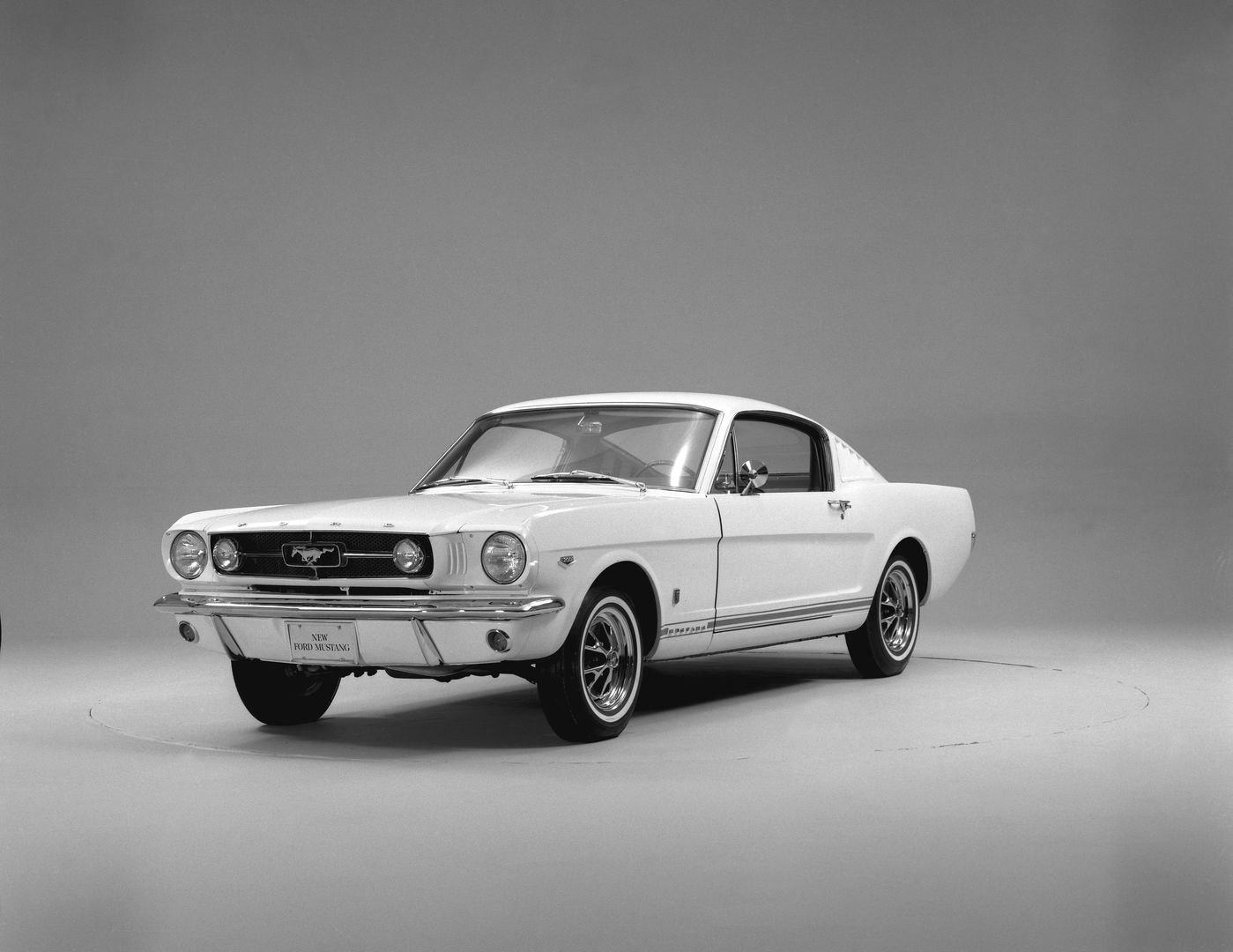
Ford’s 1967 Mustang brochure did not present the GT as a sealed model delivered from on high. It invited the buyer to build one. That verb is the key to the year. The Mustang remained a personal car assembled from choices, but the choices now reached farther than they had in 1964. A customer could begin with a hardtop, convertible, or the newly redrawn fastback 2+2, select a V-8, and then add the GT Equipment Group. For the first time, that engine list reached a 390-cubic-inch Thunderbird Special. The result was not one universal “1967 Mustang GT,” but a family of factory configurations whose badges, transmissions, and equipment mattered.
The body itself announced that the Mustang had grown into a tougher role. Ford’s fastback no longer looked like a roof gently laid over a notchback. Its roofline swept toward the tail, while the nose, grille, and rear treatment gave the car more visual weight. Ford still sold the ordinary virtues that had made Mustang successful—four seats, luggage space, comfort, and a long options list—but it could now place the 390 beside that everyday promise. This dual identity is why a six-cylinder hardtop and a 390 GT fastback belong to the same history. The first explains the Mustang’s broad market; the second explains why it belongs in an American muscle-car comparison.
The GT Equipment Group was more than a pair of letters, and the period brochure is unusually clear about the buying sequence. Ford told a customer to choose a V-8 and then add the group. The package brought grille-mounted fog lamps, Wide-Oval tires, front power disc brakes, special handling hardware, bright identification, and accent striping. With the larger Cobra and Thunderbird Special V-8s, Ford also described a low-restriction dual-exhaust system with four chromed outlets. The package therefore tied appearance to braking, tires, suspension, and exhaust. It did not turn every Mustang into the same car, and it did not erase the power-team decision made before it.
That distinction corrects one of the easiest mistakes in reading a surviving 1967 Mustang. A 390 does not, by itself, prove a factory GT. Ford offered the engine and the equipment group as related but separate choices. A restored car may wear fog lamps, stripes, and a GT fuel cap; a brochure can prove those things belonged in the catalog, but it cannot prove that a particular body received them on the assembly line. Authentication requires vehicle-specific records and physical evidence evaluated together. The honest historical statement is narrower and more useful: Ford advertised a 390-powered GT configuration, not that every 390 car was one.
The 390 Thunderbird Special gave the redesigned car its new center of gravity. Ford advertised 390 cubic inches, a four-barrel carburetor, 10.5:1 compression, dual exhaust, and 320 horsepower. Its period facts material also published 427 lb-ft of torque. Those are factory nominal ratings from the gross-horsepower era, not chassis-dynamometer readings and not values that can be silently compared with later SAE-net numbers. Even within 1967, ratings alone do not declare a winner. Axle ratio, tires, vehicle weight, transmission behavior, preparation, test method, and driver all shape what happens after the throttle opens.
Transmission choice created the most visible split inside the GT family. Ford’s own brochure identified the stick-shift version with `GT` striping and the SelectShift Cruise-O-Matic version with `GTA` striping. That gives the future comparison tool a clean, period-supported selector: GT 390 with four-speed manual on one branch, GTA 390 with SelectShift automatic on another. The archive pages inspected for this release do not call that automatic a C6, even though the shorthand is common in later enthusiast writing. The public record therefore keeps Ford’s advertised name and leaves the model designation out until an order or service document supplies it.
The four-speed GT and automatic GTA also show why comparisons must be configuration-level rather than badge-level. Both can share the same body style, engine family, advertised power, and GT-group equipment, yet they are not the same driving proposition. The close-ratio sports-type manual asks the driver to manage every shift. SelectShift offers automatic operation with manual gear selection when desired. Neither transmission makes the other illegitimate, and the GTA is not a lesser footnote. It is evidence that Ford was learning how to package muscle-era presence for buyers who wanted performance identity without giving up automatic convenience.
Body style adds another layer without changing the package logic. The brochure advertises hardtop, fastback, and convertible bodies, and illustrates GT treatment across the range. For this first selector, fastback is used as a stable comparison body because the period brochure documents it clearly and because it makes the manual-versus-automatic choice easy to understand. That choice is not a claim that every GT or GTA was a fastback, nor that the fastback was always quickest. Future records can add other factory-valid body and power teams while keeping their identities separate instead of synthesizing one imaginary “typical” GT.
This source boundary also separates catalog truth from survivor truth. A period advertisement can establish that Ford offered a combination and how Ford described it. It cannot authenticate a modern car’s original engine, transmission, package, axle, or sheet metal. A future featured-car story will need its own warranty plate, build record, ownership provenance, and inspection evidence. Keeping those layers apart protects both readers shopping for a car and owners whose vehicles deserve more than an appearance-based verdict. The selector answers “what could a buyer order?”; it does not answer “what is this particular car?”
There are important numbers this page does not publish. The familiar total-production figure and body-style totals in the sibling Mustang corpus trace to tertiary material whose exact revision is not pinned; licensed Ford-derived Marti data is an acquisition path, not a count table currently cleared for reuse. Exact equipped-car curb weights and matched period acceleration tests also remain open. Leaving those cells unknown is not a failure of the story. It prevents a broad body-style weight or an unmatched magazine result from masquerading as evidence for the exact GT 390 four-speed or GTA 390 automatic a reader selected.
Seen from 1967, the Mustang had not abandoned the formula that made it famous. It had stretched it. The same catalog still promised personal choice, comfort, colors, and daily usefulness, but the redesign created room—physically and culturally—for a big-block V-8 and a more serious chassis package. That is the year’s real story: not the arrival of one definitive Mustang, but the moment a flexible pony car could be configured as credible American muscle. The badge matters, the engine matters, and the transmission matters because Ford let the customer decide how those pieces met. MustangCarFacts’ 1967 year history carries the Mustang-specific chronology beyond this cross-marque chapter.
Identification
Read a 1967 Ford VIN
The VIN decoder runs in your browser and never sends the VIN anywhere. How the factory numbered this year's cars:
Same model year
Also in 1967
- AMC Rebel and Rebel Machine The Rebel name returned on AMC's new intermediate, offered with a 280-hp 343 four-barrel V8. This is host-car context for the later Machine.
- Buick Riviera A new 430 V-8 (360 hp, 475 lb-ft) replaced the Nailhead; 4,837 cars had the GS handling option.
- Buick Skylark Gran Sport, GS and GSX A new 400 cu in V-8 made the Gran Sport the GS 400, joined by a 340 cu in GS 340 and a California GS coupe.
- Buick Wildcat The new 430 V-8 (360 hp, 475 lb-ft) replaced the Nailhead.
- Chevrolet Chevelle and Malibu SS Second year of the SS 396 series: 59,685 sport coupes and 3,321 convertibles, front disc brakes newly listed, and a late, barely documented L78.
- Chevrolet Chevy II and Nova Super Sport production fell to 10,069 in the source table. Enthusiast-compiled production: 106,430 cars; Super Sport 10,069.
- Chevrolet El Camino SS No factory Super Sport El Camino is documented for this year; the record carries the host El Camino production as context.
- Chevrolet Impala SS The SS427 (RPO Z24) arrives: 2,124 of about 76,000 Impala Super Sports.
- Dodge Charger The first-generation fastback's second and last year: the 440 Magnum joined the options, and production fell to 15,788.
- Dodge Coronet R/T and Super Bee Dodge's first R/T: a Coronet hardtop or convertible with the 440 Magnum standard and the 426 Hemi as a special-order option; its production total is published two ways.
- Dodge Dart GTS, Swinger and Demon The restyled 1967 Dart GT offered a 235 hp 273 four-barrel and, for the first time, a 280 hp 383; Over-Drive counts 437 383-engined cars within 38,200 GT hardtops and convertibles.
- Ford Fairlane A facelifted second year for the big-block Fairlane: GT and GTA continued as Fairlane 500 hardtops and convertibles, and a 427 was offered in small numbers for drag racing.
- Ford Galaxie The last year of the approved Galaxie performance range: the 7-Litre quietly disappeared, while the 428 and a 425-hp 427 remained on the order form.
- Ford Thunderbird A new, larger fifth-generation Thunderbird added a four-door Landau; the 428 was the performance option.
- Mercury Comet and Cyclone The Cyclone and Cyclone GT continued as hardtop and convertible, and a handful of Comets were built with the 427 side-oiler.
- Mercury Cougar Mercury's first pony car arrived as a single hardtop body, added the XR-7 at mid-year, and built 150,893 in its first season.
- Mercury Marauder and S-55 The S-55's last year: 570 hardtops and 145 convertibles with the 428 four-barrel, per Wikipedia's table.
- Oldsmobile Cutlass, 4-4-2 and Hurst/Olds Multiple carburetors were gone, the 4-4-2 was trimmed as a Cutlass Supreme, and the W-30 cold-air package became a regular factory option on about 500 cars.
- Plymouth Barracuda and 'Cuda The redesigned second-generation Barracuda added a notchback hardtop and a convertible to the fastback, and the Formula S could now carry a 383.
- Plymouth GTX, Belvedere and Satellite Plymouth's first GTX put a 375-hp 440 Super Commando in a dressed-up Belvedere hardtop and convertible, with the 426 Hemi as the only engine option.
- Pontiac Catalina 2+2 and Super Duty The 2+2 returned to option status with a standard 360 hp 428, and only 1,768 were built.
- Pontiac Firebird and Trans Am Pontiac's late entry into the pony-car field: a Camaro body with a Pontiac nose, five engine-defined models, and 82,560 built in a short first season.
- Pontiac GTO Tri-Power gone, the 389 grown to 400, and a Ram Air option that Car Life ran to a 14.5-second quarter mile.
- Pontiac Grand Prix Concealed headlamps, a standard 350 hp 400, and the only Grand Prix convertible: 5,856 built.
- Pontiac Tempest and LeMans The Sprint six grows to 215 hp and the 326 HO continues; 109,413 LeMans built.
- Rambler and AMC Marlin The last Marlin moved to a 118-inch wheelbase with 290 and 343 V8s listed, the top one a 280-hp 343. Only 2,545 were built.