Racing · Bill Jenkins and Ronnie Sox · 1970
The First Pro Stock Final: Bill Jenkins Against Ronnie Sox
The first Pro Stock final, decided by thirteen hundredths, and the class that made factory drag racing a product again.
Story reviewed July 27, 2026
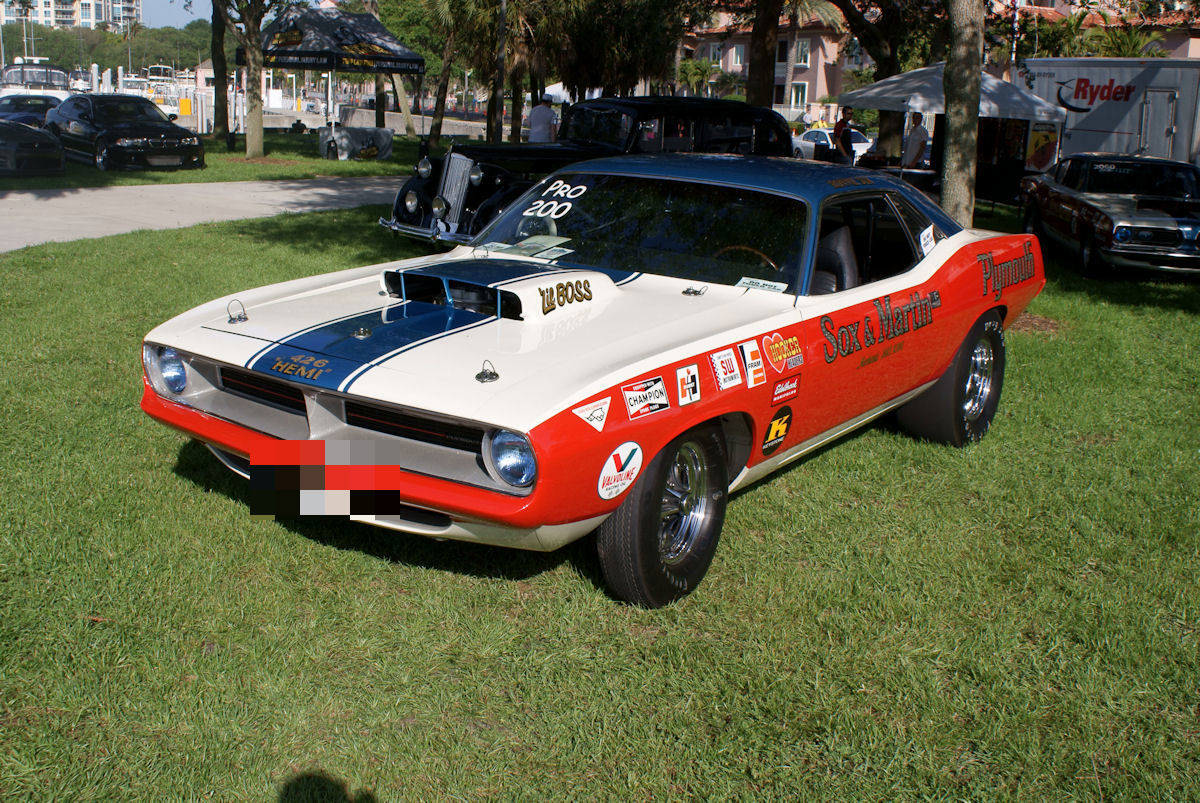
More than forty cars came to the 1970 Winternationals seeking a place in NHRA’s new Pro Stock eliminator. Sixteen qualified. The field drew from Super Stock, Modified Production, and Factory Experimental traditions, bringing Hemi Plymouths and Dodges, big-block Camaros, and Ford Mavericks with overhead-cam engines into one professional category. The first final would place Bill “Grumpy” Jenkins in a Chevrolet against Ronnie Sox in a Plymouth, but the class began as a crowded attempt to define a new kind of factory-identified drag racing.
Ronnie Sox entered as the 1969 Super Stock champion and the obvious favorite. His reputation as a precise four-speed driver belonged to a broader Sox & Martin organization in which Buddy Martin’s team leadership and promotion mattered beside the driver. Their red, white, and blue Plymouth carried an established public identity into a category that had not yet created its own history. The page treats that reputation as institutional retrospective, not license to invent what Sox thought at the starting line.
Jenkins represented a different but equally developed program. He was known for Chevrolet match racing, engine building, and methodical preparation. “Grumpy” became a public persona, yet the nickname should not turn the technical story into caricature. His Camaro, crew, engine work, and eliminations belong to exact event evidence. Chevrolet’s showroom configuration data can explain the brand connection, but it does not supply the Pro Stock car’s output or construction.
The field’s variety made the new class immediately useful to spectators. It concentrated recognizable manufacturer rivalry while allowing purpose-built preparation beyond ordinary street cars. That is precisely why none of these entries belongs in the street selector. A Pro Stock Camaro is not a 1970 SS 396 or Z28 configuration with a result attached; a Hemi Plymouth race car is not a Road Runner or ’Cuda street card. Event eligibility and preparation define separate identities.
NHRA’s anniversary account records Jenkins running 9.98 seconds against Bill Hielscher, the class’s first nine-second pass. That result belongs to the actual run, vehicle, event, and timing system. It cannot become a generic performance number for a big-block Camaro. Its importance is historical rather than promotional: before the first Pro Stock winner had even been decided, the new category had crossed a public elapsed-time threshold.
Sox and Jenkins advanced through opposite sides of eliminations. A full round chart can be added when the period sheet is acquired, but the institutional account supports the path to the final and the exact final numbers. Avoiding an invented turn-by-turn drama does not make the story thin. The contrast between the established favorite and the Chevrolet engine builder, with an entire new class being defined around them, supplies the stakes.
In the final, Jenkins ran 9.99 seconds at 139.53 mph. Sox ran 10.12 at 138.67. Jenkins won the first Pro Stock event. Those measurements remain paired with their drivers and cars; the faster elapsed time and speed describe two runs under the same event’s conditions, not universal marque performance. The record says who won and how the clocks read. It does not reveal reaction time or every mechanical reason without additional evidence.
The final also linked 1969 and 1970. Sox’s Super Stock championship represented the category lineage from which Pro Stock emerged, while Jenkins’s victory established a new professional result. Within months, teams would refine combinations around the class and manufacturers would gain another arena for performance identity. The opening event captures the rules before tradition made them seem inevitable.
People and preparation remain central. Jenkins and Sox carry the headline, but crews, engine builders, team owners, suppliers, and NHRA officials made the category possible. Buddy Martin’s role prevents Sox & Martin from becoming only a driver biography. Jenkins’s technical identity prevents his Camaro from becoming only Chevrolet advertising. Later pages can add individual crew members when period programs, team papers, or interviews source their responsibilities.
The first Pro Stock final is a story rather than a documentary because it begins with uncertainty: forty-plus hopefuls, sixteen places, and no previous winner. It moves through a nine-second threshold and ends with two established factory-performance cultures meeting for the first title. Jenkins’s 9.99 defeated Sox’s 10.12, but the enduring result was larger than one win. NHRA had created a professional stage on which engines, teams, drivers, and manufacturer identities would argue in public for decades.
Exact terminology remains important. “Pro Stock” identifies the new eliminator; it does not mean the vehicles were stock showroom configurations. NHRA’s rules determined permitted construction, weight, engine, and body relationships, while the public recognized Chevrolet, Plymouth, Dodge, and Ford identities. The future technical page needs the actual 1970 rule book before it describes those boundaries. This narrative uses the institutional account for the event and holds unsupported mechanical generalizations.
Cross-site linking should follow the people and cars in context. CamaroFacts can link from a Jenkins or drag-racing passage if it develops one; Plymouth and Mopar pages here can point to the Sox & Martin story where the Hemi competition branch is explained. A Corvette link is unnecessary unless a specific shared Chevrolet person or engine record advances the reader’s understanding. These are editorial bridges, not a site-family footer.
That separation is the final publication safeguard: exact clocks and institutional results are ready now, while rules, construction detail, crew attribution, and imagery wait for evidence suited to those questions. The page can grow without changing what the first Winternationals already proves.
The comparison database benefits from the same boundary. Jenkins’s and Sox’s elapsed times can eventually appear in race-event views connected to their exact competition cars. They will never be copied onto Camaro or Plymouth street cards. Readers can follow the manufacturer relationship across the link while seeing which facts describe an advertised road configuration and which describe a purpose-built machine in eliminations.