1970 · Plymouth · United States
1970 Plymouth Road Runner and Superbird: A Wing for Daytona and Two Counts That Will Not Agree
Production halved from 1969, the 440 Six Barrel became a regular option, and the winged Superbird was built as a Road Runner hardtop to put Plymouth back on NASCAR superspeedways.
United States · researched through 2026-09-22
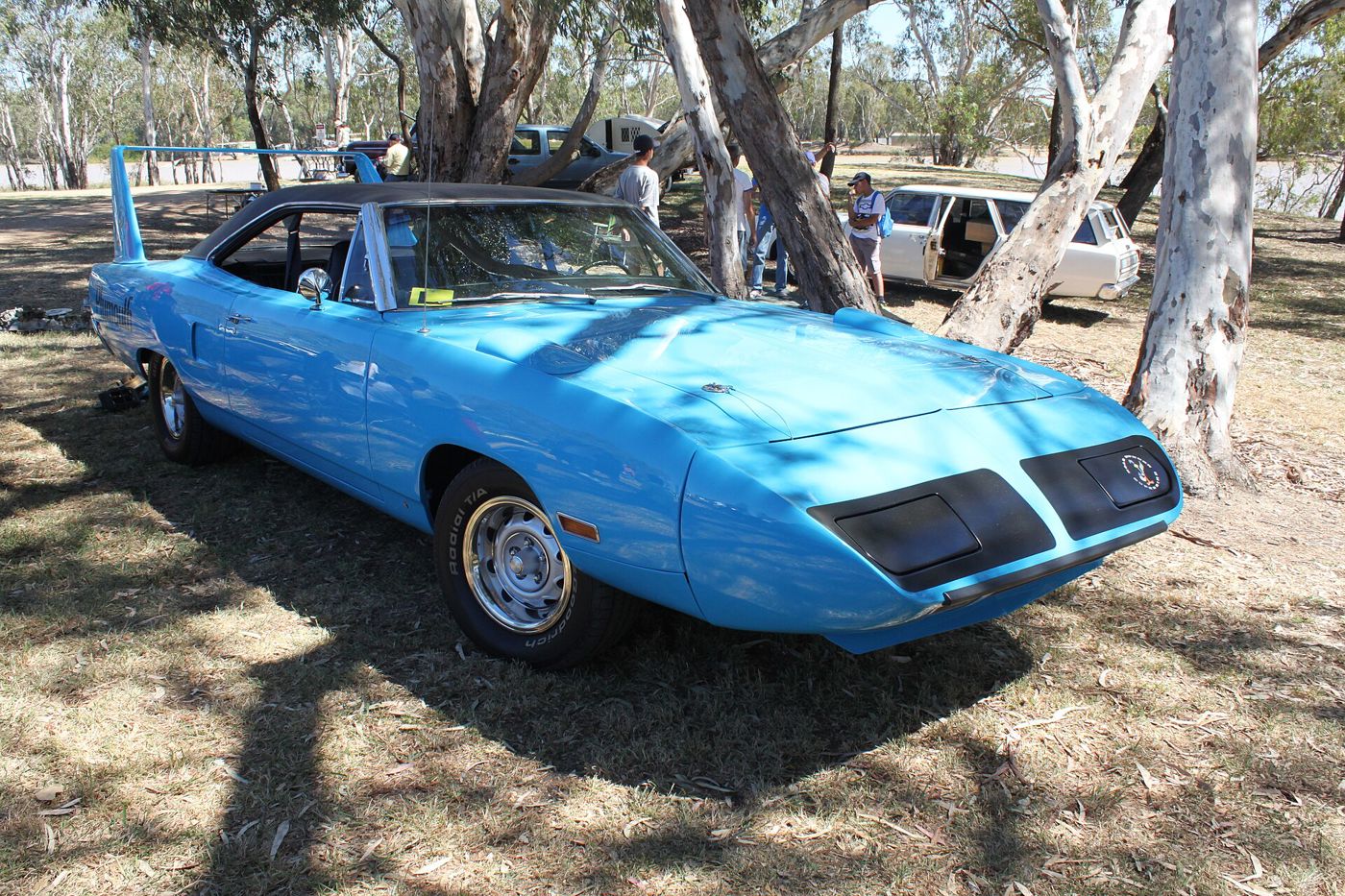
The 1970 Daytona 500 went to the second Superbird. NASCAR's account of Pete Hamilton's career says Plymouth connected the Massachusetts driver with Petty Enterprises, that Maurice Petty led the effort on the second car, and that Hamilton won the 500 after a late contest with David Pearson. It was Hamilton's first victory at NASCAR's top level, and it came in a car that had existed as a street model for only a few months. The winged Road Runner was built to win exactly this kind of race, and in its first Daytona 500 it did, with the team's second driver.1,2,3
Richard Petty was back in a Plymouth as well. The Talladega and Spoiler Registry's history notes that 1969 was the only year Petty raced a Ford, and that he won ten races that season. NASCAR's catalog of his 200 victories shows his first win in the No. 43 Superbird at the March 8, 1970 Carolina 500, the first of a 1970 run it numbers from win 102 through 119. The catalog records results, not which chassis ran each race, so it does not say how many of those eighteen wins came in a Superbird rather than another Plymouth.4,5
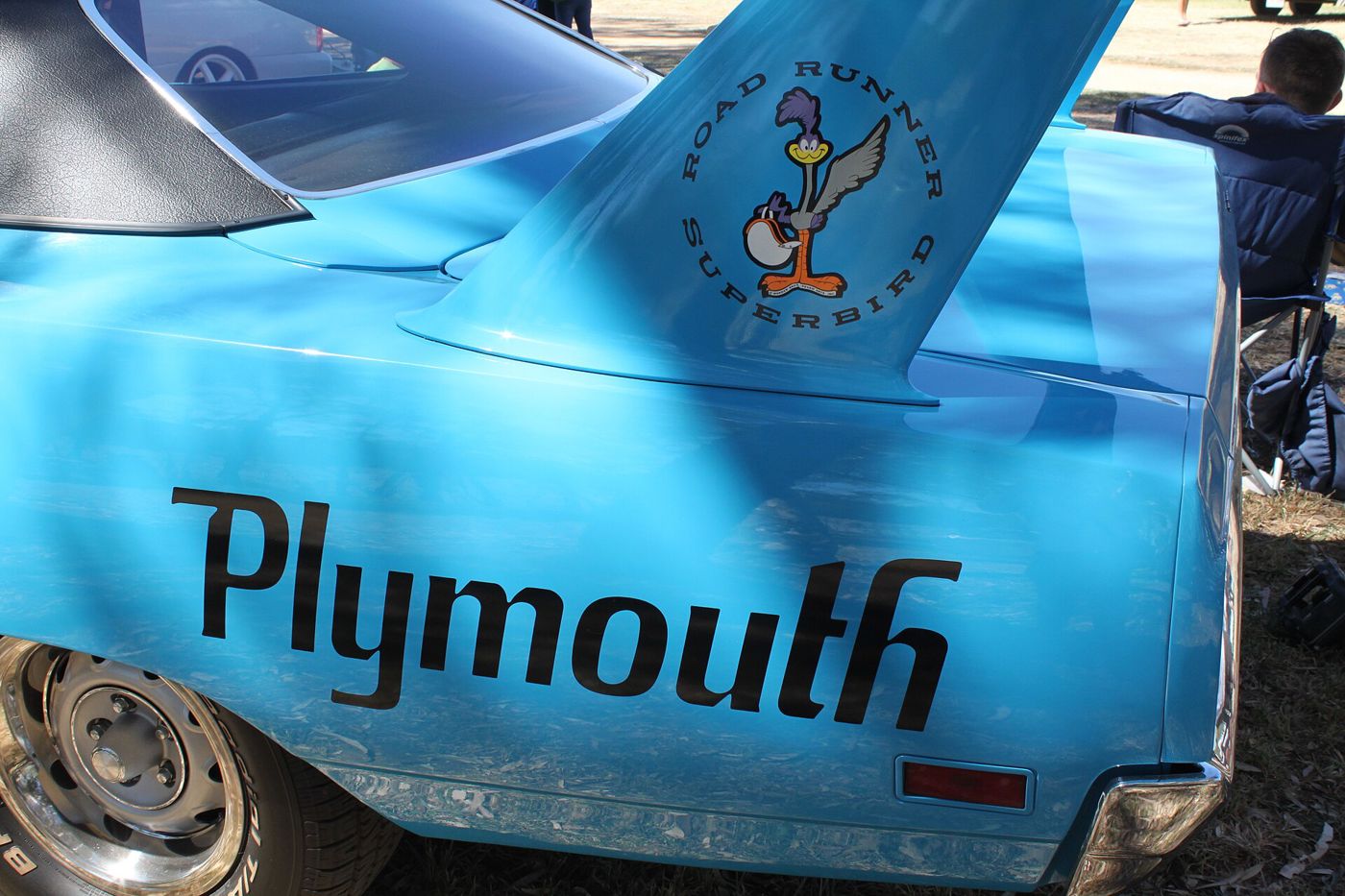
The road car existed because the rulebook demanded it. Motor Trend's January 1970 feature explained that ACCUS required one street Superbird for every two Plymouth dealers before the body could race, and reported that 1,920 had been built. The magazine credited the development to George Wallace, special vehicles engineering co-ordinator, Gary Romberg, race-car aerodynamicist, and Bill McNulty, performance supervisor at the proving grounds. The standard street engine was the GTX-type 440 four-barrel, rated 375 horsepower, with the 440 Six Barrel or the 426 Hemi optional. The nose and the tall rear wing were the point; everything else was Road Runner.6,7
The street cars came together quickly. Aero Warriors dates Superbird production from October 22 to December 15, 1969, and gives a manufacturer's suggested retail price of $4,298 as of September 23, 1969. The production table lists the Superbird on the Road Runner's RM23 hardtop body at that same $4,298, against $3,034 for a regular Road Runner hardtop, and gives it a shipping weight of 3,785 pounds, against 3,475 for the hardtop. By the factory's own list and shipping figures, the winged car, which also carried a bigger standard engine, cost about $1,264 more and weighed about 310 pounds more before any option was ticked.3,7
How many were built is where the Superbird story splits in two. Motor Trend's 1,920 matches the NASCAR race-program serial-number list that Aero Warriors reproduces, which divides the cars into 1,162 with the 440 four-barrel, 665 with the Six Barrel and 93 with the Hemi. A Chrysler Historical count, published by Aero Warriors and by the independent researcher behind brcook.com, gives 1,935: 1,084 four-barrels, 716 Six Barrels and 135 Hemis. The two totals count different things, entries on a sanctioning list and a later corporate tally, and neither is adopted as the build total. Their engine splits cannot be mixed.6,3,8
That researcher's list shows how far the counting can spread. Beside 1,920 and 1,935, it records a United States shipping list of 1,850 cars and a count of 1,925 VINs, made up of 1,850 for the United States and 75 for Canada, and it concludes only that fewer than 2,000 Superbirds were built. Those are not rounding differences. They reflect different documents, different geography and different moments in the car's paper trail. The fair reading keeps both leading totals side by side, 1,920 and 1,935, each with its basis, until a Chrysler build record decides between them.8,3
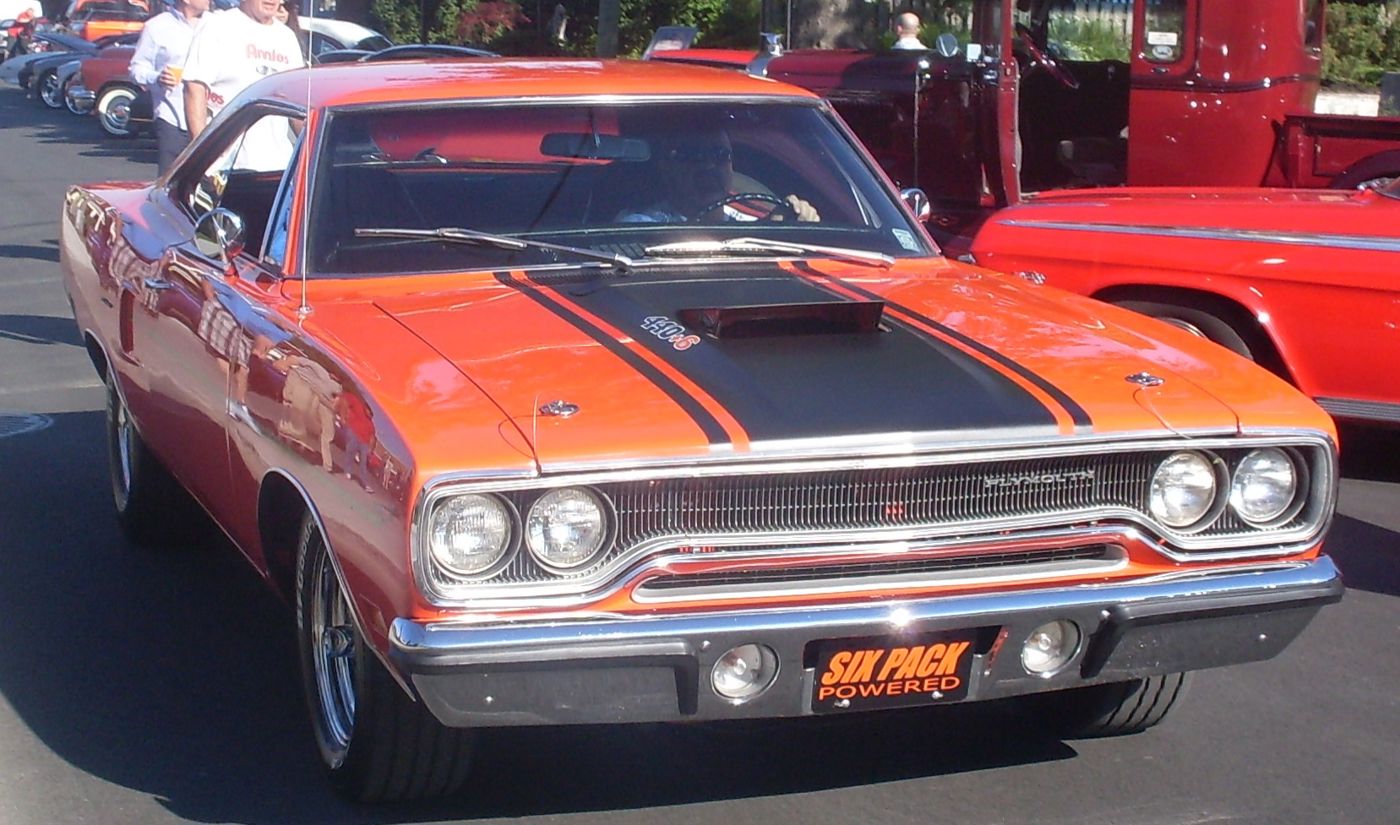
The ordinary Road Runner had a harder year. The production table gives 15,716 coupes, 24,944 hardtops and 824 convertibles, and a model total of 43,404 that includes 1,920 Superbirds. Ate Up With Motor's history prints 41,484 for 1970, which is the same total without the winged cars, and 82,109 for 1969, so by that history's own figures the regular car sold about half as many as the year before. The list prices were $2,896 for the coupe, $3,034 for the hardtop and $3,289 for the convertible, and the hardtop was the most popular body by a wide margin, with more cars than the coupe and convertible combined.7,9
What those buyers could order was the strongest Road Runner menu yet. The 383 rated 335 horsepower remained standard. The 440 Six Barrel, rated 390 horsepower, became a regular $250 option, and the Hemi cost $841; Over-Drive notes that 1970 was the Hemi's first year with a hydraulic camshaft. The Air Grabber scoop was $66 and standard with the Hemi, hood pins were $15, Dust Trail stripes $16 and bright exhaust trumpets $21. Standard axles were 3.23 with the 383 and 3.54 with a four-speed Hemi or 440. No documented engine count for the regular 1970 Road Runner has been found.7
Motor Trend put a Six Barrel hardtop against a Chevelle and a Torino in its December 1969 comparison of three strippers. The Plymouth had the four-speed, a 4.10 Sure-Grip axle, the Super Track Pak and the Air Grabber, and its sticker started at $3,034 and reached $4,417 delivered. At 3,935 pounds it ran 60 mph in 6.6 seconds and the quarter-mile in 14.4 seconds at 99.0 mph, and stopped from 60 in 125.5 feet. After a Chrysler specialist corrected sticking valves and lifters, reset carburetion and timing, and the tire pressure was raised, it ran 14.06 seconds at 101.69 mph.10
On the track, Hamilton followed Daytona with two Talladega victories for Petty Enterprises, and NASCAR's catalog kept counting Richard Petty's 1970 wins. Those results belong to race cars with their own chassis, engines and preparation, not to the street Superbirds or to any Road Runner in a showroom. The winged body lasted one model year. Ate Up With Motor records the 1971 fuselage-style redesign of Chrysler's intermediates and Road Runner sales of 14,218 that year. The 1970 car closes the first Road Runner era with its most famous variant, and with two production totals that are still waiting for a Chrysler ledger to settle them.1,5,9,3,8
Fact sheet · 1970 · United States
The numbers
1970 Plymouth Road Runner and Superbird — Production halved from 1969, the 440 Six Barrel became a regular option, and the winged Superbird was built as a Road Runner hardtop to put Plymouth back on NASCAR superspeedways.
Coverage: Partial — researched sections are shown; missing ones are not yet sourced. Researched through 2026-09-22.
Every figure is labeled with how sure we are. Reported means a manufacturer, registry, or reference figure we cite but have not reconciled against factory records ourselves. Disputed means credible sources disagree and both are shown. Rows are separately scoped; don't add them together unless the note says they make up a total.
Key facts
- Motor Trend credits the Superbird's development to George Wallace (special vehicles engineering co-ordinator), Gary Romberg (race-car aerodynamicist), and Bill McNulty (performance supervisor at the proving grounds).6
- 1970 was the first year the 426 Hemi received a hydraulic camshaft, according to the fact sheet.7
- Plymouth's 1970 code guide makes a transverse tape stripe mandatory on the Road Runner hardtop and convertible (and on the coupe with the A87 Decor Group) unless the delete code V88 is specified.11
- The guide lists four Road Runner engines by sales code: E63 383 four-barrel (standard), E74 426 Hemi, E87 440 Six Barrel, with E86 440 four-barrel reserved for the GTX; the floor-shift three-speed D13 was standard, with D21 four-speed and D34 TorqueFlite optional.11
Production
| What was counted | Count | Basis | Status |
|---|---|---|---|
| Road Runner 2-door coupe (RM21)7 Road Runner · 2-door coupe · not stated | 15,716 | not stated (production table), model-year | Reported |
| Road Runner 2-door hardtop (RM23)7 Road Runner · 2-door hardtop · not stated Excludes Superbirds, which the table lists separately. | 24,944 | not stated (production table), model-year | Reported |
| Road Runner convertible (RM27)7 Road Runner · convertible · not stated | 824 | not stated (production table), model-year | Reported |
| Superbird7,6,3 Road Runner Superbird · Superbird (RM23 body) · not stated See conflicts: a Chrysler Historical count of 1,935 is also published. | 1,920 | built (period and serial-list count), model-year | Disputed |
| What was counted | Count | Basis | Status |
|---|---|---|---|
| Road Runner model total (incl. Superbird)7 Road Runner · not stated Stated total; includes the 1,920 Superbird row. | 43,404 | not stated (production table), model-year | Reported |
| Superbird total, per Chrysler Historical count3,8 Superbird · Superbird (RM23 body) · not stated | 1,935 | Chrysler Historical count, model-year | Disputed |
| What was counted | Count | Basis | Status |
|---|---|---|---|
| Superbird 440 6-bbl, per NASCAR serial list3 Superbird · Superbird (RM23 body) · 440 3x2-bbl · not stated | 665 | serial-number list entries, model-year | Disputed |
| Superbird 440 4-bbl, per NASCAR serial list3 Superbird · Superbird (RM23 body) · 440 4-bbl · not stated | 1,162 | serial-number list entries, model-year | Disputed |
| Superbird 426 Hemi, per NASCAR serial list3 Superbird · Superbird (RM23 body) · 426 Hemi · not stated | 93 | serial-number list entries, model-year | Disputed |
| Superbird 426 Hemi, per Chrysler Historical count8 Superbird · Superbird (RM23 body) · 426 Hemi · not stated | 135 | Chrysler Historical count, model-year | Disputed |
| Superbird 440 6-bbl, per Chrysler Historical count8 Superbird · Superbird (RM23 body) · 440 3x2-bbl · not stated | 716 | Chrysler Historical count, model-year | Disputed |
| Superbird 440 4-bbl, per Chrysler Historical count8 Superbird · Superbird (RM23 body) · 440 4-bbl · not stated | 1,084 | Chrysler Historical count, model-year | Disputed |
| Road Runner with 426 Hemi (excluding Superbird)12 Road Runner · 426 Hemi · not stated Single secondary lineage (Chrysler/Govier figures as repeated by UltimateMuscleCar); scope not stated. | 152 | not stated, model-year | Reported |
The two Superbird engine splits come from different records and must not be mixed or added.
No documented breakdown of the regular Road Runner by engine or transmission was found; see unpublished leads.
Prices when new
| Model | Price | Basis |
|---|---|---|
| Road Runner 2-door coupe7 | $2,896 | factory price (list, per production table), 1970 model year |
| Road Runner 2-door hardtop7,10 | $3,034 | factory price (list, per production table), 1970 model year |
| Road Runner convertible7 | $3,289 | factory price (list, per production table), 1970 model year |
| Superbird3,7 | $4,298 | manufacturer suggested retail price, 1969-09-23 |
| Road Runner 440 6-bbl hardtop test car, delivered10 | $4,417 | delivered price of Motor Trend test car, 1969-12 |
Prices are the nominal dollars of the day, not adjusted for inflation.
Engines
| Engine | Factory rating | Availability | Built |
|---|---|---|---|
| 383 4-bbl (Road Runner Hi-Po)7 383 cu in · single 4-barrel | 335 hp @ 5,200, 425 lb-ft @ 3,400 (SAE gross) | standard in Road Runner | Not yet sourced |
| 440 4-bbl Super Commando7,3,6 440 cu in · single 4-barrel | 375 hp @ 4,600, 480 lb-ft @ 3,200 (SAE gross) | standard in Superbird | Not yet sourced |
| 440 Six Barrel (three 2-bbl)7,10 440 cu in · three 2-barrels | 390 hp @ 4,700, 490 lb-ft @ 3,200 (SAE gross) | optional; $250 in Road Runner | Not yet sourced |
| 426 Hemi7 426 cu in · two 4-barrels | 425 hp @ 5,000, 490 lb-ft @ 4,000 (SAE gross) | optional; $841 in Road Runner | Not yet sourced |
Ratings are the manufacturer's advertised figures under the standard shown (SAE gross before 1972, SAE net after). They are not dyno results, and gross and net ratings can't be compared directly.
Transmissions
| Transmission | Availability | Built |
|---|---|---|
| Four-speed manual7 | available; $188-$197 where not standard (range price) | Not yet sourced |
| TorqueFlite automatic7 | optional; $191-$227 with V-8s (range price) | Not yet sourced |
Options and packages
| Code | Option | Price | Installed |
|---|---|---|---|
|
440 Six Pack 390-hp V-8 (Road Runner)7 | $250 | Not yet sourced |
|
426 Street Hemi (Road Runner)7 | $841 | Not yet sourced |
|
Air Grabber hood scoop (Road Runner, GTX; standard with Hemi)7 | $66 | Not yet sourced |
|
Hood hold-down pins (Road Runner, GTX)7 | $15 | Not yet sourced |
|
Dust Trail tape stripes (Road Runner)7 | $16 | Not yet sourced |
|
Bright exhaust trumpets (Road Runner; standard with Hemi and GTX)7 | $21 | Not yet sourced |
|
Performance hood (Road Runner, GTX)7 | $18 | Not yet sourced |
|
Front disc brakes7 | $28 | Not yet sourced |
|
Sure-Grip positive traction rear axle7 | $42 | Not yet sourced |
|
Air conditioning7 | $357 | Not yet sourced |
|
Power steering7 | $105 | Not yet sourced |
|
Sport steering wheel7 | $32 | Not yet sourced |
A87sales code |
Road Runner Decor Group (RM21 coupe only)11 | — | Not yet sourced |
A04sales code |
Basic Group11 | — | Not yet sourced |
A01sales code |
Light Package11 | — | Not yet sourced |
A36package |
Performance Axle Package, heavy-duty 3.55 (383 4-bbl, Hemi, 440 with TorqueFlite)11 | — | Not yet sourced |
A31package |
Performance Axle Package, heavy-duty 3.91 (383 4-bbl)11 | — | Not yet sourced |
A32package |
Performance Axle Package, heavy-duty 4.10 (Hemi and 440 4-bbl with TorqueFlite)11 | — | Not yet sourced |
A33package |
Track Pak, heavy-duty 3.54 (Hemi, 440 4-bbl and 440 6-bbl with 4-speed)11 | — | Not yet sourced |
A34package |
Super Track Pak, heavy-duty 4.10 (Hemi, 440 4-bbl and 440 6-bbl with 4-speed)11 | — | Not yet sourced |
A35package |
Trailer Towing Package (not with 440 6-bbl or Hemi; TorqueFlite only)11 | — | Not yet sourced |
T87 / U84sales code |
Tires: F70x14 raised white letter; F60x15 raised white letter (disc or heavy-duty brakes and Extra H.D. Handling Pkg. S15 required)11 | — | Not yet sourced |
Paint
| Code | Color | Built |
|---|---|---|
A4 |
Platinum7 | Not yet sourced |
B3 |
Ice Blue7 | Not yet sourced |
B5 |
Blue Fire7 | Not yet sourced |
B7 |
Jamaica Blue7 | Not yet sourced |
C7 |
In Violet7 | Not yet sourced |
E5 |
Rally Red7 | Not yet sourced |
F4 |
Lime Green7 | Not yet sourced |
F8 |
Ivy Green7 | Not yet sourced |
J5 |
Lime Light7 | Not yet sourced |
K2 |
Vitamin C7 | Not yet sourced |
K3 |
Burnt Orange7 | Not yet sourced |
K5 |
Deep Burnt Orange7 | Not yet sourced |
L1 |
Sand Pebble Beige7 | Not yet sourced |
M3 |
Moulin Rouge7 | Not yet sourced |
P6 |
Frosted Teal7 | Not yet sourced |
R6 |
Scorch Red7 | Not yet sourced |
T3 |
Sahara Tan7 | Not yet sourced |
T6 |
Burnt Tan7 | Not yet sourced |
T8 |
Walnut7 | Not yet sourced |
V2 |
Tor Red7 | Not yet sourced |
W1 |
Alpine White7 | Not yet sourced |
X9 |
Black Velvet7 | Not yet sourced |
Y1 |
Lemon Twist7 | Not yet sourced |
Y2 |
Sunfire Yellow7 | Not yet sourced |
Y3 |
Yellow Gold7 | Not yet sourced |
Y4 |
Citron Mist7 | Not yet sourced |
Y6 |
Citron Gold7 | Not yet sourced |
V8W / V8X / V8Y / V88 |
Road Runner transverse tape stripe: white / black / gold / delete11 | Not yet sourced |
V6Y |
"Dust Trail" tape stripe, gold (Road Runner, extra cost)11 | Not yet sourced |
V1F / V1W / V1X / V1G |
Vinyl roof (extra cost): green / white / black / gator grain11 | Not yet sourced |
V3W / V3X |
Convertible top: white / black11 | Not yet sourced |
Color names are the factory's. We don't show color swatches, because a screen color is no guide for a restoration.
Interiors
| Code | Trim | Built |
|---|---|---|
H2B5 / H2F8 / H2K4 / H2T5 / H2X9 / H2BW / H2KW / H2XW |
Vinyl bench seat, standard Road Runner coupe and hardtop: blue, green, burnt orange, tan, black, white and blue, white and burnt orange, white and black (coupe only with A87 Decor Group)11,11 | Not yet sourced |
M2B5 / M2T5 / M2X9 |
Vinyl bench seat, Road Runner coupe without Decor Group: blue, tan, charcoal (black)11,11 | Not yet sourced |
H2B5 / H2K4 / H2X9 / H2BW / H2KW / H2XW |
Vinyl bench seat, Road Runner convertible: blue, burnt orange, black, white and blue, white and burnt orange, white and black11 | Not yet sourced |
P6B5 / P6F8 / P6K4 / P6T5 / P6BW / P6KW / P6XA / P6XW / P6XY |
Vinyl bucket seats (extra cost), Road Runner coupe with A87 or hardtop: blue, green, burnt orange, tan, white and blue, white and burnt orange, charcoal and black, white and black, gold and black11,11 | Not yet sourced |
P6B5 / P6K4 / P6BW / P6KW / P6XA / P6XW |
Vinyl bucket seats (extra cost), Road Runner convertible: blue, burnt orange, white and blue, white and burnt orange, charcoal and black, white and black11 | Not yet sourced |
Specifications
| Measure | Value | Applies to |
|---|---|---|
| Wheelbase7 | 116 in | non-wagon bodies |
| Overall length7 | 204 in | non-wagon bodies |
| Overall width7 | 76.4 in | all |
| Overall height, hardtop and coupe7 | 53 in | hardtops and coupes |
| Overall height, convertible7 | 54.1 in | convertible |
| Front tread7 | 59.7 in | all |
| Rear tread, V-87 | 59.2 in | V-8 cars |
| Standard axle ratio, 383 Hi-Po7 | 3.23 :1 | all transmissions |
| Standard axle ratio, 426 Hemi or 440 with four-speed7 | 3.54 :1 | four-speed |
| Standard axle ratio, 426 Hemi or 440 with automatic7 | 3.23 :1 | TorqueFlite |
| Shipping weight, coupe7 | 3,450 lb | RM21 |
| Shipping weight, hardtop7 | 3,475 lb | RM23 |
| Shipping weight, Superbird7 | 3,785 lb | Superbird |
| Shipping weight, convertible7 | 3,550 lb | RM27 |
Period road tests
| Test | Car tested | Result |
|---|---|---|
| Motor Trend, 1969-12100-60 mph | 440 6-bbl, four-speed manual, 4.10 Sure-Grip, Super Track Pak, Air Grabber, 2-door hardtop ($4,417 delivered)test weight 3,935 lb; Irwindale Raceway | 6.6 s |
| Motor Trend, 1969-1210standing quarter mile | 440 6-bbl, four-speed manual, 4.10 Sure-Grip, Super Track Pak, Air Grabber, 2-door hardtop ($4,417 delivered)at 99.0 mph, as delivered | 14.4 s |
| Motor Trend, 1969-1210standing quarter mile, after tune | 440 6-bbl, four-speed manual, 4.10 Sure-Grip, Super Track Pak, Air Grabber, 2-door hardtop ($4,417 delivered)at 101.69 mph after a Chrysler specialist corrected sticking valves and lifters and reset carburettor and timing; tyre pressure raised | 14.06 s |
| Motor Trend, 1969-1210stopping distance from 60 mph | 440 6-bbl, four-speed manual, 4.10 Sure-Grip, Super Track Pak, Air Grabber, 2-door hardtop ($4,417 delivered) | 125.5 ft |
A road test result belongs to the one car that was tested, with its engine, gearing, tires, and conditions. It is not a figure for every car of the year.
Identification
- Series and body numbers
- Series FR2; body RM21 = coupe, RM23 = hardtop and Superbird, RM27 = convertible.7
- Body codes
- RM21 Road Runner 2-door coupe; RM23 Road Runner 2-door hardtop; RM27 Road Runner convertible; RS23 GTX 2-door hardtop.11
- Trim code
- Letter-digit seat code plus two-character colour: M2 standard vinyl bench (Road Runner and Belvedere), H2 vinyl bench, P6 vinyl buckets; colours B5 blue, F8 green, K4 burnt orange, T5 tan, X9 black, XA charcoal and black, BW white and blue, KW white and burnt orange, XW white and black, XY gold and black.11
Where the sources disagree
Superbird production total
- 1,920 (NASCAR race-program serial number list; also Motor Trend, January 1970, and the Over-Drive table)3,6,7
- 1,935 (Chrysler Historical count: 135 Hemi, 716 six-barrel, 1,084 four-barrel)3,8
- Other bases: 1,850 US shipping list; 1,925 VINs (1,850 US + 75 Canada); fewer than 2,000 overall8
Present 1,920 and 1,935 side by side with their bases. They count different things (serial-list entries vs a later historical tally) and neither is adopted as the build total.
Identification
Read a 1970 Plymouth VIN
The VIN decoder runs in your browser and never sends the VIN anywhere. How the factory numbered this year's cars:
Same model year
Also in 1970
- AMC AMX The last two-seat AMX: a restyled nose, a 360 base V8 and a 325-hp 390. At 4,116 cars it was the rarest of the three two-seat years.
- AMC Javelin Penske and Donohue brought the Javelin to Trans-Am, and the showroom answered with 2,501 Mark Donohue Javelins and 100 red-white-blue Trans Am Javelins, while total production fell to 28,210.
- AMC Rebel and Rebel Machine AMC's intermediate supercar: a 340-hp 390, four-speed and Hurst shifter in the Rebel hardtop, first in white with red-white-blue stripes. Totals reported for the one-year run range from about 1,200 to 2,326.
- Buick Riviera The 455 (370 hp gross) arrived with a restyle; production fell to about 37,300 with some 3,505 GS cars.
- Buick Skylark Gran Sport, GS and GSX Buick's GS went to a 455 rated at 510 lb-ft, the Stage 1 option added 10 advertised hp, and a mid-year GSX package was built 678 times in two colors.
- Buick Wildcat The final Wildcat, Custom trim only, with the 370-hp 455; 23,645 built.
- Chevrolet Chevelle and Malibu SS The year the Chevelle Super Sport split into RPO Z25 SS 396 and RPO Z15 SS 454, with the LS6 454 rated at 450 gross horsepower.
- Chevrolet Chevy II and Nova Last year the source engine table lists the big-block (as 402) in the Nova. Enthusiast-compiled production: 307,280 cars; Super Sport 19,558.
- Chevrolet El Camino SS The Malibu/Custom El Camino could carry either RPO Z25 SS 396 or RPO Z15 SS 454, including the 450 hp LS6; the El Camino share is not separately published.
- Chevrolet Monte Carlo SS The first Monte Carlo, with the SS 454 as RPO Z20: 3,823 of 145,976 Monte Carlos per Chevrolet-report-derived tables.
- Dodge Challenger Dodge's first pony car arrived as a 1970 model with nine advertised engines, base, SE, R/T, and R/T SE hardtops, two convertibles, and a one-year Trans-Am homologation special, the T/A.
- Dodge Charger The last year of the second-generation body: a new full-width grille, three series (Charger, 500, R/T), the 440 Six Pack added to the R/T, and production roughly half of 1969's.
- Dodge Coronet R/T and Super Bee The final Coronet-based R/T and Super Bee: the R/T fell to 2,615 cars, while the Super Bee added a 3-speed manual and kept its Six Pack and Hemi options.
- Dodge Dart GTS, Swinger and Demon With the GTS gone, the Swinger 340 was the only performance Dart; it kept front discs, Rallye suspension and a twin-scoop hood and sold about 13,800 beside the new Challenger.
- Ford Fairlane The last Fairlane year: the name survived only on the Fairlane 500 beneath the new Torino, with a mid-year Falcon sharing the body at the bottom of the range.
- Ford Maverick Grabber The Grabber appearance and tire package arrived in mid-1970 on the new two-door Maverick; no Grabber count for 1970 was found.
- Ford Ranchero GT The Torino-based Ranchero GT could take the 429 Cobra Jet and Super Cobra Jet; reference counts give 3,905 GTs, while Barn Finds rounds the GT figure to about 3,600 of 21,640 Rancheros.
- Ford Thunderbird The 429 at 360 hp was the standard and only engine listed in the 1970 catalog.
- Ford Torino A new, longer body on a 117-inch wheelbase; the Torino Cobra became its own model with the 429, offered in 360, 370 (Cobra Jet) and 375 (Super Cobra Jet) horsepower forms.
- Mercury Comet and Cyclone A new, longer Montego-based Cyclone in three versions: the 429 Cyclone, the small-block Cyclone GT that outsold both others, and the Ram Air 429 Cobra Jet Cyclone Spoiler.
- Mercury Cougar The last first-generation Cougar moved to the 351 Cleveland, kept the Boss 302 as an Eliminator-only engine, and built 2,268 Eliminators.
- Mercury Marauder and S-55 The second and last year of the 1969-70 Marauder: production fell to about a third of 1969's, with the X-100 near half of it.
- Oldsmobile Cutlass, 4-4-2 and Hurst/Olds The 4-4-2 got a standard 455 rated at 365 hp, the W-30 went to 370 hp, and the small-block W-31 moved to the Cutlass and F-85 coupes.
- Plymouth Barracuda and 'Cuda The E-body redesign split the line into Barracuda, Gran Coupe, and 'Cuda hardtops and convertibles, put every Chrysler performance engine through the 426 Hemi on the order form, and added the one-year AAR 'Cuda for Trans-Am homologation.
- Plymouth Duster 340 and 360 Plymouth's new Valiant-based fastback coupe arrived with a 275 hp 340 performance model priced at $2,547; the Standard Catalog lineage counts 24,817 Duster 340s among 217,192 Dusters.
- Plymouth GTX, Belvedere and Satellite Now hardtop-only, the GTX fell to 7,748 cars while its 440 Six Barrel option cost just $119.
- Pontiac Firebird and Trans Am A late-arriving, coupe-only second generation: 48,739 Firebirds, 3,196 of them Trans Ams, and 88 Ram Air IVs.
- Pontiac GTO A new Endura nose, a 455 added beside the three 400s, and GTO production falling to 40,149.
- Pontiac Grand Prix The SJ took a 370 hp 455, Hurst built the SSJ, and production fell to 65,750.
- Pontiac Tempest and LeMans The T-37 and GT-37 bring budget performance to the Tempest.