Racing · Stevenson Motorsports · Pratt & Miller · 2010
The Camaro GT.R Leaves the Shop Before It Has a Season
The shakedown is documented, the intended programme is documented, and what happened next is the part the record does not supply.
Story reviewed July 27, 2026
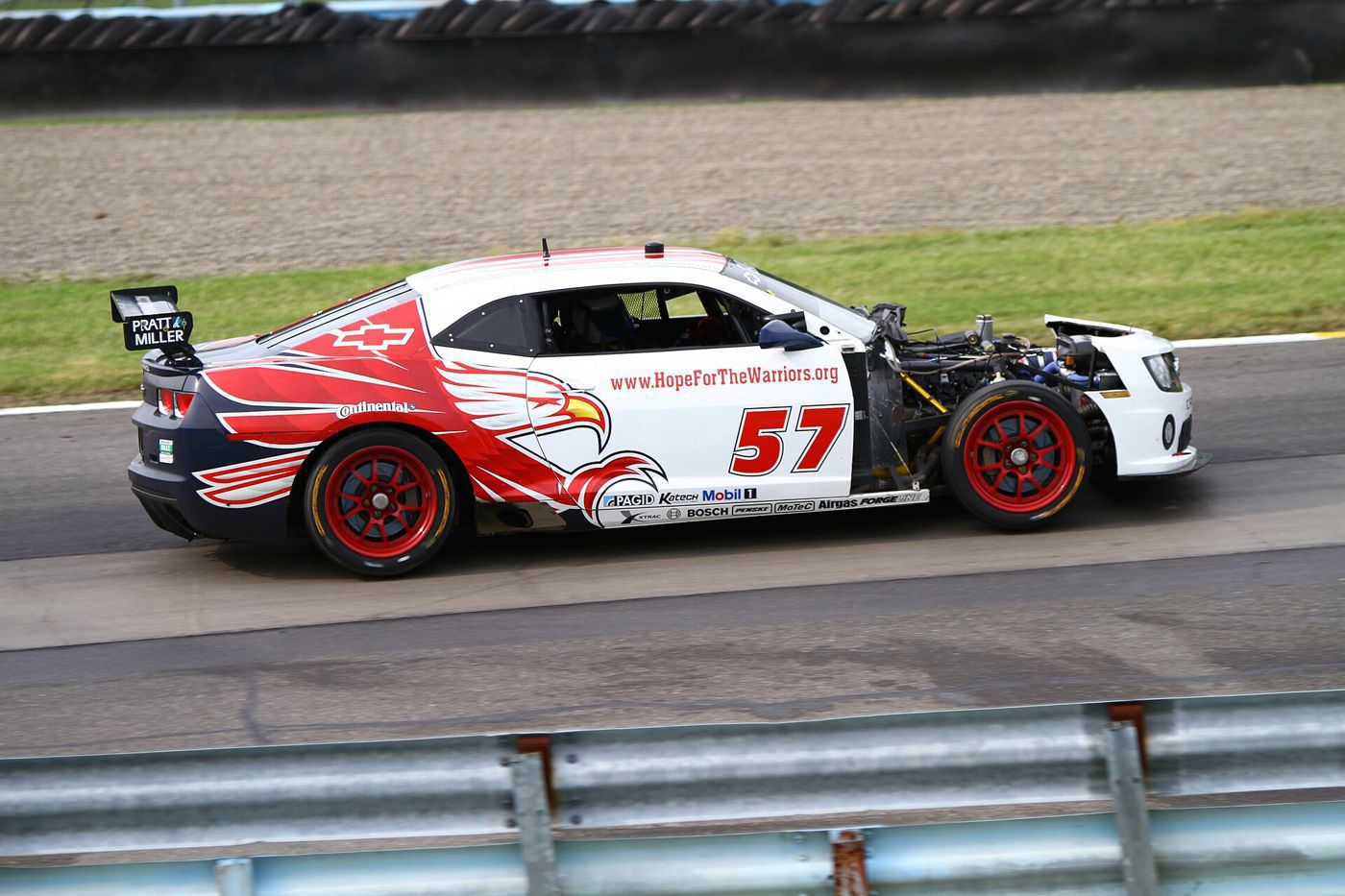
In December 2009, Stevenson Motorsports brought a new Camaro GT.R to a shakedown before the 2010 Rolex GT season. The team’s release identifies Pratt & Miller as builder and says knowledge from the Pontiac GXP.R informed the new car. That moment—new body identity, experienced builder, no completed season yet—captures the uncertainty of Camaro’s return to competition better than a retrospective trophy list.
John Stevenson appears as entrant and team leader; Andrew Davis and Robin Liddell appear in the driving program. Pratt & Miller supplied specialized construction and development work. Chevrolet and Grand-Am occupied manufacturer and rules relationships. These roles should not collapse into “Chevrolet built and raced it” or into one person creating the program. Each actor needs evidence appropriate to the work attributed.
The GT.R was not a Camaro SS modified by selecting enough dealer options. It was purpose-built for the Rolex GT rules environment. Its engine, chassis, gearbox, brakes, suspension, body allowances, aero, fuel system, safety structure, weight, and tires require homologation and technical records. The street SS’s LS3 manual or L99 automatic specifications do not cross that boundary.
The body name still mattered. Chevrolet had just restored Camaro to U.S. showrooms, and a visually related race car made the return public in another arena. The street page can link here to explain how the identity traveled. The race page can link back to show what buyers actually selected. Neither route uses resemblance as technical proof.
Knowledge carried from Pontiac GXP.R is another phrase that needs scope. The team release supports continuity of experience, but not a claim that the Camaro copied every component or setup. Personnel, data practices, fabrication knowledge, and program procedures can transfer without identical machinery. Homologation and builder records are needed before the page names specific inherited parts.
A shakedown is an opening because the purpose is to find what is not yet settled. Systems are checked, drivers and crew communicate, and the car produces its first integrated evidence. Exact laps, problems, changes, and conclusions remain held until test reports or attributed interviews provide them. The page will not invent the satisfying failure-and-fix sequence a reader might expect.
The intended 2010 season supplies direction without prewritten outcome. Entry lists, rulebooks, event reports, timing, and official classifications must establish each appearance and result. Team releases can explain goals and reactions. A later championship summary cannot safely be used to reconstruct the first test. Chronology lets the story develop from expectation into whatever the records show.
Camaro’s four street configurations stay visible in parallel. V6 manual and automatic carry 304 horsepower. SS manual carries the LS3 at 426, while SS automatic carries L99 at 400. Those distinctions show why even street “Camaro” is too broad a technical identity. The leap from any of them to a GT.R is larger still.
The preliminary-to-final rating change belongs to the showroom story, not the race car. Chevrolet projected one set of outputs before certification and published another in final literature. GT.R lap times or engine output cannot validate either set. Race measurement, factory street rating, and certification observation remain separate evidence classes even when marketing places them on adjacent pages.
Pratt & Miller’s role also creates a link toward Corvette racing history, but Corvette remains outside this catalog. A builder’s experience across programs does not make the Camaro a Corvette or authorize importing LS-family assumptions. Vette Facts may receive a contextual link only when a precise shared-engineering topic advances the reader and warns against interchangeability.
The human story will deepen when crew roles are documented. Mechanics, engineers, fabricators, data personnel, transport staff, and drivers converted the shakedown from motion into useful preparation. Naming only Stevenson, Davis, Liddell, or a famous builder would reproduce the lone-hero pattern this project avoids. Complete credits and interviews can distribute the work honestly.
Competition images are particularly tempting because the car’s visual identity does so much narrative work. Stevenson, Pratt & Miller, Grand-Am/IMSA, agencies, and individual photographers may hold different rights. Online display or distribution with a press release is not blanket commercial permission. A candidate must carry creator, source, exact date/test, car, driver where claimed, holder, terms, crop, and credit through owner review.
This page should feel like a story, not a documentary timeline, because the shakedown creates a genuine question: what happens when a newly returned showroom name enters a race program built from prior knowledge but not prior certainty? The answer unfolds through tests and a season. It does not require invented dialogue, camera directions, or a narrator promising triumph.
The race branch also protects comparison integrity. A reader can compare 2010 Mustang GT to Camaro SS, manual to automatic, or any 1967 configuration to any later one. Race-only GT.R never appears as a 23rd street row and never wins a horsepower chart with an inapplicable number. Its value lies in a different narrative and sporting context.
At publication, the shakedown scene is supported while detailed season claims remain an acquisition path. That is a legitimate full page: it names the car’s provenance, builder, entrant, drivers, intended series, inherited program knowledge, and strict boundary from the showroom. Future results can extend the arc without correcting fictional detail because none was added.
There is also a useful contrast with the Boss 302R. Ford described a race fleet feeding telemetry toward a later production engine; Stevenson described a new GT.R drawing on knowledge from a previous race program. Both are development stories, but their information flows and corporate relationships differ. The site should link them as parallel 2010 experiments rather than forcing them into a winner-and-loser race that the acquired sources do not support.
That parallel makes the human work easier to see. Engineers do not begin with a blank sheet merely because a body name changes, and they do not simply copy the prior car. They carry methods, lessons, tools, and questions forward, then encounter new rules and packaging. The shakedown is the moment inherited knowledge meets a machine that has not yet accumulated its own history.