Racing · Cadillac Racing · 2023
Cadillac Returns to Le Mans and Reaches the Podium
A manufacturer return measured by where the car finished rather than by what the announcement claimed.
Story reviewed July 27, 2026
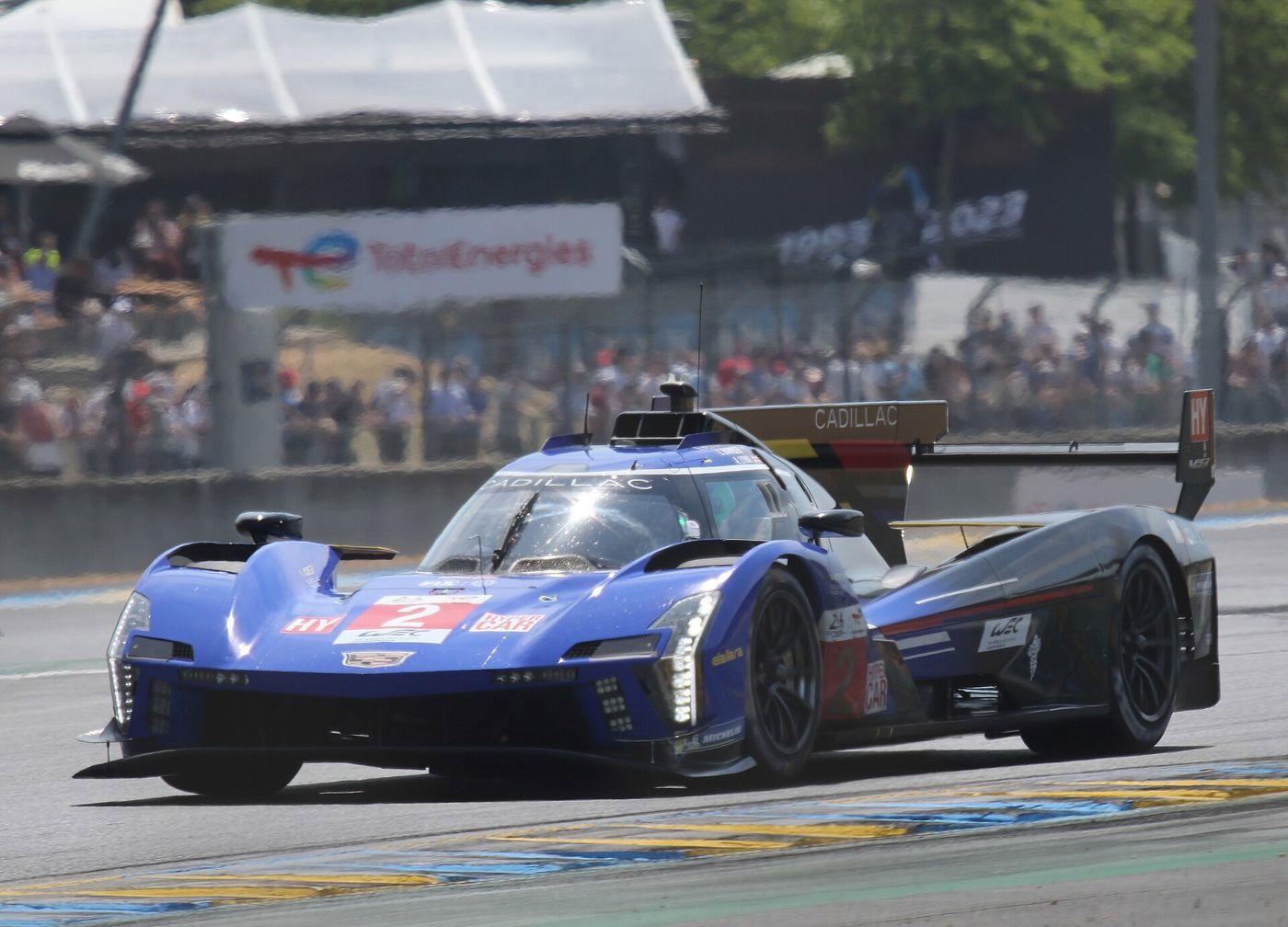
The No. 2 Cadillac V-Series.R finished third at Le Mans with Earl Bamber, Alex Lynn, and Richard Westbrook. Cadillac’s report gives the program’s perspective; the FIA classification establishes the decisive result. Driver names, team work, and podium belong to a race-only hybrid prototype, not to any CT4-V or CT5-V street configuration.
The distinction starts with architecture. V-Series.R used a 5.5-liter race engine and hybrid system under its competition rules. CT4-V used a turbocharged four-cylinder, CT4-V Blackwing a twin-turbo V6, CT5-V a twin-turbo V6, and CT5-V Blackwing a supercharged V8. Shared V branding and design language do not transfer parts, output, gearbox, weight, or energy system.
Cadillac’s eight street rows remain exact. CT4-V is offered with ten-speed and rear- or all-wheel drive at 325 horsepower, while its 2023 torque stays held for a same-year locator. CT4-V Blackwing carries 472 horsepower and 445 pound-feet with manual or automatic, rear drive, and electronic limited-slip.
CT5-V similarly splits rear- and all-wheel-drive ten-speed rows at 360 horsepower, with 2023 torque held. CT5-V Blackwing carries 668 horsepower and 659 pound-feet through six-speed manual or ten-speed automatic, rear drive and eLSD. Numeric final drives remain unknown until exact 2023 engineering or order evidence is archived.
Holding regular-V torque prevents a common form of model-year leakage. Cadillac’s 2024 continuation cards may print 380 and 405 pound-feet, but later-year evidence does not automatically populate 2023. The engine and trim names match; the observation date does not. Unknown values stay absent rather than copied.
The podium story includes more than three drivers. Pit crew, engineers, strategists, program leadership, Cadillac Racing, chassis and powertrain partners, suppliers, and officials made the result possible. Each role needs team and institutional documentation. The page avoids attributing a pit decision or component to someone merely because they held a visible leadership title.
Le Mans supplies a long arc without requiring a result dump. Qualifying position, incidents, repairs, pit work, pace, and class context should enter when official timing, classification, team records, and attributed interviews show why they mattered. The third-place result is settled; the narrative sequence needs event evidence at the same standard.
The FIA classification and Cadillac report answer different questions. FIA establishes official finishing order and status. Cadillac explains program meaning and participant perspective. Neither alone supplies every technical detail. Keeping sources in their roles prevents corporate enthusiasm from replacing sanctioning evidence or a bare classification from becoming a human story.
The V-Series.R name deliberately connected racing and road identity. That connection can be told as design, brand, and engineering culture while the data stays separate. A reader may follow the race page back to Blackwing configurations, but no race horsepower or hybrid capability appears in the street selector.
The same venue hosted Garage 56 Camaro, creating a broader American-brand Le Mans moment. The programs used different rules, classes, organizations, and goals. Linking the pages is useful; ranking them through one result is not. Camaro’s experimental entry and Cadillac’s podium each need their own classification and technical context.
Corvette also belongs at Le Mans but remains outside this catalog. A link to Vette Facts’ 2023 C8 page can explain Chevrolet sports-car context without importing Corvette data or implying that all GM race programs shared parts. Exact routes replace generic family navigation.
Images from Cadillac Racing, FIA WEC, ACO, Chip Ganassi Racing, Action Express, agencies, or photographers carry separate rights. Race accreditation is not a reuse license. Candidate selection needs exact car, session, driver where claimed, creator, holder, commercial terms, crop, and credit, all outside Git until owner approval.
The podium can feel immediate through attributed participant accounts rather than invented cockpit sensation. Brief licensed quotations may capture exhaustion or satisfaction; paraphrase carries the rest. The page never claims access to what Bamber, Lynn, Westbrook, or crew thought without a source.
The street comparison then gains context rather than racing prestige pasted onto it. Manual CT5-V Blackwing versus automatic, CT4-V AWD versus RWD, or Cadillac versus Hellcat are choices of road configuration. V-Series.R is a story about what Cadillac built for another rulebook. Both can strengthen V identity without becoming the same car.
Cadillac’s return matters because the program reached an official podium in a centenary Le Mans context while a wide V-Series street range existed. Evidence keeps that achievement sharp: FIA result, Cadillac narrative, named roles, held street fields, and a firm race/street boundary. The podium is impressive enough without borrowing 668 horsepower from a Blackwing.
Hybrid-system detail requires particular caution. Energy storage, deployment, recuperation, control, and rules limits belong to homologation and series technical records, not broad marketing analogy. Calling V-Series.R hybrid does not authorize a component diagram from another LMDh car, and it does not make any 2023 Cadillac street selector electrified.
Action Express and Chip Ganassi program relationships also need car-specific treatment. The No. 2 result cannot be assigned to every Cadillac entrant, and work performed by one organization cannot be credited to another. Entry lists, crew rosters, team reports, and classification identifiers keep participants connected to the correct chassis and result.
Future revisions can compare Cadillac’s podium with earlier Le Mans programs only after rules eras, classes, distances, and result conventions are clear. A third place in 2023 is not numerically interchangeable with a class result from another decade. Historical connection should illuminate persistence and change rather than manufacture an all-time ranking.
The podium photograph itself may show several rights-bearing layers: car livery and trademarks, event environment, drivers, team members, and the photographer’s composition. Editorial relevance does not erase copyright. The licensing queue must identify the precise frame and intended crop, especially if a caption names people or implies it was taken after the classified finish.
That rights discipline mirrors the technical one. A familiar V badge, a dramatic podium, or a manufacturer gallery can invite assumptions. The page pauses at each boundary, records what is known, and lets the official result carry the achievement. Cadillac returned, completed the race, and placed third; the evidence does not need borrowed street specifications or borrowed imagery.