Racing · NASCAR, Chevrolet, Hendrick Motorsports · 2023
Camaro Goes to Le Mans Before Chevrolet Announces the Ending
An invitational entry with nothing to win, sent to Le Mans while the road car's ending was still unannounced.
Story reviewed July 27, 2026
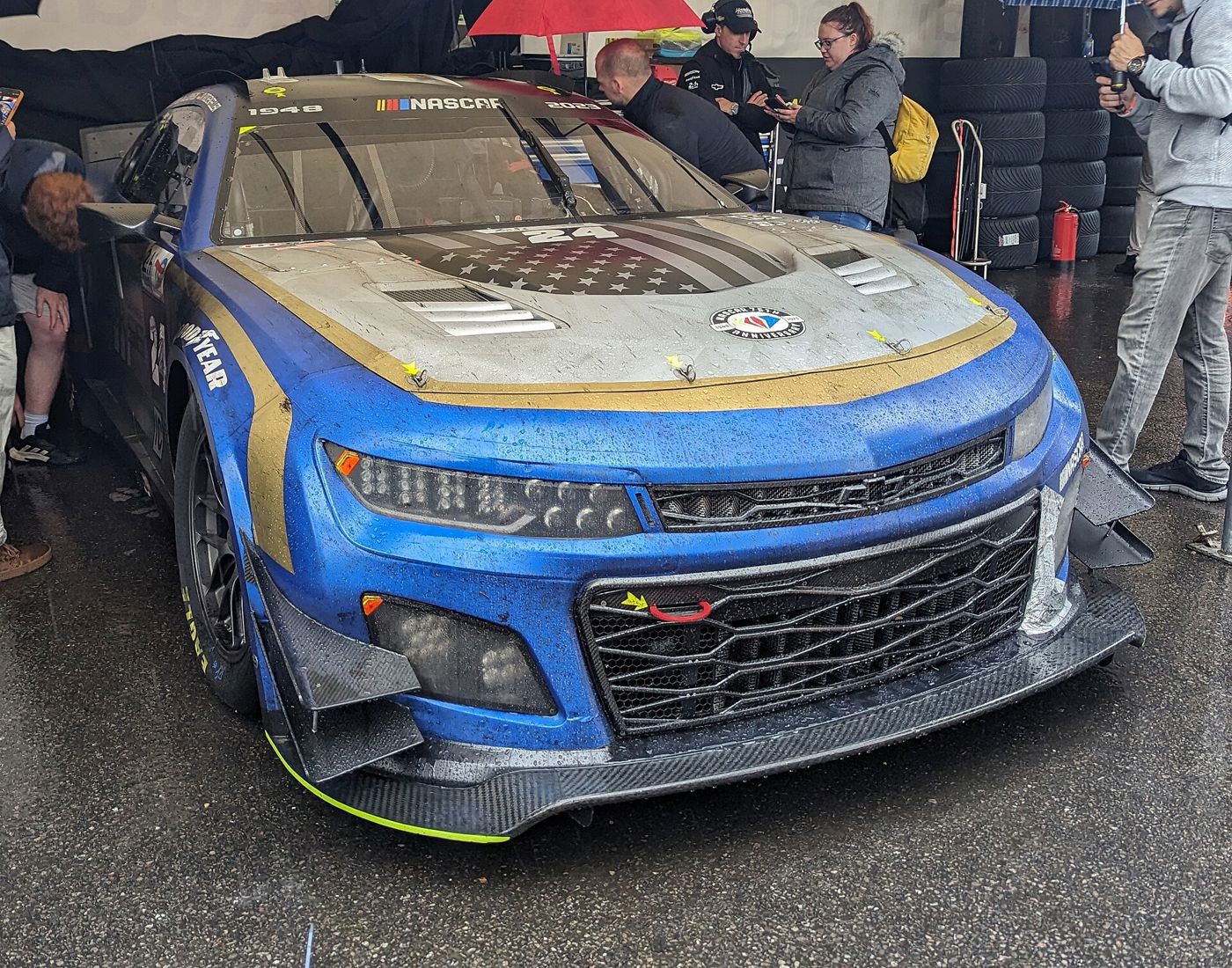
After twenty-four hours at Le Mans, Jimmie Johnson brought the Garage 56 Camaro to its final laps with a Hendrick Motorsports, NASCAR, Chevrolet, and Goodyear program gathered around the result. NASCAR’s completion report supplies the people and outcome; it does not turn the car into a street ZL1. The machine belonged to an experimental race entry built for a particular international stage.
That distinction is essential because the body identity looked deliberately familiar. A 2023 ZL1 street coupe used a supercharged LT4 at 650 horsepower and 650 pound-feet, with six-speed manual or ten-speed automatic choices. Garage 56 used its own race architecture, engine, gearbox, aero, weight, brakes, tires, fuel, safety, and rules relationship. No street number crosses the boundary.
The race story also arrived in the calendar year Chevrolet announced that sixth-generation Camaro production would conclude after model year 2024. That makes 2023 a year of announcement, not the final Camaro model year. The selector contains 2023 configurations, while the ending belongs to the next model-year chapter.
Eight coupe baselines describe the street range. Turbo four manual and eight-speed rows carry 275 horsepower and 295 pound-feet with 3.27. V6 manual and ten-speed rows carry 335 and 284 with 3.27 versus 2.77. LT1/SS manual and automatic carry 455/455 with 3.73 versus 2.77 baseline. ZL1 manual uses 3.73 and automatic coupe uses 2.85.
Convertible expansion remains held because body can change applicability and axle; ZL1 automatic convertible uses 2.77 rather than the coupe’s 2.85. “Camaro ZL1 automatic” is therefore not complete without body. The comparison starts with coupe baselines and refuses to clone them into convertibles.
Garage 56 was a collaboration whose roles must remain visible. Johnson, fellow drivers, crew, Hendrick personnel, NASCAR, Chevrolet, Goodyear, ACO, suppliers, and organizers contributed different work. A sanctioning invitation, manufacturer support, entrant preparation, tire program, and driver stint are not interchangeable authorship.
The full story should use official classification and team records for laps, position, stops, repairs, and finish context. NASCAR’s narrative can establish significance and participant recollection. A social-media highlight cannot reconstruct the event. The page follows decisive problems and recoveries only when timing, technical, and attributed records support them.
The Le Mans setting does not make Camaro a Corvette. Chevrolet sports-car history may intersect through the venue and personnel, but Corvette stays link-only to Vette Facts’ 2023 C8 page. A contextual link should explain the difference among Camaro street, Garage 56 experiment, and Corvette program rather than imply shared parts.
Camaro Facts is the more direct sibling path. Camaro Facts’ 2023 page can link here for Garage 56 and to the exact comparison for street choices. This page returns to the model-specific year without a generic family footer. The sibling is navigation, not evidence.
The ending announcement requires precise tense. Chevrolet said the generation would conclude after 2024 and avoided claiming the name could never return. This page does not write an absolute obituary in 2023. It tells how a generation approached its scheduled ending while its silhouette completed a highly public Le Mans experiment.
That contrast gives the story shape. In one arena the coupe name stretched beyond normal category rules; in another, customers still chose turbo, V6, V8, and supercharged street configurations. The race car showed cultural reach at the moment the production generation’s horizon became visible. Neither fact needs to absorb the other.
Race results remain separate observation types. A Le Mans classification does not prove factory engine output, and a manufacturer performance claim does not replace FIA or ACO records. Period independent tests and modern owner measurements stay separate again. The publication can connect them narratively while the data retains provenance.
Photographs from Le Mans involve NASCAR, Hendrick, Chevrolet, Goodyear, ACO, agencies, and original photographers. Race accreditation or press-gallery display does not grant reuse. Exact car, driver where claimed, session, creator, holder, commercial license, crop, and credit must pass private owner review before an image enters the page.
The people story should feel lived without inventing radio dialogue or private emotion. Attributed post-race words can carry exhaustion and achievement within quotation limits. Timing and repair records can carry the mechanical arc. The page does not need a documentary narrator telling viewers what every crew member felt after twenty-four hours.
Garage 56 completed its mission as a race-only Camaro while Chevrolet prepared to close sixth-generation production one model year later. That dual ending is the point. The 2023 street selector remains exact, the Le Mans car remains separate, and the announcement remains about 2024—not a convenient but false final-year label.
The experimental entry’s class status must remain visible in any result language. Completing the event, running among classified competitors, and winning a conventional class are different claims. Official classification and invitation terms control the wording. The cultural success described by participants can coexist with a result that does not fit an ordinary class leaderboard.
Development work also deserves its own chain. NASCAR knowledge, Hendrick preparation, Chevrolet design and powertrain support, Goodyear tire work, suppliers, simulation, pit practice, and driver feedback met in one program. A famous driver did not single-handedly create the car, and a manufacturer badge does not describe who fabricated or operated each system.
The street ending will need its own final-production records when model year 2024 is documented. Announced conclusion, final order, final assembly, and final delivery are distinct milestones. This 2023 page stops at the announcement rather than borrowing a later final VIN or making every remaining coupe into a commemorative last car.
Garage 56’s experimental status also changes how technical freedom is described. Rule waivers, invitation conditions, and safety requirements must come from ACO/NASCAR documentation rather than the vague claim that the team could do anything. The project was exceptional within an organized event, not outside evidence or regulation.
That distinction protects both the achievement and the event’s rules.