Racing · Team Penske · Chevrolet · 1967–1969
Penske, Donohue, and the Camaro: Building a Manufacturer’s Champion
A small organization, a new pony car, and the careful accumulation of decisions that produced two manufacturers’ championships.
Story reviewed July 27, 2026
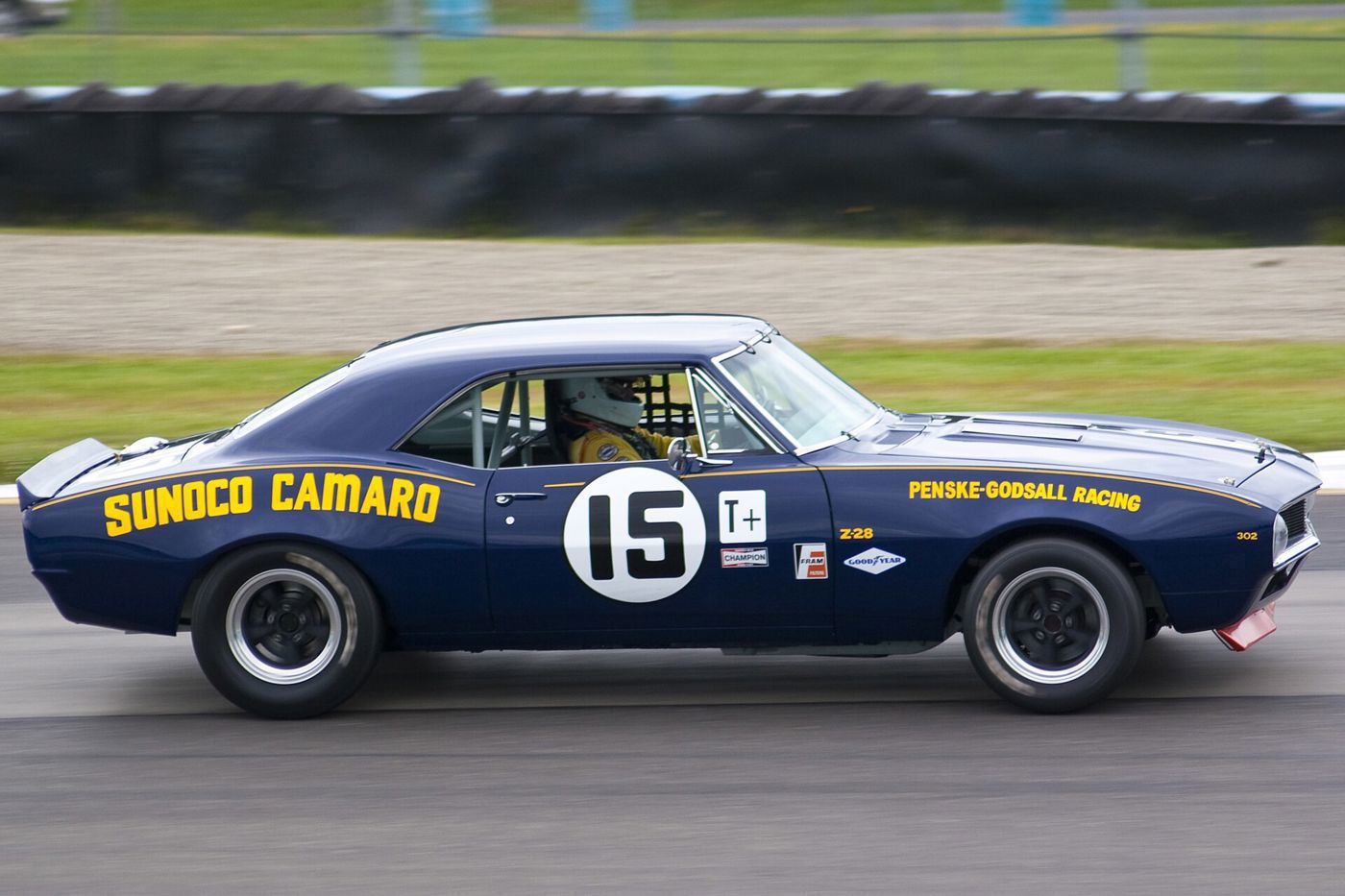
Woody Woodard remembered the scale before the trophies made it look inevitable. In Team Penske’s retrospective, the future crewman recalled seeing Mark Donohue win at Marlboro Park in 1967 and later visiting the organization’s small shop, where Donohue answered the door. The memory is told as Woodard remembered it—without invented weather, dialogue, or private thoughts—but it gives the program a human size. The operation that would become synonymous with methodical preparation was still close enough to its beginning that a driver could be the person greeting a visitor.
The dated turning point came on August 13, 1967. Donohue’s Marlboro Park victory was Team Penske’s first in Trans-Am, and the official series history credits him with three wins during the season. Three victories did not yet make Chevrolet the champion, but they established that the Camaro program could do more than participate. The new car had arrived in showrooms only months before, and its competition identity was being created while the road-car identity was still new. Racing did not simply advertise a finished legend; it helped determine what kind of Camaro enthusiasts believed they were seeing.
The Z/28 was central to that relationship, but the cleanest popular version of its homologation story remains on hold. Chevrolet’s period records prove a 302-powered coupe package with a four-speed, special suspension, cooling, steering, brakes, wheels, axle, and stripes. They do not, in the artifacts located here, prove the repeated claim that SCCA demanded 1,000 Z/28s and casually accepted only 602. The available FIA homologation form concerns a different-displacement Camaro record. The racing page can explain that the 302 existed for the five-liter contest without pretending the exact exception mechanism has been found. CamaroFacts’ racing history carries the Camaro-specific Z/28 and later competition chronology.
Penske and Donohue’s 1968 season transformed the promising beginning into control of the series. Official Trans Am histories count ten Donohue wins, including the Sebring class victory shared with Craig Fisher. The co-drive matters because it exposes a real discrepancy instead of smoothing it away. Camaro Research Group summarizes nine Penske Z/28 wins for 1968 but does not define whether its scope excludes the shared result, counts a particular car, or uses another basis. This page leads with the official series total, names Fisher, and preserves the specialist figure as an unresolved accounting difference.
The word “champion” needs the same care. SCCA’s own history explains that the original Trans-American Sedan Championship awarded manufacturer points; an official drivers’ championship did not begin until 1972. Chevrolet was therefore the contemporary manufacturers’ champion in 1968 and again in 1969. Donohue’s driver titles for those seasons are retrospective assignments created by later series history. Calling him simply the 1968 and 1969 drivers’ champion projects a later scoring idea backward. Calling Chevrolet the manufacturer winner while acknowledging Donohue’s retrospective recognition tells readers how the contest actually worked.
Donohue added six wins in 1969, and Chevrolet retained the manufacturers’ crown. Team Penske had expanded the Camaro effort to two cars, evidence of how far the small-shop program had moved in two seasons. Yet the point of the story is not a column of nineteen wins across 1967–1969. It is the development of an organization and a car together: three breakthrough victories, a dominant middle season, then a second title defended under growing expectations. Each season changes the stakes, which is why the results belong inside an arc rather than in an undifferentiated list.
The counting discrepancy is a useful reminder that even race results need an identity model. A win may attach to a driver, a co-driver pairing, an entrant, a manufacturer, or a particular chassis, and summaries do not always say which they count. Sebring makes that ambiguity visible because Fisher shared the class result. Rather than hiding the specialist total or averaging nine and ten into nonsense, the claim ledger keeps both, identifies the official series interpretation as leading, and records what evidence would reconcile them: a race-by-race audit with entrant, car, driver, and co-driver scope.
The championship distinction changes the emotional shape of the story too. Penske and Donohue were essential to Chevrolet’s titles, but the trophy belonged to the manufacturer under the contemporary rules. Later recognition of Donohue as the notional leading driver honors his season without altering what competitors were scoring at the time. This is more than terminology. It restores the contest that teams actually entered and prevents a modern reader from imagining a drivers’ points chase that did not yet exist.
One famous preparation story can now enter with its evidence class visible. Car and Driver’s 1994 retrospective reports that Penske and Donohue campaigned a 1967 Camaro whose removable or body sheet metal had been acid-dipped and which became known as the Lightweight. The account also carries Donohue’s later memory of how the car moved through inspection. That makes the core story publishable as retrospective history, not as a reconstructed 1967 technical ruling.
The boundary around that core remains important. Exact weight before and after dipping, which panels or portions of the shell were treated, the Lockheed work order, SCCA’s precise response, number-switch details, and a final rules judgment still require the applicable rulebook and period inspection records. Exact pit-stop timing, the complete service sequence, and comparisons with Ford likewise remain held until a specific edition and page of Donohue and Paul Van Valkenburgh’s The Unfair Advantage or a period timing record is inspected. The book title can be named; a claimed period team nickname is not projected backward without contemporary evidence.
The Camaro chapter ended with a move that makes the rivalry larger than Chevrolet versus Ford. Team Penske switched its Trans-Am effort to AMC Javelin for 1970. The same preparation culture and lead driver that had made Camaro formidable now served another manufacturer trying to prove its pony car. This was not an epilogue detached from the Chevrolet years. It was a consequence of them. Penske and Donohue had demonstrated the value of a disciplined factory-supported sedan program, and AMC wanted that capability applied to Javelin. For the team’s earlier Corvette chapter, VetteFacts’ Penske and Dick Guldstrand story follows the road that led into this Trans-Am program.
The three-year Camaro story therefore closes without pretending the people or methods stopped. Marlboro Park gave the young organization its first Trans-Am win. The 1968 and 1969 seasons delivered Chevrolet the championships the rules actually awarded. Donohue became the central driver of the era, later recognized with retrospective titles, while Craig Fisher’s Sebring contribution reminds us that even the cleanest summary can conceal another participant. Then the program crossed to AMC, carrying its knowledge into the next American muscle story. The real “advantage” visible in the inspected record is not a colorful trick; it is the accumulation of decisions, people, and preparation across seasons.