Stories · 2015 · cross-marque
Flat Rock Builds a Global Mustang
Flat Rock builds a Mustang for markets that had never officially had one, and independent rear suspension stops being the argument it had been for decades.
Story reviewed July 27, 2026
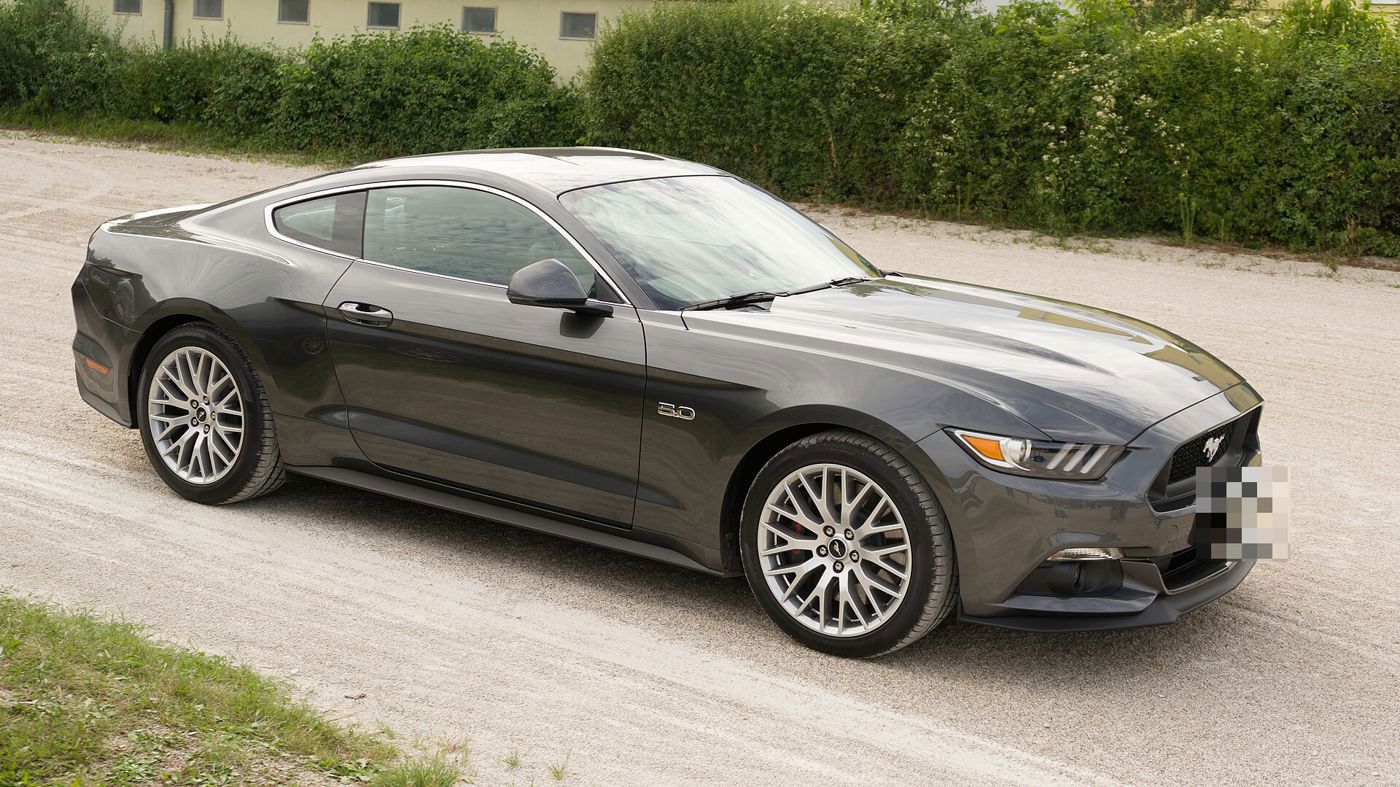
The 2015 Mustang moved down the Flat Rock line as a car Ford intended to sell more broadly than any previous generation. Ford’s production material framed the S550 as a global program, while the engineering package brought independent rear suspension and a turbocharged four-cylinder into the main U.S. comparison. The scene is not a lone designer unveiling a shape. It is a plant, supply chain, engineering organization, and launch system changing what Mustang could mean.
The base comparison contains six exact configurations before the Shelby story begins. V6 manual and automatic share 300 horsepower and 280 pound-feet with a 3.15 axle. EcoBoost manual and automatic share a premium-fuel figure of 310 horsepower and 320 pound-feet, but the manual maps to 3.31 and the automatic to 3.15. GT manual and automatic share a premium-fuel 435 and 400, again with 3.31 versus 3.15.
Those rows demonstrate why transmission cannot be treated as a cosmetic filter. Output may remain shared while axle mapping changes, and a later period test will reflect the complete car rather than a free-floating engine number. The selector keeps gearbox, axle, fuel note, body, and rating attached. It does not describe every EcoBoost or GT by the equipment of the quickest test car someone remembers.
Independent rear suspension deserves similar precision. It changed the production architecture, but it did not make every suspension package identical or guarantee one handling result. Spring, damper, bushing, wheel, tire, brake, alignment, and package evidence belong to their exact configurations. Ford’s global design choice provides the story; a complete technical matrix must provide any component claim.
Flat Rock’s workers and production leaders belong in the narrative once plant records identify them. A corporate release can establish launch, market intent, and manufacturing location without establishing what a particular worker felt or performed. Plant newspapers, union records, process documentation, and oral history can turn “Flat Rock built it” into a human account without inventing anonymous line dialogue.
Global sale also complicates “American muscle” productively. Mustang remained an American-brand performance car assembled in Michigan, but homologation, market equipment, right-hand-drive engineering, suppliers, and customers crossed borders. A U.S. comparison keeps its market explicit. A foreign-market rating or package can become another observation later; it cannot silently populate the U.S. row because the name and model year match.
The final 2015 chapter arrived through Shelby GT350 and GT350R. Ford published 526 horsepower at 7,500 rpm and 429 pound-feet at 4,750 for the 5.2-liter flat-plane-crank V-8, with a TR-3160 six-speed. The very limited model-year run was 100 GT350 cars plus 37 GT350Rs. That means 137 in total, not 100 with 37 hidden inside it.
The detailed technical sheet available in this pass is labeled 2016, so its numeric final drive is held for the 2015 rows. The engine and transmission are supported by Ford’s 2015 announcement; the axle needs a model-year-correct artifact. A later sheet can be a useful acquisition lead without being backdated. Unknown remains unknown rather than a number copied from the nearest year.
GT350 and GT350R share the supported power team while remaining distinct configuration identities. The R package changed the car’s purpose and equipment, and production accounting names it separately. A full component delta requires Ford order and technical records. The selector does not infer every R feature from memory, yet it also does not collapse 37 R cars into the ordinary GT350 row.
The anniversary context is real but should not become a claim that every 2015 Mustang was a commemorative special. Ford tied the limited Shelby production to Mustang’s history. Ordinary V6, EcoBoost, and GT buyers encountered the new global generation on their own terms. Anniversary storytelling belongs where the artifact establishes it, not as a badge pasted across the entire model year.
Camaro remained on its fifth-generation architecture for one final model-year argument, offering SS, ZL1, and Z/28 choices alongside V6. Challenger and Charger expanded through Scat Pack and Hellcat. The S550 therefore entered a mature, varied performance field. Comparing only GT to SS would miss EcoBoost, transmissions, sedans, packages, and the new top-end Shelby pair.
The contextual link to Mustang Facts’ 2015 page lets readers move into model-specific detail and return to the cross-marque comparison. It belongs in this exact story, not in a generic family footer. Reciprocal editing must wait for a clean sibling worktree and its own tests because the current Mustang repository contains unrelated owner changes.
Images of Flat Rock production or the first global cars require creator and rights evidence. Ford media availability is not blanket commercial permission. A production image must be dated and captioned accurately, especially if the story claims a particular trim or launch moment. Review derivatives remain outside Git with holder, license, credit, crop, and visible-worker privacy recorded.
The deepest change in 2015 was not one horsepower figure. It was Mustang becoming a broader technical and geographic proposition without abandoning exact choices. A buyer could select V6, turbo four, or V-8, manual or automatic, then encounter a flat-plane Shelby at the model year’s edge. The database preserves those choices while the story follows the plant and engineering system that made them possible.
Flat Rock’s global S550 and the tiny GT350 run finally belong in one arc because they show scale moving in opposite directions. Ford launched a broadly exportable generation, then closed the year with 137 highly specific Shelby configurations. Both are true. Neither turns every Mustang into the other, and both become more meaningful when production, model year, package, and evidence remain exact.
Production quantity and configuration quantity must stay separate. The 137-car Shelby announcement does not reveal every color, option, destination, or completion sequence, while the six mainstream selector rows do not imply equal build volume. Final accounting can later add carefully scoped totals, but planned figures, registry survivors, and auction claims cannot manufacture a breakdown.
That separation keeps rarity from replacing history.