Stories · 2023 · cross-marque
A Helicopter Lowers Demon 170 into Las Vegas
A helicopter lowered the Demon 170 into Las Vegas, which tells you most of what you need to know about how the era chose to end.
Story reviewed July 27, 2026
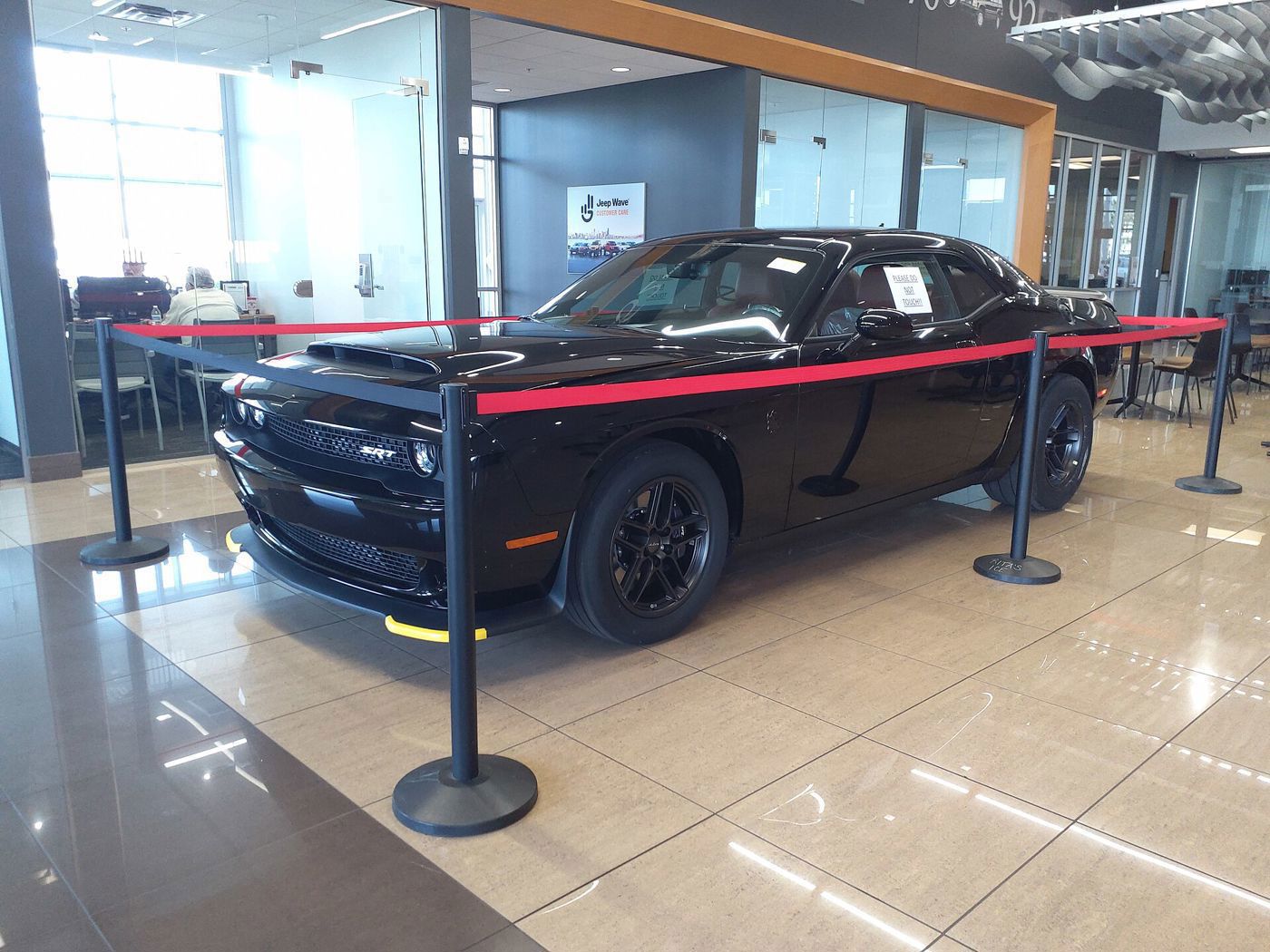
On March 20, 2023, a helicopter lowered the Challenger SRT Demon 170 into its Las Vegas reveal. Dodge already had a dramatic final-year story; the aircraft made the arrival literal. Tim Kuniskis’s documented remarks can frame the program’s ambition, while engineers, suppliers, test teams, and assembly workers need their own sourced roles rather than invented backstage dialogue.
The headline rating was inseparable from fuel: 1,025 horsepower and 945 pound-feet on E85, 900 horsepower and 810 pound-feet on E10. Those are two factory observations of one configuration, not two cars and not one unconditional 1,025-horsepower row. The comparison displays the E85 rating with an alternate E10 rating and labels both.
Ethanol sensing made that distinction operational. The car had to determine fuel composition and select an appropriate calibration state. A tank containing some ethanol does not automatically guarantee the published E85 observation, and owner mixtures or modified software cannot establish factory behavior. Dodge technical material controls the conditions described.
The program combined a 3.0-liter supercharger, strengthened driveline, TransBrake 2.0, drag-oriented tires, and other documented changes. Each component claim stays within the release’s scope. A shared Hellcat engine family does not make Demon 170 simply a Redeye with a different number, and a surviving modified car does not reveal every delivered part.
The eight-speed automatic is part of the exact configuration. A manual row is not invented because Challenger Hellcat offered one elsewhere. Numeric final drive remains held pending a Demon-specific engineering sheet. The release can publish engine, fuel states, and transmission while leaving one unresolved field unknown rather than borrowing Super Stock gearing.
Dodge’s NHRA-certified 8.91-second elapsed time at 151.17 mph is a separate manufacturer/regulatory performance observation. It does not become engine output. Surface, preparation, rollout, weather, fuel, tires, driver, vehicle state, and certification procedure belong with the result. The story can report the achievement without using it to calculate “real horsepower.”
Production language needs equal care. Dodge announced at most 3,300 cars, with 3,000 for the United States and 300 for Canada, subject to capacity. “At most” and market allocation are not final build accounting. No owner should be told a car is “one of 3,000” without final records and car-specific provenance.
Demon 170 sat atop a thirteen-row Challenger baseline. SXT and GT offered rear- or all-wheel-drive V6 choices. R/T manual and automatic carried different ratings. Scat Pack split manual and automatic. Hellcat, Redeye, and Super Stock each preserved their own output, gearbox, and axle. Final-year branding did not make the range one configuration.
The familiar “Last Call” phrase also needs scope. It marked the end of Challenger and Charger in their current HEMI-powered forms. It did not promise Dodge would never use Charger again or never build another performance car. Future electric or multi-energy Charger specifications remain outside 2023 and cannot be treated as Demon aftermath data.
Other Last Call specials remain specialty branches unless exact mechanical and order evidence makes them distinct selectors. Shakedown, Super Bee, Swinger, King Daytona, and Black Ghost may have announced production plans or appearance identity. Those do not automatically create new powertrain rows or final totals. Charger Jailbreak 807 remains held for the same order-code reason.
The helicopter scene should not consume the engineering story. Reveal production staff, event partners, Las Vegas Motor Speedway, and photographers made the spectacle. Powertrain, calibration, driveline, tire, chassis, safety, and manufacturing teams made the car. A good page moves from the aircraft to the work rather than treating spectacle as proof.
Rights follow those layers. Dodge/Stellantis may control press material, an event company may control staging, the speedway may control venue rights, and a photographer controls the image. Press-gallery presence is not permission. Review copies stay outside Git with creator, holder, exact moment, license, crop, credit, and commercial terms.
Fuel-dependent ratings also set a precedent for comparison. If a car’s factory output changes with fuel, the interface must show the basis rather than select the maximum silently. The same rule applies to premium-fuel figures, key modes, overboost, and later electric peak-duration claims. Demon 170 makes the evidence contract visible.
The story can include disagreement when credible sources conflict, but forum dyno claims and auction descriptions do not become disputes by repetition. Factory E85/E10 ratings lead; independent tests can join as exact measured observations with configuration and method. Modified-car results remain modified-car results.
Demon 170’s reveal was designed as a climax, and the verified facts sustain that feeling. A car descended from a helicopter, carried four-digit advertised output on one fuel, retained a lower but still extraordinary rating on another, and ended a current-form Challenger era. Precision does not diminish the spectacle; it explains what the spectacle actually promised.
E85 itself is not a universal substance with one composition in every pump and season. The factory’s fuel-basis language and sensing strategy therefore belong close to the ratings. A reader should not interpret the alternate figures as a guaranteed switch at any arbitrary ethanol percentage. Exact threshold and control behavior wait for engineering documentation.
The car-specific ordering path also needs preservation. Allocation, dealer process, customer acknowledgement, options, and final build status can affect provenance without changing the baseline engine observation. Window stickers, invoices, and build records may authenticate an individual car, but private owner data and identifying numbers require review before publication.
Finally, Demon’s drag claim should not turn the entire 2023 comparison into a quarter-mile ranking. Mustang, Camaro, Cadillac sedans, 300C, Challenger, and Charger served different bodies and missions. Users remain free to compare them, while the interface exposes whether a figure is engine output, factory performance, sanctioning observation, or independent test.
That distinction also keeps the story open to later evidence. A complete engineering sheet can settle final drive; final accounting can replace the planned ceiling; exact tests can join with fuel and conditions. New evidence will extend the record without forcing a rewrite of an unconditional 1,025-horsepower claim, because the fuel basis was visible from the beginning.