1956 · Chrysler · United States
1956 Chrysler 300B: One Horsepower per Cubic Inch, and a Team the Crowds Booed
The second 300 grew the Hemi to 354 cu in and offered a 355 hp version, which the club calls the first American engine at one horsepower per cubic inch; 1,102 hardtops.
United States · researched through 2026-09-22
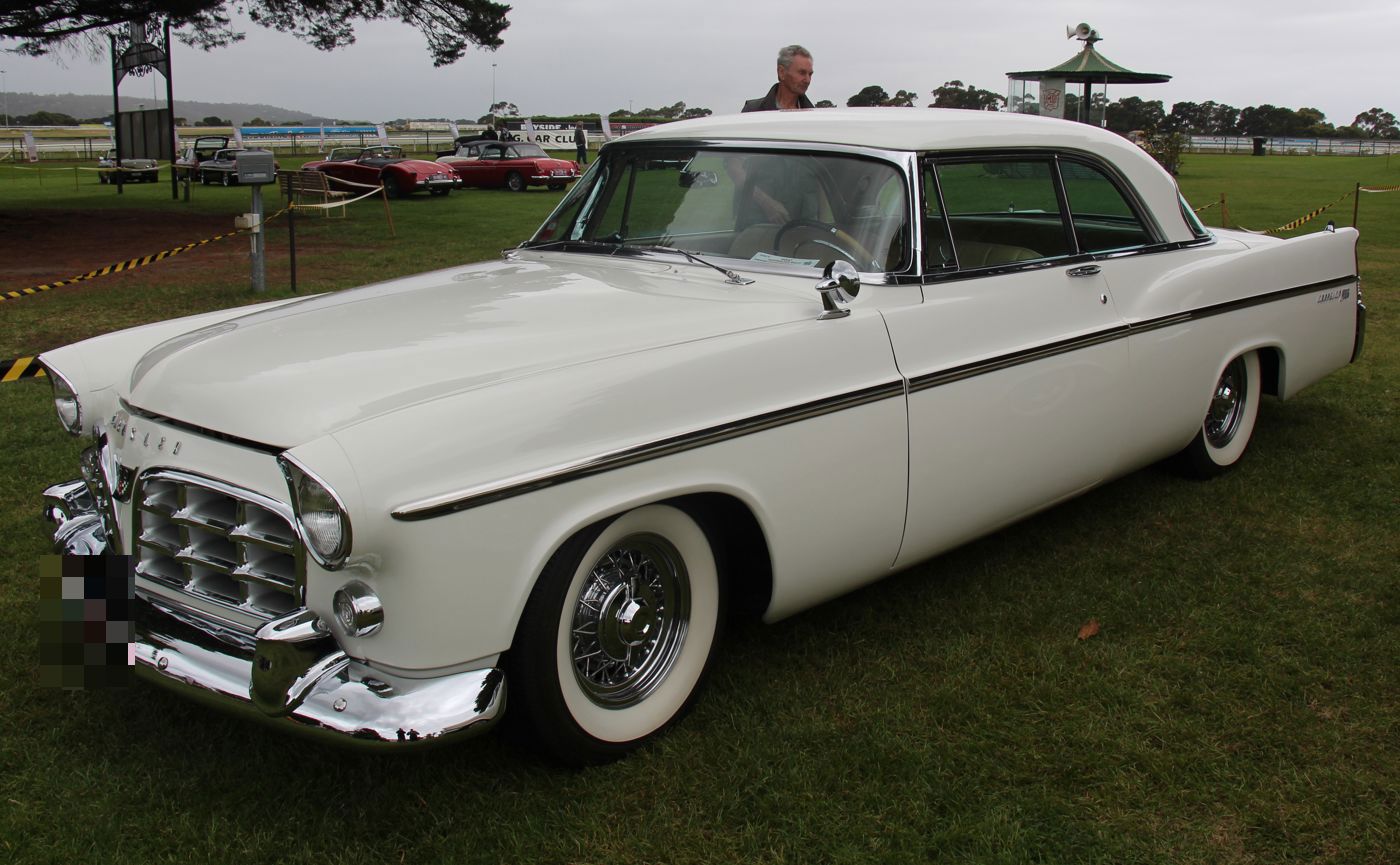
Tim Flock started 1956 on the sand. At the Daytona Speed Weeks, Ate Up With Motor records, he drove one of Carl Kiekhaefer's 300Bs to a new flying-mile record at a two-way average of 139.549 mph and then won the Daytona Beach Grand National. The Chrysler 300 Club's figure for the same record is 139.373 mph; neither source shows its timing sheet, so both numbers stay attached to their sources. By the end of the year Flock was gone from the team, the team had won the championship anyway, and its owner was on his way out of NASCAR.1,2
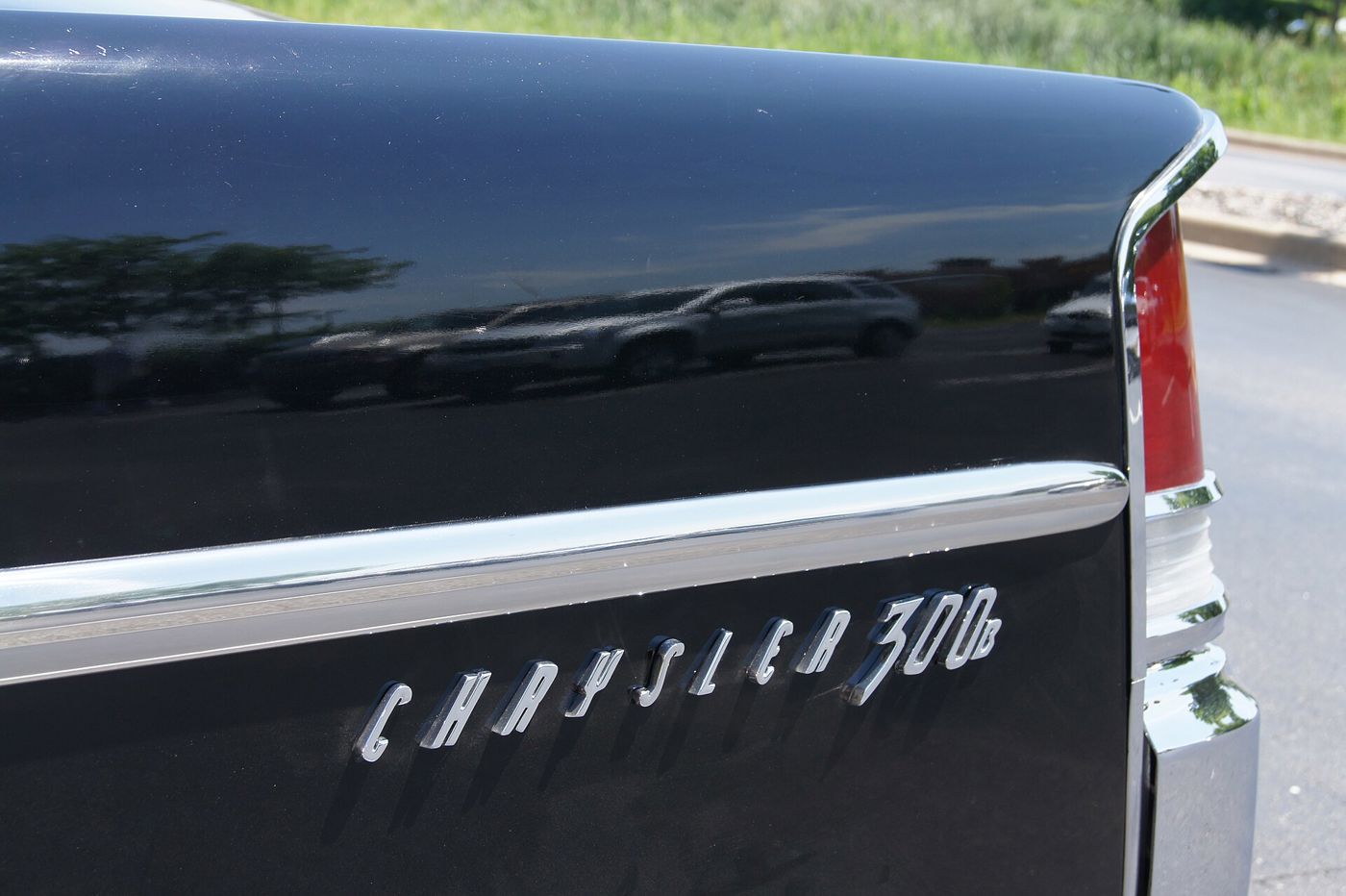
The car Flock drove was the second letter car, and the club says the 300B began the sequential lettering that every later 300 followed. It was a hardtop only, series C72-300, technically a sub-series of the New Yorker. Over-Drive says styling changes were essentially limited to the fins and taillamps, and the club notes Exner's new, taller fins as the way to tell it from the 1955 car. At 222.7 inches by the club's measure, or 221.0 by Over-Drive's, it was the longest letter car of the 1955-1965 run, as the club counts them.3,4,2
The engine carried the year's headline. The Hemi was bored to 354 cubic inches on a 3.94-inch bore and 3.63-inch stroke, still with two Carter four-barrels, and Over-Drive lists it at 340 horsepower at 5,200 rpm and 385 lb-ft at 3,200 rpm on 9.0:1 compression. An optional version on 10.0:1 compression was rated at 355 horsepower and 405 lb-ft; Ate Up With Motor dates it to mid-summer. That second engine is the source of the 300B's best-known claim: the club calls it the first American car to make one horsepower per cubic inch, a year before Chevrolet's 283-horsepower 283. Both ratings are manufacturer-published, basis not stated.4,1,2,3
The transmission list shows a company changing its mind during the year. The two-speed PowerFlite was standard, worked by push buttons mounted to the left of the dash. A three-speed manual could be special-ordered. Late in the run came the new A-488 TorqueFlite, which Ate Up With Motor credits with a 2.45 low and 1.45 second gear and considerably better low-speed pickup than the PowerFlite. The history puts a standard-engine PowerFlite 300B at around 9 seconds from 0 to 60 mph and says the manual cars were about a second quicker, a general statement rather than a dated road test.4,1
It was not a car for a buyer who wanted choices. Over-Drive lists three colors only, Cloud White, Regimental Red and Raven Black, with leather upholstery standard, 8.00 x 15 tires, and a 3.36 axle standard with Sure-Grip available. Ate Up With Motor puts the base price at more than $4,300, up from the 1955 car's $4,055.25 FOB Detroit. Inside Chrysler Corporation it now had company: the history names the Dodge D-500 from December 1955, the Plymouth Fury from January 1956 and the DeSoto Adventurer from February 1956, each a division's own performance flagship.4,1
The racing team was run like nothing NASCAR had seen. The Henry Ford describes Kiekhaefer's drivers and mechanics in matching uniforms, immaculately prepared cars carried in closed trucks rather than open trailers, and crews that were among the first to practice pit stops. The museum's catalog entry for its surviving team car adds dynamometer-tested engines and names Ray Fox as chief mechanic. Kiekhaefer, the founder of Mercury Outboard, had run white Chryslers in 1955 without Chrysler's money, by the club's account, and Tim Flock had won that year's championship with 18 victories.5,6,2
The 1956 season did not stay Flock's. Ate Up With Motor says he won two more races for Kiekhaefer, quit the team in April and switched to Mercury. Buck Baker, who replaced him, won the Grand National championship, and Chrysler kept the manufacturers' title. The Henry Ford credits Baker and Speedy Thompson with 22 wins in 41 races, including 16 in a row. NASCAR's own count for Kiekhaefer's Chrysler-Dodge organization, 52 wins from 190 entries, covers 1955 and 1956 together and both makes, so it is not a 300B figure. Neither source assigns every 1956 win to a particular model.1,5,7
One of those cars survives at The Henry Ford. The museum identifies it as a Kiekhaefer 300-B driven by Buck Baker and lists a 354-cubic-inch, 355-horsepower engine, a three-speed manual, 4,145 pounds and 220.5 inches overall. It is also honest about its limits: the team did not keep track of wins by particular cars, so the museum cannot say which races this one won. That warning applies to the whole season. Twenty-two wins belong to the team and its two lead drivers, not to any one chassis, and the museum car's specification describes that car, not every 300B sold.6
Success on the track came with a price in the grandstands. Ate Up With Motor records that Kiekhaefer's cars were booed by crowds after an October accident involving his drivers Herb Thomas and Speedy Thompson, and that at the end of the season he announced he was pulling out of NASCAR. The Henry Ford's catalog puts it more generally: the team's success bred fan resentment, and Kiekhaefer disbanded the operation in 1957. The museum's article draws the longer lesson that the professionalism he brought soon became the norm. The white Chryslers had won so often that winning itself had become the complaint.1,6,5
In the showroom the numbers went the other way. The club, Over-Drive and Ate Up With Motor all count 1,102 300Bs, and the history says 42 of them were exported. The club counts 1,725 C-300s for 1955, so the 300B sold about 36 percent fewer cars, and Ate Up With Motor places that drop inside a hard year for the whole company, with Chrysler Corporation's total sales down more than 30 percent from 1955's record. No published split of the 1,102 by engine or transmission has been found, so how many buyers took the 355-horsepower engine or the late TorqueFlite is unknown.2,4,1
The 300B therefore closes the first chapter of the letter cars with two records and a warning. It gave Chrysler a published rating of one horsepower per cubic inch and a flying-mile speed that the club says stood as a record, and it carried the team that won a second straight championship. It also showed how fast a racing reputation could turn on the crowd and how thin the market was for a $4,300 hardtop. The 1957 300C kept the flying mile and dropped the oval, and it arrived with a new chassis, a 392 and a convertible.2,3,1
Fact sheet · 1956 · United States
The numbers
1956 Chrysler 300B — The second 300 grew the Hemi to 354 cu in and offered a 355 hp version, which the club calls the first American engine at one horsepower per cubic inch; 1,102 hardtops.
Coverage: Partial — researched sections are shown; missing ones are not yet sourced. Researched through 2026-09-22.
Every figure is labeled with how sure we are. Reported means a manufacturer, registry, or reference figure we cite but have not reconciled against factory records ourselves. Disputed means credible sources disagree and both are shown. Rows are separately scoped; don't add them together unless the note says they make up a total.
Key facts
Production
| What was counted | Count | Basis | Status |
|---|---|---|---|
| Chrysler 300B, two-door hardtop2,3,4 300B · 2-door hardtop · not stated Only body style. No split by engine (340/355 hp) or transmission was found. | 1,102 | built, model-year | Reported |
| What was counted | Count | Basis | Status |
|---|---|---|---|
| Chrysler 300B, all bodies8 300B · not stated Stated total from the club's own registry table, which lists 0 convertibles for 1956 and gives the same 1,102 as the 300B's aggregate Units. Same club lineage as the hardtop row above, not an independent confirmation; no Chrysler production ledger was inspected. | 1,102 | built, model-year | Reported |
Single body style; the body row and the total row are the same 1,102 cars, the total being the club registry table's own Total column.
Over-Drive's 1956 production table prints the same 1,102 (series C72-300, 2-dr Spt Cpe-6P) within a Chrysler total of 128,322; same Over-Drive lineage as the fact sheet.
Prices when new
| Model | Price | Basis |
|---|---|---|
| Factory price, 300B two-door sport coupe (hardtop)9 | $4,242 | 'Factory Price' column of a compiled production table (basis not further stated), 1956 model year |
Prices are the nominal dollars of the day, not adjusted for inflation.
Engines
| Engine | Factory rating | Availability | Built |
|---|---|---|---|
| 354 Hemi V8, dual 4-bbl, 340 hp4 354 cu in · 2 x 4-barrel (Carter WCFB 2444S front, 2445S rear) | 340 hp @ 5,200, 385 lb-ft @ 3,200 (manufacturer published (basis not stated)) | standard | Not yet sourced |
| 354 Hemi V8, dual 4-bbl, 355 hp4,3 354 cu in · 2 x 4-barrel (Carter WCFB 2444S front, 2445S rear) | 355 hp @ 5,200, 405 lb-ft @ 3,200 (manufacturer published (basis not stated)) | optional | Not yet sourced |
Ratings are the manufacturer's advertised figures under the standard shown (SAE gross before 1972, SAE net after). They are not dyno results, and gross and net ratings can't be compared directly.
Transmissions
| Transmission | Availability | Built |
|---|---|---|
| PowerFlite automatic (1.72 / 1.00)4 | standard | Not yet sourced |
| TorqueFlite three-speed automatic (2.45 / 1.45 / 1.00)4 | optional, late year | Not yet sourced |
| Three-speed manual (2.50 / 1.68 / 1.00)4 | special order | Not yet sourced |
Options and packages
| Code | Option | Price | Installed |
|---|---|---|---|
|
Standard (manual) shift transmission10,11 | — | Not yet sourced |
|
Full-time power steering (16.2:1)10 | — | Not yet sourced |
|
Rear axle ratios 3.08, 3.54, 3.73, 3.91, 4.10, 4.30, 4.56, 4.89 (no extra cost) and 5.38, 5.83, 6.17 (extra cost)10,11 | — | Not yet sourced |
|
15 x 9½ L wheels (as printed)10,11 | — | Not yet sourced |
|
Paper-element air cleaners10 | — | Not yet sourced |
Paint
| Code | Color | Built |
|---|---|---|
41 |
Cloud White4,12 | Not yet sourced |
37 |
Regimental Red4,12 | Not yet sourced |
01 |
Raven Black4,12 | Not yet sourced |
Color names are the factory's. We don't show color swatches, because a screen color is no guide for a restoration.
Interiors
| Code | Trim | Built |
|---|---|---|
|
Leather upholstery, standard4 | Not yet sourced |
|
Monochromatic natural leather interior with single-tone exterior paint10 | Not yet sourced |
|
Instrument panel painted Saddle Beige gloss (Ditzler 21181)12 | Not yet sourced |
Specifications
| Measure | Value | Applies to |
|---|---|---|
| Wheelbase4 | 126 in | 2-door hardtop |
| Overall length4 | 221 in | 2-door hardtop |
| Overall width4 | 78.8 in | 2-door hardtop |
| Overall height4 | 59.4 in | 2-door hardtop |
| Tread, front / rear4 | 60.4 / 59.6 in | 2-door hardtop |
| Tires4 | 8.00 x 15 (8.20 x 15 with wire wheels) | 2-door hardtop |
| Rear axle ratio4 | 3.36:1 standard (manual and TorqueFlite); optional 3.07 to 6.17 | as listed |
| Shipping weight (standard car weight, no fuel or water)11,10 | 4,145 lb | C-72-300 |
| Steering ratio, overall / turning diameter11 | 30.9 / 43 ft 9 in | all 1956 Chryslers (AMA sheet) |
| Brakes11,10 | 12 in drums front and rear, 251 sq in effective area, vacuum booster standard | C-72-300 |
| Wheels11 | 15 x 6 K disc | C-72-300 |
| Tires (factory)11,10 | 8.00 x 15 four-ply tubeless, Special Hi-Speed Goodyear Super Cushion Nylon; 24 psi (30 psi for extended high speed) | C-72-300 |
| Spring rates, front / rear10 | 800 / 160 lb per in | 300B (rear: 7-leaf semi-elliptic) |
| Fuel tank10 | 21.5 US gal | 300B |
| Horsepower rating basis11 | AMA advertised maximum brake horsepower, corrected per the SAE Engine Test Code with generator, water pump, manifolds and fuel pump fitted (a gross rating); the AMA sheet lists only the 340 hp, 9.0:1 engine for the C-72-300 | C-72-300 |
Identification
- Series
- Series C72-300, technically a sub-series of the New Yorker.4
Where the sources disagree
Overall length
Both shown. The factory AMA sheet and the owner's supplement give 222.7 in, which leads; Over-Drive's 221.0 in appears to be the New Yorker sedan figure (221.2 in on the AMA sheet) and is kept only as its claim.
Shipping weight
The factory figure leads in specifications; the compiled-table figure is shown here.
Same model year
Also in 1956
- Ford Thunderbird The rarest two-seat year at 15,631 built, and the first Thunderbird with an optional 312 V-8 (up to 260 hp with dual quads) and a 12-volt electrical system.
- Studebaker Hawk The first year of the Hawk family: four models from the 101 hp Flight Hawk to the Golden Hawk, which carried Packard's 352 V8 at 275 hp. 4,071 Golden Hawks were built.