1957 · Chrysler · United States
1957 Chrysler 300C: The Beautiful Brute That Raced Only the Clock
The Forward Look 300C added a convertible, a 392 Hemi rated at 375 or 390 hp and torsion-bar front suspension; its hardtop count is disputed between the club (1,767) and Over-Drive (1,918).
United States · researched through 2026-09-22
The letter car went back to Daytona Beach in 1957 without the team that had made its name. Carl Kiekhaefer's Chryslers had won 22 of 41 NASCAR races in 1956, and at the end of that season, Ate Up With Motor records, he announced that he was leaving NASCAR. The Chrysler 300 Club says plainly that the 300C did not compete in NASCAR track events. It went to the sand for the flying mile instead, and won it, which by the club's count made the 300 the fastest American car in its class for a third straight year.1,2,3,4
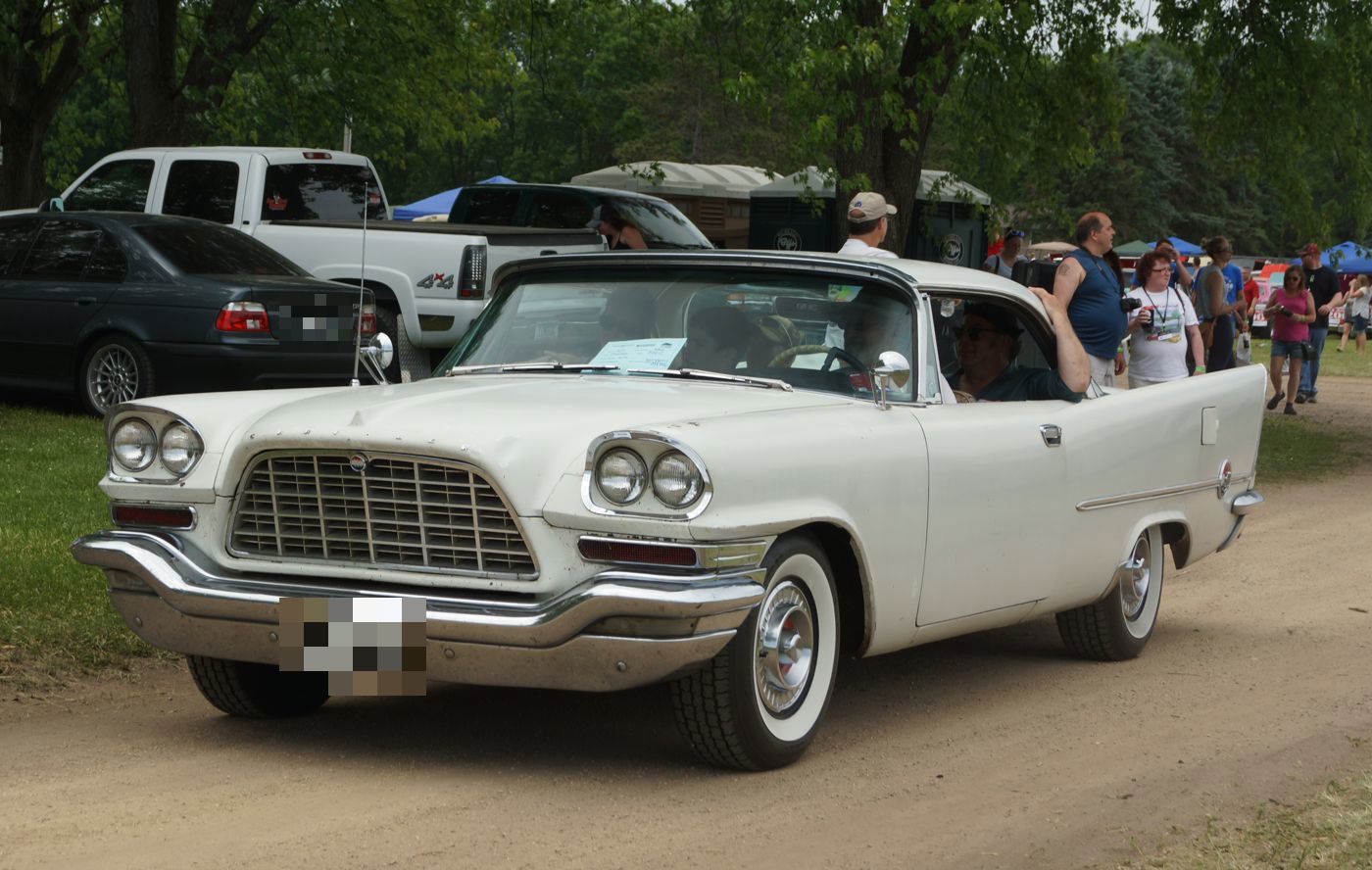
What stood on the beach was a new automobile from the bumpers in. Mac's Motor City Garage describes 1957 as the year Virgil Exner's Forward Look reached full maturity, with Plymouth advertising 'Suddenly, it's 1960' and Chrysler promising 'a step ahead of tomorrow.' The club history credits Exner with sleeker bodies and upswept fins, and on the 300C those fins began at the rear door edge and ran almost straight to the taillamp tips. Over-Drive calls the grille masculine and unlike any other Chrysler's; the club calls it Ferrari-like. Trim was spare: a single spear on each rear quarter and the round red, white and blue 300 medallion.5,4,6
The bigger change was underneath. The club says Chrysler engineered an entirely new chassis for 1957 through 1959, with torsion bars in the front suspension and angled upper and lower control arms that reduced dive under braking; Mac's names the system Torsion-Aire and places it on a conventional ladder frame. The 300C carried twin-leading-shoe front brakes and 9.00 x 14 Goodyear Blue Streak nylon tires on wider rims. The smaller wheels had a cost, and Over-Drive records Chrysler's answer: a rectangular opening below each pair of headlamps that ducted cooling air to the front brakes.4,5,6
The Hemi grew again, to 392 cubic inches on a 4.00-inch bore and 3.90-inch stroke. With 9.25:1 compression and two Carter four-barrels it was rated at 375 horsepower at 5,200 rpm and 420 lb-ft at 4,000, a manufacturer-published figure whose rating basis the sources do not state. The TorqueFlite three-speed automatic was standard. The optional engine, on 10.0:1 compression with what the club calls a more radical camshaft and larger exhaust pipes, was rated at 390 horsepower at 5,400 rpm, and Over-Drive lists mechanical lifters for it and says it came only with the manual transmission and no power accessories.6,4
That optional car is the rarest 300C, and even its definition is slippery. The club history says the three-speed manual went into only 18 special high-performance chassis-package cars; the club's model page describes 18 cars built with the 390 horsepower engine. Whether those are the same eighteen, and whether every 390 car was a manual car, is not settled by the club's own pages. Mac's describes the package as adding stiffer suspension and a limited-slip differential, and reports that Motor Trend recorded 0-60 mph in 8.0 seconds with a 390 horsepower car, a secondhand figure whose tested axle and weight are unknown. Against the club's 2,251 cars, eighteen is under one percent.4,3,5
The 300C also brought the first convertible letter car. The club lists the 1955 C-300 as a two-door coupe and the 1956 300B as a hardtop only, so this was the first time a buyer could take the Hemi with the top down, and the club says it rode a massive frame meant to let it handle like the hardtop. Both the club and Over-Drive count 484 convertibles, and Over-Drive prints a $5,359 price for the open car, basis not stated. The hardtop count divides the sources. The club gives 1,767; Over-Drive gives 1,918, and Mac's total of 2,402 with 484 convertibles is the same arithmetic as Over-Drive's. Neither side names the factory record behind its figure. Either way the convertible took about one sale in five: 21.5 percent on the club's numbers, 20.1 percent on Over-Drive's.4,6,5
Inside Chrysler's own showroom the 300C was a sliver. Over-Drive puts total 1957 Chrysler production at 122,273, and Mac's gives about 122,000, some five percent below 1956. On those numbers the letter car was about two Chryslers in every hundred: 1.8 percent with the club's hardtop count, 2.0 percent with Over-Drive's. Mac's lists the base Windsor four-door sedan at $3,088, which puts the 300C convertible's printed price $2,271 above the least expensive Chrysler. The club says the 300C sold strongly anyway, despite sticker prices above most American luxury cars, and describes it as a halo car that drew customers into the showroom. It was also the best-selling letter car yet: the club counts 1,725 C-300s for 1955 and 1,102 300Bs for 1956, both below either 300C total.6,5,4
It was a luxury car first and a fast one second, and Chrysler equipped it that way. Over-Drive lists full leather trim, power steering, backup lights and a parking-brake warning light as standard, and the club specifies the leather as tan. Paint was monotone only, in five colors: Cloud White, Gauguin Red, Jet Black, Parade Green and a brown the sources name differently, Copper Brown in Over-Drive and Copper Spice in the club history. The club counts ten 300 emblems on the car inside and out. Tom McCahill, as Mac's quotes him, called it 'motorized dynamite.'6,4,5
The brute is a fair label for the 300C, and the club records that the letter cars earned 'Beautiful Brutes' after its introduction. Over-Drive's compilation goes further, calling the 300C the fastest and most powerful production car in the country and comparing it only, and hesitantly, to the Corvette. Those are claims of rank, not measurements, and the compilation does not pair them with a period road test. What the documents do establish is the configuration that made the argument: a 392 Hemi with two four-barrels in a 126-inch-wheelbase luxury body on 14-inch wheels, rated at 375 horsepower as delivered and 390 in its rare special form.3,6
The next year showed how quickly the formula could lose its audience. The club records that the 1958 300D kept the 392, raised to 380 horsepower, and offered Chrysler's first electronic fuel injection, a Bendix system fitted to 21 cars that were recalled and converted to twin four-barrels. Production fell to 619 hardtops and 191 convertibles, about a third of the 300C's total on the club's figures. The 300C remained the car the club calls among the most beautiful and desirable 300s: the year the letter car stopped needing a stock-car team and started selling on speed it proved against the clock.4
Fact sheet · 1957 · United States
The numbers
1957 Chrysler 300C — The Forward Look 300C added a convertible, a 392 Hemi rated at 375 or 390 hp and torsion-bar front suspension; its hardtop count is disputed between the club (1,767) and Over-Drive (1,918).
Coverage: Partial — researched sections are shown; missing ones are not yet sourced. Researched through 2026-09-22.
Every figure is labeled with how sure we are. Reported means a manufacturer, registry, or reference figure we cite but have not reconciled against factory records ourselves. Disputed means credible sources disagree and both are shown. Rows are separately scoped; don't add them together unless the note says they make up a total.
Key facts
- Convertible production: 484 (club and Over-Drive agree).4,6
- Hardtop production is disputed: 1,767 (Chrysler 300 Club) versus 1,918 (Over-Drive Magazine).4,6
- Convertible price: $5,359.6
- Chrysler announced the 300C on November 29, 1956, for first public showing at the New York Automobile Show on December 8, and claimed an unofficial stock-car record of 145.7 mph average on the 4.7-mile banked oval at its Chelsea, Michigan proving grounds (a manufacturer claim).7
Production
| What was counted | Count | Basis | Status |
|---|---|---|---|
| Chrysler 300C, two-door hardtop4,3 300C · 2-door hardtop · not stated Marque-club figure shown. Over-Drive Magazine gives 1,918 hardtops; see conflicts. | 1,767 | built, model-year | Disputed |
| Chrysler 300C, convertible4,6 300C · convertible · not stated | 484 | built, model-year | Reported |
| What was counted | Count | Basis | Status |
|---|---|---|---|
| Chrysler 300C, all bodies8 300C · not stated Stated total from the club's own registry table (1,767 hardtop + 484 convertible), matching the club's 'Letter Car Production Dates' table's 'C' aggregate of 2,251. Uses the club's disputed hardtop figure; Over-Drive's hardtop (1,918) plus its own convertible figure would sum to 2,402. | 2,251 | built, model-year | Reported |
| What was counted | Count | Basis | Status |
|---|---|---|---|
| Chrysler 300C, special high-performance chassis package (three-speed manual)4,3 300C special high-performance chassis · not stated · 3-speed manual · not stated Club figure. The history ties the 18 to the manual-transmission chassis package; the model page ties them to the 390 hp engine. Not a count of all 390 hp cars unless those scopes coincide. | 18 | built, model-year | Reported |
Hardtop and convertible rows come from different lineages where they disagree; the total row uses the club's own stated sum and does not resolve the hardtop dispute (see the total row's note).
Over-Drive's 1957 production table gives body 566 hardtop 1,918 and body 563 convertible 484, model total 2,402, within 122,273 Chryslers; it is the lineage behind Over-Drive's fact sheet, not a second confirmation of it.
Prices when new
| Model | Price | Basis |
|---|---|---|
| Base price, 300C convertible6,9 | $5,359 | base price as printed by the fact sheet (basis not stated), 1957 model year |
| Base price, 300C two-door hardtop9,10 | $4,929 | 'Factory Price' in a compiled table; Motor Life prints the same figure as 'Basic Price' of its test car, 1957 model year |
| Optional Chassis Package (390 hp power pack)10 | $500 | approximate figure as printed by Motor Life ('a $500 factory power pack'), 1957-05 |
Prices are the nominal dollars of the day, not adjusted for inflation.
Engines
| Engine | Factory rating | Availability | Built |
|---|---|---|---|
| 392 Hemi V8, dual 4-bbl, 375 hp6 392 cu in · 2 x 4-barrel (Carter WCFB 2534S front, 2535S rear) | 375 hp @ 5,200, 420 lb-ft @ 4,000 (manufacturer published (basis not stated)) | standard | Not yet sourced |
| 392 Hemi V8, dual 4-bbl, 390 hp6,4 392 cu in · 2 x 4-barrel (Carter WCFB) | 390 hp @ 5,400, 410 lb-ft @ 4,200 (manufacturer published (basis not stated)) | optional | Not yet sourced |
Ratings are the manufacturer's advertised figures under the standard shown (SAE gross before 1972, SAE net after). They are not dyno results, and gross and net ratings can't be compared directly.
Transmissions
| Transmission | Availability | Built |
|---|---|---|
| TorqueFlite three-speed automatic (2.45 / 1.45 / 1.00)6 | standard | Not yet sourced |
| Three-speed manual (2.31 / 1.55 / 1.00)6,4 | special high-performance chassis only (see note in overview) | 184 Reported |
Options and packages
| Code | Option | Price | Installed |
|---|---|---|---|
|
Optional performance group / Optional Chassis Package: 10.0:1 compression, high-speed camshaft, low back-pressure exhaust, limited-slip differential, manual transmission, manual steering (390 hp)7,10 | $500 | 184 Reported |
|
Manual (standard-shift) transmission11,12 | — | Not yet sourced |
|
Full-time power steering (16.2:1)11,10 | — | Not yet sourced |
|
Radio10 | — | Not yet sourced |
|
Heater10 | — | Not yet sourced |
|
Air conditioning10 | — | Not yet sourced |
|
Power windows10 | — | Not yet sourced |
|
Rear axle ratios 2.92, 3.18, 3.54, 3.73, 3.91, 4.10, 4.30, 4.56, 4.89 (no extra cost); 5.38, 5.83, 6.17 (extra cost)11,12,10 | — | Not yet sourced |
Paint
| Code | Color | Built |
|---|---|---|
X |
Cloud White6,13,7 | Not yet sourced |
P |
Gauguin Red6,13,7 | Not yet sourced |
A |
Jet Black6,13 | Not yet sourced |
F |
Parade Green (metallic)6,13 | Not yet sourced |
N |
Copper Brown (metallic)6,13,7 | Not yet sourced |
Color names are the factory's. We don't show color swatches, because a screen color is no guide for a restoration.
Interiors
| Code | Trim | Built |
|---|---|---|
|
Full leather interior trim6 | Not yet sourced |
|
Natural cowhide leather with airfoam seat cushions front and rear; overhanging safety pad over the instrument panel7 | Not yet sourced |
|
Instrument panel Saddle Beige gloss (Ditzler 21181); convertible top bows and linkage Sahara Tan gloss (Ditzler 21279)13 | Not yet sourced |
Specifications
| Measure | Value | Applies to |
|---|---|---|
| Wheelbase6,3 | 126 in | all bodies |
| Overall length6,3 | 219.2 in | all bodies |
| Overall width6,3 | 78.8 in | all bodies |
| Overall height6 | 54.7 in | as printed |
| Tread, front / rear6 | 61.2 / 60.0 in | all bodies |
| Tires6,4 | 9.00 x 14 | all bodies |
| Rear axle ratio6 | 3.36:1 standard | TorqueFlite and manual |
| Front suspension4 | Torsion bars | all bodies |
| Overall height by body11,12 | 54.7 (hardtop) / 55.0 (convertible) in | by body |
| Shipping weight9 | 4,235 (hardtop) / 4,390 (convertible) lb | by body; compiled table (the AMA sheet prints N/A for the C-76-300) |
| Steering ratio, overall / turning diameter12 | 29.9 / 43 ft 11 in | C-76-300 |
| Wheels11 | 14 x 6½ K | 300C |
| Tires (factory detail)11 | 9.00 x 14 nylon racing-type white sidewalls (Goodyear Blue Streak); 22 psi normal, 30 psi extended high speed | 300C |
| Brakes11,7 | 12 in drums, 251 sq in, vacuum power assist standard | 300C |
| Spring rates11 | Front torsion bars 40% stiffer than standard; rear 135 lb per in, 7 leaves (50% stiffer than standard) | 300C |
| Fuel tank11 | 23 US gal | 300C |
Period road tests
| Test | Car tested | Result |
|---|---|---|
| Motor Life, 1957-05100-60 mph | 300C hardtop, 392 Hemi 375 hp, TorqueFlite, 3.36 axle (one of the first cars produced)Daytona Beach sand pictured; text says no 0-60 run took more than 7.8 s | 7.7 s |
| Motor Life, 1957-05100-30 mph | 300C hardtop, 375 hp, TorqueFlite, 3.36 axleAlso printed: 0-45 4.9 s | 3.4 s |
| Motor Life, 1957-05100-80 mph | 300C hardtop, 375 hp, TorqueFlite, 3.36 axleAverage | 12.6 s |
| Motor Life, 1957-0510Fuel economy | 300C hardtop, 375 hp, TorqueFlite, 3.36 axleAverage in light to medium-heavy traffic at normal speeds | 15 mpg |
A road test result belongs to the one car that was tested, with its engine, gearing, tires, and conditions. It is not a figure for every car of the year.
Identification
- Series
- Series C76-300.6
- Appearance
- Rectangular brake-cooling opening below the headlamps; single spear-like moldings on the lower rear quarters; round 300 medallion with a red-white-blue background on sides, hood, trunk and interior.6,3
Where the sources disagree
300C hardtop production
The marque-club figure leads the table as disputed; the Over-Drive figure is shown here. Neither source names the factory record behind its count.
Scope of the 18 special 300Cs
- 18 special high-performance chassis-package cars, the only 300Cs with the three-speed manual4
- 18 units built with the 390 hp version3
The row is labelled by the history's definition; the page does not claim that only 18 cars had the 390 hp engine.
Same model year
Also in 1957
- AMC Rebel and Rebel Machine The first Rebel: a one-year Rambler four-door hardtop with AMC's new 327 V8. It is the precursor to the name the 1970 Machine carried, not the same car.
- Ford Thunderbird The last two-seat Thunderbird was also the fastest: a supercharged F-code 312 joined the dual-quad E-code, and 21,380 were built over a season that ran to December 1957.
- Studebaker Hawk The Golden Hawk dropped the Packard 352 for a McCulloch-supercharged Studebaker 289 with the same 275 hp rating. The Silver Hawk replaced the three lesser 1956 Hawks.