1951 · Hudson · United States
1951 Hudson Hornet: A Debut Year With Hudson's First NASCAR Win and Championship
The first Hornet put a 308-cubic-inch L-head six in Hudson's step-down body, and Marshall Teague took it to Hudson's first NASCAR win at Daytona.
United States · researched through 2026-09-23
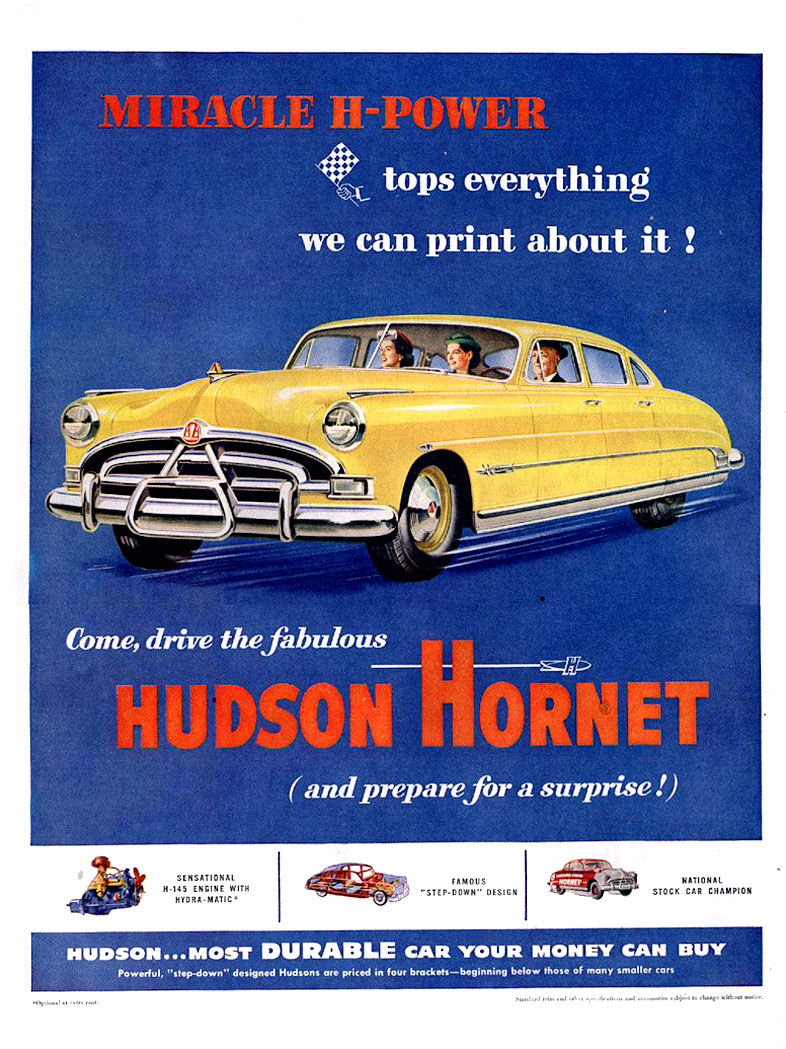
The Hornet arrived for 1951 as Hudson's new top series, badged 7A and built on the low, unibody "step-down" platform, powered by a 308-cubic-inch L-head six rated 145 horsepower with its standard single carburetor. Old Cars Weekly reports a second state of tune introduced during the year, Twin-H Power's dual-carburetor setup, at 160 horsepower, though exactly when that option became available and whether it started as a dealer or factory fitment is not established in the sources read. The engine's bore and stroke, 3-13/16 by 4-1/2 inches, and the Hornet's 124-inch wheelbase carried across every 7A body style that year. Mac's Motor City Garage adds 275 lb-ft of torque to the base 145-horsepower figure, with a standard three-speed manual and Hydra-Matic automatic available at $158 extra.1,2,3
On the track, the new Hornet delivered immediately. Marshall Teague won the 1951 Daytona Beach and Road Course race, Hudson's first NASCAR victory, in a field NASCAR's own Hall of Fame puts at 55 cars from 14 different automakers; NASCAR credits Teague with seven premier-series wins that year in his number 6 Hudson. Herb Thomas took the 1951 NASCAR championship in a Hudson as well, the marque's first title, adding a Southern 500 win to the season's highlights. Two different drivers delivering Hudson's first win and first championship in the same debut year gave the Hornet an unusually strong competition record right out of the gate.4,5,6,1
Hudson-Essex-Terraplane Club's serial-number compilation counts 43,666 Hornets built across the model year, drawn from Hudson parts books and the Standard Catalog of American Cars, though the figure is not split by body style, engine, or transmission in any source read. The same table's monthly breakdown shows the pace of that first year clearly: production started slowly with just 18 cars in September 1950, climbed through the winter to a peak of 6,352 built in March 1951, and tapered off through the summer before ending the run at 4,325 in October 1951.7
Hudson's November 1950 price folder shows the new Hornet spanning a real range within its own three body styles: $2,477.25 for the club coupe, $2,501.50 for the four-door sedan, and $3,018.50 for the Convertible Brougham, all factory town delivered. Hydra-Matic added $158.30 to any of those prices, while overdrive with the standard three-speed manual cost less, $99.92, a genuine choice between two different ways to reduce engine speed on the highway rather than a straightforward upgrade path from one to the other.3
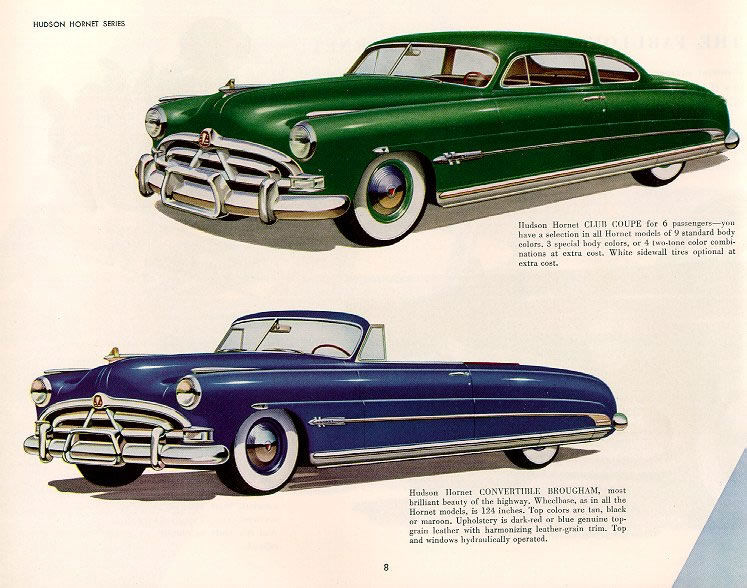
Beyond the drivetrain, Hudson's 1951 order sheet ran to dozens of individually priced items grouped into option packages: a $64.90 Safety Group added a back-up light, direction indicator, outside rear-view mirror, and windshield washer together, while a $27.22 Comfort & Convenience Group covered window shades, a vanity mirror, and an automatic utility light. The standard Gem-Lustre paint palette ran to nine colors, from Pacific Blue and Ebony Black to Jefferson Green Opalescent, with four further special colors and six extra-cost two-tone combinations layered on top, none of the two-tones available on the convertible body, which instead came standard with dark-red genuine leather upholstery.3
Fact sheet · 1951 · United States
The numbers
1951 Hudson Hornet — The first Hornet put a 308-cubic-inch L-head six in Hudson's step-down body, and Marshall Teague took it to Hudson's first NASCAR win at Daytona.
Coverage: Partial — researched sections are shown; missing ones are not yet sourced. Researched through 2026-09-23.
Every figure is labeled with how sure we are. Reported means a manufacturer, registry, or reference figure we cite but have not reconciled against factory records ourselves. Disputed means credible sources disagree and both are shown. Rows are separately scoped; don't add them together unless the note says they make up a total.
Key facts
- 43,666 Hornets built for 1951 (club compilation drawn from Hudson parts books and the Standard Catalog of American Cars).7
- Teague's win at the 1951 Daytona beach-road race was Hudson's first NASCAR victory; the NASCAR Hall of Fame puts the field at 55 cars from 14 automakers.6,4
- Herb Thomas won the 1951 NASCAR championship in a Hudson; Hudson's first title.6
- Old Cars Weekly records Herb Thomas's 1951 Southern 500 win.1
- Hudson's November 1950 price folder listed the Hornet at $2,477.25 (club coupe) to $3,018.50 (Convertible Brougham) factory town delivered, with Hydra-Matic at $158.30 and overdrive at $99.92.3
- Monthly build counts peaked at 6,352 Hornets in March 1951.7
Production
| What was counted | Count | Basis | Status |
|---|---|---|---|
| Hornet, all bodies (series 7A)7 Hornet · 308 six · all production The source labels this a production run; its model-year basis is inferred from the per-year table. | 43,666 | built, model-year | Reported |
| What was counted | Count | Basis | Status |
|---|---|---|---|
| Hornet built in September 19507 Hornet (7A) · all production | 18 | built, calendar month (September 1950) | Reported |
| Hornet built in October 19507 Hornet (7A) · all production | 2,977 | built, calendar month (October 1950) | Reported |
| Hornet built in November 19507 Hornet (7A) · all production | 3,560 | built, calendar month (November 1950) | Reported |
| Hornet built in December 19507 Hornet (7A) · all production | 4,603 | built, calendar month (December 1950) | Reported |
| Hornet built in January 19517 Hornet (7A) · all production | 5,949 | built, calendar month (January 1951) | Reported |
| Hornet built in February 19517 Hornet (7A) · all production | 5,254 | built, calendar month (February 1951) | Reported |
| Hornet built in March 19517 Hornet (7A) · all production | 6,352 | built, calendar month (March 1951) | Reported |
| Hornet built in April 19517 Hornet (7A) · all production | 4,353 | built, calendar month (April 1951) | Reported |
| Hornet built in May 19517 Hornet (7A) · all production | 1,955 | built, calendar month (May 1951) | Reported |
| Hornet built in June 19517 Hornet (7A) · all production | 431 | built, calendar month (June 1951) | Reported |
| Hornet built in July 19517 Hornet (7A) · all production | 539 | built, calendar month (July 1951) | Reported |
| Hornet built in August 19517 Hornet (7A) · all production | 1,553 | built, calendar month (August 1951) | Reported |
| Hornet built in September 19517 Hornet (7A) · all production | 1,797 | built, calendar month (September 1951) | Reported |
| Hornet built in October 19517 Hornet (7A) · all production | 4,325 | built, calendar month (October 1951) | Reported |
No body-style, engine or transmission split was found in an accessible source.
Mac's Motor City Garage says 'nearly 44,000' sold in the first year; that rounded figure is not used as a row.
The calendar-month rows are the club table's monthly build counts for the 7A Hornet column; they sum to the 43,666 total (September 1950 through October 1951).
The same club table gives approximate convertible and Hollywood counts, which it labels approximate. For 1951 the cell under the Hornet column reads 181 convertibles and 669 Hollywoods, while 551 and 2,101 sit under the Commodore Eight column. The column alignment of those two rows could not be confirmed, so no body-style row is published.
The November 1950 price folder lists the 7A Hornet in three bodies only (four-door sedan, club coupe, Convertible Brougham); no Hollywood hardtop appears in that edition.
Prices when new
| Model | Price | Basis |
|---|---|---|
| Hornet sedan, four-door, six-passenger (7A)3 | $2,501.50 | factory town delivered price (list, factory delivery, provision for Federal tax and dealer conditioning; excludes local taxes and extra-cost equipment), 1950-11 |
| Hornet club coupe, six-passenger (7A)3 | $2,477.25 | factory town delivered price (as above), 1950-11 |
| Hornet Convertible Brougham, six-passenger (7A)3 | $3,018.50 | factory town delivered price (as above), 1950-11 |
| Hydra-Matic Drive (option OO)3 | $158.30 | option price including provision for Federal tax, 1950-11 |
| Overdrive (option T)3 | $99.92 | option price including provision for Federal tax, 1950-11 |
Prices are the nominal dollars of the day, not adjusted for inflation.
Engines
| Engine | Factory rating | Availability | Built |
|---|---|---|---|
| H-145 · 308 L-head six, single carburetor1,2 308 cu in · single carburetor | 145 hp, 275 lb-ft (period advertised rating; SAE basis not stated by source (gross era)) | standard | Not yet sourced |
| Twin-H Power · 308 L-head six, dual carburetors1 308 cu in · two carburetors, dual manifold | 160 hp (period advertised rating as reported by Old Cars Weekly; SAE basis not stated) | introduced during 1951; timing and dealer-versus-factory fitment not established here | Not yet sourced |
Ratings are the manufacturer's advertised figures under the standard shown (SAE gross before 1972, SAE net after). They are not dyno results, and gross and net ratings can't be compared directly.
Transmissions
| Transmission | Availability | Built |
|---|---|---|
| Three-speed manual2 | standard | Not yet sourced |
| Hydra-Matic automatic2 | optional, $158 | Not yet sourced |
| T · Overdrive (with three-speed manual)3 | optional, $99.92 (November 1950 folder) | Not yet sourced |
Options and packages
| Code | Option | Price | Installed |
|---|---|---|---|
APorder code (group option) |
Appearance Group, 6A-7A-8A: wheel trim rings and exhaust deflector3 | $16 | Not yet sourced |
OCorder code (group option) |
Comfort & Convenience Group, 6A-7A-8A except convertibles: window and wing vent shades, vanity mirror, automatic utility light kit3 | $27.22 | Not yet sourced |
SKorder code (group option) |
Safety Group: back-up light, direction indicator, outside rear-view mirror, windshield washer, combination fuel and vacuum pump, glareproof mirror3 | $64.90 | Not yet sourced |
UKorder code (group option) |
Utility Group: hydraulic jack and Magnalite (requires cigar lighter)3 | $16.16 | Not yet sourced |
OOorder code |
Hydra-Matic Drive3 | $158.30 | Not yet sourced |
Torder code |
Overdrive3 | $99.92 | Not yet sourced |
Yorder code |
Radio3 | $87.65 | Not yet sourced |
Xorder code |
Weather-Control heater with remote control3 | $67.20 | Not yet sourced |
DDorder code |
Direction indicator3 | $22.08 | Not yet sourced |
YRorder code |
Back-up light3 | $11.28 | Not yet sourced |
FLorder code |
Fog lamps3 | $18.86 | Not yet sourced |
SLorder code |
Spotlight3 | $28.34 | Not yet sourced |
BBorder code |
Heavy-duty shock absorbers3 | $13.12 | Not yet sourced |
NNorder code |
Wheel trim rings3 | $14.16 | Not yet sourced |
WAorder code |
Windshield washer3 | $10.44 | Not yet sourced |
Oorder code |
Oil-bath air cleaner (4A-5A-6A-7A)3 | $7.34 | Not yet sourced |
OForder code |
Oil filter, six-cylinder3 | $12.96 | Not yet sourced |
HHorder code |
Combination fuel and vacuum pump3 | $11.54 | Not yet sourced |
ZEorder code |
Hydraulic jack3 | $12.01 | Not yet sourced |
TDorder code |
Outside rear-view mirror3 | $5.25 | Not yet sourced |
GMorder code |
Glareproof mirror3 | $4.46 | Not yet sourced |
ULorder code |
Automatic utility light (not convertibles)3 | $8.13 | Not yet sourced |
MAorder code |
Magnalite3 | $4.14 | Not yet sourced |
MVorder code |
Vanity mirror (not convertibles)3 | $1.84 | Not yet sourced |
DEorder code |
Exhaust deflector3 | $1.84 | Not yet sourced |
VPorder code |
Window and wing vent shades (not convertibles)3 | $17.26 | Not yet sourced |
OVorder code |
Outside visor and traffic light viewer3 | $30.89 | Not yet sourced |
STorder code |
Spare-tire valve extension3 | $2.80 | Not yet sourced |
Dorder code |
Wheel color, red3 | $0 | Not yet sourced |
Eorder code |
Wheel color, cream3 | $0 | Not yet sourced |
CB / CDorder code |
Seat covers, rayon twill (gray or tan upholstery), 6A-7A-8A: sedan $46.32, club coupe $50.463 | — | Not yet sourced |
Paint
| Code | Color | Built |
|---|---|---|
B |
Pacific Blue (standard Gem-Lustre)3 | Not yet sourced |
G |
Northern Gray Opalescent (standard)3 | Not yet sourced |
H |
Texas Tan Opalescent (standard; extra cost on Pacemaker only)3 | Not yet sourced |
HN |
Dark Maroon Opalescent (standard; extra cost on Pacemaker only)3 | Not yet sourced |
J |
Bali Blue (standard)3 | Not yet sourced |
K |
Ebony Black (standard)3 | Not yet sourced |
P |
Naples Green Opalescent (standard; extra cost on Pacemaker only)3 | Not yet sourced |
Q |
Newport Gray Opalescent (standard)3 | Not yet sourced |
S |
Jefferson Green Opalescent (standard)3 | Not yet sourced |
CC |
Dark Platinum Opalescent (special color, extra cost)3 | Not yet sourced |
M |
Toro Red (special color, extra cost)3 | Not yet sourced |
N |
Cornish Cream (special color, extra cost; convertibles only)3 | Not yet sourced |
RR |
French Gray (special color, extra cost)3 | Not yet sourced |
JB |
Two-tone: Pacific Blue upper, Bali Blue lower (extra cost; not convertibles)3 | Not yet sourced |
QG |
Two-tone: Northern Gray upper, Newport Gray lower (extra cost; not convertibles)3 | Not yet sourced |
RB |
Two-tone: Pacific Blue upper, French Gray lower (extra cost; not convertibles)3 | Not yet sourced |
RC |
Two-tone: Northern Gray upper, French Gray lower (extra cost; not convertibles)3 | Not yet sourced |
RD |
Two-tone: Dark Maroon upper, French Gray lower (extra cost; not convertibles)3 | Not yet sourced |
SP |
Two-tone: Naples Green upper, Jefferson Green lower (extra cost; not convertibles)3 | Not yet sourced |
Color names are the factory's. We don't show color swatches, because a screen color is no guide for a restoration.
Interiors
| Code | Trim | Built |
|---|---|---|
|
Blue-gray nylon three-dimensional weave with blue stripes, plastic Dura-fab trim in antique-crush leather-grain finish (all Hornets except convertibles; standard with colors B, G, J, K, Q, JB, QG and RB, optional with the others at no extra cost)3 | Not yet sourced |
|
Tan-brown nylon three-dimensional weave with gold stripes, plastic Dura-fab trim (all Hornets except convertibles; standard with colors H, M, P, S, CC, HN, RC, RD, RR and SP, optional with the others at no extra cost)3 | Not yet sourced |
|
Convertible: dark-red genuine leather with harmonizing leather-grain trim, standard with all body colors3 | Not yet sourced |
|
Convertible: blue genuine leather with harmonizing leather-grain trim, optional at no extra charge3 | Not yet sourced |
AA-1 / AA-2 / AA-3 |
Leather trim, extra cost, all models except convertibles: brown (AA-1), blue (AA-2), maroon (AA-3); the 7A prices are not legible with confidence in the available scan3 | Not yet sourced |
|
Convertible tops: tan standard with colors N, P, S and CC; black standard with G, K, Q, RR, J and B; maroon standard with H, M and HN; any top optional with other colors at no charge3 | Not yet sourced |
Specifications
| Measure | Value | Applies to |
|---|---|---|
| Bore and stroke3 | 3-13/16 x 4-1/2 in | Hornet six |
| Wheelbase3 | 124 in | Hornet |
| Standard tires3 | 15 x 7.10 four-ply (15 x 7.60 on the Convertible Brougham) | Hornet |
| Rear axle ratio, standard transmission3 | 4.10:1 (3.58 or 4.55 optional) | 7A |
| Rear axle ratio with Overdrive3 | 4.55:1 (4.10 optional) | all series |
| Rear axle ratio with Hydra-Matic3 | 3.58:1 | Hydra-Matic-equipped models, 7A included |
Identification
- Series designation
- 1951 Hornets carry the 7A model designation; the serial plate is on the right front door hinge pillar.7
Same model year
Also in 1951
- Oldsmobile Rocket 88 The 88 moved to the B-body and gained a Super 88 companion; the Super 88 four-door (90,131) was the best-selling Oldsmobile.