1952 · Hudson · United States
1952 Hudson Hornet: Twenty-Seven Wins, and a Champion Who Finished on His Roof
Hudson's best NASCAR season: Hornets won 27 of 34 premier-series races and Tim Flock took the championship, while production fell to 35,921.
United States · researched through 2026-09-23
When NASCAR's 1952 season reached its last race at West Palm Beach, Florida, in November, Tim Flock needed only to start to be champion. The International Motorsports Hall of Fame records what happened next: on lap 64 his Hudson hit the retaining wall and flipped, skidding down the frontstretch on its roof. Flock's own summary, as the Hall quotes it, was 'I bet I'm the only guy who ever won a championship while on his head.' The title was his anyway, and it capped Hudson's most successful NASCAR season, in a year when fewer Hornets were built than the year before.1,2,3
The NASCAR Hall of Fame counts the season as Hudson's best: 27 wins in 34 premier-series races, about 79 percent. Hornets won the first six races of the year and 11 of the first 12. Hudson also took the first of three straight manufacturers' titles, 1952, 1953 and 1954, which the Hall says ties it with Toyota and Oldsmobile for third on the all-time list. Those are institutional totals published by NASCAR's own museum, not a reconstructed race-by-race ledger, and they are the scale against which every individual Hudson result that year should be read.2
Within that total the championship was a fight between two Hudson drivers. The Hall of Fame biography says Flock and Herb Thomas staged a furious battle for the title, and that Flock won eight times in 34 races. NASCAR's own profile of Thomas says he also won eight races in 1952 and finished second to Flock. Thomas had been NASCAR's champion in a Hudson in 1951, the first driver to win the premier-series title in a Hornet by the Hall's account, so 1952 was a Hudson champion losing his crown to another Hudson driver.1,4,2
The man who had given Hudson its first NASCAR win took his biggest 1952 honor in another series. Marshall Teague won the Daytona beach-road race in a Hornet in 1951, Hudson's first premier-series victory, and won there again in 1952, according to Mac's Motor City Garage. NASCAR's Research and Archives Center credits him with the AAA National Stock Car division championship for 1952. That title belongs to a different sanctioning body and must not be counted as a NASCAR championship. Hudson that year was winning in two organizations at once, with different drivers earning different honors.5,2,6,7
The season was the work of a program, not of one famous car. Flock and Thomas won eight races each by the sources' counts, and the Hall's summary does not break the rest of Hudson's twenty-seven down race by race or driver by driver. Mac's credits Teague with seven NASCAR wins in Hornets over his career, and describes Thomas and the mechanic Smokey Yunick as the pairing that went on to win 24 times in 71 starts in 1953 and 1954. The National Historic Vehicle Register credits Thomas with 78 podium finishes in Hornets and the highest winning percentage in the sport's history.1,4,2,5,8
One car from that season survives as physical evidence. The National Historic Vehicle Register says Hudson provided a 1952 Hornet two-door club coupe, VIN 7B-185596, to Herb Thomas halfway through the 1952 season, and that Smokey Yunick prepared it. The register calls it the only Hudson campaigned in NASCAR known to exist and records its later restoration and repainting and its present era-correct 7-X replacement engine; it is now owned by Al Schultz and displayed at the National Hudson Motor Car Company Museum. Its current state is a preservation state, not a specification for every 1952 race car.8
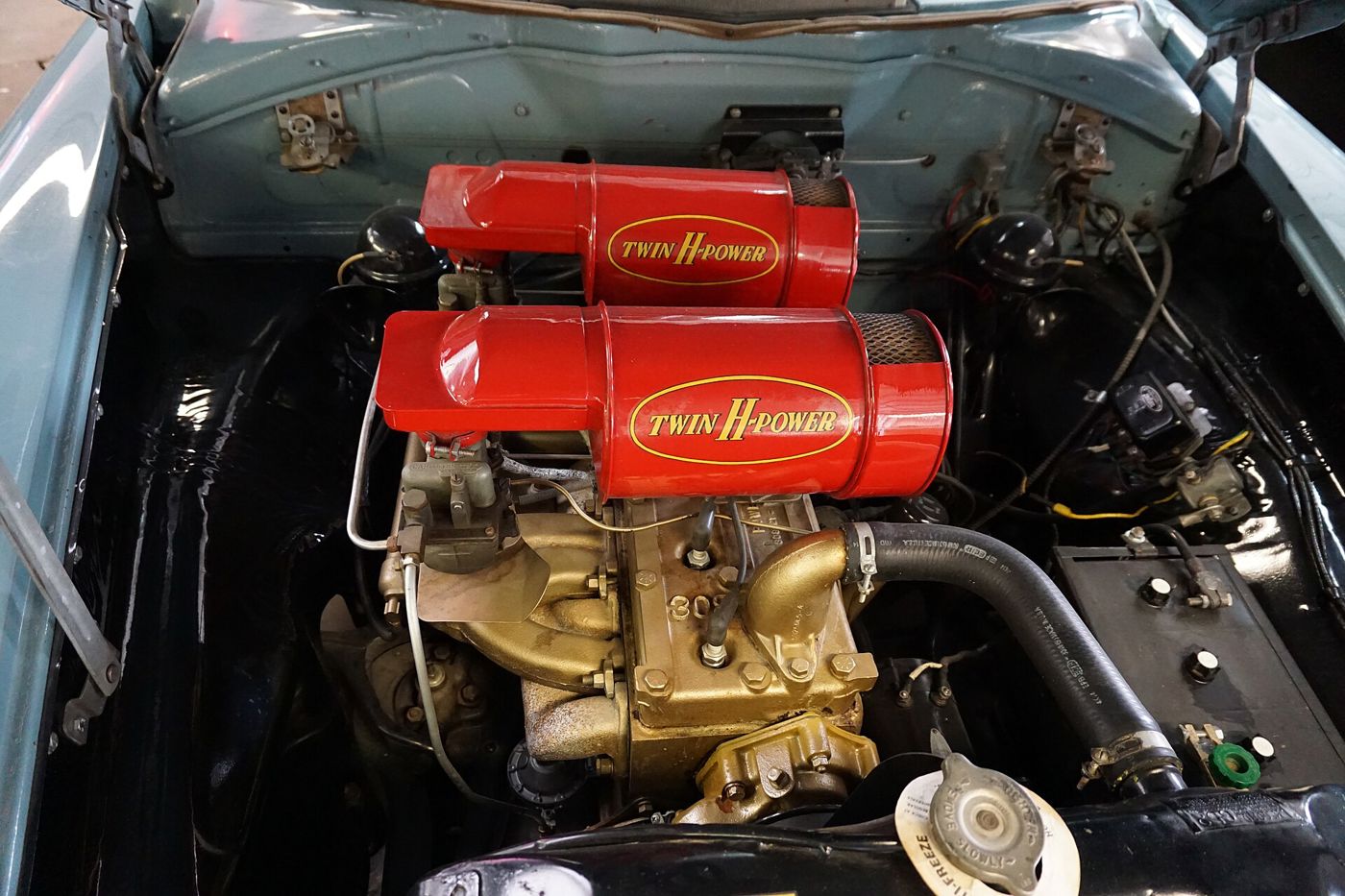
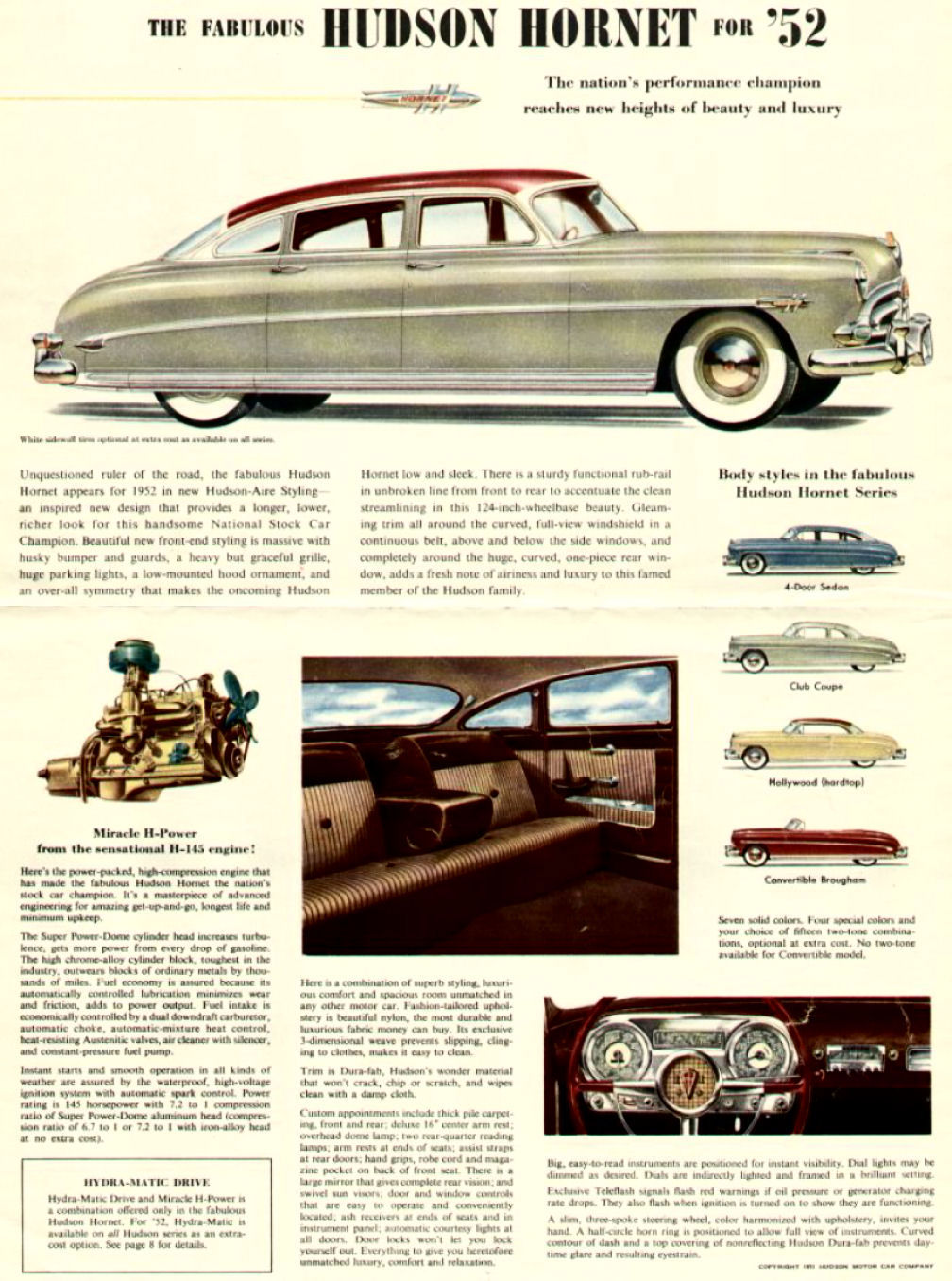
Under the hood of the showroom car was an L-head six, not a V8. Mac's describes the 308-cubic-inch Hornet engine in baseline form as rated at 145 horsepower and 275 lb-ft. Twin H-Power, two carburetors on a dual manifold, appeared in mid-1951, first as an over-the-counter dealer kit and then, the article says, as a regular production option in 1952; it was eventually rated at 170 horsepower. Old Cars Weekly gives 160 horsepower for Twin-H in its 1951 article, so the rating changed over time and the dates of each figure are not reconciled.5,7
Why a six-cylinder car won so often is a question the sources answer with its construction. Mac's says racers recognized the Hornet's low center of gravity, battleship construction and muscular engine, and notes that Hudson lacked the money to develop a modern overhead-valve V8. The low-slung body and the big six therefore had to carry the fight on their own. The same article describes a later 7-X engine, a factory-blueprinted H-145 with overbored cylinders and a special camshaft, offered over the counter; the Thomas car's current engine is one of those.5,8
The showroom went the other way. The Hudson-Essex-Terraplane Club's serial-number compilation, which shares a lineage with the Standard Catalog of American Cars, counts 35,921 Hornets for 1952, series 7B, down from 43,666 in 1951: a fall of about 18 percent in the year Hudson won 27 NASCAR races. No split by body style, engine or transmission has been confirmed in an accessible source, so how many 1952 Hornets carried Twin H-Power, or were Hollywood hardtops or convertibles, is unknown. Every 1952 Hornet carries its 7B serial plate on the right front door hinge pillar.3,2
Winning did not reverse that slide. The compilation counts 27,208 Hornets for 1953 and 24,833 for 1954, while the Hall of Fame records that Hudson kept the manufacturers' title both years. The Hall names Thomas as the star of the whole effort, with 39 Hudson wins, and Dick Rathmann a distant second with 13. Lifetime totals disagree: the Hall's materials give 79 and 80 Hudson wins and the National Historic Vehicle Register gives 81, a difference no source yet reconciles with a defined counting rule.3,2,8
The 1952 champion carried what he learned elsewhere. The Hall of Fame biography follows Flock to Carl Kiekhaefer's Chryslers, where in 1955 he won 18 races and a second championship, and NASCAR's own record of that season makes the same move. Hudson merged with Nash-Kelvinator in 1954, and the Hall records that Hudson production ended on June 25, 1957. The 1952 season remains the high point of the record: 27 wins from 34 races, a champion who clinched it upside down, and a surviving car that Hudson handed to Herb Thomas halfway through the year.1,9,2,8
Fact sheet · 1952 · United States
The numbers
1952 Hudson Hornet — Hudson's best NASCAR season: Hornets won 27 of 34 premier-series races and Tim Flock took the championship, while production fell to 35,921.
Coverage: Partial — researched sections are shown; missing ones are not yet sourced. Researched through 2026-09-23.
Every figure is labeled with how sure we are. Reported means a manufacturer, registry, or reference figure we cite but have not reconciled against factory records ourselves. Disputed means credible sources disagree and both are shown. Rows are separately scoped; don't add them together unless the note says they make up a total.
Key facts
- 35,921 Hornets built for 1952.3
- 27 wins in 34 NASCAR premier-series races (79.4 percent), per the NASCAR Hall of Fame.2
- Tim Flock won the 1952 NASCAR championship in a Hudson.2,4
- Marshall Teague won the 1952 AAA National Stock Car title, which is not a NASCAR championship.6,7
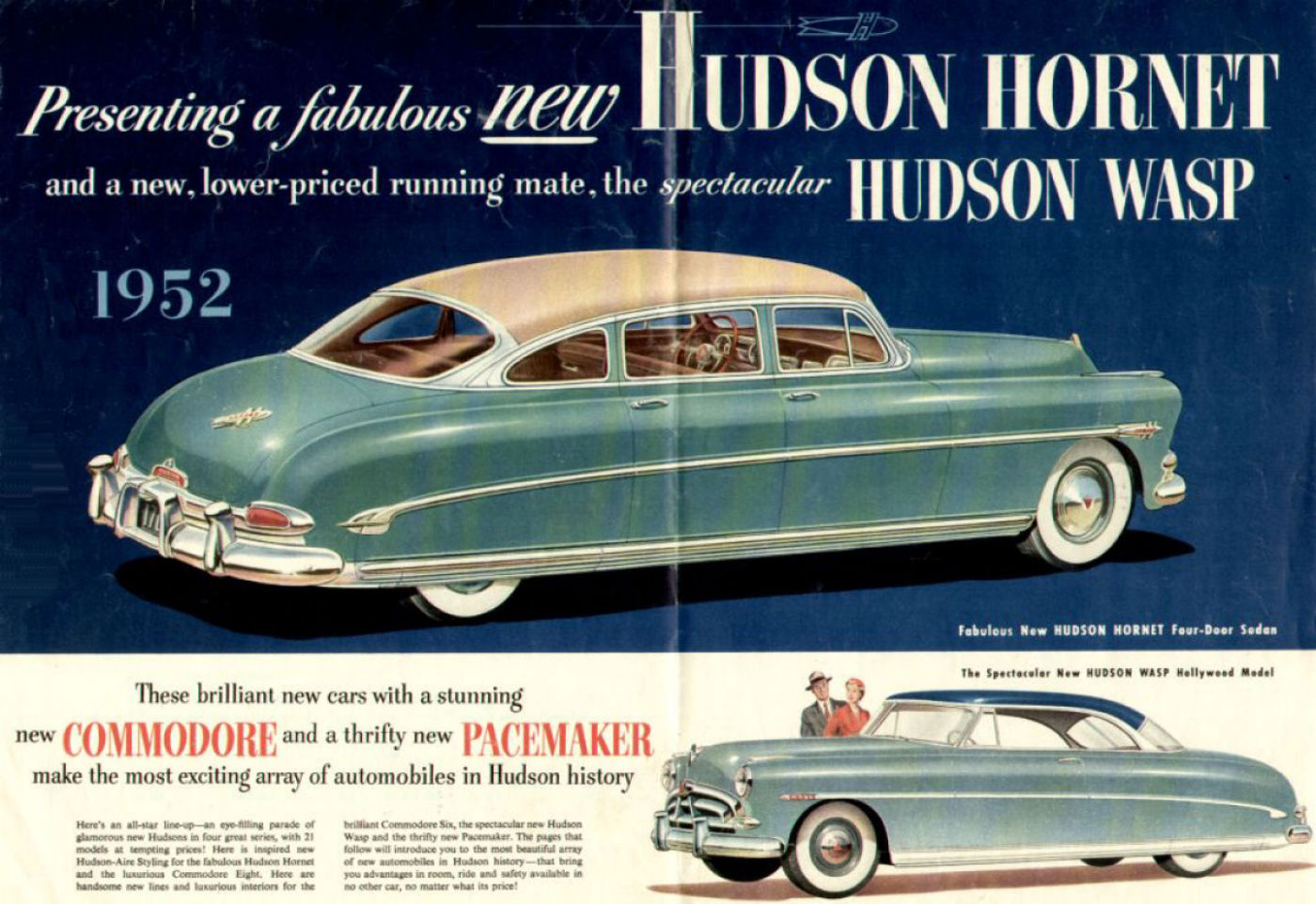
- Hudson's March 1952 price folder listed Twin H-Power as an extra-cost option (code E, $85.60) for the Wasp and Hornet, not as standard equipment, and printed 145 hp for the Hornet six.10
- The Hornet came in four bodies for 1952, from the $2,722.51 club coupe to the $3,318.24 Convertible Brougham (factory town delivered, March 1952).10
Production
| What was counted | Count | Basis | Status |
|---|---|---|---|
| Hornet, all bodies (series 7B)3 Hornet · 308 six · all production | 35,921 | built, model-year | Reported |
| What was counted | Count | Basis | Status |
|---|---|---|---|
| Hornet built in November 19513 Hornet (7B) · all production | 624 | built, calendar month (November 1951) | Reported |
| Hornet built in December 19513 Hornet (7B) · all production | 1,901 | built, calendar month (December 1951) | Reported |
| Hornet built in January 19523 Hornet (7B) · all production | 2,710 | built, calendar month (January 1952) | Reported |
| Hornet built in February 19523 Hornet (7B) · all production | 2,593 | built, calendar month (February 1952) | Reported |
| Hornet built in March 19523 Hornet (7B) · all production | 4,254 | built, calendar month (March 1952) | Reported |
| Hornet built in April 19523 Hornet (7B) · all production | 3,911 | built, calendar month (April 1952) | Reported |
| Hornet built in May 19523 Hornet (7B) · all production | 3,089 | built, calendar month (May 1952) | Reported |
| Hornet built in June 19523 Hornet (7B) · all production | 3,585 | built, calendar month (June 1952) | Reported |
| Hornet built in July 19523 Hornet (7B) · all production | 3,736 | built, calendar month (July 1952) | Reported |
| Hornet built in August 19523 Hornet (7B) · all production | 3,364 | built, calendar month (August 1952) | Reported |
| Hornet built in September 19523 Hornet (7B) · all production | 3,810 | built, calendar month (September 1952) | Reported |
| Hornet built in October 19523 Hornet (7B) · all production | 2,344 | built, calendar month (October 1952) | Reported |
| What was counted | Count | Basis | Status |
|---|---|---|---|
| Hornet Convertible Brougham (approximate)3 Hornet (7B) · Convertible Brougham · all production The club table marks its convertible and Hollywood counts as approximate and states no method. The same 360 figure is attributed to Hemmings Motor News (June 2004) by Wikipedia (see unpublished leads). | 360 | built, model-year | Estimate |
No firm body-style, engine or transmission split was found in an accessible source; the only body row is the club table's approximate convertible count.
The calendar-month rows are the club table's monthly build counts for the 7B Hornet column; they sum to the 35,921 total (November 1951 through October 1952).
The club table's approximate Hollywood row puts 190 under the Hornet column and 2,160 under the Commodore Eight column (a series of 3,125 cars). Wikipedia, citing Hemmings, gives the Hornet about 2,160 Hollywoods. The column alignment cannot be confirmed from the table, so no Hollywood row is published.
Prices when new
| Model | Price | Basis |
|---|---|---|
| Hornet sedan, four-door, six-passenger (7B)10 | $2,749.18 | factory town delivered price (list, factory delivery, provision for Federal tax and dealer conditioning; excludes local taxes and extra-cost equipment), 1952-03 |
| Hornet club coupe, six-passenger (7B)10 | $2,722.51 | factory town delivered price (as above), 1952-03 |
| Hornet Hollywood hardtop, six-passenger (7B)10 | $3,071.19 | factory town delivered price (as above), 1952-03 |
| Hornet Convertible Brougham, six-passenger (7B)10 | $3,318.24 | factory town delivered price (as above), 1952-03 |
| Twin H-Power (option E)10 | $85.60 | option price including provision for Federal tax, 1952-03 |
| Hydra-Matic Drive (left-hand drive only)10 | $175.71 | option price including provision for Federal tax, 1952-03 |
| Overdrive (option T)10 | $110.77 | option price including provision for Federal tax, 1952-03 |
Prices are the nominal dollars of the day, not adjusted for inflation.
Engines
| Engine | Factory rating | Availability | Built |
|---|---|---|---|
| 308 L-head six10 308 cu in · single carburetor | 145 hp (manufacturer's advertised rating as printed in the March 1952 price folder; SAE basis not stated (gross era)) | standard | Not yet sourced |
| E · 308 L-head six with Twin H-Power10 308 cu in · two carburetors, dual manifold | optional on 5B Wasp and 7B Hornet, $85.60 (March 1952); the folder prints no rating for it | Not yet sourced |
Ratings are the manufacturer's advertised figures under the standard shown (SAE gross before 1972, SAE net after). They are not dyno results, and gross and net ratings can't be compared directly.
Transmissions
| Transmission | Availability | Built |
|---|---|---|
| Standard manual transmission10 | standard (4.10:1 axle) | Not yet sourced |
| T · Overdrive10 | optional, $110.77 (4.55:1 axle standard with it) | Not yet sourced |
| Hydra-Matic Drive10 | optional, $175.71, left-hand drive only (3.58:1 axle, no other ratio) | Not yet sourced |
Options and packages
| Code | Option | Price | Installed |
|---|---|---|---|
SKorder code (group option) |
Safety Group: two back-up lights, combination fuel and vacuum pump, direction indicator, glareproof mirror, outside rear-view mirror, windshield washer10 | $81.60 | Not yet sourced |
Eorder code |
Twin H-Power (5B, 7B)10 | $85.60 | Not yet sourced |
|
Hydra-Matic Drive (left-hand drive only)10 | $175.71 | Not yet sourced |
Torder code |
Overdrive10 | $110.77 | Not yet sourced |
Yorder code |
Radio10 | $95.94 | Not yet sourced |
Xorder code |
Weather-Control with remote control10 | $74.39 | Not yet sourced |
|
Direction indicator10 | $23.57 | Not yet sourced |
|
Exhaust deflector10 | $1.97 | Not yet sourced |
YRorder code |
Back-up lights, pair10 | $24.14 | Not yet sourced |
CForder code |
Solex glass with sun-shade windshield10 | $41.83 | Not yet sourced |
BBorder code |
Heavy-duty shock absorbers10 | $14.05 | Not yet sourced |
NNorder code |
Wheel rim trim rings10 | $15.15 | Not yet sourced |
|
Natural Orlon convertible top10 | $134 | Not yet sourced |
Uorder code |
Large plastic rear window (convertibles)10 | $10.10 | Not yet sourced |
VPorder code |
Window and wing vent shades (not convertible or Hollywood)10 | $18.46 | Not yet sourced |
OVorder code |
Outside visor and traffic light viewer (not Hollywood)10 | $33.05 | Not yet sourced |
WAorder code |
Windshield washer10 | $11.17 | Not yet sourced |
Oorder code |
Oil-bath air cleaner10 | $7.85 | Not yet sourced |
OForder code |
Oil filter10 | $13.86 | Not yet sourced |
HHorder code |
Combination fuel and vacuum pump10 | $12.35 | Not yet sourced |
TDorder code |
Outside rear-view mirror10 | $5.61 | Not yet sourced |
GMorder code |
Glareproof mirror10 | $4.78 | Not yet sourced |
Paint
| Code | Color | Built |
|---|---|---|
B |
Broadway Blue (solid, no extra cost)10 | Not yet sourced |
G |
Jupiter Gray (solid, no extra cost)10 | Not yet sourced |
H |
Texas Tan (solid, no extra cost on Hornet)10 | Not yet sourced |
J |
Southern Blue (solid, no extra cost)10 | Not yet sourced |
K |
Ebony Black (solid, no extra cost)10 | Not yet sourced |
S |
Jefferson Green (solid, no extra cost)10 | Not yet sourced |
Q |
Gulf Green (solid, no extra cost)10 | Not yet sourced |
P |
Symphony Blue-Green (Dark) (solid, no extra cost on Hornet)10 | Not yet sourced |
M |
Toro Red (special solid color, $28.07)10 | Not yet sourced |
N |
Boston Ivory (special solid color, $30.29)10 | Not yet sourced |
CC |
Symphony Blue-Green (Light) (special solid color, $28.07)10 | Not yet sourced |
RR |
French Gray (special solid color, $28.07)10 | Not yet sourced |
RA |
Two-tone: Black lower, Boston Ivory upper ($30.86; not convertibles)10 | Not yet sourced |
RC |
Two-tone: Southern Blue lower, Boston Ivory upper ($30.86)10 | Not yet sourced |
RD |
Two-tone: Jefferson Green lower, Boston Ivory upper ($30.86)10 | Not yet sourced |
RF |
Two-tone: Texas Tan lower, Boston Ivory upper ($30.86)10 | Not yet sourced |
RH |
Two-tone: Toro Red lower, French Gray upper ($33.67)10 | Not yet sourced |
RI |
Two-tone: French Gray lower, Black upper ($30.86)10 | Not yet sourced |
RJ |
Two-tone: French Gray lower, Toro Red upper ($33.67)10 | Not yet sourced |
RK |
Two-tone: French Gray lower, Southern Blue upper ($30.86)10 | Not yet sourced |
RM |
Two-tone: Symphony Blue-Green (Light) lower, Boston Ivory upper ($33.67)10 | Not yet sourced |
RN |
Two-tone: Boston Ivory lower, Symphony Blue-Green (Light) upper ($33.67)10 | Not yet sourced |
RO |
Two-tone: Boston Ivory lower, Texas Tan upper ($30.86)10 | Not yet sourced |
RP |
Two-tone: Boston Ivory lower, Jefferson Green upper ($30.86)10 | Not yet sourced |
RQ |
Two-tone: Symphony Blue-Green (Dark) lower, Symphony Blue-Green (Light) upper ($30.86)10 | Not yet sourced |
RS |
Two-tone: Jefferson Green lower, Gulf Green upper ($24.69)10 | Not yet sourced |
RT |
Two-tone: Symphony Blue-Green (Light) lower, Symphony Blue-Green (Dark) upper ($30.86)10 | Not yet sourced |
RU |
Two-tone: Gulf Green lower, Jefferson Green upper ($24.69)10 | Not yet sourced |
RV |
Two-tone: Boston Ivory lower, Black upper ($30.86)10 | Not yet sourced |
RW |
Two-tone: Symphony Blue-Green (Light) lower, Black upper ($30.86)10 | Not yet sourced |
RX |
Two-tone: Southern Blue lower, Broadway Blue upper ($24.69)10 | Not yet sourced |
Color names are the factory's. We don't show color swatches, because a screen color is no guide for a restoration.
Interiors
| Code | Trim | Built |
|---|---|---|
W-1 |
Tan-brown nylon three-dimensional weave with gold stripes, plastic Dura-fab trim in leather-grain finish (Hornet and Commodore Eight, all models except convertibles; standard with H, M, N, P, Q, S, CC and the tan, green and ivory two-tones, optional with other colors at no cost)10 | Not yet sourced |
W-2 |
Blue-gray nylon three-dimensional weave with blue stripes, plastic Dura-fab trim (standard with B, J, K, G, RR and the blue, black and gray two-tones, optional with other colors at no cost)10 | Not yet sourced |
|
Convertible: two-tone blue and gray genuine leather with harmonizing leather-grain trim, standard with body colors B, G, J, K and RR10 | Not yet sourced |
|
Convertible: two-tone maroon and gray genuine leather, standard with body colors H, M, N, P, Q, S and CC10 | Not yet sourced |
AA-1 / AA-2 / AA-3 |
Leather trim, extra cost, all models except convertibles: brown and gray (AA-1), blue and gray (AA-2), maroon and gray (AA-3); solid maroon, blue or brown by special order. 7B sedan $137.74; 7B club coupe and Hollywood $141.6910 | Not yet sourced |
|
Convertible tops: tan standard with N, S, P, Q and CC; black standard with B, G, J, K and RR; maroon standard with H and M; natural Orlon top at extra cost10 | Not yet sourced |
Specifications
| Measure | Value | Applies to |
|---|---|---|
| Bore and stroke10 | 3-13/16 x 4-1/2 in | Hornet six |
| Wheelbase10 | 124 in | Hornet |
| Standard tires10 | 15 x 7.10 four-ply Super-Cushion (15 x 7.60 on the Convertible Brougham) | Hornet |
| Rear axle ratio, standard transmission10 | 4.10:1 (FF); 4.55:1 (LL) or 3.58:1 (JJ) optional on Hornets | 7B without Overdrive or Hydra-Matic |
| Rear axle ratio with Overdrive10 | 4.55:1 standard (4.10 optional) | all models |
| Rear axle ratio with Hydra-Matic10 | 3.58:1 (no other ratio) | all models |
Identification
- Series designation
- 1952 Hornets carry the 7B model designation; the serial plate is on the right front door hinge pillar.3
Same model year
Also in 1952
- Oldsmobile Rocket 88 A four-barrel Super 88 rated at 160 hp; 118,558 Super 88s and 18,617 DeLuxe 88s.