1992 · Pontiac · United States
1992 Pontiac Grand Prix: The Richard Petty Edition
GTP and GT carry the 210 hp 3.4 twin-cam.
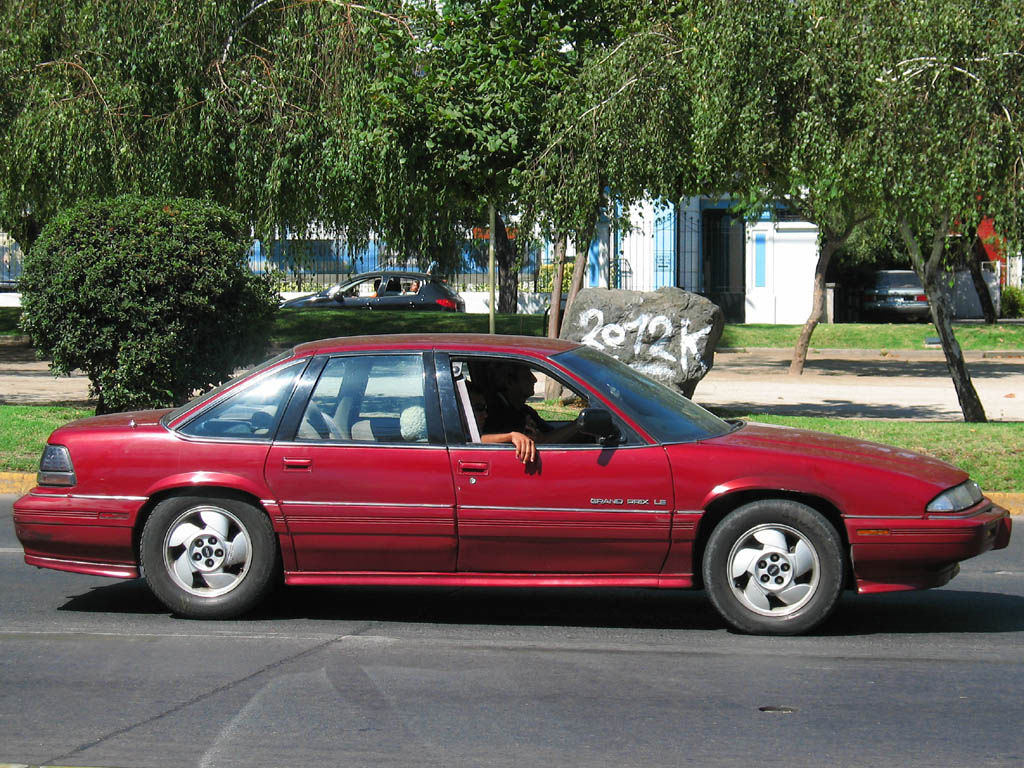

The 1992 Grand Prix came in five versions, LE, SE, STE, GT and GTP, with two V6 engines under the hood. The 3.1-liter was rated at 140 horsepower and 185 lb-ft, SAE net. The GT and GTP carried the 3.4-liter twin-cam, rated at 210 horsepower and 215 lb-ft, which gave them 70 more horsepower and 30 more lb-ft than the 3.1, the same engine every Petty Edition would get. The published production count for the year is 106,583 Grand Prix, built across all five of its versions. It was also the year Pontiac turned its coupe into a tribute to Richard Petty.1,2
The Richard Petty Edition marked the driver's 1992 retirement and his Fan Appreciation Tour. It was limited to 1,000 cars, and each one was finished in red, white or blue. Every one of them carried the 210-horsepower 3.4-liter twin-cam, specific ground effects and a rear spoiler, and Petty's signature sat on the dash beside a Fan Appreciation Tour badge. Cars with the automatic got a second-gear-start button, and a five-speed manual was also available. A manufacturer reply reproduced on an enthusiast forum also gives 1,000 built.2
That same reply gives the year's total as 106,633, fifty more than the 106,583 that the compiled history and the Standard Catalog of Pontiac print, and lists numerous engine and equipment splits whose internal arithmetic does not reconcile. It also supplies a count of 1,380 for the GT coupe alone. The reply survives as a secondhand copy posted to an enthusiast forum.1,2,3
EPA vehicle records 9065 through 9068 list four powertrain combinations for the year. The 3.1-liter came with a three-speed or a four-speed automatic; the 3.4-liter came with the four-speed automatic or a five-speed manual. Consumer Guide says the manual was limited to GT models for 1992 and 1993. That made the GT the one regular Grand Prix with a clutch pedal, and the twin-cam engine always came with it. The four-speed automatic was the only gearbox offered with both engines; the three-speed automatic was listed only with the 3.1.1,4,5
For a buyer, the choice of engine shaped everything else. The 3.1 was the everyday Grand Prix, offered with a three-speed or four-speed automatic. The 3.4's extra 70 horsepower came with the GT, the GTP and the Petty Edition, and only the 3.4 could be paired with the five-speed; by Consumer Guide's account, the GT alone offered it among the regular models. A Petty Edition automatic could leave a stop in second gear at the push of a button. Both engines carried SAE net ratings, which were published without rpm figures.1,4,5,2
The Petty Edition gave the 1992 car its most visible identity: red, white or blue paint, ground effects, a spoiler and the signature of the driver whose final season it honored. Beneath that trim sat the same 210-horsepower twin-cam that powered the GT and GTP, in a line of 106,583 cars for the year by the published count, and of which 1,000 were planned as Petty Editions, all in one of three colors.1,2
Fact sheet · 1992 · United States
The numbers
1992 Pontiac Grand Prix: GTP and GT carry the 210 hp 3.4 twin-cam.
Figures may describe different groups of cars. Add rows together only when the note says they make up a total.
Key facts
- Pontiac marked Richard Petty's 1992 retirement with a Richard Petty Edition Grand Prix coupe, reported as limited to 1,000 cars in red, white or blue, with the 210 hp 3.4-liter twin-cam V6, specific ground effects and spoiler, a second-gear-start button for the automatic, and Petty's signature on the dash beside a Fan Appreciation Tour badge; a 5-speed manual was also available.2
Production
| What was counted | Built |
|---|---|
| Grand Prix total (LE/SE/STE/GT/GTP)1,3 LE/SE/STE/GT/GTP | 106,583 |
| What was counted | Count | Counted as |
|---|---|---|
| Richard Petty Edition coupe (stated limit)2 Richard Petty Edition · 2-door coupe · 3.4L DOHC V6 The same article says production by colour and configuration is not published. | 1,000 | planned limit |
Engines
| Engine | Factory rating | Availability |
|---|---|---|
| 3.1L V61 3.1 L | 140 hp, 185 lb-ft (SAE net (per source's note that post-1972 ratings are net)) | |
| 3.4L V61 3.4 L | 210 hp, 215 lb-ft (SAE net (per source's note that post-1972 ratings are net)) |
Ratings are published figures, not dyno results. Gross and net ratings aren't directly comparable.
Transmissions
| Transmission | Availability |
|---|---|
| 3-speed automatic4 | EPA-listed with the 3.1 L V6 (record 9065) |
| 4-speed automatic4 | EPA-listed with the 3.1 L V6 (record 9066) and the 3.4 L V6 (record 9067) |
| 5-speed manual4,5 | EPA-listed only with the 3.4 L V6 (record 9068); Consumer Guide: the 3.4/5-speed combination limited to GT models for 1992 and 1993 |
Options and packages
| Option |
|---|
| Richard Petty Edition (coupe; red, white or blue; Petty signature badge, ground effects, spoiler, second-gear-start button)2 |
Identification
Read a 1992 Pontiac VIN
The VIN decoder runs in your browser and never sends the VIN anywhere. How the factory numbered this year's cars:
Same model year
Also in 1992
- Buick Riviera Sources disagree on 1992 production: 12,585 or 12,324.
- Ford Taurus SHO The last manual-only SHO year: 7,818 cars in the code table, with a passenger airbag on about half of them.
- Ford Thunderbird The Super Coupe carried on at 210 hp alongside a new 5.0 V-8 Sport model.
- Lincoln Mark VII LSC The final Mark VII year: production ended on 22 April 1992, and the year's total is disputed.
- Mercury Cougar The 25th Anniversary Cougar in Tourmaline Green; Wikipedia counts 46,928 Cougars, AEROCATS 46,982.
- Pontiac Firebird and Trans Am The third generation's last year and the GTA's smallest: 508 built, nearly half for export.