1957 · Studebaker · United States
1957 Studebaker Golden Hawk: A Supercharger Replaces the Packard V8
The Golden Hawk dropped the Packard 352 for a McCulloch-supercharged Studebaker 289 with the same 275 hp rating. The Silver Hawk replaced the three lesser 1956 Hawks.
United States · researched through 2026-09-23
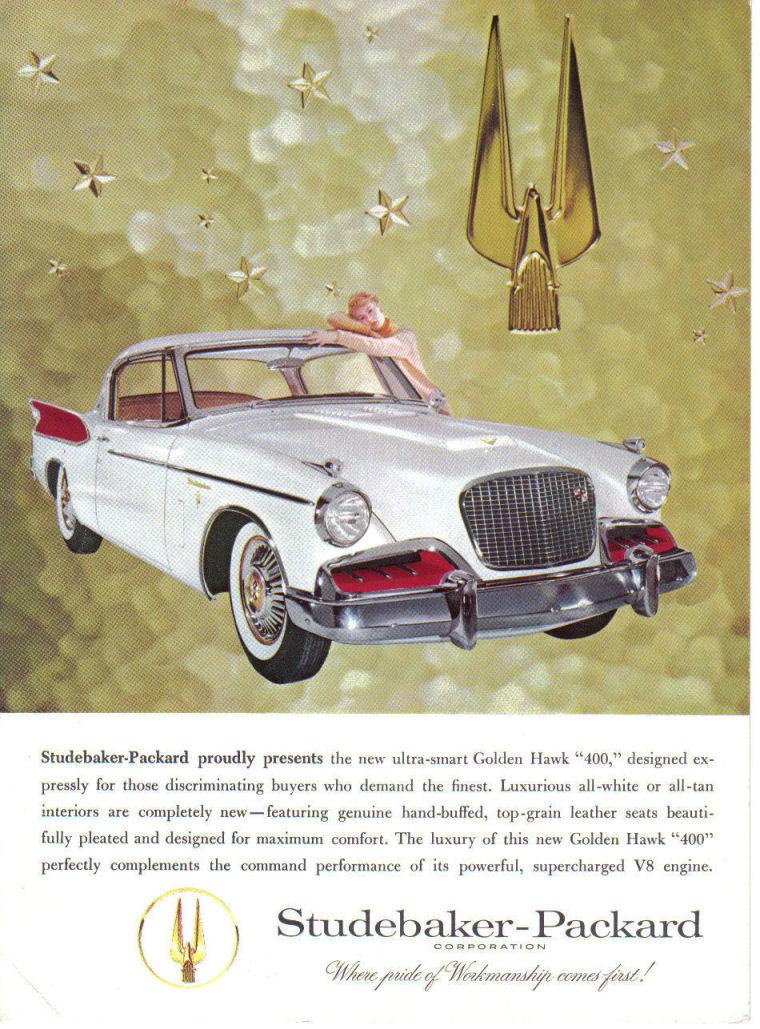
The 1957 Golden Hawk's engine was chosen by events outside the engineering department. Ate Up With Motor records that in January 1956 Studebaker-Packard's financiers refused president Jim Nance's request for a $50 million long-term loan, and that in early August the board reached a management agreement with Roy Hurley, president of Curtiss-Wright, giving him operational control. Nance resigned and Harold Churchill became president. Production at the company's Detroit facilities had already ended in late June 1956, and the board consolidated car building at South Bend. Studebaker-Packard also gave up its Utica plant in the deal. With it went the 352-cubic-inch Packard V8 and the Ultramatic transmission that had powered the 1956 Golden Hawk.1,2
The replacement came from Studebaker's own engine and an outside supplier. The Golden Hawk now used the Studebaker 289 V8 with a McCulloch VS57 centrifugal supercharger, a unit that Mac's Motor City Garage describes as a popular aftermarket booster also used on Kaiser production cars from 1954. A variable-diameter driven pulley held boost to 5 psi, and compression was cut to 7.8:1. The rating was 275 bhp at 4,800 rpm and 333 lb-ft at 3,200 rpm, the same horsepower as the Packard engine it replaced.2,3,1
The new engine changed the car's balance. Mac's Motor City Garage writes that the lighter Studebaker V8 gave the 1957 car better balance and handling, although road tests still noted excessive understeer. Ate Up With Motor credits slightly better weight distribution, rear suspension changes and an optional Twin Traction limited-slip differential with making the 1957 Golden Hawk somewhat more manageable than the 1956. It puts performance at about nine seconds to 60 mph and a top speed near 120 mph, a characterization that does not name a tested car.2,1
The body grew fins. The Studebaker National Museum records that tail fins were added to both 1957 Hawks, along with a revised hood, deck lid and taillights. Ate Up With Motor and Mac's Motor City Garage both note that the 1956 car's small bolt-on fiberglass fins were replaced by taller fins stamped in steel. The Golden Hawk kept its 120.5-inch wheelbase and hardtop body, and the museum lists its base price at $3,182, up from $3,065 in 1956.3,1,2
The supercharger cost money. Ate Up With Motor says the supercharged engine was more expensive than the Packard V8 and raised the Golden Hawk's price by $121. The museum's list prices show a $117 increase from 1956 to 1957. The two figures describe the same change on slightly different bases and are close enough to agree on the point: the 1957 car cost more than the 1956 for the same rated horsepower.1,3
The rest of the Hawk line was simplified around the Golden Hawk. The museum records that the four 1956 Hawks became two for 1957: the Golden Hawk hardtop and the Silver Hawk, a pillared coupe offered with a six or a V8. The Silver Hawk six listed at $2,142 and the V8 at $2,263, more than $900 below the Golden Hawk. The Silver Hawk's V8s were the 259 at 180 horsepower and an unsupercharged 289 rated at 210 or 225, and its six was the 185 at 101 horsepower.3,1
In April 1957 Studebaker added a more expensive version. The museum describes the Golden Hawk 400 as having special paint, a full leather interior and an upholstered luggage compartment, and lists it at $3,671. It counts 51 built. Mac's Motor City Garage explains the figure of 41 that appears elsewhere: of the 51, it says, 10 were show cars and 41 went to customers. Mac's also describes the 400's two-tone paint and notes that only a handful survive.3,2,4
The production figures for 1957 agree across sources. The museum lists 4,305 standard Golden Hawks and 51 Golden Hawk 400s. Old Cars Weekly and 1956goldenhawk.com give 4,356, the sum of those two numbers. The Golden Hawk 400 was therefore about 1 percent of 1957 Golden Hawk production. Against the 1956 Golden Hawk's 4,071, the museum's figure for the Packard-engined car, the supercharged 1957 sold 285 more, a rise of about 7 percent in a year when the Hawk line was cut from four models to two.3,5,6
The Silver Hawk sold in much larger numbers. 1956goldenhawk.com gives 15,318 in all, the sum of the museum's 4,283 sixes and 11,035 V8s. The V8 figure includes 1,180 coupes and 248 hardtops with the Commander 259 built for Canadian and export sale, and there were also 120 export-only six-cylinder hardtops. Together the two Hawks came to 19,674 cars, consistent with Ate Up With Motor's statement that Hawk sales stayed under 20,000. The Golden Hawk was about 22 percent of the total.6,3,1
The period press gave the supercharged car a generally good hearing. Mac's Motor City Garage records that the 1957 Golden Hawk appeared in Sports Cars Illustrated and Motor Life, and describes their reviews as complimentary overall, with the understeer as the chief complaint. Mac's does not relay their measured figures, so the magazines' verdicts survive only in summary. The Twin Traction differential, four-barrel carburetor with dual exhausts, power steering, power brakes and air conditioning were among the options listed for the Hawks.2,3,5
The 1957 car was the high point of the supercharged Golden Hawk. For 1958 the museum lists only 878 Golden Hawks, and a new model built on the same body took the Packard name: the Packard Hawk, which Ate Up With Motor says began as a one-off for Roy Hurley and was styled by Duncan McRae. It sold 588 copies at $3,995. The Curtiss-Wright arrangement that had removed the Packard engine from the Golden Hawk in 1957 produced a Packard-badged Hawk a year later.3,1
Seen through its numbers, the 1957 Golden Hawk solved a supply problem without losing ground. Studebaker kept the 275 horsepower rating when the Packard engine disappeared, the car handled better with a lighter engine, and production rose from 4,071 to 4,356. The cost was a higher price and a supercharger bought from an outside maker. The result was the best-selling year of the supercharged Golden Hawk, before its production fell to 878 in 1958.2,3,1
Fact sheet · 1957 · United States
The numbers
1957 Studebaker Hawk — The Golden Hawk dropped the Packard 352 for a McCulloch-supercharged Studebaker 289 with the same 275 hp rating. The Silver Hawk replaced the three lesser 1956 Hawks.
Coverage: Partial — researched sections are shown; missing ones are not yet sourced. Researched through 2026-09-23.
Every figure is labeled with how sure we are. Reported means a manufacturer, registry, or reference figure we cite but have not reconciled against factory records ourselves. Disputed means credible sources disagree and both are shown. Rows are separately scoped; don't add them together unless the note says they make up a total.
Key facts
- Golden Hawk production 4,356 including the 400. The museum lists 4,305 standard Golden Hawks and 51 Golden Hawk 400s.5,6,3
- Silver Hawk production totalled 15,318. Of these, 1,180 coupes and 248 hardtops with the Commander 259 were built for Canadian and export sale, plus 120 export-only six-cylinder hardtops.6
Production
| What was counted | Count | Basis | Status |
|---|---|---|---|
| Golden Hawk including Golden Hawk 4005,6 Golden Hawk · 2-door hardtop · 289 V8 supercharged · not stated Equals the museum's 4,305 + 51. | 4,356 | built, model-year | Reported |
| Golden Hawk (excluding 400)3 Golden Hawk · 2-door hardtop · 289 V8 supercharged · not stated | 4,305 | built, model-year | Reported |
| What was counted | Count | Basis | Status |
|---|---|---|---|
| Golden Hawk 4003,2 Golden Hawk 400 · 2-door hardtop · 289 V8 supercharged · not stated Wikipedia's 41 matches the customer-car subset. See conflicts. | 51 | built, model-year | Reported |
| What was counted | Count | Basis | Status |
|---|---|---|---|
| Silver Hawk, all engines and bodies6 Silver Hawk · coupe and hardtop · including Canadian and export Equals the museum's six (4,283) + V8 (11,035). | 15,318 | built, model-year | Reported |
| What was counted | Count | Basis | Status |
|---|---|---|---|
| Silver Hawk V8 (259 and 289), all markets3 Silver Hawk · coupe and hardtop · 259 or 289 V8 · all markets | 11,035 | built, model-year | Reported |
| Silver Hawk six, all markets3 Silver Hawk · coupe and export hardtop · 185 six · all markets | 4,283 | built, model-year | Reported |
| Silver Hawk V8, excluding the Canadian/export Commander 259 cars6,5 Silver Hawk · coupe · V8 · as printed; excludes the footnoted Canadian/export cars 9,607 + 1,180 + 248 = 11,035, the museum's V8 figure. | 9,607 | built, model-year | Reported |
| What was counted | Count | Basis | Status |
|---|---|---|---|
| Silver Hawk coupe with Commander 259, Canadian and export (57B-C3)6 Silver Hawk · 2-door coupe · 259 V8 · Canada and export | 1,180 | built, model-year | Reported |
| Silver Hawk hardtop with Commander 259, Canadian and export (57B-K3)6 Silver Hawk · 2-door hardtop · 259 V8 · Canada and export | 248 | built, model-year | Reported |
| Silver Hawk six coupe6 Silver Hawk · 2-door coupe · 185 six · as printed | 4,163 | built, model-year | Reported |
| Silver Hawk six hardtop, export only (57G-K3)6 Silver Hawk · 2-door hardtop · 185 six · export | 120 | built, model-year | Reported |
The two sources reconcile exactly. 1956goldenhawk.com's components (4,163 + 120 six; 9,607 + 1,180 + 248 V8) equal the museum's six (4,283) and V8 (11,035) rows. Both sets sum to the 15,318 total that the site states.
Prices when new
| Model | Price | Basis |
|---|---|---|
| Golden Hawk3,6 | $3,182 | base price, 1957 model year |
| Golden Hawk 4003 | $3,671 | base price as tabulated by the museum, April 1957 |
| Silver Hawk V83,5 | $2,263 | base price, 1957 model year |
| Silver Hawk six3,6 | $2,142 | base price, 1957 model year |
Prices are the nominal dollars of the day, not adjusted for inflation.
Engines
| Engine | Factory rating | Availability | Built |
|---|---|---|---|
| 289 V8, McCulloch VS57 centrifugal supercharger (Golden Hawk)2,3 289 cu in · Stromberg WW 2-barrel in a pressure box; supercharger boost limited to 5 psi | 275 hp @ 4,800, 333 lb-ft @ 3,200 (SAE gross (period advertised)) | Golden Hawk standard | Not yet sourced |
| 289 V8 (Silver Hawk)3,5 289 cu in · 2-barrel; 4-barrel with dual exhaust optional | 210 hp (SAE gross (period advertised)); 225 hp (SAE gross (period advertised); four-barrel and dual exhaust) | Silver Hawk V8 | Not yet sourced |
| 259 V8 (Silver Hawk)3 259 cu in · 2-barrel; 4-barrel with dual exhaust optional | 180 hp (SAE gross (period advertised)) | Silver Hawk V8 | Not yet sourced |
| 185 six (Silver Hawk)3 185 cu in · not stated in the sources read | 101 hp (SAE gross (period advertised)) | Silver Hawk six | 4,2833 Reported |
Ratings are the manufacturer's advertised figures under the standard shown (SAE gross before 1972, SAE net after). They are not dyno results, and gross and net ratings can't be compared directly.
Transmissions
| Transmission | Availability | Built |
|---|---|---|
| Three-speed manual, column shift5 | standard (Silver Hawk) | Not yet sourced |
| Automatic5 | optional | Not yet sourced |
Options and packages
| Code | Option | Price | Installed |
|---|---|---|---|
|
Twin Traction limited-slip differential5 | — | Not yet sourced |
|
Four-barrel carburetor with dual exhaust (+15 hp)3 | — | Not yet sourced |
|
Power steering, power brakes, air conditioning5 | — | Not yet sourced |
Interiors
| Code | Trim | Built |
|---|---|---|
|
Golden Hawk 400: full leather interior and upholstered luggage compartment3 | Not yet sourced |
Specifications
| Measure | Value | Applies to |
|---|---|---|
| Wheelbase6 | 120.5 in | all 1957 Hawks |
| Weight6 | 3,400 lb | Golden Hawk, basis not stated |
| Weight6 | 3,185 lb | Silver Hawk V8, basis not stated |
| Weight6 | 2,790 lb | Silver Hawk six, basis not stated |
| Supercharger boost limit2 | 5 psi | Golden Hawk McCulloch VS57 |
Identification
- Model codes
- Golden Hawk 57H-K7. Silver Hawk: 57G-C3 / 57G-K3 (Champion six), 57B-C3 / 57B-K3 (Commander 259), 57H-C3 (President 289).6
- Engine numbers
- Supercharged Golden Hawk engines start at PS-1,001. 1957 President-series 289s, including the Silver Hawk, start at P-39,601. Engine numbers are on top of the front of the block.7
- Factory build record
- The Studebaker National Museum holds factory Production Orders for most 1936-1966 Studebakers.8
- Body codes (compiled table)
- 57G-C3 Silver Hawk six coupe (185.6); 57G-K3 Silver Hawk six hardtop, export only; 57H-C3 Silver Hawk V8 coupe (289); 57H-K7 Golden Hawk hardtop (supercharged 289); 57H-K7# Golden Hawk 400 hardtop (special).9
Where the sources disagree
Golden Hawk 400 production
Lead with 51. Explain that 41 matches the customer cars once the 10 show cars are excluded (Mac's Motor City Garage).
Same model year
Also in 1957
- AMC Rebel and Rebel Machine The first Rebel: a one-year Rambler four-door hardtop with AMC's new 327 V8. It is the precursor to the name the 1970 Machine carried, not the same car.
- Chrysler 300 letter series The Forward Look 300C added a convertible, a 392 Hemi rated at 375 or 390 hp and torsion-bar front suspension; its hardtop count is disputed between the club (1,767) and Over-Drive (1,918).
- Ford Thunderbird The last two-seat Thunderbird was also the fastest: a supercharged F-code 312 joined the dual-quad E-code, and 21,380 were built over a season that ran to December 1957.