1957 · Ford · United States
1957 Ford Thunderbird: The Supercharged F-Code and the Race Program That Ended Around It
The last two-seat Thunderbird was also the fastest: a supercharged F-code 312 joined the dual-quad E-code, and 21,380 were built over a season that ran to December 1957.
United States · researched through 2026-09-23
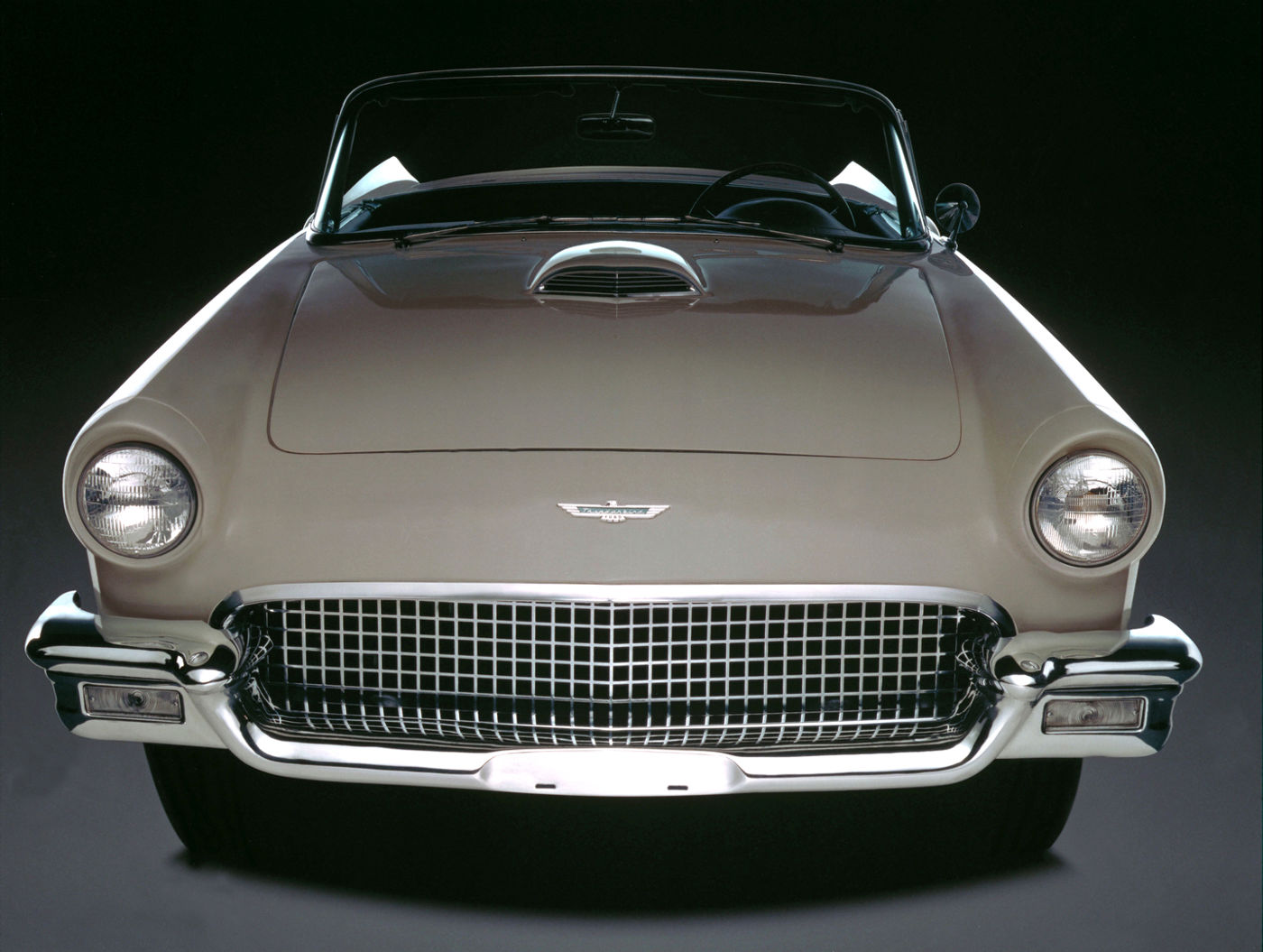
The first supercharged Thunderbirds were built for a rulebook, not a showroom. According to John Gunnell, writing in Old Cars Weekly, the first 15 production supercharged cars were reportedly built in January 1957 to homologate the engine for NASCAR competition. They were D-series cars, carrying the 312 four-barrel V-8, fitted with Paxton-McCulloch superchargers, and Gunnell places their serial numbers near 30,000. Behind them stood a racing operation that had already been working on Thunderbirds: Peter DePaolo Engineering in Long Beach, California, had modified the factory-sponsored 1956 cars, and its Gus Davis developed a dual-point distributor.1
The blown Thunderbird proved its point on the sand before the season's politics caught up with it. At the 1957 Daytona Spring Speed Week trials, Gunnell writes, a modified supercharged Thunderbird with a crankshaft stroked a quarter-inch, lightweight aerodynamic body panels and a strengthened gearbox and rear axle beat the Corvettes and ran the two-way flying mile on the beach at 138.755 mph. Later that year, he adds, the car topped 160 mph at Bonneville. That was a race-prepared machine, not a showroom Thunderbird, and the article does not name its driver. What it showed was what Ford's supercharged 312 could become.1
The car those racers were based on was having its best year. Old Cars Weekly and the Classic Thunderbird Club International both give 21,380 Thunderbirds for 1957, the most of the three two-seat years, and 53,166 two-seaters for 1955 through 1957. Old Cars Weekly prices the car at $3,383 with the hardtop and $3,438 as a convertible, without stating the basis, and says some 75 percent of 1957s had the porthole hardtop. A three-speed manual was standard and the tires were 7.50 by 14. Most of the 21,380, on those figures, left the factory as comfortable two-seat tourers rather than anything built for the sand.1,2
Under the hood, the engine chart ran from mild to wild, with ratings that were period advertised gross figures as the sources report them. The C-code 292 two-barrel made 212 hp, and the club says it came only with the manual transmission. The D-code 312 Thunderbird Special four-barrel made 245 hp. The E-code 312 with two four-barrel carburetors is given by Old Cars Weekly as 285 hp in one article and 270 hp with 9.7:1 compression in another, and the club gives it as 270 to 285. At the top sat the F-code, the Paxton-McCulloch supercharged 312, which Old Cars Weekly rates at 300 hp and the club at 300 to 360.1,2
Gunnell describes the F-code's hardware in detail. It used a Paxton-McCulloch VR57 supercharger on the 312 four-barrel, compression lowered to 8.5:1, and a camshaft with 290 degrees of duration against the stock 256. He gives tuned ratings of 325 to 340 hp, and a factory invoice price of $340 for the option; the club gives the supercharger's cost as $500. The two figures sit on different bases, invoice against an unstated one, and neither can correct the other. Gunnell says the F engines, 196 of them, were built from the spring of 1957.1,2
How many supercharged Thunderbirds exist is a question both sources answer with a hedge. Gunnell counts the 15 DF cars plus 196 F engines and writes that the "official" total of 211 superchargers in the D and F series "is an approximation." The club gives 208 to 211 F-series cars, 14 of them D-F cars rather than 15. Against 21,380 Thunderbirds, even the higher figure means about one car in a hundred. The engine letter alone does not settle a claim, either: the early DF cars were D-coded cars fitted with superchargers, so a D in the serial does not rule one out.1,2
The club's counts for the other engines are published as approximations too: about 3,300 C-series cars, about 16,423 D-series and about 1,499 E-series. They add up to roughly 21,430, not 21,380, so they cannot be read as an exact partition, but they show the shape of the year: on the club's figures roughly three Thunderbirds in four had the 245-hp four-barrel 312. Old Cars Weekly offers a different picture of the dual-quad car, saying only 10 percent of 1957s were E-codes. That share and the club's count do not agree, and the share is not a count of its own.2,1
The racing program the F-code was built for did not last the year. In April 1957, Speed Sport's history records, NASCAR disallowed optional equipment such as fuel injection and superchargers in favor of normal production four-barrel carburetors, partly because Ford and Chevrolet had violated its new "Pure Advertising Law." On June 6, 1957, the Automobile Manufacturers Association voted to halt its members' participation in racing and to emphasize safety in advertising. Ford's John Holman said, "I'm in the process of closing up the shop," and Chevrolet's Chuck Daigh said he was going back to California to look for a job. The supercharged Thunderbird had been homologated in January and had lost its reason for being by summer.3,1
The Thunderbird itself stayed in production into December. The club dates the last 1957 car to December 13, 1957, and its data-plate guide shows the plates changing in the middle of the run: large plates through mid-April 1957, then smaller plates phased in between April 15 and 19 that dropped destination and scheduled-item codes and added transmission and axle codes. That change is a physical marker that helps place a 1957 car in the early or late part of a season that ran until a few weeks before the new year.2
What followed was a different car. Old Cars Weekly records that production of the four-seat 1958 coupe began on January 13, 1958, weeks after the last two-seater, on a 113-inch wheelbase, and that 37,392 were built that year; Wikipedia, citing Hemmings, gives 37,892, and the difference stands unresolved. The 1957 car was the last two-seat Thunderbird of the era, the best-selling of the three, and the one with a supercharger on the option list. About 211 buyers, by the hedged counts, took that option in a year when the racing it was built for had been shut down.1,4,2
Fact sheet · 1957 · United States
The numbers
1957 Ford Thunderbird — The last two-seat Thunderbird was also the fastest: a supercharged F-code 312 joined the dual-quad E-code, and 21,380 were built over a season that ran to December 1957.
Coverage: Partial — researched sections are shown; missing ones are not yet sourced. Researched through 2026-09-23.
Every figure is labeled with how sure we are. Reported means a manufacturer, registry, or reference figure we cite but have not reconciled against factory records ourselves. Disputed means credible sources disagree and both are shown. Rows are separately scoped; don't add them together unless the note says they make up a total.
Key facts
- 21,380 built for 1957; 53,166 two-seat Thunderbirds across 1955–57.1,2
- F-code supercharged 312 rated 300 hp; the supercharged total is about 211 (15 DF plus 196 F) by Gunnell's count and 208–211 by the club's. Both call their figures approximate.1,2
- Old Cars Weekly says about 75 percent of 1957s had the porthole hardtop.1
- Production ran to December 13, 1957; data plates changed from the large to the small style in mid-April 1957.2
Production
| What was counted | Count | Basis | Status |
|---|---|---|---|
| Thunderbird, all engines1,2,4,5 Thunderbird · 2-seat convertible with hardtop and/or soft top · all production Old Cars Weekly, the club and Hemmings (via Wikipedia) agree; independence of these lineages is not established. | 21,380 | built, model-year | Reported |
| What was counted | Count | Basis | Status |
|---|---|---|---|
| C-series (292 two-barrel)2 Thunderbird · 292 V-8 2-bbl (C) · all production Published by the club as an approximation; method not stated. | 3,300 | built, model-year | Estimate |
| D-series (312 four-barrel)2 Thunderbird · 312 V-8 4-bbl (D) · all production Published by the club with a '~' approximation mark; method not stated. | 16,423 | built, model-year | Estimate |
| E-code (312 dual four-barrel)2 Thunderbird · 312 V-8 2x4-bbl (E) · all production Club approximation. Old Cars Weekly (OCW-1957b) says 'only 10 percent' were E-code, which implies about 2,100; see conflicts. | 1,499 | built, model-year | Estimate |
| F-code (312 supercharged), including D/F conversions2,1 Thunderbird · 312 V-8 supercharged (F and D/F) · all production The two sources give 208–211 and about 211 respectively, and differ on 14 or 15 D/F cars. No single figure is published here. | Unknown | built, model-year | Disputed |
| F engines (excluding D/F conversions), per Gunnell1 Thunderbird · 312 V-8 supercharged (F) · all production | 196 | built, model-year | Reported |
| D/F supercharged conversions, per Gunnell1 Thunderbird · 312 V-8 supercharged (D/F) · all production The Classic Thunderbird Club gives 14. | 15 | built, model-year | Disputed |
Engine rows are separately sourced approximations and do not partition the 21,380 total; the club's four figures sum to about 21,430.
No body-style, transmission, paint or trim counts were found in an accessible source.
Prices when new
| Model | Price | Basis |
|---|---|---|
| Base price, Thunderbird with hardtop1 | $3,383 | base price as reported by Old Cars Weekly (basis not stated), 1957 model year |
| Base price, Thunderbird convertible1 | $3,438 | base price as reported by Old Cars Weekly (basis not stated), 1957 model year |
| Thunderbird convertible (series C7, model 40), factory price5 | $3,408 | factory price as compiled, 1957 model year |
Prices are the nominal dollars of the day, not adjusted for inflation.
Engines
| Engine | Factory rating | Availability | Built |
|---|---|---|---|
| C · 292 V-8, two-barrel1,2 292 cu in · 2-barrel | 212 hp (period advertised gross rating as reported) | standard (the club says manual transmission only) | 3,3002 Estimate |
| D · 312 Thunderbird Special V-8, four-barrel1,2 312 cu in · 4-barrel (Holley) | 245 hp (period advertised gross rating as reported) | optional | 16,4232 Estimate |
| E · 312 Thunderbird Super V-8, two four-barrels1,2 312 cu in · 2 x 4-barrel (Holley) | 270 hp (period advertised gross rating as reported (9.7:1 compression)); 285 hp (period advertised gross rating as reported (higher-compression version)) | optional | 1,4992 Estimate |
| F · 312 V-8, Paxton-McCulloch supercharged1 312 cu in · Paxton-McCulloch supercharger | 300 hp (period advertised gross rating as reported) | optional; factory invoice price $340 per Gunnell | Unknown1,2 Disputed |
| 312 Thunderbird High Output V-8, race version (not sold to the public)5 312 cu in · 2 x 4-barrel | 285 hp @ 5,000, 340 lb-ft @ 3,800 (SAE gross) | selected race teams only, per the compilation | Not yet sourced |
| 312 Supercharged V-8, race version (not sold to the public)5 312 cu in · supercharged 4-barrel | 340 hp @ 5,400, 430 lb-ft @ 3,000 (SAE gross) | selected race teams only, per the compilation | Not yet sourced |
Ratings are the manufacturer's advertised figures under the standard shown (SAE gross before 1972, SAE net after). They are not dyno results, and gross and net ratings can't be compared directly.
Transmissions
| Transmission | Availability | Built |
|---|---|---|
| Three-speed manual1 | standard | Not yet sourced |
| Overdrive (3-speed manual with overdrive)5 | optional, $146 in the option list (the transmission section says $110); 0.72 overdrive | Not yet sourced |
| Ford-O-Matic automatic5 | optional; 2.40/1.46/1.00, floor shift | Not yet sourced |
Options and packages
| Code | Option | Price | Installed |
|---|---|---|---|
Fengine code |
Supercharged 312 V-81,2 | — | Unknown1,2 Disputed |
|
Thunderbird Special V-8, 245 hp, for standard-transmission cars5 | $125 | Not yet sourced |
|
Automatic transmission5 | $215 | Not yet sourced |
|
Overdrive transmission5 | $146 | Not yet sourced |
|
Power steering5 | $68 | Not yet sourced |
|
Power brakes5 | $38 | Not yet sourced |
|
Power seat5 | $60 | Not yet sourced |
|
Power windows5 | $70 | Not yet sourced |
|
Radio5 | $100 | Not yet sourced |
|
Heater5 | $85 | Not yet sourced |
|
Engine dress-up kit5 | $25 | Not yet sourced |
|
Wire wheel covers5 | $35 | Not yet sourced |
|
Full wheel covers5 | $12.75 | Not yet sourced |
|
Back-up lights5 | $8.50 | Not yet sourced |
|
Full-flow oil filter5 | $9.15 | Not yet sourced |
|
Rear fender shields5 | $26.60 | Not yet sourced |
|
Tinted safety glass5 | $23.13 | Not yet sourced |
|
White sidewall tires5 | $30 | Not yet sourced |
|
Windshield washers5 | $10 | Not yet sourced |
|
Outside rear-view mirror5 | $5 | Not yet sourced |
|
Dial-O-Matic memory seat5 | — | Not yet sourced |
Paint
| Code | Color | Built |
|---|---|---|
A |
Raven Black5 | Not yet sourced |
C |
Dresden Blue5 | Not yet sourced |
E |
Colonial White5 | Not yet sourced |
F |
Starmist Blue5 | Not yet sourced |
G |
Cumberland Green5 | Not yet sourced |
J |
Willow Green5 | Not yet sourced |
K |
Silver Mocha5 | Not yet sourced |
L |
Doeskin Tan5 | Not yet sourced |
N |
Gunmetal Gray5 | Not yet sourced |
Q |
Bronze5 | Not yet sourced |
T |
Woodsmoke Gray5 | Not yet sourced |
V |
Berkshire Green5 | Not yet sourced |
V |
Flame Red5 | Not yet sourced |
W |
Springmist Green5 | Not yet sourced |
X |
Dusk Rose5 | Not yet sourced |
Y |
Inca Gold5 | Not yet sourced |
Y |
Sunset Coral5 | Not yet sourced |
Z |
Coral Sand5 | Not yet sourced |
Color names are the factory's. We don't show color swatches, because a screen color is no guide for a restoration.
Specifications
| Measure | Value | Applies to |
|---|---|---|
| 312 bore x stroke1 | 3.80 x 3.44 in | 312 V-8 |
| Tires1 | 7.50 x 14 | all |
| Shipping weight5 | 3,134 lb | production table |
| Overall length5 | 181.4 in | all |
| Overall width5 | 72.8 in | all |
| Overall height, top up5 | 51.6 in | soft top or hardtop |
| Front track5 | 56 in | all |
| Rear track5 | 56 in | all |
| Rear axle, standard5 | 3.56 (3-speed; optional 3.70), 3.70 (overdrive; optional 3.91), 3.10 (Ford-O-Matic; optional 3.70) | by transmission |
Period road tests
| Test | Car tested | Result |
|---|---|---|
| Old Cars Weekly (reporting the 1957 Daytona speed trials), 19571Flying mile | Supercharged Thunderbird, race-prepared; exact entry, driver and date not specified by the sourceDaytona Beach speed trials; secondary report | 138.755 mph |
A road test result belongs to the one car that was tested, with its engine, gearing, tires, and conditions. It is not a figure for every car of the year.
Identification
- Engine code
- The engine letter (C, D, E, F) identifies the 1957 engine; early DF cars were D-coded cars fitted with superchargers, so the letter alone does not settle a supercharged car.1,2
- Data plate
- The patent/data plate is on the firewall near the heater duct. Large plates were used through mid-April 1957; small plates, phased in April 15–19, 1957, dropped the destination and scheduled-item codes and added transmission and axle codes.2
Where the sources disagree
Supercharged (F and D/F) production
Show both with attribution; no single count is published. A Ford production-order or Marti-type build record would settle it.
E-code production
The club's approximate count is shown as an estimate; the percentage is not converted into a count.
Supercharger option price
Different bases (invoice versus unspecified); both shown.
Identification
Read a 1957 Ford VIN
The VIN decoder runs in your browser and never sends the VIN anywhere. How the factory numbered this year's cars:
Same model year
Also in 1957
- AMC Rebel and Rebel Machine The first Rebel: a one-year Rambler four-door hardtop with AMC's new 327 V8. It is the precursor to the name the 1970 Machine carried, not the same car.
- Chrysler 300 letter series The Forward Look 300C added a convertible, a 392 Hemi rated at 375 or 390 hp and torsion-bar front suspension; its hardtop count is disputed between the club (1,767) and Over-Drive (1,918).
- Studebaker Hawk The Golden Hawk dropped the Packard 352 for a McCulloch-supercharged Studebaker 289 with the same 275 hp rating. The Silver Hawk replaced the three lesser 1956 Hawks.