People · Team owner and executive · Penske Racing, Penske Corporation
Roger Penske: Preparation as a Competitive Technology
From a borrowed-money Chevrolet dealership to a Corvette program to a Camaro-then-Javelin championship team to owning the Indianapolis Motor Speedway itself, the same organizing method scaled up three separate times.
Story reviewed September 27, 2026
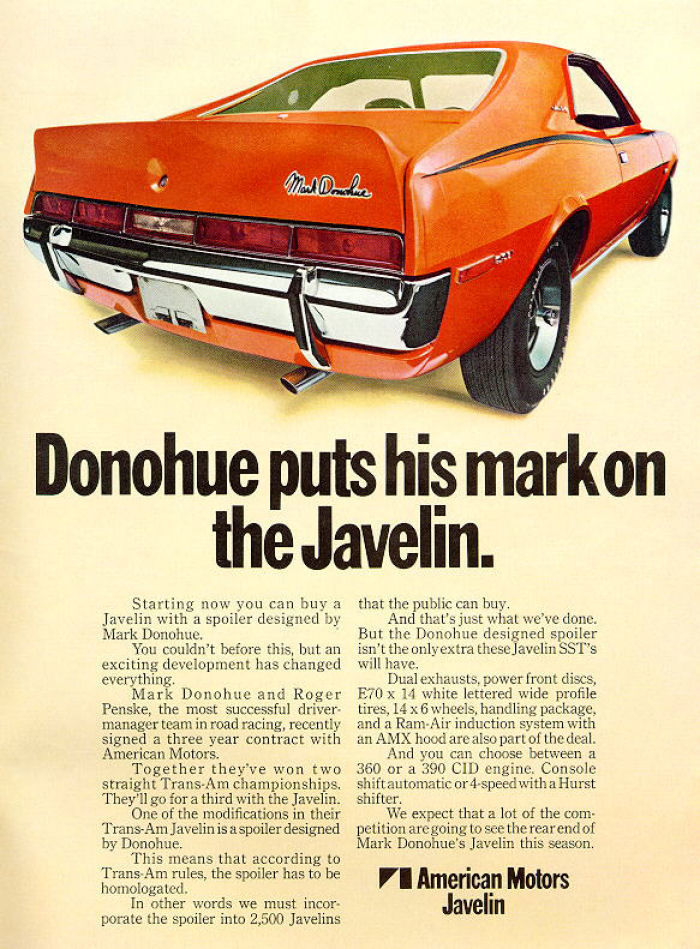
"The Captain" is not a driver's nickname in the usual sense — Roger Penske earned it as an owner and organizer, not for anything he did behind a wheel after 1965. The throughline of his career, from a borrowed-money Chevrolet dealership to a Corvette effort to a Camaro program to an AMC Javelin championship to owning the Indianapolis Motor Speedway itself, is not raw speed. It is the belief that preparation, presentation, and organization are themselves a competitive advantage, applied at a steadily increasing scale for more than sixty years.
Penske was born in 1937 in Shaker Heights, Ohio, the son of a metal-distributorship executive who taught him, in Penske's own telling, the value of loyalty. A summer at the Culver Military Academy at age eleven left him with lessons in leadership and self-discipline he credited for the rest of his life. At fourteen, his father took him to the Indianapolis 500; Penske later said he knew immediately the racetrack was where he wanted to be. He studied business at Lehigh University, worked three college summers at an Alcoa plant, and became an Alcoa sales engineer in 1959 while racing on the side — competing at Le Mans, Sebring, and Daytona, and building relationships with Chevrolet executives along the way. In 1961, Sports Illustrated named him the Sports Car Club of America's Driver of the Year.
The crossroads between driving and business arrived early. In 1963, at 26, Penske left Alcoa to become general manager of a Philadelphia Chevrolet dealership, later borrowing $50,000 from his father to buy it outright. That same year he was invited to a rookie test for the Indianapolis 500 — the exact goal his fourteen-year-old self had set — and turned it down, because Chevrolet was not comfortable with him dividing his attention between the dealership and racing. He kept competing for two more years before retiring from driving in 1965 to focus on business full time.
Racing did not disappear from the plan; it changed shape. Penske fielded Corvettes at the 1966 Daytona and Sebring endurance races, then partnered with driver Mark Donohue to campaign a Lola T70 in the USRRC and Can-Am sports car series. The results came fast: two consecutive USRRC championships and three SCCA Trans-Am titles, the Trans-Am years built first around Chevrolet's Camaro and covered in full elsewhere on this site's own racing pages, which this page does not repeat.
Indy car racing came next. Penske Racing entered USAC-sanctioned road races in 1968, then made its Indianapolis 500 debut in 1969, where Donohue finished seventh and earned Rookie of the Year honors. After 1969 the operation moved from Camaro to a new AMC Javelin program — a switch this site's own account of the 1971 season covers in the detail it deserves — and Penske Racing scored its first Championship Car victory at Pocono on July 3, 1971. Less than a year later, Donohue gave Penske his first Indianapolis 500 win, at an average speed that stood as the race record for the next twelve years.
The operation kept widening from there. Penske Racing debuted in NASCAR in 1972, the same season as that first Indy 500 win, and fielded a Formula 1 car later in the decade. Across the following five decades the team became one of the winningest organizations in American motorsports, carrying drivers including Rick Mears, Bobby and Al Unser, Danny Sullivan, Emerson Fittipaldi, and Helio Castroneves. By its 60th anniversary season in 2026, Team Penske's own count stood at more than 660 race victories, over 700 pole positions, 48 national championships, 20 Indianapolis 500 wins, three Daytona 500 championships, an F1 win, overall victories at the 24 Hours of Daytona and 12 Hours of Sebring, and a win in Australia's Bathurst 1000.
The Chevrolet dealership Penske bought in 1963 became the actual cornerstone of a business run on the same logic as the racing operation. It grew into Penske Corporation, a privately held transportation-services holding company whose subsidiaries span truck leasing and logistics (Penske Truck Leasing, Penske Logistics) and retail automotive (the publicly traded Penske Automotive Group, NYSE: PAG). As of Team Penske's own current figures, the corporation manages businesses with more than $43 billion in consolidated revenue, operating from over 3,300 locations and employing nearly 69,000 people worldwide — a scale built from the same dealership where a 26-year-old chose business over an Indy 500 rookie test. Penske has described the growth as relational rather than planned in advance: racing connections led to the dealership, the dealership led into truck rental and leasing, and a return to racing as a team owner eventually led to a diesel-engine distributorship as well. He has said money was never the motivator behind any of it — the reward, in his own account, was building an organization people wanted to join and did not want to leave.
The clearest expression of that same instinct came in 2019, when Penske Corporation bought the racing world's own center of gravity. On November 4, 2019, the Hulman-George family, which had controlled Indianapolis Motor Speedway since Tony Hulman bought it in 1945, announced the sale of IMS, the IndyCar Series, and IMS Productions to Penske Corporation, making Penske just the fourth ownership group in the Speedway's century-plus history. Penske Corp. officially took ownership on January 6, 2020, operating the properties under a new subsidiary, Penske Entertainment; in 2025, Fox Corporation acquired a one-third interest in that subsidiary.
A driver who quit driving to run a dealership better than his competitors ran theirs, a team owner who out-prepared bigger-budget rivals in sports cars, Trans-Am, and Indy cars, and an executive who eventually bought the track where his cars had once had to earn their place — it is the same method scaled up three separate times, not three separate careers. Team preparation and presentation, the qualities Penske's own organization has always credited for its early competitive edge over better-funded factory efforts, turned out to be portable: from a dealership floor, to a garage, to a company that now owns the sport itself.