Racing · K&K Insurance Dodge · Harry Hyde · 1970
Bobby Isaac, Harry Hyde, and the 1970 Title: Eleven Wins Were the Disciplined Season
Eleven wins from forty-seven starts, and a championship that the aero-war headlines have mostly buried.
Story reviewed July 27, 2026
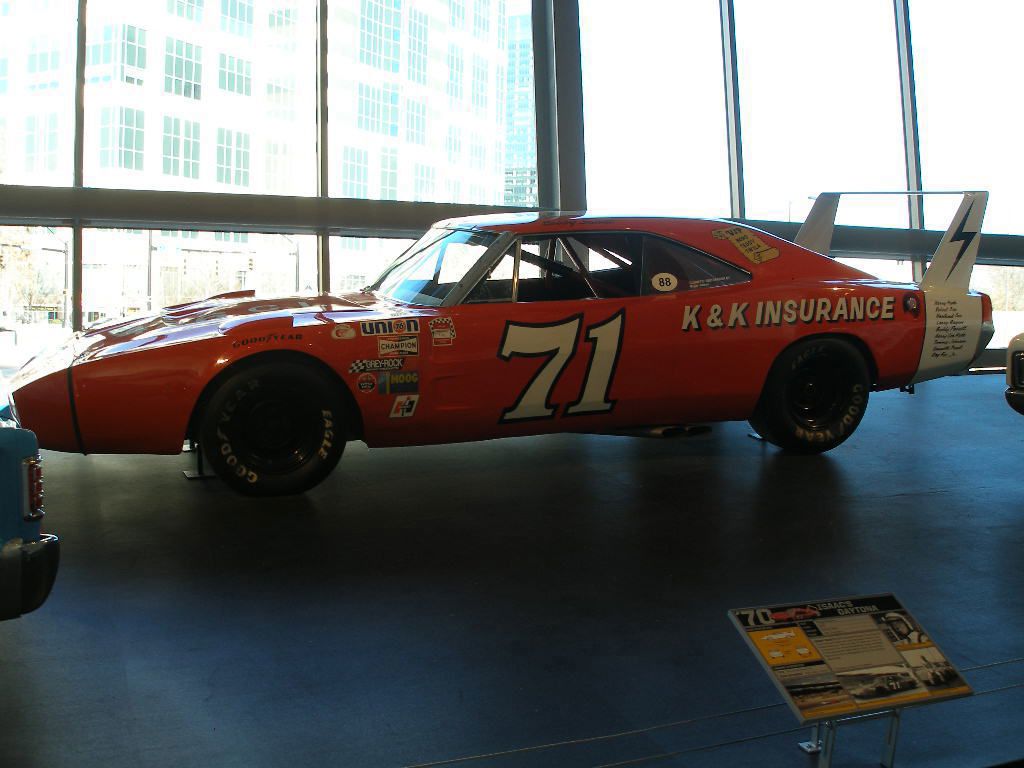
Bobby Isaac entered 1970 after a season of spectacular speed that had not produced a championship. NASCAR’s institutional biography records 17 wins and 19 poles in 1969, yet failures left him sixth in the final standings. That contrast is the opening scene: the No. 71 K&K Dodge already knew how to be fastest, but owner Nord Krauskopf, crew chief Harry Hyde, Isaac, and the team needed to make speed survive an entire schedule.
The organization deserves to be named as a working unit. Krauskopf owned the effort, Hyde directed preparation and race decisions, Isaac drove, and mechanics turned the plan into a reliable car. The familiar bright Dodge and winged Daytona imagery can obscure those roles. A manufacturer supplied identity and support; a private team converted it into repeated entries. The championship cannot be assigned solely to Dodge hardware or solely to the driver.
Isaac’s 1969 numbers make the engineering problem clear. Winning often and starting at the front did not compensate for unfinished races. The 1970 approach emphasized completing events without surrendering competitive speed. NASCAR’s record gives 47 starts, 11 victories, 32 top-five finishes, and 38 top tens. Those statistics belong in the narrative because their pattern shows consistency, not because the page is intended as a database recital.
Hyde’s reputation for preparation sits at the center of that change. A crew chief’s work includes decisions whose documentation varies from race to race, so this release avoids invented shop dialogue and undocumented setup details. What the season record supports is the effect: a team that converted more of its starts into durable high finishes. Future team papers, interviews, and race reports can deepen individual events without rewriting the championship-level arc.
The Charger Daytona belongs to the team’s identity but not to every result as a universal chassis claim. Aero cars were built around NASCAR homologation and superspeedway demands; conventional Dodge bodies remained part of the season. Each race record needs the exact make, model, entrant, and chassis evidence before the winged silhouette is attached. The street Daytona likewise stays in a factory-special branch rather than becoming an ordinary Charger R/T trim.
That distinction matters for comparison. A 1970 Charger R/T 440 with standard TorqueFlite, a Six Pack four-speed car, and a Hemi four-speed car are factory street configurations. Isaac’s race engine, weight, tires, aerodynamic preparation, and axle belong to competition records. Shared names and engine architecture make the public connection understandable, but they do not make a showroom rating an observed race output.
The 11 wins of 1970 were fewer than the 17 of 1969. In a story trained to treat the largest number as the best number, that sounds like decline. The 32 top fives and 38 top tens reveal the opposite. Krauskopf, Hyde, Isaac, and the team made the season less fragile. Reliability and disciplined finishing turned a car capable of dominating weekends into a program capable of winning the championship.
Isaac’s Hall of Fame account confirms the title and places it within a career that included extraordinary qualifying speed. The page uses that institutional retrospective for broad record and character, while exact events remain attached to period results when acquired. A later honor can summarize significance; it should not silently supply missing mechanical detail or reconstruct every shop decision.
Images remain a separate rights problem. NASCAR and archive pages contain compelling photographs of Isaac, Hyde, the K&K team, and winged Dodges, but page access is not reuse permission. A candidate must identify photographer or agency, date, event, car, rights holder, permitted use, and credit. Until owner review authorizes contact or licensing, the page remains text-only with a prioritized external request.
The disciplined season is a better title story than a claim that the fastest car finally won. Isaac’s driving, Hyde’s preparation, Krauskopf’s organization, Dodge support, and crew labor reduced the failures that had made 1969 spectacular but insufficient. Eleven victories became more valuable than seventeen because they arrived inside 47 starts that kept producing points. The championship belonged to a working system, and the narrative keeps every documented part of that system visible.
The story also leaves room for discrepancy rather than smoothing it away. Later summaries may differ in event counts, body identification, or which races used aero equipment. Those are not solved by attaching the most famous photograph to every weekend. Each result should be reconciled against an official sheet, team record, or period report, with credible differences narrated. A lone forum claim remains an acquisition lead rather than a public conflict.
Contextual links belong where the machinery actually overlaps. The Charger R/T comparison can point here when explaining Dodge’s competition identity, but it must state that the street configuration is not Isaac’s car. A future Daytona specialty page can link to exact races after chassis evidence is acquired. The site gains coherence through those specific bridges; a generic family footer would add no historical understanding.
Research priorities are equally specific: acquire K&K team papers, Hyde interviews, official results, and manufacturer correspondence; identify mechanics whose roles can be sourced; and present exact photographs for owner licensing review. That work can add shop and race scenes later. Until then, the season totals and institutional biographies support a full team narrative without pretending access to private conversations.
The championship also belongs in the site’s wider 1970 story. Plymouth’s Hamilton success, Ford’s Trans-Am title, and NHRA’s new Pro Stock class show factories pursuing several kinds of public competition at once. Isaac’s achievement was the season-long NASCAR answer: not one homologation claim or one spectacular qualifying lap, but a durable accumulation of finishes.
Seen that way, the No. 71 becomes more than a winged-car icon. It is evidence that a racing organization learned from a brilliant but fragile year, redistributed effort toward completion, and allowed every participant’s role to compound across 47 starts. The title was won repeatedly before it was awarded.
The lesson belongs beside the horsepower pages because it challenges their easiest assumption. Maximum output can define an advertised engine, but championships also depend on preparation, repair, judgment, and finishing. Isaac and Hyde did not make 1970 less exciting by winning eleven times instead of seventeen. They made the program effective across the calendar, which is a different and more demanding measurement of performance.