1970 · Dodge · United States
1970 Dodge Charger: 200 MPH at Talladega, Half the Sales at Home
The last year of the second-generation body: a new full-width grille, three series (Charger, 500, R/T), the 440 Six Pack added to the R/T, and production roughly half of 1969's.

On March 24, 1970, Buddy Baker took a blue Dodge onto the Alabama International Motor Speedway at Talladega and, on his 34th lap, went around at 200.447 mph. NASCAR inspected the car for legality beforehand, chief timer and scorer Joe Epton brought timing equipment from Atlanta, Bill France was there to watch, and Dodge engineers had been tuning the car throughout the test. It was the first officially timed lap above 200 mph on a closed course. Afterward Baker called it ‘the best feeling I've had in a long, long time.’ He was the first to top 200 mph behind the wheel of a Hemi-powered Charger.1,2,3
The car was not a showroom Daytona, and its history says a good deal about how the aero program worked. It was Chrysler development car DC-93, which began life as a 1969 Charger 500 used as a magazine test car on the West Coast. It was stolen, stripped and found on blocks in Los Angeles, then rebuilt by Nichels Engineering as a NASCAR development car and fitted with the Daytona's nose and rear wing, and a 426 Hemi. Bobby Allison, Bobby Isaac, Dan Gurney, Paul Goldsmith and Charlie Glotzbach had all driven the chassis before Baker. The 200-mph Charger was an engineering test car built from a recovered street car, which is about as far from a dealer's order form as a Charger could get.1
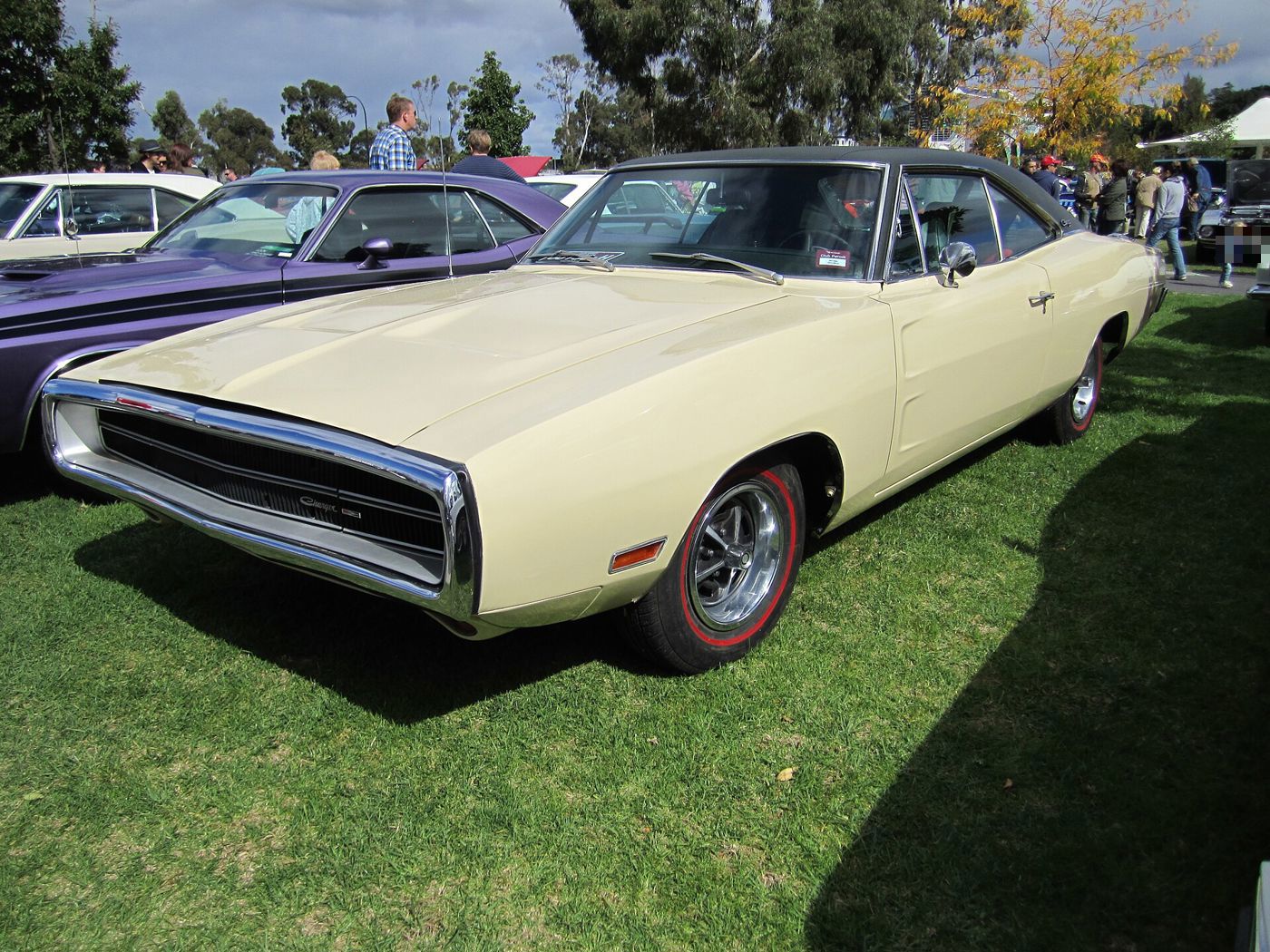
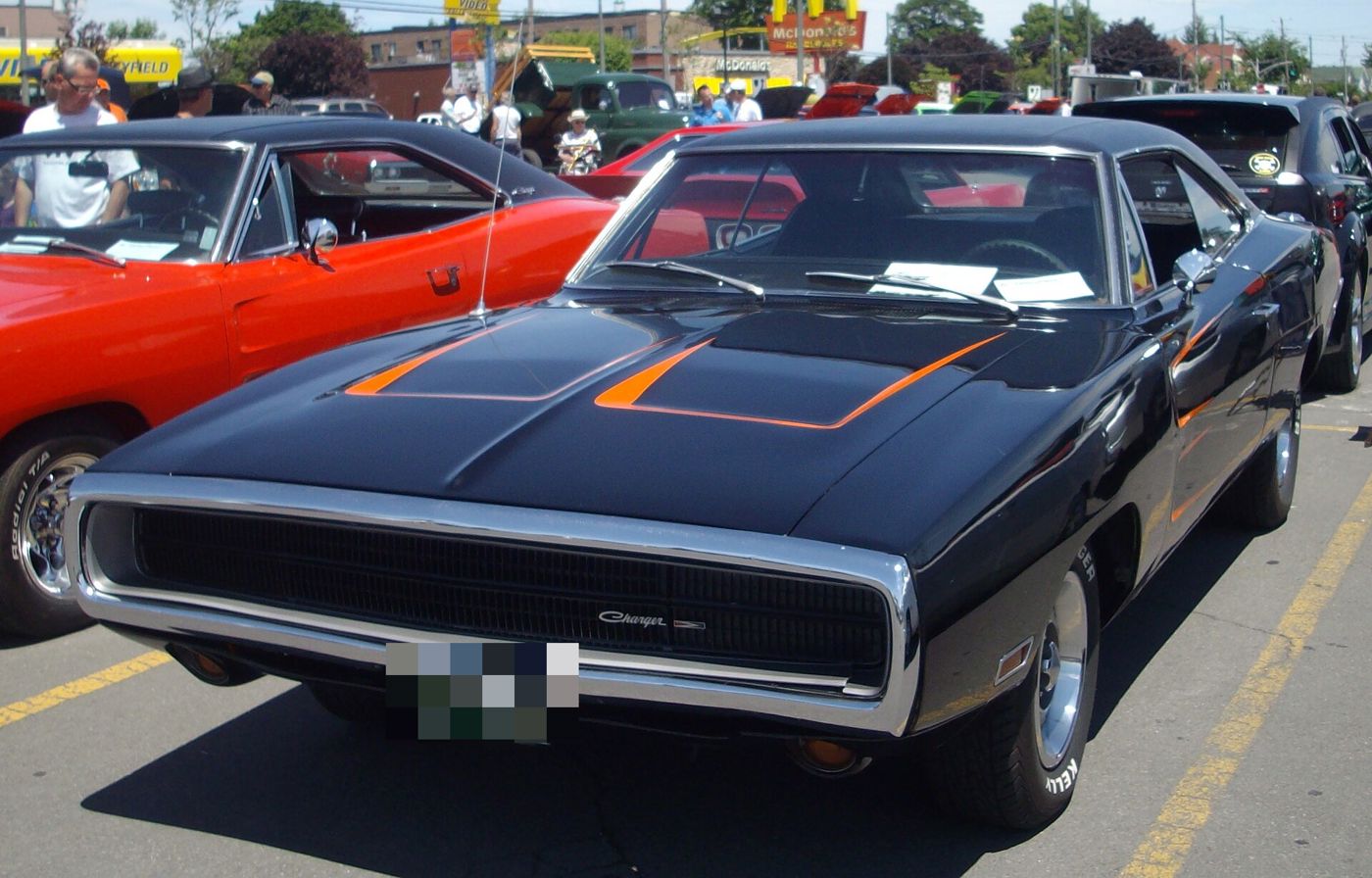
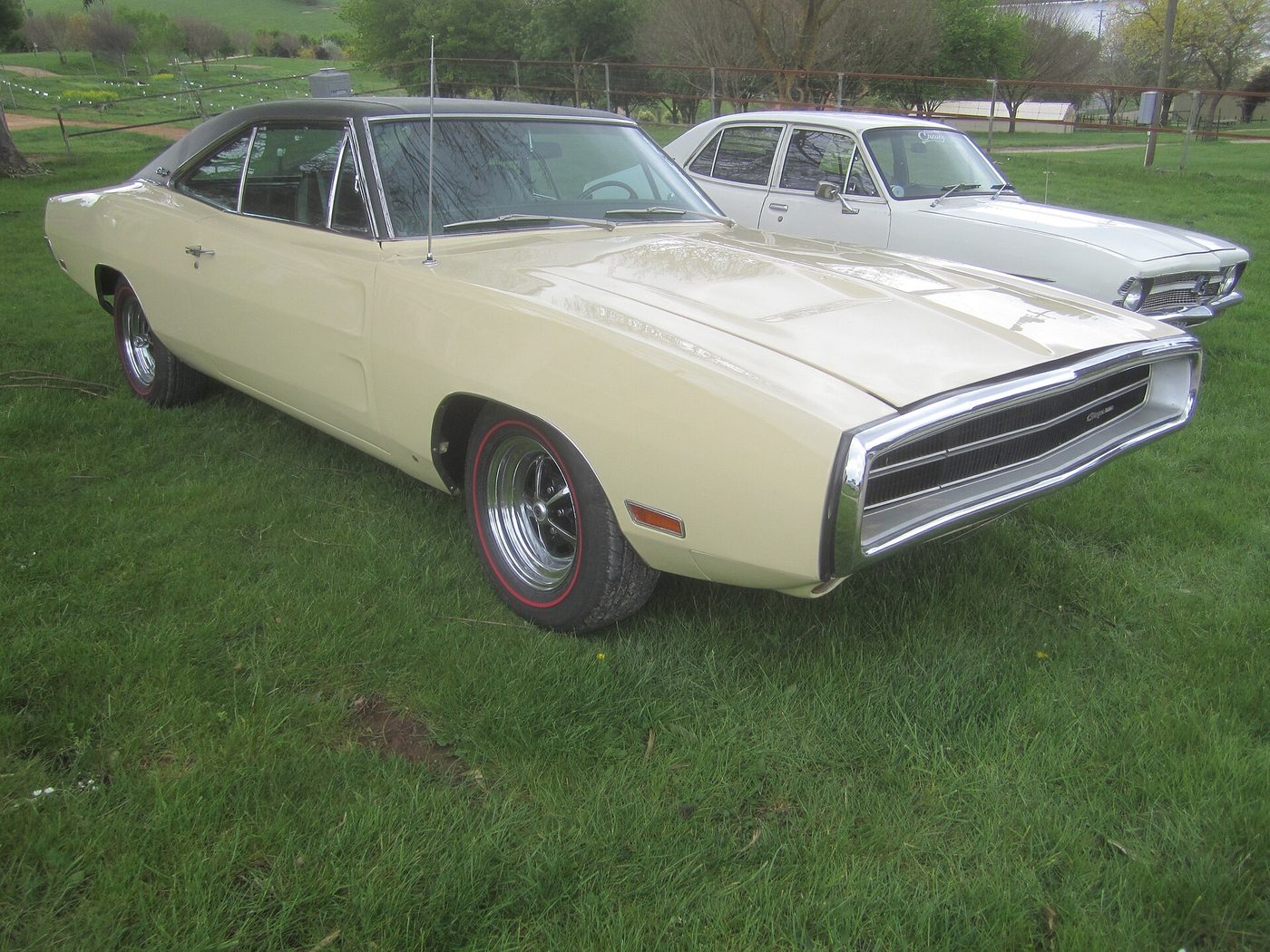
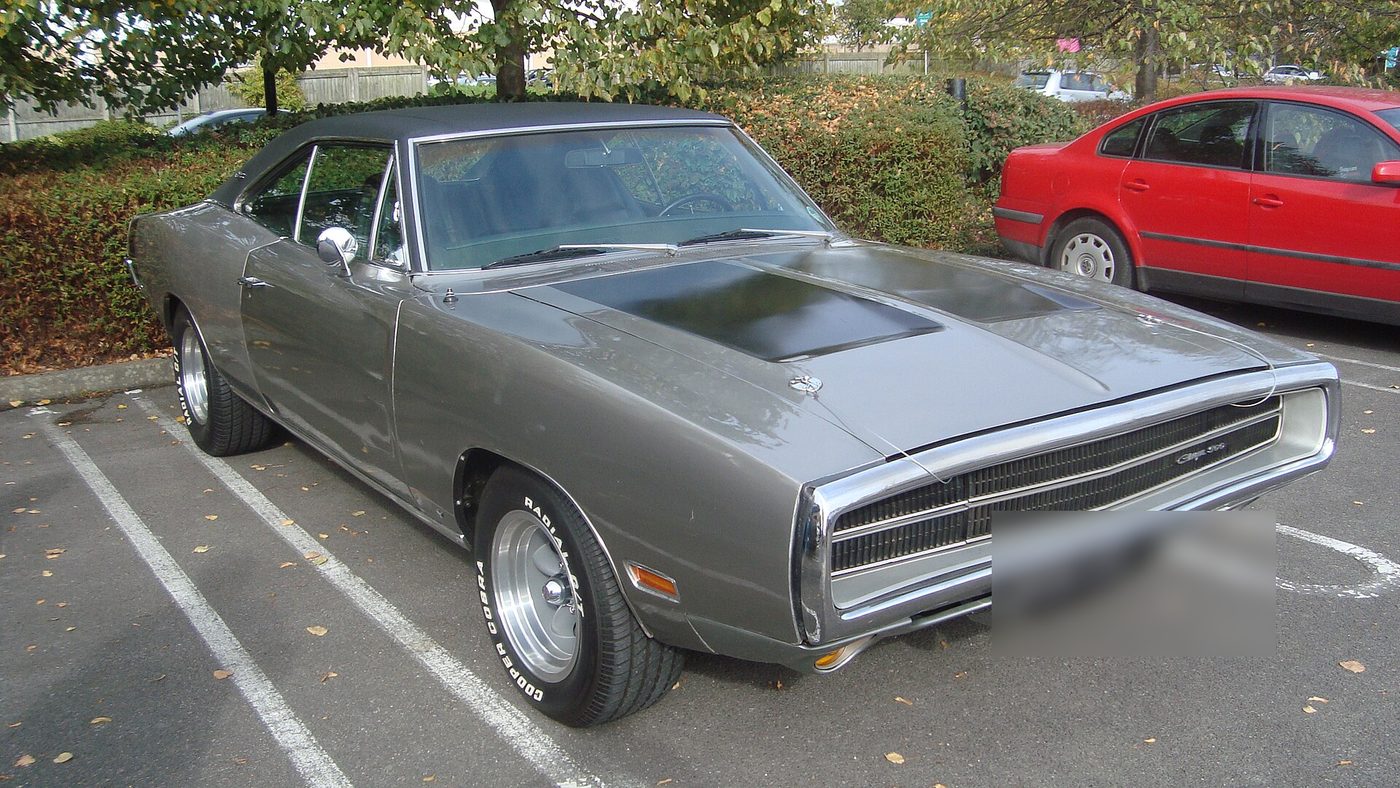
The Charger a customer could order that spring looked different from the 1969 car in the details. It had a full-width single grille opening with a scripted Charger badge, rear-facing scoops on the R/T doors with large R/T emblems, and a redesigned bumblebee tail stripe. The range now ran in three series: the base Charger, the Charger 500 and the R/T, the base car with a split-back vinyl bench and the others with sport bucket seats. The Charger 500 name, which a year earlier had meant a limited-production homologation special with a flush grille and flush rear window, now identified the volume middle model. The 1970 Charger 500 was a trim level, not a racing special.3

The sales result went the other way. Flory tabulates 49,768 Chargers for 1970, against 89,199 in the industry figures for 1969. The 1970 Charger Registry, which counts by VIN series and includes cars shipped in September 1970, gives 46,315: 9,345 base Chargers, 27,461 Charger 500s and 9,509 R/Ts. The two totals have not been reconciled, but either way production fell by close to half. Sales dropped nearly 50 percent too and failed to reach 50,000. By the registry's count, the Charger 500 was now the heart of the line, 59 percent of all 1970 Chargers.4,5,6
The R/T kept its standard 440 Magnum and TorqueFlite, rated at 375 hp and 480 lb-ft, and for the first time added the 440 Six Pack, with three two-barrel carburettors, at 390 hp and 490 lb-ft, for $119.05. The Hemi remained at the top at $648.25 and 425 hp. The registry's US figures split 9,370 domestic R/Ts into 8,574 440 four-barrel cars, 684 Six Packs and 112 Hemis, the same 9,370 domestic total Mueller and Glatch print. The Six Packs divided almost evenly, 347 four-speeds and 337 automatics, and so did the Hemis, 56 and 56, with 12 more Hemi R/Ts built for Canada. Not every book agrees on the Hemi: Gunnell prints 42, and Newhardt's data box 116.5,7,8,9
Read as proportions, the R/T figures describe a car most buyers ordered with an automatic and the standard engine. Of 8,574 domestic 440 four-barrel R/Ts, 7,131 had TorqueFlite and 1,443 the four-speed, about 17 percent. The Six Pack reached 7.3 percent of domestic R/Ts and the Hemi 1.2 percent. Total R/T production is itself a matter of accounting: Mueller and Glatch give 10,337 including export cars, while the registry gives 9,509 including Canada and cars shipped in September 1970. Both agree on the 9,370 built for the United States, and the gap between them lies in how export and late-shipped cars are counted, not in any disagreement about the domestic market.5,7

The option sheet shows where R/T buyers actually spent their money. The registry counts 4,301 R/Ts with air conditioning at $357.65, 1,462 with the $142.85 Track Pak and 394 with the $235.65 Super Track Pak. The $161.65 SE package went on 1,452 R/Ts. The $461.45 power sunroof went on 112, the same number as the Hemi. The $14.05 high-impact paints, including Plum Crazy, Sublime, Panther Pink, Top Banana, Hemi Orange, Go Mango and Green Go, were ordered 3,317 times. The registry's option units appear to be calculated from rounded installation percentages, so they are approximate. Even so, the pattern is plain: more R/T buyers paid for air conditioning than for both Track Paks combined.5
The prices frame the choice. The base Charger with the slant six listed at $3,001, the Charger 500 at $3,139 and the R/T at $3,711, with the R/T's shipping weight at 3,638 lb. The Hemi's $648.25 added about 17 percent to the R/T's base price, and fewer than one domestic R/T buyer in eighty paid it. The Six Pack, at $119.05, matched the Hemi's advertised 490 lb-ft for less than a fifth of the Hemi's option price, and still found only 684 US buyers. Even the cheaper route to more power was a minority taste.5,4

On the tracks, 1970 belonged to a Dodge team. Bobby Isaac won the championship with Nord Krauskopf's K&K Insurance Dodge and crew chief Harry Hyde: 11 wins, 32 top-five finishes and 38 top tens from 47 starts, after a 1969 season of 17 wins that ended sixth in points. Which Dodge body carried those wins is disputed. NASCAR's Hall of Fame account says Isaac won only once in the winged Daytona, at Texas World Speedway late in 1969, while Ate Up With Motor says he drove a Charger Daytona to the 1970 title. Dodge's heritage history claims that from September 1969 into 1970, Charger 500 and Daytona race cars won 45 of 59 NASCAR races.10,11,6,3
Chrysler's other winged car had the headline races. Plymouth's Superbird brought Richard Petty back from his 1969 season with Ford, and he won his first Superbird victory at the Carolina 500 on March 8, 1970. Pete Hamilton, placed with Petty Enterprises at Plymouth's request, won the Daytona 500 and both Talladega races that year in a second Superbird. The end came by regulation. Bill France ruled for 1971 that winged cars would be limited to engines of no more than 305 cu in. Dodge moved on in the showroom too, with an all-new, shorter Charger for 1971. The second-generation body, and the aero era it had provoked, finished together.12,13,14,6,3
Fact sheet · 1970 · United States
The numbers
1970 Dodge Charger: The last year of the second-generation body: a new full-width grille, three series (Charger, 500, R/T), the 440 Six Pack added to the R/T, and production roughly half of 1969's.
Figures may describe different groups of cars. Add rows together only when the note says they make up a total.
Key facts
- Charger R/T production: 10,337 in total, 9,370 of them domestic.7,4
- 440 Six Pack R/Ts, US: 684 (347 four-speed, 337 TorqueFlite).5
- Hemi R/Ts, US: 112 (56 four-speed, 56 TorqueFlite), plus 12 for Canada, per the registry.5
- SE package (A47) on the R/T: 1,452; power sunroof (M51) on the R/T: 112.5
- Buddy Baker became the first driver to top 200 mph in a Hemi-powered Charger (1970, at Talladega); the car was the Chrysler development car DC-93, not a street Daytona.3,1
Production
| What was counted | Built |
|---|---|
| Charger, all series (Flory)4 2-door hardtop | 49,768 |
| Charger, all series (registry, incl. cars shipped September 1970)5 2-door hardtop · US and Canada | 46,315 |
| What was counted | Built |
|---|---|
| Charger (base, XH29)5 Charger · 2-door hardtop · US and Canada | 9,345 |
| Charger 500 (XP29)5 Charger 500 · 2-door hardtop · US and Canada | 27,461 |
| Charger R/T, all markets7,4 R/T · 2-door hardtop · all markets | 10,337 |
| Charger R/T, domestic7,5 R/T · 2-door hardtop · US | 9,370 |
| Charger R/T (registry, incl. September 1970 shipments)5 R/T · 2-door hardtop · US and Canada | 9,509 |
| Charger and Charger 500 combined (XH29 + XP29)15 Charger + Charger 500 · 2-door hardtop | 39,431 |
| Charger R/T (Over-Drive production table)15 R/T · 2-door hardtop | 18,400 |
| What was counted | Built |
|---|---|
| Charger base, 225 six5 Charger · 2-door hardtop · 225 1-bbl six · US | 182 |
| Charger base, 318 2-bbl5 Charger · 2-door hardtop · 318 2-bbl · US | 6,705 |
| Charger 500, 225 six5 Charger 500 · 2-door hardtop · 225 1-bbl six · US | 29 |
| Charger 500, 318 2-bbl5 Charger 500 · 2-door hardtop · 318 2-bbl · US | 13,101 |
| Charger 500, 383 4-bbl5 Charger 500 · 2-door hardtop · 383 4-bbl · US | 7,027 |
| Charger 500, 426 Hemi5 Charger 500 · 2-door hardtop · 426 Hemi 2x4-bbl · US | 1 |
| Charger R/T, 440 4-bbl5 R/T · 2-door hardtop · 440 4-bbl · US | 8,574 |
| Charger R/T, 440 Six Pack5 R/T · 2-door hardtop · 440 3x2-bbl · US | 684 |
| Charger R/T, 426 Hemi, US5 R/T · 2-door hardtop · 426 Hemi 2x4-bbl · US | 112 |
| Charger R/T, 426 Hemi, Canada5 R/T · 2-door hardtop · 426 Hemi 2x4-bbl · Canada | 12 |
| What was counted | Built |
|---|---|
| Charger base, 383 2-bbl (automatic)5 Charger · 2-door hardtop · 383 2-bbl · 3-speed automatic · US | 1,434 |
| Charger base, 383 4-bbl, 3-speed manual5 Charger · 2-door hardtop · 383 4-bbl · 3-speed manual · US | 37 |
| Charger base, 383 4-bbl, 4-speed5 Charger · 2-door hardtop · 383 4-bbl · 4-speed manual · US | 201 |
| Charger base, 383 4-bbl, automatic5 Charger · 2-door hardtop · 383 4-bbl · 3-speed automatic · US | 758 |
| Charger 500, 383 2-bbl (automatic)5 Charger 500 · 2-door hardtop · 383 2-bbl · 3-speed automatic · US | 7,109 |
| Charger 500, 383 4-bbl, 4-speed5 Charger 500 · 2-door hardtop · 383 4-bbl · 4-speed manual · US | 1,335 |
| Charger R/T, 440 4-bbl, 4-speed5 R/T · 2-door hardtop · 440 4-bbl · 4-speed manual · US | 1,443 |
| Charger R/T, 440 4-bbl, TorqueFlite5 R/T · 2-door hardtop · 440 4-bbl · 3-speed automatic · US | 7,131 |
| Charger R/T, 440 Six Pack, 4-speed5 R/T · 2-door hardtop · 440 3x2-bbl · 4-speed manual · US | 347 |
| Charger R/T, 440 Six Pack, TorqueFlite5 R/T · 2-door hardtop · 440 3x2-bbl · 3-speed automatic · US | 337 |
| Charger R/T, 426 Hemi, 4-speed5 R/T · 2-door hardtop · 426 Hemi 2x4-bbl · 4-speed manual · US | 56 |
| Charger R/T, 426 Hemi, TorqueFlite5 R/T · 2-door hardtop · 426 Hemi 2x4-bbl · 3-speed automatic · US | 56 |
| What was counted | Built |
|---|---|
| Charger 500 with SE package, V-85 Charger 500 SE · 2-door hardtop · V-8 · US | 2,887 |
| Charger R/T with SE package (A47)5 R/T SE · 2-door hardtop · US | 1,452 |
Prices when new
| Model | Price | Price type |
|---|---|---|
| Base price, Charger hardtop (slant six)5 | $3,001 | base price, 1970 model year |
| Base MSRP, Charger 500 (XP29)4,5 | $3,139 | base manufacturer's suggested retail price, 1970 model year |
| Base MSRP, Charger R/T (XS29)4,5 | $3,711 | base manufacturer's suggested retail price, 1970 model year |
| Base price, Charger hardtop (XH29) V-815 | $3,108 | base price, 1970 model year |
| Base price, Charger 500 hardtop (XP29) V-815 | $3,246 | base price, 1970 model year |
| Base price, Charger 500 hardtop (XP29) six15 | $3,139 | base price, 1970 model year |
Prices are the nominal dollars of the day, not adjusted for inflation.
Engines
| Engine | Factory rating | Availability | Built |
|---|---|---|---|
| E86 · 440 Magnum 4-bbl V-85 440 cu in · 4-barrel | 375 hp, 480 lb-ft (period factory advertised (gross)) | standard on R/T | 8,5745 |
| E87 · 440 Six Pack (3x2-bbl) V-85 440 cu in · three 2-barrel | 390 hp, 490 lb-ft (period factory advertised (gross)) | R/T option, $119.05 | 6845 |
| E74 · 426 Hemi 2x4-bbl V-85 426 cu in · two 4-barrel | 425 hp, 490 lb-ft (period factory advertised (gross)) | R/T option, $648.25 | 1125 |
| E63 · 383 4-bbl V-85,16 383 cu in · 4-barrel | 330 hp @ 5,000, 425 lb-ft @ 3,200 (SAE gross (AMA 'publishing max bhp')) | optional on Charger and 500 | 7,0275 |
| E61 · 383 2-bbl V-85,16 383 cu in · 2-barrel | 290 hp @ 4,400, 390 lb-ft @ 2,800 (SAE gross (AMA 'publishing max bhp')) | optional on Charger and 500 | 7,1095 |
| E44 · 318 2-bbl V-85,16 318 cu in · 2-barrel | 230 hp @ 4,400, 320 lb-ft @ 2,000 (SAE gross (AMA 'publishing max bhp')) | standard V-8 on Charger and 500 | 13,1005 |
Ratings are published figures, not dyno results. Gross and net ratings aren't directly comparable.
Transmissions
| Transmission | Availability | Built |
|---|---|---|
| D32 · A727 TorqueFlite 3-speed automatic5 | standard on R/T | |
| D21 · A833 4-speed manual5 | no-cost R/T option; optional with 383 4-bbl on Charger/500 | |
| D31 · A904 TorqueFlite 3-speed automatic5 | with 318 on Charger/500 | 13,0195 |
| D12 / D13 · 3-speed manual (column with 318; floor with 383 4-bbl)5 | Charger/500 |
Options and packages
| Code | Option | Price | Installed |
|---|---|---|---|
A33sales code |
Track Pak5 | $142.85 | 1,4625 |
A34sales code |
Super Track Pak5 | $235.65 | 3945 |
A47sales code |
Special Edition (SE) package5 | $161.65 | 1,4525 |
A36sales code |
3.55 axle package5 | $92.25 | 7785 |
A32sales code |
4.10 axle package with TorqueFlite5 | $250.65 | 2165 |
M51sales code |
Power sunroof5 | $461.45 | 1125 |
H51sales code |
Air conditioning5 | $357.65 | 4,3015 |
D91sales code |
Sure-Grip differential5 | $42.35 | 5,0795 |
N85sales code |
Tachometer with clock5 | $68.45 | 3,1585 |
V21sales code |
Performance hood paint5 | $18.05 | 1695 |
J81sales code |
Rear spoiler5 | 1975 | |
J45sales code |
Hood pins5 | $15.40 | 3,2055 |
S77sales code |
Power steering5 | $105.20 | 8,5365 |
B41sales code |
Power disc brakes5 | $27.90 | 3,7675 |
R22sales code |
Solid-state AM radio with 8-track tape5 | $196.25 | 1,9025 |
U84sales code |
F60x15 Polyglas GT raised-white-letter tyres5 | $62.25 | 1,1345 |
W23sales code |
Chrome road wheels, 14 in5 | $86.15 | 3,7015 |
V8_sales code |
Bumblebee tape stripe5 | 2,8675 | |
V6_sales code |
Longitudinal tape stripe5 | 4,6015 | |
(high-impact paint)sales code |
Multi-colour high-impact paint (Plum Crazy, Sublime, Panther Pink, Top Banana, Hemi Orange, Go Mango, Green Go)5 | $14.05 | 3,3175 |
| 426 Street Hemi V-8, in Charger R/T (Over-Drive price)15 | $648 | ||
| 440 Six Pack V-8, in Charger R/T (Over-Drive price)15 | $287 |
Paint
| Code | Color | Built |
|---|---|---|
FC7 |
Plum Crazy (high impact)5 | 1,1995 |
EB5 |
Bright Blue Metallic5 | 1,0125 |
EF8 |
Dark Green Metallic5 | 8815 |
FK5 |
Dark Burnt Orange Metallic5 | 8815 |
FE5 |
Medium Red5 | 6655 |
FY1 |
Top Banana (high impact)5 | 6475 |
FF4 |
Light Green Metallic5 | 6375 |
EV2 |
Hemi Orange (high impact)5 | 6005 |
EK2 |
Go Mango (high impact)5 | 4315 |
EW1 |
White5 | 4035 |
TX9 |
Black5 | 4035 |
FJ5 |
Sublime (high impact)5 | 3945 |
EB7 |
Dark Blue Metallic5 | 3285 |
FT6 |
Dark Tan Metallic5 | 3095 |
EB3 |
Light Blue Metallic5 | 2255 |
FY4 |
Light Gold Metallic5 | 2065 |
DY3 |
Cream5 | 845 |
FM3 |
Panther Pink (high impact)5 | 285 |
BL1 |
Beige5 | 195 |
FJ6 |
Green Go (high impact)5 | 195 |
Color names are the factory's. We don't show color swatches, because a screen color is no guide for a restoration.
Interiors
| Code | Trim | Built |
|---|---|---|
C6XA |
Vinyl bucket seats, charcoal and black5 | 3,6075 |
C6XW |
Vinyl bucket seats, white and black5 | 1,3125 |
C6F8 |
Vinyl bucket seats, green5 | 9465 |
C6K4 |
Vinyl bucket seats, burnt orange5 | 6755 |
C6B5 |
Vinyl bucket seats, blue5 | 6565 |
C6T5 |
Vinyl bucket seats, tan5 | 2535 |
C5XA |
Cloth and vinyl bucket seats, charcoal/black5 | 4695 |
CRXA |
Leather bucket seats, charcoal and black (SE only)5 | 8815 |
CRF8 |
Leather bucket seats, green (SE only)5 | 2165 |
CRT5 |
Leather bucket seats, tan (SE only)5 | 1875 |
CRB5 |
Leather bucket seats, blue (SE only)5 | 1595 |
Specifications
| Measure | Value | Applies to |
|---|---|---|
| Shipping weight, Charger 500 XP294 | 3,228 lb | Charger 500 |
| Shipping weight, Charger R/T XS294 | 3,638 lb | R/T |
| Shipping weight, Charger XH29 six15 | 3,228 lb | base Charger, 225 six |
| Shipping weight, Charger XH29 V-815 | 3,363 lb | base Charger, V-8 |
| Shipping weight, Charger 500 XP29 V-815 | 3,362 lb | Charger 500, V-8 |
| Wheelbase15 | 117 in | all Charger models |
| Curb weight, Charger hardtop (with automatic)16 | 3,455 lb | Charger WH29 V-8 |
| Curb weight, Charger 500 hardtop (with automatic)16 | 3,440 lb | Charger 500 WP29 V-8 |
| Curb weight, Charger R/T hardtop (with automatic)16 | 3,765 lb | Charger R/T WS29 |
| Curb-weight addition, 4-speed manual on Charger R/T16 | 103 lb | Charger R/T versus automatic |
Identification
- VIN series codes
- The registry groups production by VIN prefix: XH29 (Charger), XP29 (Charger 500), XS29 (Charger R/T); the fifth VIN character is the engine (C 225 six, G 318, L 383 2-bbl, N 383 4-bbl, U 440 4-bbl, V 440 Six Pack, R 426 Hemi) and the sixth is 0 for 1970.5
- 1970 styling identifiers
- Full-width single grille opening with Charger badge; R/T door scoops facing rearward with R/T emblems; single-line bumblebee tail stripe.3
- AMA style codes
- The AMA specification lists the 1970 Charger as WH29 (six or V-8), the Charger 500 as WP29 (six or V-8) and the Charger R/T as WS29; Over-Drive's production table prints XH-29, XP-29 and XS-29.16,15
Where the sources disagree
1970 Charger R/T total
Identification
Read a 1970 Dodge VIN
The VIN decoder runs in your browser and never sends the VIN anywhere. How the factory numbered this year's cars:
Read next
The people and races behind the 1970 Dodge Charger
- Bobby Isaac, Harry Hyde, and the 1970 Title Racing program
- 1970 Showroom Argument Cross-marque story
- Every Dodge Charger year 1966–2026
Same model year
Also in 1970
- AMC AMX The last two-seat AMX: a restyled nose, a 360 base V8 and a 325-hp 390. At 4,116 cars it was the rarest of the three two-seat years.
- AMC Javelin Penske and Donohue brought the Javelin to Trans-Am, and the showroom answered with 2,501 Mark Donohue Javelins and 100 red-white-blue Trans Am Javelins, while total production fell to 28,210.
- AMC Rebel and Rebel Machine AMC's intermediate supercar: a 340-hp 390, four-speed and Hurst shifter in the Rebel hardtop, first in white with red-white-blue stripes. Totals reported for the one-year run range from about 1,200 to 2,326.
- Buick Riviera The 455 (370 hp gross) arrived with a restyle; production fell to about 37,300 with some 3,505 GS cars.
- Buick Skylark Gran Sport, GS and GSX Buick's GS went to a 455 rated at 510 lb-ft, the Stage 1 option added 10 advertised hp, and a mid-year GSX package was built 678 times in two colors.
- Buick Wildcat The final Wildcat, Custom trim only, with the 370-hp 455; 23,645 built.
- Chevrolet Chevelle and Malibu SS The year the Chevelle Super Sport split into RPO Z25 SS 396 and RPO Z15 SS 454, with the LS6 454 rated at 450 gross horsepower.
- Chevrolet Chevy II and Nova Last year the source engine table lists the big-block (as 402) in the Nova. Enthusiast-compiled production: 307,280 cars; Super Sport 19,558.
- Chevrolet El Camino SS The Malibu/Custom El Camino could carry RPO Z25 SS 396 or RPO Z15 SS 454, including the 450 hp LS6; 8,773 Z15s across Malibu models.
- Chevrolet Monte Carlo SS The first Monte Carlo, with the SS 454 as RPO Z20: 3,823 of 145,976 Monte Carlos per Chevrolet-report-derived tables.
- Dodge Challenger Dodge's first pony car arrived as a 1970 model with nine advertised engines, base, SE, R/T, and R/T SE hardtops, two convertibles, and a one-year Trans-Am homologation special, the T/A.
- Dodge Coronet R/T and Super Bee The final Coronet-based R/T and Super Bee: the R/T fell to 2,615 cars, while the Super Bee added a 3-speed manual and kept its Six Pack and Hemi options.
- Dodge Dart GTS, Swinger and Demon With the GTS gone, the Swinger 340 was the only performance Dart; it kept front discs, Rallye suspension and a twin-scoop hood and sold about 13,800 beside the new Challenger.
- Ford Fairlane The last Fairlane year: the name survived only on the Fairlane 500 beneath the new Torino, with a mid-year Falcon sharing the body at the bottom of the range.
- Ford Maverick Grabber The $179 Grabber package of stripes, a spoiler and a blacked-out grille arrived mid-1970 on the new two-door Maverick.
- Ford Ranchero GT The Torino-based Ranchero GT could take the 429 Cobra Jet and Super Cobra Jet; reference counts give 3,905 GTs, while Barn Finds rounds the GT figure to about 3,600 of 21,640 Rancheros.
- Ford Thunderbird The 429 at 360 hp was the standard and only engine listed in the 1970 catalog.
- Ford Torino A new, longer body on a 117-inch wheelbase; the Torino Cobra became its own model with the 429, offered in 360, 370 (Cobra Jet) and 375 (Super Cobra Jet) horsepower forms.
- Mercury Comet and Cyclone A new, longer Montego-based Cyclone in three versions: the 429 Cyclone, the small-block Cyclone GT that outsold both others, and the Ram Air 429 Cobra Jet Cyclone Spoiler.
- Mercury Cougar The last first-generation Cougar moved to the 351 Cleveland, kept the Boss 302 as an Eliminator-only engine, and built 2,268 Eliminators.
- Mercury Marauder and S-55 The second and last year of the 1969-70 Marauder: production fell to about a third of 1969's, with the X-100 near half of it.
- Oldsmobile Cutlass, 4-4-2 and Hurst/Olds The 4-4-2 got a standard 455 rated at 365 hp, the W-30 went to 370 hp, and the small-block W-31 moved to the Cutlass and F-85 coupes.
- Plymouth Barracuda and 'Cuda The E-body redesign split the line into Barracuda, Gran Coupe, and 'Cuda hardtops and convertibles, put every Chrysler performance engine through the 426 Hemi on the order form, and added the one-year AAR 'Cuda for Trans-Am homologation.
- Plymouth Duster 340 and 360 Plymouth's new Valiant-based fastback coupe arrived with a 275 hp 340 performance model at $2,547; 24,817 Duster 340s among 217,192 Dusters.
- Plymouth GTX, Belvedere and Satellite Now hardtop-only, the GTX fell to 7,748 cars while its 440 Six Barrel option cost just $119.
- Plymouth Road Runner Production halved from 1969, the 440 Six Barrel became a regular option, and the winged Superbird was built as a Road Runner hardtop to put Plymouth back on NASCAR superspeedways.
- Pontiac Firebird and Trans Am A late-arriving, coupe-only second generation: 48,739 Firebirds, 3,196 of them Trans Ams, and 88 Ram Air IVs.
- Pontiac GTO A new Endura nose, a 455 added beside the three 400s, and GTO production falling to 40,149.
- Pontiac Grand Prix The SJ took a 370 hp 455, Hurst built the SSJ, and production fell to 65,750.
- Pontiac Tempest and LeMans The T-37 and GT-37 bring budget performance to the Tempest.