Racing · Sox & Martin, Motown Missile, and the 1971 field · 1971
1971 Pro Stock: Ronnie Sox Wins Six, Mike Fons Leaves with the Title
Six event wins for one driver, and a title decided at the World Finals by another.
Story reviewed July 27, 2026
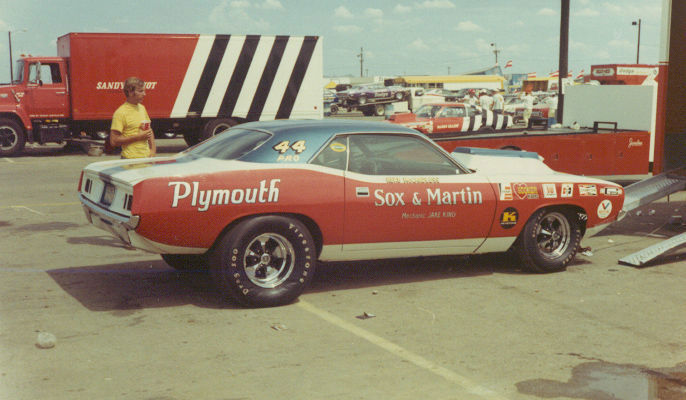
At the World Finals semifinal, Ronnie Sox ran 10.14 seconds and Mike Fons ran 10.06. The season’s most successful Pro Stock driver was out. Fons then defeated Herb McCandless in the final and left with the championship. Beginning with that upset makes the period’s winner-take-all structure visible before any season summary: six event wins could establish dominance, yet one final weekend could decide the title.
Sox had begun the season as the category’s central force. NHRA’s retrospective records him winning the first three events and six of eight overall. His precise four-speed reputation operated inside Sox & Martin, where Buddy Martin’s ownership, organization, and public presentation mattered beside the driver. Their Plymouths were purpose-built competition cars, not showroom ’Cudas or Road Runners with elapsed times attached.
The 1971 street selector proves why that separation matters. Plymouth’s Barracuda AMA sheet clears 340, 383, 440 Six Barrel, and Hemi four-speed configurations. It does not document Sox & Martin’s engine build, race weight, gearing, tires, or class preparation. A race result belongs to the exact entrant, car, event, and rules. Shared body and manufacturer identity create a narrative link, not a generic performance field.
Ford’s first national-event Pro Stock victory came from Don Nicholson’s Maverick at the Summernationals, not a Mustang. Sox lost after a flat tire, and Nicholson defeated Mike Fons. That result corrects the instinct to make Ford performance history automatically Mustang history. The Maverick was a purpose-built race car, and its victory belongs in Pro Stock records rather than a showroom comparison row.
The Supernationals added a rules dispute. Butch Leal was disqualified for rear weight distribution, Sox was reinstated, and Sox’s own car then came under scrutiny before officials declared the result on Monday. The story records what NHRA says officials did. It does not invent motives, private arguments, or technical facts beyond the published ruling. Credible controversy belongs in the narrative when its scope is clear.
Sox’s six wins still define the season’s competitive rhythm. The cars, crew, Martin’s organization, and Sox’s driving repeatedly produced results across the calendar. Yet the championship system placed decisive weight on the World Finals. That difference between “most races won” and “champion” is not a statistical trick; it is part of the rules under which everyone competed and part of why the semifinal carries such force.
Fons’s 10.06 defeated Sox’s 10.14, then Fons beat McCandless for the title. The exact clocks remain event observations, not street-car claims. They can later live in structured race results connected to the purpose-built cars. They will never overwrite advertised Hemi, 440, 383, or Ford engine values. Comparison works best when related histories can be linked without being merged.
The category also shows manufacturer identity crossing body lines. Sox represented Plymouth, Fons and the Rod Shop represented Dodge, Nicholson put Ford’s first trophy in a Maverick, and Chevrolet’s Camaro wins had come the year before. A muscle-car site should tell that factory rivalry while resisting the urge to classify every racing body as a consumer muscle configuration. Purpose and provenance remain visible.
NHRA archive photographs are high-priority licensing leads, especially the semifinal, final, Sox & Martin crew, Rod Shop Dodge, and Nicholson Maverick. Page access does not grant reuse. Exact event, driver, car, photographer, agency, rights holder, license, and credit must be recorded outside Git for owner review. A restored replica cannot stand in for the World Finals car without a caption that states what it is.
The 1971 Pro Stock story ends with two truths held together. Ronnie Sox was the season’s dominant event winner, taking six of eight. Mike Fons won the decisive semifinal and final and became champion under the contemporary system. Explaining the rules and keeping race cars separate from street selectors lets the apparent contradiction become the story, rather than choosing one achievement and erasing the other.
The first task for deeper technical coverage is acquiring the exact 1971 NHRA rule book and event sheets. Those records can define class construction, minimum weights, engine/body relationships, qualifying, and round-by-round results. They will also prevent later Pro Stock practice from being projected backward. The anniversary narrative establishes the public arc; period rules and sheets will establish the technical one.
Crew attribution needs the same patience. Sox, Martin, Fons, McCandless, Nicholson, Leal, and Hielscher are visible in institutional accounts, but the mechanics and engine builders behind individual cars require team programs, interviews, or archive records. A full story should add them when their roles are sourced, not invent a generic crew or let the driver’s name absorb every contribution.
The Supernationals ruling is valuable because it exposes the category being actively governed. Weight distribution mattered enough to change eligibility and results, and scrutiny did not end when one car was reinstated. Telling the procedural sequence shows officials, competitors, and rules shaping the season. It does not require the site to decide a technical question from a retrospective paragraph.
Contextual links can carry readers from Plymouth ’Cuda rows to Sox & Martin and from Ford history to Nicholson’s Maverick, but the link labels must say they enter racing. No family footer is needed. The exact transition is the editorial value: from an advertised street engine to a purpose-built car whose specifications and results live under another evidence contract.
That contract also protects future comparisons. Qualifying and elimination results can be compared across the same event once exact sheets are acquired, but a cross-year race query must preserve rules that changed. Street cars remain selectable by factory configuration. The two systems can meet through people, manufacturers, and body identity without pretending a ten-second Pro Stock run predicts what a customer’s Hemi ’Cuda would do.
In 1971, that distinction lets the upset remain sharp: Sox owned the season’s rhythm, Fons owned the championship-deciding day, and neither result becomes a claim about an unspecific showroom badge.