Stories · 1971 · cross-marque
1971: Two Horsepower Languages on One Factory Page
The year one factory page carried gross and net ratings for the same engines, and every horsepower argument since has been conducted in two languages at once.
Story reviewed July 27, 2026
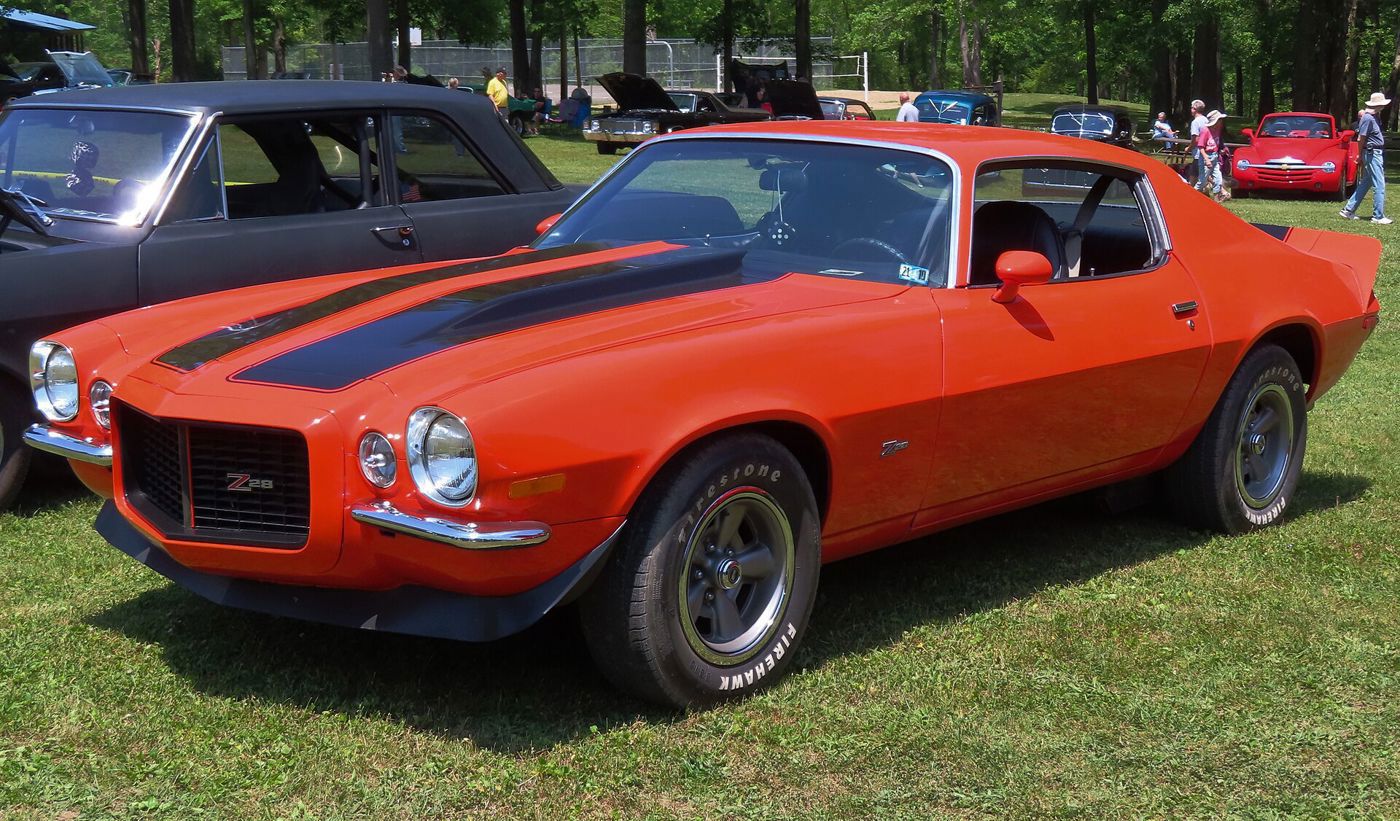
The January 1971 Camaro sheet places two horsepower numbers beside the same engine. A Z28 350 reads 330 gross and 275 net; an LS3 reads 300 gross and 260 net. Nothing has been averaged, and neither column is a correction of the other. Chevrolet is publishing observations under different test conditions. The page is the best opening to 1971 because it turns a familiar argument—whether horsepower “really fell”—into something readers can see in the factory record before any explanation begins.
Gross output describes an engine tested under the manufacturer’s stated laboratory convention. Net output moves closer to installation conditions and accounts for equipment and restrictions defined by the factory standard. The two values cannot be converted with a universal percentage. The database stores both as parallel ratings, each with rpm, torque, standard, source, and revision. A comparison can choose like-for-like gross or net; it never mixes a Ford gross number with a Chevrolet net number in one unlabeled leaderboard.
Chevrolet’s revisions make the year even more revealing. A preliminary September Camaro sheet printed 350 horsepower for the LS3. The revised January sheet prints 300 gross and 260 net. The public row follows the later document while the earlier figure remains a conflict record and part of the story. Revision does not mean the earlier paper should disappear. It means the date, document sequence, and fields changed must remain visible.
The Chevelle LS6 demonstrates another documentary boundary. Factory sheets list a 454 at 425 gross and 325 net horsepower, and a March price schedule still contains the row. Yet the price says “Will Advise,” a sales-facing power-team page omits it, and normal customer delivery is not established. The LS6 remains a documented factory plan rather than a normal selector configuration. A Corvette LS6 cannot prove a Chevelle was delivered; Corvette coverage remains with VetteFacts and the sports-car site.
Pontiac’s AMA sheets make gross and net comparison possible across the Firebird and GTO. A Formula 400 carries 300 gross and 250 net horsepower. The Trans Am’s 455 HO carries 335 gross and 305 net. GTO’s standard 400 is 300 gross and 255 net, while its 455 HO is 335 gross and 310 net. Those pairs show why subtracting a fixed amount would be wrong: accessories, calibration, exhaust, and test context interact differently across engines.
Buick and Oldsmobile add still more pairs. Buick’s GS 350, GS 455, and Stage 1 455 provide gross and net horsepower and torque in one revised table. Oldsmobile’s 4-4-2 and W-30 do the same. GSX remains an appearance and equipment package, not a synonym for Stage 1; W-30 remains a factory engine and performance package, not a generic visual label. The configuration keeps the engine separate from the package that may surround it.
Ford’s literature explicitly calls its Mustang and Torino figures gross dynamometer horsepower, but the acquired brochures do not provide parallel net values for the released rows. Boss 351 is 330 gross horsepower with a four-speed; Mach 1 offers 351 4V at 285 and 429 CJ-R at 370. Unknown net output stays unknown. The selector does not estimate it from a GM percentage or a later chart, and missing torque for Ford’s ordinary 351 and 429 choices does not become zero.
AMC and Plymouth evidence likewise retains the rating language the artifact actually supplies. Javelin AMX Go Package configurations use 360 and 401 engines with advertised output. Plymouth’s clear Barracuda AMA rows cover 340, 383, 440 Six Barrel, and Hemi choices. Other Plymouth and Dodge rows remain held because a Barracuda sheet cannot establish Road Runner, GTX, Duster, Challenger, Charger, Super Bee, or Demon availability. Breadth never outranks the exact locator.
The engineering context also resists a simple villain. Compression, fuel requirements, emissions work, calibration, and test convention were changing together. EPA’s later technical history describes unleaded fuel and lower compression being phased in beginning in 1971; SAE and corporate records document manufacturer design work. Regulators did not simply ban horsepower, and the year was not merely a paper-rating trick. Each engine needs evidence for what physically changed, while the rating sheet tells how output was presented.
Twenty-five cleared configurations make 1971 directly comparable without pretending the transition was uniform. Readers can place Boss 351 beside Z28, 455 HO Trans Am beside 455 HO GTO, Stage 1 beside W-30, or 401 Javelin AMX beside Hemi ’Cuda, with body and purpose always visible. The two horsepower languages remain side by side where the factory supplied both. The apparent contradiction becomes the year’s organizing fact: the same engine could truthfully carry two published ratings because the questions being measured were different.
Transmission and axle remain part of every identity. A four-speed Z28 with 3.73 gearing is not represented by the word Camaro alone, just as a close-ratio 455 HO Trans Am is not interchangeable with every Firebird. Manual and automatic variants can join later when their exact rows are sourced. The comparison engine does not infer one drivetrain from a trim badge or copy an axle from a neighboring power-team line.
Specialty and dealer claims stay equally disciplined. Ford’s Drag Pack requires exact CJ/CJ-R and order-code mapping. Buick Stage 2 waits for dealer parts and installation records. Judge and GSX remain packages rather than engines. Baldwin-Motion, Mr. Norm, Yenko, and Randall programs require offers, invoices, conversion records, and car-specific provenance. A famous name is a reason to research more deeply, not a lower evidence threshold.
The images will follow the same contract. Factory sheet access supports research but not scan republication. A Boss 351, Z28, Stage 1, W-30, Javelin AMX, or Hemi ’Cuda photograph needs exact year and configuration review, creator, rights holder, license, credit, privacy treatment, and owner approval. Until then the page’s most important visual is conceptual: two columns printed by the factory on one sheet.