1971 · Ford · United States
1971 Ford Maverick Grabber: The Economy Compact Gets a V8 and Its Own Model
The Grabber became its own model with a dual-scoop hood, and the 210 hp 302 V8 arrived; Classic Industries counts 38,963 Grabbers.
United States · researched through 2026-09-23
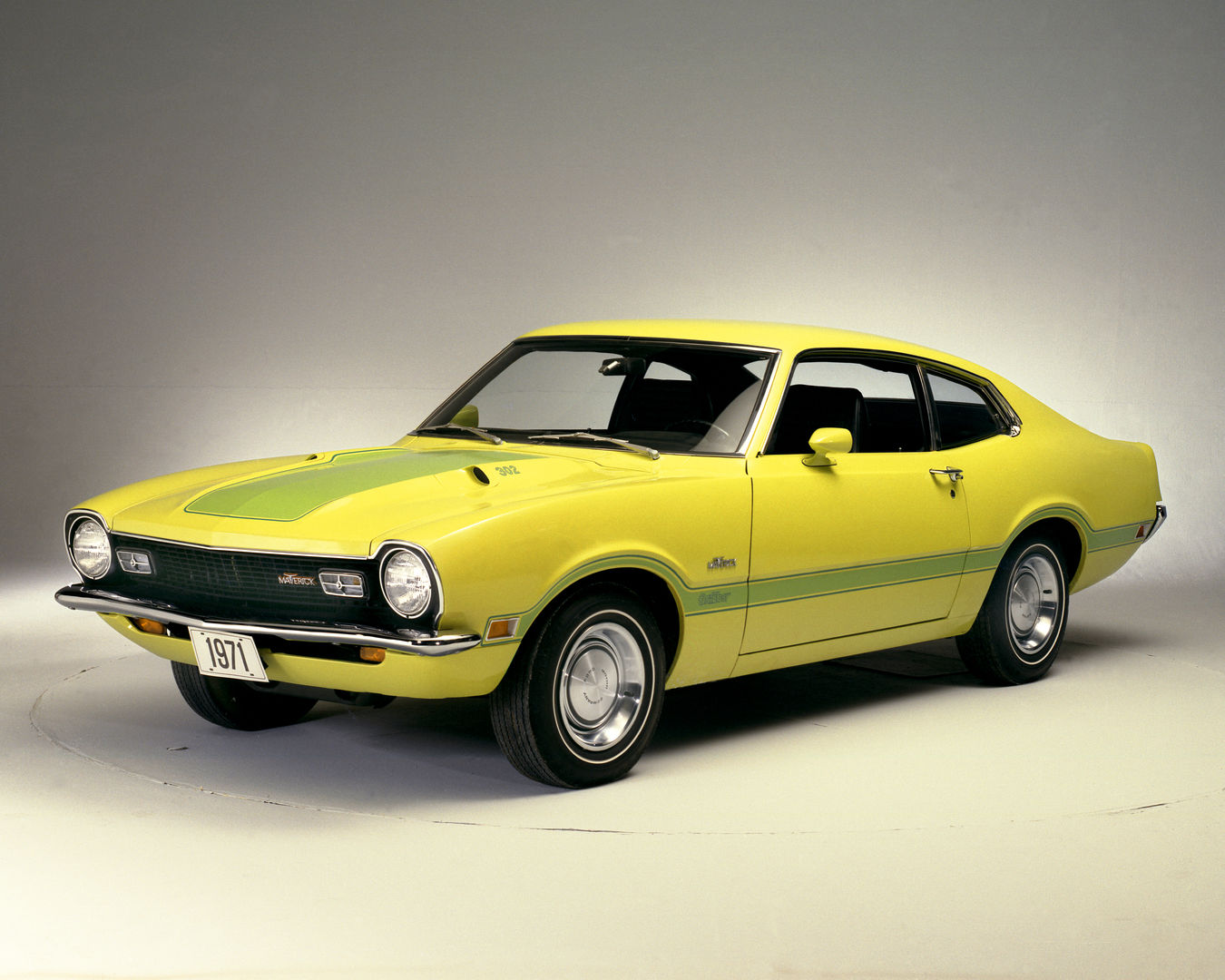
Ford introduced the Maverick on April 17, 1969, as a 1970 model priced at $1,995, and the response set the terms for everything that followed. Wikipedia records nearly 579,000 Mavericks produced in the first year, close to the Mustang's first-year record of nearly 619,000. Classic Industries uses the same comparison. The car was conceived and marketed as an inexpensive compact and an import fighter. Wikipedia names the Datsun 610 and Toyota Mark II as the imports in its sights, while Consumer Guide says it competed directly with the Chevrolet Nova as well. Hooniverse's Jim Brennan sums up its main purpose as an inexpensive option in the compact segment. Performance was not part of the original brief. The Grabber was how Ford added it later.1,2,3,4
The first Grabber was an appearance package. Classic Industries dates it to the spring of 1970, and Wikipedia to mid-1970. Consumer Guide gives its price as $179 and lists larger wheels and tires, racing-style stripes and graphics, a blacked-out grille and other trim details. Wikipedia adds a spoiler. Consumer Guide describes the aim as a more youthful, muscle-car-inspired look. Every item on that list was appearance. The V8 that would give the look some substance did not reach the Maverick option list until 1971, according to both Wikipedia and Classic Industries, so a 1970 Grabber had one of the Maverick's six-cylinder engines.2,1,4
For 1971 the Grabber became a model in its own right. Consumer Guide, Hooniverse and Classic Industries all describe the change, and Classic Industries lists the 1971 Grabber under its own body code, 62D, beside the 62A two-door sedan. Consumer Guide lists a dual-dome hood, a rear spoiler, blacked-out accents including the tail panel, grille-mounted driving lights and dual sport mirrors. Hooniverse describes the hood scoops as simulated and adds side stripes and fender decals. Wikipedia notes that the dual-scoop hood was a Grabber feature in 1971 and 1972 only.4,3,2,1
The more important change was the engine. For 1971 Ford added an optional 302-cubic-inch V8 rated at 210 horsepower, and Wikipedia records that it was offered in both the Maverick and the revived Mercury Comet. Hooniverse specifies a two-barrel carburetor. The six-cylinder range continued: Classic Industries lists the 170 at 105 horsepower, plus the 200 and the 250. Consumer Guide says the V8 was paired with a three-speed manual or an automatic. The 210 rating was an SAE gross figure, the last year before the industry changed to net ratings.1,3,2,4
Neither of the sources that describe the V8 Grabber's performance cites a road test. Consumer Guide says it could reach 60 mph in less than 10 seconds and run the quarter-mile in a little over 16. Hooniverse puts it at a mid-9-second 0-60 and a sub-17-second quarter-mile. Those are characterizations, not measurements of an identified car, and no 1971 magazine test of a Grabber was found. Both describe a lively compact, and neither claims more.4,3
The Maverick line grew in other ways too. Wikipedia records that a four-door model, available with a vinyl roof, arrived for 1971, and that Mercury revived the Comet name on a rebadged Maverick. Classic Industries' 1971 production lines show where buyers went: 159,726 two-door sedans, 73,208 four-door sedans and 38,963 Grabbers. Those three lines add up to 271,897 cars, though the source does not say they cover every Maverick built that year. Against that sum the Grabber was about 14 percent. Consumer Guide's rounded figure of about 39,000 agrees.1,2,4
The key unknown is how many of those 38,963 Grabbers had the V8. No source read gives a split by engine, and the Grabber could be ordered with a six, so the Grabber count is not a count of 302 cars. That matters when setting the Grabber beside its rivals. Its production figure measures a styling model; most of the rival figures measure engine packages. Treating the Grabber total as a V8 count would inflate Ford's share of the compact-performance market by an amount no source can yet state.2,4
The rivals' numbers show what the market for compact V8 performance looked like in 1971. MuscleCarClub's table gives 12,886 Duster 340s out of 186,478 Dusters. NovaResource counts 7,015 Nova Super Sports out of 194,878 Chevy II and Nova cars. AMC's Hornet SC/360, a compact with a 360 V8, reached 784 cars by the SC/360 registry's count. Each of those figures was defined by a V8 engine. The Grabber's 38,963 was larger than all of them combined, but it is not directly comparable.5,6,7,2
What the Grabber offered was the look of a performance car on an economy car's price structure. The Maverick had been launched at $1,995, the 1970 Grabber package added $179, and the 1971 car added a V8 option, a scooped hood and a spoiler to a compact that had been designed around inexpensive transportation. No 1971 Grabber list price was found in the sources read, so the cost of the full V8 Grabber in 1971 cannot be stated here. Its equipment made the sporty version of Ford's compact easy to identify from the curb.1,4,3
The following year changed the numbers the Grabber was sold on. Hooniverse notes that for 1972 the industry switched from gross to net ratings, and the 302 fell to 143 horsepower on paper. Grabber production declined from there: 38,963 in 1971, 35,347 in 1972, 32,350 in 1973, 23,502 in 1974 and 8,473 in 1975, according to Hooniverse. Consumer Guide's rounded figures for 1971 and 1975, about 39,000 and about 8,500, agree. In 1975, the Grabber's final year, the changes were limited to white-letter radial tires and 14-inch styled-steel wheels.3,4
That makes 1971 the Grabber's best documented year by volume. It was the first year the Grabber stood as its own model, the first year a V8 was available, one of the two years with the dual-scoop hood, and the last year the 302 carried a gross rating. Plymouth, Chevrolet and AMC all sold V8 compacts against it that year. The Grabber outsold each of them by a wide margin, and how many of its buyers chose the V8 is still not documented.3,1,5,6,7
Fact sheet · 1971 · United States
The numbers
1971 Ford Maverick Grabber — The Grabber became its own model with a dual-scoop hood, and the 210 hp 302 V8 arrived; Classic Industries counts 38,963 Grabbers.
Coverage: Partial — researched sections are shown; missing ones are not yet sourced. Researched through 2026-09-23.
Every figure is labeled with how sure we are. Reported means a manufacturer, registry, or reference figure we cite but have not reconciled against factory records ourselves. Disputed means credible sources disagree and both are shown. Rows are separately scoped; don't add them together unless the note says they make up a total.
Production
| What was counted | Count | Basis | Status |
|---|---|---|---|
| All 1971 Mavericks (conceptcarz total)8 as published A total stated by the page. It equals the sum of the body rows below (73,208 + 159,726 + 38,963 Grabber), which repeat the Classic Industries rows, so it is the same lineage with a stated whole-year figure, not an independent count. | 271,897 | built, model-year | Reported |
| What was counted | Count | Basis | Status |
|---|---|---|---|
| Grabber2 Grabber · 2-door · as published | 38,963 | built, model-year | Reported |
| What was counted | Count | Basis | Status |
|---|---|---|---|
| 2-door sedan2 Maverick · 2-door sedan · as published | 159,726 | built, model-year | Reported |
| 4-door sedan2 Maverick · 4-door sedan · as published | 73,208 | built, model-year | Reported |
Body and Grabber rows as published by Classic Industries; conceptcarz states a 1971 whole-year total (271,897) equal to their sum, so the rows partition the year on that page (same lineage, not an independent count).
Consumer Guide gives about 39,000 Grabbers for 1971, consistent with 38,963.
Searched 2026-09-29: conceptcarz (series modelID 543), Wikipedia, the Classic Industries and Standard Catalog lineages already cited.
Prices when new
| Model | Price | Basis |
|---|---|---|
| Maverick 2-door sedan (170 six) | $2,175 | manufacturer's suggested retail, F.O.B. Detroit (excludes dealer preparation), 1971 model year |
| Maverick 4-door sedan (170 six) | $2,235 | manufacturer's suggested retail, F.O.B. Detroit (excludes dealer preparation), 1971 model year |
| Maverick 2-door Grabber (170 six) | $2,354 | manufacturer's suggested retail, F.O.B. Detroit (excludes dealer preparation), 1971 model year |
Prices are the nominal dollars of the day, not adjusted for inflation.
Engines
| Engine | Factory rating | Availability | Built |
|---|---|---|---|
| 302 V8 2-bbl1,4 302 cu in · 2-barrel | 210 hp (SAE gross) | optional | Not yet sourced |
Ratings are the manufacturer's advertised figures under the standard shown (SAE gross before 1972, SAE net after). They are not dyno results, and gross and net ratings can't be compared directly.
Options and packages
| Code | Option | Price | Installed |
|---|---|---|---|
|
High-back bucket seats9 | — | Not yet sourced |
|
Floor shift (3-speed with 200/302; SelectShift with buckets)9 | — | Not yet sourced |
|
D70-14 Wide Oval belted WSW tires9 | — | Not yet sourced |
|
Heavy-duty suspension9 | — | Not yet sourced |
|
Grabber racing stripes and blackout hood9 | — | Not yet sourced |
|
302 CID 2V 210 hp V8 (over 170 six) | $169 | Not yet sourced |
|
250 CID 1V 145 hp six (requires automatic) | $79 | Not yet sourced |
|
200 CID 1V 115 hp six | $39 | Not yet sourced |
|
SelectShift transmission (required with 250) | $183 | Not yet sourced |
|
Power steering | $95 | Not yet sourced |
|
Grabber: bright window frames, trim rings and hub caps, black grille and hood, grille-mounted road lamps, body side tape stripes, dual racing mirrors, deck-lid spoiler, carpets, hood scoops (included in Grabber price) | — | Not yet sourced |
|
Interior trim option, Grabber | $34 | Not yet sourced |
|
Accent Group | $52 | Not yet sourced |
|
Vinyl roof | $77 | Not yet sourced |
|
Air conditioner, SelectAire | $374 | Not yet sourced |
|
Radio, AM | $61 | Not yet sourced |
Paint
| Code | Color | Built |
|---|---|---|
|
Grabber Blue9 | Not yet sourced |
|
Grabber Yellow9 | Not yet sourced |
|
Grabber Lime9 | Not yet sourced |
|
Grabber Green Metallic9 | Not yet sourced |
|
Medium Green Metallic9 | Not yet sourced |
|
Platinum9 | Not yet sourced |
|
Light Gold9 | Not yet sourced |
|
White9 | Not yet sourced |
|
Dark Green Metallic9 | Not yet sourced |
|
Gray Gold Metallic9 | Not yet sourced |
|
Bright Blue Metallic9 | Not yet sourced |
|
Black9 | Not yet sourced |
|
Medium Blue Metallic9 | Not yet sourced |
|
Bright Red9 | Not yet sourced |
Color names are the factory's. We don't show color swatches, because a screen color is no guide for a restoration.
Specifications
| Measure | Value | Applies to |
|---|---|---|
| Curb weight, Grabber9 | 2,679 lb | Grabber 2-door |
| Curb weight, 2-door9 | 2,624 lb | 2-door |
| Axle ratio, 302 V89 | 2.79 ratio | 302 with 3-speed or SelectShift; 3.00 with air conditioning |
Identification
Read a 1971 Ford VIN
The VIN decoder runs in your browser and never sends the VIN anywhere. How the factory numbered this year's cars:
Same model year
Also in 1971
- AMC AMX The AMX name moves onto the redesigned Javelin as its top model. It is a derivative badge, not a continuation of the two-seater. 2,054 were built, all with the 360 or 401.
- AMC Hornet SC/360 AMC's one-year compact muscle car pitched as an insurance-friendly alternative. AMC reportedly planned 10,000, but 784 were built.
- AMC Javelin A new, flared-fender Javelin, with the AMX name as its top model. Javelin won AMC the 1971 Trans-Am manufacturers' championship.
- AMC Matador Machine The Rebel Machine's unadvertised successor, a 'Machine Go' option package for the Matador hardtop. Production is unknown; published guesses run from 43 to 68.
- Buick Riviera The boattail Riviera: 455 rated 315 gross / 255 net, GS 330 / 265; 3,175 of 33,810 were GS.
- Buick Skylark Gran Sport, GS and GSX Compression fell to 8.5:1, the GS 350 and GS 455 were merged into one GS series of 9,170 cars, and the GSX became an appearance package on any GS.
- Chevrolet Chevelle and Malibu SS A single RPO Z15 SS package now spanned small- and big-block V8s; 9,502 of 19,293 SS cars carried the LS5 454, and Chevrolet began printing net ratings beside gross.
- Chevrolet Chevy II and Nova SS limited to the L48 350 per the source; Rally Nova (RPO YF1) offered. Enthusiast-compiled production: 194,878 cars; Super Sport 7,015.
- Chevrolet El Camino SS A single RPO Z15 SS package on the Malibu/Custom El Camino; the El Camino share of 19,293 SS cars is not separately published.
- Chevrolet Monte Carlo SS The last SS 454 year: RPO Z20 on 1,919 of 128,600 Monte Carlos.
- Dodge Challenger Challenger's second year lost the SE, the R/T convertible, and the T/A; a new pillared coupe joined the hardtop and convertible, and production fell to roughly a third of 1970's.
- Dodge Charger A new, shorter third-generation body absorbed the Coronet two-doors and the Super Bee; it was the last year for the R/T and for a factory Hemi Charger.
- Dodge Coronet R/T and Super Bee The end of the line for Coronet performance: the two-door Coronets were replaced by the Charger, taking the Super Bee with them.
- Dodge Dart GTS, Swinger and Demon Dodge's version of the Duster fastback arrived as the Demon, and the Demon 340 became the performance Dart: 10,098 built, plus 85 Canadian Swinger 340 Specials.
- Ford Ranchero GT The second Torino-based Ranchero year; reference counts give 3,632 GTs, while Barn Finds rounds the GT figure to about 3,900 of 24,946 Rancheros.
- Ford Thunderbird The last fifth-generation year kept the 360-hp 429 as standard; production fell to 36,055.
- Ford Torino A carryover year for the 1970 body; the Torino Cobra now came standard with a 351 four-barrel and offered the 429 Cobra Jet-R, but only 3,054 Cobras were built.
- Mercury Comet and Cyclone The final Cyclone year: production fell to a few thousand across Cyclone, Cyclone GT and Cyclone Spoiler.
- Mercury Cougar A larger second-generation Cougar, new body codes, and the one-year 429 Cobra Jet option, fitted to 448 cars.
- Oldsmobile Cutlass, 4-4-2 and Hurst/Olds Compression fell to 8.5:1 for regular fuel, the W-31 was dropped, the sports coupe was gone, and 4-4-2 production fell to 7,589.
- Plymouth Barracuda and 'Cuda Four headlamps and a new grille marked the second E-body year; the Hemi and 440 Six Barrel stayed on the 'Cuda order form, but Barracuda-line production fell to about a third of 1970's.
- Plymouth Duster 340 and 360 The Duster 340's second year brought a new grille, a Thermo-Quad 340 rated 275 gross and 235 net hp, and a $2,703 list price, while output fell to about 12,900.
- Plymouth GTX, Belvedere and Satellite On the redesigned 1971 Satellite body the GTX fell to 2,942 cars, only 30 of them with the Hemi.
- Plymouth Road Runner Redesigned on the new Satellite body as a hardtop only, the Road Runner fell to 14,218 cars, and a 340 joined the 383, 440, and Hemi.
- Pontiac Firebird and Trans Am The 455 HO year: the Trans Am's biggest engine, 2,116 cars, and a Formula line split across three V-8s.
- Pontiac GTO Lower compression, dual gross and net ratings, the 455 HO as the top engine, and production down to 10,532.
- Pontiac Grand Prix Boat-tail styling, lower compression, and the manual transmission gone by March: 116 of 58,325 had one.
- Pontiac Tempest and LeMans The Tempest name gives way to T-37; the GT-37 option carries on and the 455 HO is available in two-door LeMans models.