Racing · Bob Glidden · Ford Thunderbird · 1987
Bob Glidden and the Thunderbird That Kept Coming Back
Quickest in qualifying at all fourteen events, ten finals, eight wins — a season of dominance told in a class that rarely allows it.
Story reviewed July 27, 2026
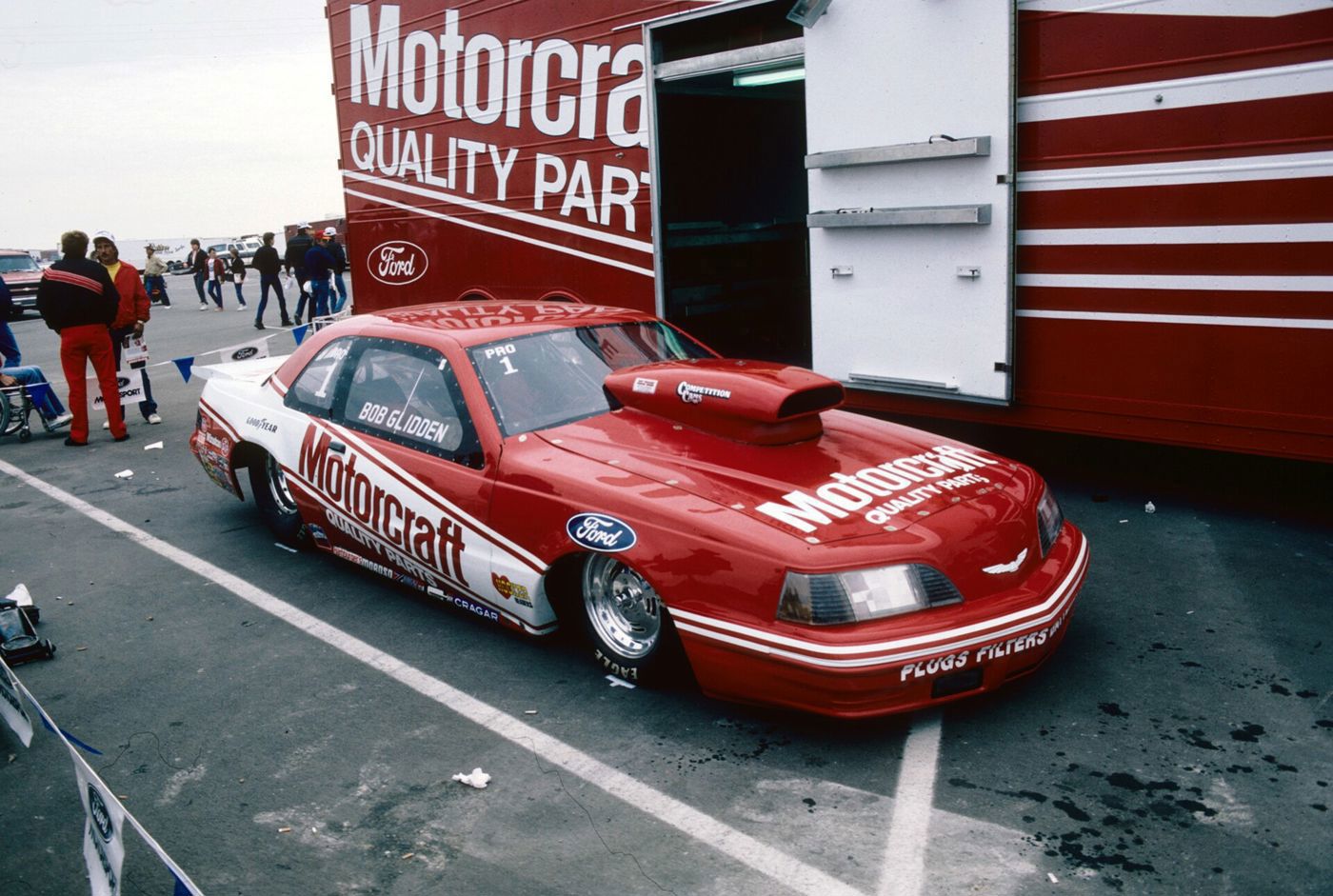
At Phoenix in 1987, Bob Glidden returned to a Pro Stock final with Butch Leal in the other lane. A single pairing can look ordinary in a career filled with final rounds, but the season surrounding it was extraordinary. NHRA credits Glidden with eight victories in fourteen races, number-one qualifying position at all fourteen, ten final-round appearances, and five consecutive wins to close the year. Phoenix was not an isolated flash. It was one stop in a pattern the rest of the field had to confront repeatedly.
The repetition is the heart of the story. A dominant season is easy to compress into percentages and superlatives, then harder to understand. Number one at every event means the car, engine, clutch, gearing, chassis, body preparation, and crew process had to return to a narrow competitive window under changing tracks and weather. Ten finals mean early speed survived eliminations often enough to matter. Five closing victories mean development and execution continued after rivals had months to respond.
Glidden’s Thunderbird is a particularly useful subject for a site about exact configurations because the body name invites a mistake. Ford sold a 1987 Thunderbird Turbo Coupe with an intercooled 2.3-liter turbo four-cylinder, advertised at different horsepower levels for manual and automatic transmissions. Glidden did not take that showroom power team through NHRA Pro Stock. His car was purpose-built for a professional drag-racing class, with engine, chassis, body, minimum weight, tires, fuel, and procedures governed by the rulebook and event inspection.
The shared Thunderbird identity still mattered. Pro Stock depended on recognizable manufacturer and model relationships, and those relationships gave fans and manufacturers a reason to care. But cultural recognition is not mechanical equivalence. This page links back to the street Turbo Coupe configurations so a reader can see Ford’s showroom offering; it never copies the street engine into the race record. A later technical dossier must source Glidden’s exact 1987 combination from NHRA rules, team records, and event-specific material.
NHRA’s season summary provides the stable frame: eight of fourteen, fourteen number-one starts, ten finals, five straight wins at the end. Those figures should not be padded with unsourced round details. Event sheets can eventually identify opponents, elapsed times, speeds, lane choice, qualifying order, and margins at each stop. Until those records are acquired, the story names only the sequence the sanctioning body establishes and does not invent a perfect mechanical explanation for it.
The Phoenix final also contains a milestone. NHRA’s retrospective ties the event to Glidden’s 60th national-event victory. A round number can dominate a career profile, but here it works best as a marker inside the larger arc. The car had to qualify, survive its rounds, and return to another final before the milestone existed. By placing the number after the process rather than before it, the story stays about work accumulating into dominance instead of destiny producing another trophy.
That work was not solitary, even when the results carry one driver’s name. Glidden was famously hands-on, but a publication-ready account of engine development, crew roles, family participation, fabrication, transport, and between-round service needs role-specific sources. Obituaries and retrospectives can establish broad career facts; they cannot support every remembered task at a particular 1987 event. The page therefore resists the convenient “one man did everything” legend while leaving room for a richer team history as archives and oral accounts are dossiered.
Pro Stock’s format also makes qualifying dominance distinct from race victory. The quickest qualifier earns position and demonstrates pace under the session’s conditions. Eliminations add reaction, lane variation, mechanical survival, and direct competition. Glidden’s fourteen number-one starts did not automatically create eight wins; six events still ended without one. The ten finals sit between those facts and show how frequently qualifying speed became a chance to win. Keeping the categories separate makes the season more impressive than merging them into a vague claim of invincibility.
The five-race closing streak supplies narrative motion without fictional dialogue. By the final portion of a fourteen-race schedule, every competitor knew the performance standard. Each successive win narrowed the chance that the run was temporary. Yet “five consecutive victories” does not mean every pass was easy or every opponent helpless. Round sheets and contemporary reports are needed before describing margins, failures, or reactions. The verified streak already carries tension because any elimination round could end it.
This approach also avoids using later reputation to rewrite the contemporary record. Glidden’s Hall of Fame status and career totals explain why NHRA revisited his work, but the 1987 page remains anchored to 1987 evidence. Later honors are aftermath, not proof of a specific engine part or tuning decision. The chronology moves from Phoenix and the season statistics outward to legacy, then returns to what the acquired sources can actually establish about the car.
Comparison readers may reasonably ask how Glidden’s Thunderbird would rank beside Elliott’s NASCAR Thunderbird or a street Grand National. The answer is that a single ranking would be meaningless. Pro Stock measures acceleration within one technical and sporting regime. NASCAR qualifying at Talladega measured a lap at sustained speed in another. A factory street rating is a laboratory-advertised engine observation in a road car. The site can place the stories beside one another while refusing to turn horsepower, elapsed time, and average lap speed into one universal score.
That refusal is not evasive. It directs attention to the interesting variables: purpose, rules, preparation, surface, distance, weight, driveline, and evidence class. A reader can choose the exact street models they want to compare, then enter the race branches to understand what manufacturers did under sanctioning-body rules. Glidden’s Pro Stock Thunderbird belongs in that branch with event-year identity and race-only provenance. It should never appear as a trim in a dealership selector.
The season’s numbers finally reveal why the story should feel like repeated return. Fourteen times the team arrived and qualified first. Ten times it reached the last pairing. Eight times it left with the victory. Five of those wins formed an uninterrupted closing run. Those are not four versions of the same claim; they are stages of competition, each asking something different of the people and machine. The pattern makes the Phoenix staging lanes feel less like a single dramatic exception and more like the place the Thunderbird kept finding.
Glidden’s 1987 does not need invented certainty about every component to be vivid. The sanctioning body has already supplied an extraordinary structure, and the unresolved details become an honest research agenda: acquire the rulebook, entry lists, qualifying sheets, elimination ladders, team records, and role-specific accounts. As those arrive, they can deepen the scenes without changing the category of the car. It will remain a race-built Thunderbird, linked to Ford’s showroom identity but never confused with the turbocharged coupe sitting in a 1987 brochure.