Racing · Melling Racing · Ford Thunderbird · 1987
Bill Elliott: The Record, the Grass, and Two Different Kinds of Speed
The fastest qualifying lap in the sport's history, and a race he led almost start to finish and did not win.
Story reviewed July 27, 2026
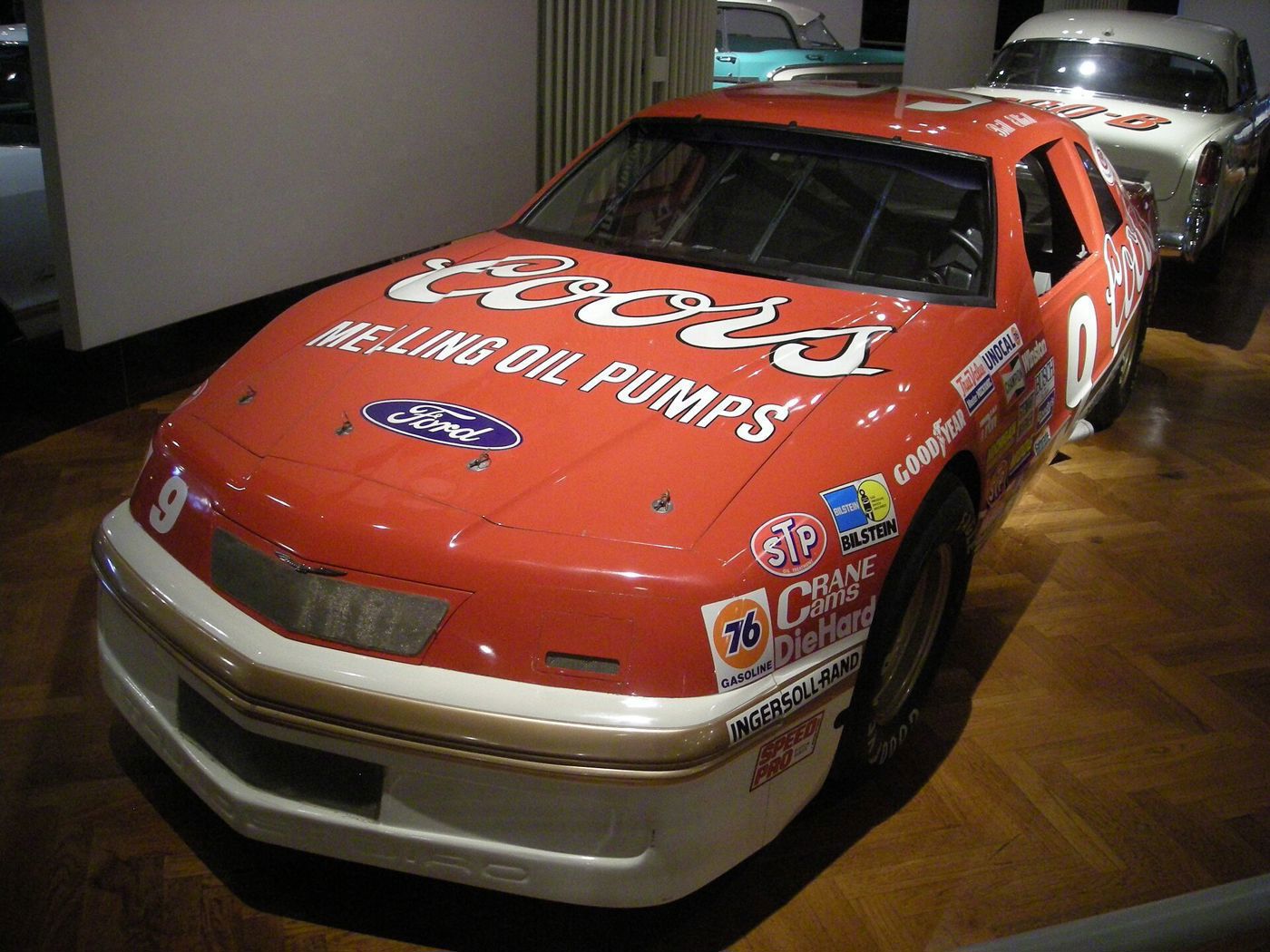
On April 30, 1987, Bill Elliott took the No. 9 Ford Thunderbird around Talladega in 44.998 seconds. The average speed was 212.809 miles per hour. NASCAR still identifies that run as the circuit’s all-time qualifying record, a figure fixed in memory partly because the rules that followed made another attempt under the same conditions impossible. The number is clean and official. Everything around it—the setup, weather, drafting absence, crew work, engine build, and risk—needs its own event evidence before it can be described with equal precision.
The qualifying lap works as a scene because the timing line settles one question and opens many others. Elliott did not average 212.809 in a showroom Thunderbird Turbo Coupe, and Ford did not sell that NASCAR engine behind a dealer’s five-speed. The race car carried Thunderbird identity within a purpose-built stock-car rules system. Its chassis, body allowances, aerodynamic preparation, tires, engine, fuel, weight, safety equipment, and inspection history belong to the event and rulebook. The name connects the racing and street stories culturally, but it does not make their specifications transferable.
That boundary is especially important in 1987 because the street Thunderbird Turbo Coupe is itself a complicated comparison. Ford advertised its intercooled turbocharged 2.3-liter four-cylinder at 190 horsepower with a five-speed and 150 with Automatic Overdrive. Those street rows illustrate transmission-specific calibration. Elliott’s No. 9 illustrates an entirely different engineering problem: sustained speed under NASCAR rules at Talladega. Linking the pages lets the reader see what the badge meant in two arenas while keeping every number in its rightful arena.
Talladega’s record did not stand alone as a triumphant season postcard. Weeks later at Charlotte, Elliott entered NASCAR’s all-star race and led 121 of 135 laps according to NASCAR’s retrospective. Dale Earnhardt was the other gravitational force in the event. Their late struggle produced the episode generations of race fans know as the “pass in the grass.” The phrase is vivid and slightly misleading. NASCAR’s own account notes that it was not actually a pass.
The distinction changes how the moment should be told. Earnhardt put wheels into the grass and maintained control amid the fight, but the famous move did not itself complete an overtake. Elliott’s race ended with a flat tire and a fourteenth-place finish; Earnhardt won. Those outcomes can be stated without inventing intent inside either cockpit. Later memories from the drivers can be presented as recollections, not omniscient access to what each man thought during the contact and evasive movement.
The popular nickname survives because it compresses motion, rivalry, and danger into four words. Correcting it does not require draining the scene of life. In fact, the discrepancy gives the story structure: what viewers remember, what the record says, and why the memory remains powerful despite the literal mismatch. The page calls it the celebrated “pass in the grass,” then immediately explains that it was not a completed pass. Questionable data from a credible source becomes part of the story instead of disappearing in a footnote.
Elliott’s Talladega lap and Charlotte frustration reveal two different kinds of speed. Qualifying asks for one timed performance within a defined procedure. The all-star race demands position, tire survival, traffic judgment, and repeated decisions across 135 laps. Dominating most of those laps did not guarantee Elliott the finish. One record can remain untouched for decades while a nearly controlled race turns in moments. The same driver and Thunderbird body identity connect the episodes, but the measures of success are not interchangeable.
The team around No. 9 belongs in the finished history as more evidence is acquired. Engine builders, crew chief, fabricators, aerodynamic preparation, spotters, and pit crew made both efforts possible. This first publication does not assign a technical innovation or decisive adjustment to a person merely because later summaries associate that person with the team. Event entry material, qualifying sheets, inspection records, contemporary team documents, and credited oral histories should establish roles. “Bill Elliott’s record” is useful shorthand, not a claim that he built the machine alone.
The same evidence rule controls sensory writing. Talladega at qualifying speed invites easy invention: a particular vibration, steering effort, engine note, or line through the tri-oval. Unless Elliott or a contemporary observer described that sensation, the page should not place it in his body. The official elapsed time and average speed already create scale. A future revision can add weather and procedure from the event packet, and can quote brief firsthand recollection within licensing limits, without manufacturing the atmosphere.
The 212.809 figure also needs historical placement. NASCAR connects it to the era before restrictor plates became the governing context at Talladega. The record’s endurance is therefore not simple evidence that later drivers or teams were slower. Rule packages, safety responses, aerodynamics, engines, tires, and qualifying formats changed the question being asked. A leaderboard stripped of that context would turn unlike regimes into one false contest. The story preserves the number and explains why comparison across regimes must remain qualified.
Chevrolet’s Monte Carlo SS Aerocoupe provides another street-to-track bridge nearby. Chevrolet’s 1987 information kit connected the showroom Aerocoupe’s sloping rear window to race-proven aerodynamic thinking on the NASCAR circuit. That does not mean the street car shared the race car’s construction or performance. It means manufacturers used racing form, showroom identity, and marketing in conversation. A contextual link can help readers follow that conversation while the configuration selector continues to show the street car’s 180-horsepower B4V 305 and automatic power team.
Likewise, Mustang Facts and other sibling sites should link here only when the racing story illuminates a specific year or design relationship. There is no need for a generic family footer. A reader on a 1987 Thunderbird or Ford performance page benefits from a deep link to the record; a reader seeking an unrelated model does not. Contextual links keep the network useful and make reciprocal placement a matter of editorial meaning rather than branding.
Read together, the two 1987 episodes refuse a tidy documentary summary. Elliott is not simply “the fastest,” because the record was one particular qualifying achievement. Earnhardt’s grass moment is not literally the pass its nickname promises. Leading 121 laps is not the same as winning. Those complications are not corrections around the edges; they are the story. They let the reader feel how a season can produce an immortal number and an immortal image, with only one of them describing the result people assume.
The page ends where the street comparison begins. Select a five-speed Turbo Coupe and Ford’s brochure says 190 horsepower; choose the automatic and it says 150. Follow the badge onto Elliott’s NASCAR Thunderbird and those values cease to apply. The exact-configuration contract does not weaken the emotional bridge between showroom and speedway. It makes the bridge honest, allowing 212.809, the grass, and a pair of street ratings to coexist without pretending they measure the same car.