Stories · 2004 · cross-marque
Three Letters Cross the Pacific
Three letters, one Holden Monaro, and a reintroduction that asked American buyers to accept a shape they had not been arguing about for thirty years.
Story reviewed July 27, 2026
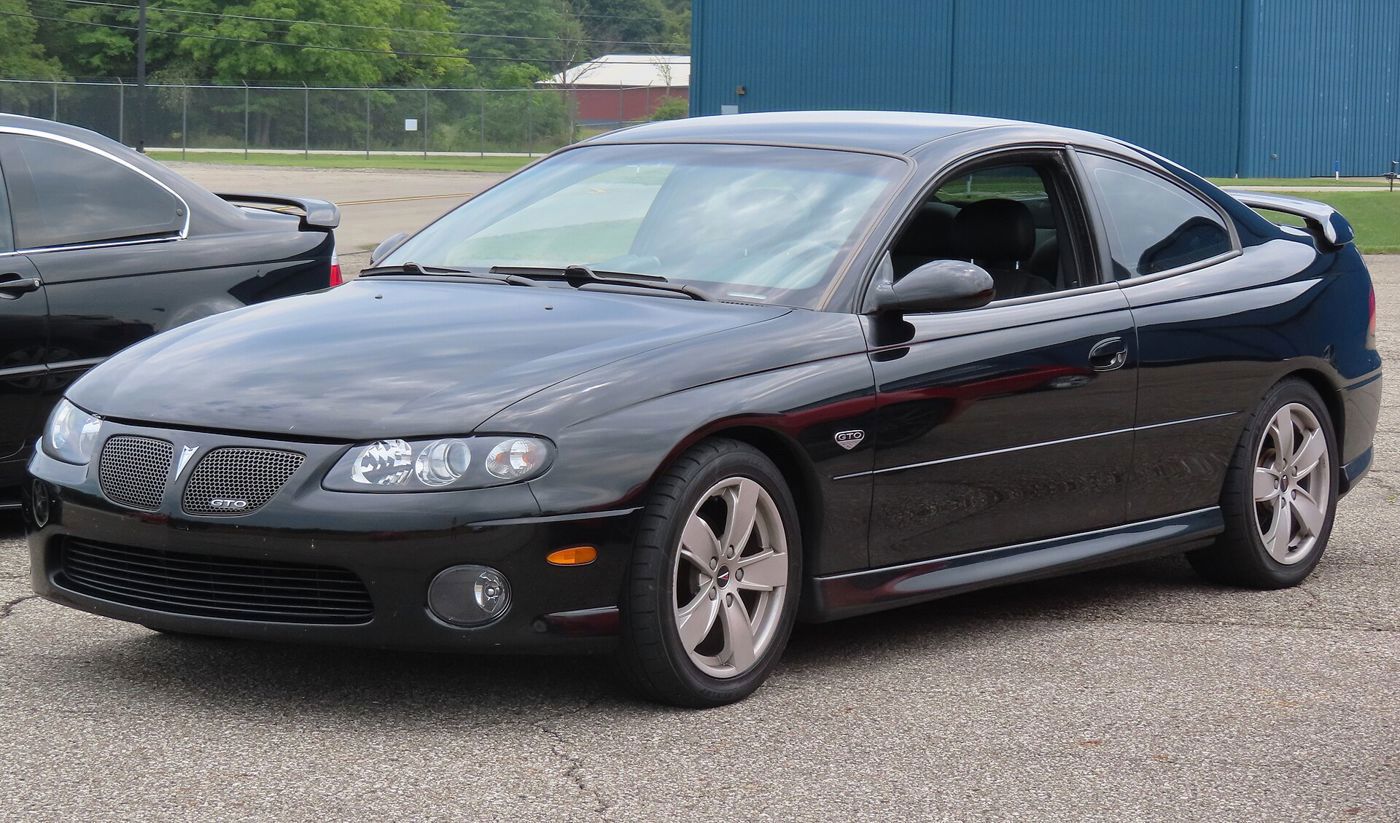
Somewhere inside Holden’s Elizabeth plant, the revived Pontiac GTO took physical form as a left-hand-drive coupe for the United States. That opening image remains a research target rather than a fabricated scene: the page needs a dated assembly photograph, creator, export record, and permission before it can describe a particular car on the line. What the factory record already establishes is consequential enough. An American performance badge returned for 2004 on a car assembled in Australia.
Pontiac advertised a four-passenger, front-engine, rear-drive coupe with an LS1 5.7-liter V-8, limited-slip differential, and a choice of transmissions. The rating was 350 horsepower at 5,200 rpm and 365 pound-feet at 4,000. An M12 close-ratio six-speed manual and M30 4L60-E four-speed automatic receive separate selector rows even though their advertised engine output matches. Choosing “GTO” is only the start of choosing a configuration.
General Motors later called the revival a rebadged Holden Monaro assembled by its Australian arm. That language establishes the broad relationship and should be attributed as GM’s own summary. It is not a complete engineering-change list. A badge description cannot prove that fascia, fuel system, tank, exhaust, cooling, safety equipment, calibration, lighting, certification, and every other export detail remained identical.
The missing export matrix becomes part of the story rather than a reason to improvise. Pontiac and Holden specifications, homologation records, change-control documents, shipping records, and assembly evidence can show how the Monaro-related platform became a U.S.-market GTO. Until acquired, the page distinguishes what Pontiac sold from what GM retrospectively called it and avoids the false precision of an unsourced parts catalog.
The historic name makes that discipline necessary. Pontiac’s original GTO story began in a very different corporate, regulatory, manufacturing, and cultural setting. The 2004 car was not a continuous production evolution of the 1974 Ventura-based model. Nor was it a costume without engineering consequence. It was a new market program using a familiar name, a Holden-built coupe, and contemporary GM V-8 hardware.
Assembly origin does not answer whether the car belongs in an American muscle history; it changes the question. The vehicle wore an American-market Pontiac identity and was assembled by GM’s Australian operation. Designers, engineers, assembly workers, certification teams, product planners, marketers, and executives worked across that boundary. A complete people story must identify their roles through records rather than crediting one famous executive with the entire revival.
Bob Lutz is often central in retellings, but the site will not make him the sole author without role-specific evidence. The same applies to a single Holden designer or Pontiac product manager. Leadership decisions matter, as do platform work, export engineering, assembly, logistics, dealer preparation, and the labor of building each car. Good storytelling can follow a decision without turning collaboration into a lone-savior myth.
The transmission choice reveals how the research model improves ordinary history. Pontiac advertised one engine output, but manual and automatic cars differed in gearbox, operation, and potentially later measured performance. Period tests can eventually show those observations when exact test-car equipment, article pages, conditions, and method are preserved. A manual factory acceleration claim remains an advertised claim, not a measured result that can be pasted onto the automatic.
Axle ratio remains held because the acquired Pontiac sheet does not state it with the required mapping. Production totals, colors, and transmission breakdowns are held pending final accounting. Unknown does not mean zero, and auction descriptions or survivor registries cannot produce “one of N” facts. The comparison can be useful now without pretending every desirable rarity number is ready.
Placed beside Mustang, the GTO changed the shape of 2004 choice. Ford offered GT, Mach 1, and supercharged Cobra from Dearborn’s final Mustang model year. Pontiac offered one LS1 output with two transmissions from Elizabeth. The comparison is not a referendum on which car was more authentically American. It exposes origin, body, seating, transmission, rating, and evidence so readers can decide which historical question they want to ask.
Cadillac’s CTS-V adds another GM angle. Its LS6 was related to contemporary Corvette performance hardware, but engine-family language does not prove identical installation or calibration. Likewise, GTO’s LS1 label does not allow Corvette or Camaro data to fill Pontiac gaps. Contextual links to Vette Facts’ 2004 C5 page can explain the family while Corvette remains outside this selector.
Camaro and Firebird absence gives the return more weight. Both had ended production after 2002, leaving Pontiac’s imported coupe to carry a revived performance name into a market without a current F-body. The site should link to a Camaro ending story only when a stable exact route exists. It does not invent a 2004 Camaro page or use a sibling site as evidence for Pontiac specifications.
The desired image of GTOs at Elizabeth is not yet licensed. GM/Holden archives, Australian institutional collections, and plant-worker archives are leads, not permissions. The owner must review creator, date, plant context, rights holder, license, exact depiction, visible people, proposed crop, and credit before contact or use. Brochure access establishes evidence and no automatic right to reproduce its art.
The crossing was physical, organizational, and cultural. A coupe moved through Australian assembly and export systems, entered American Pontiac dealerships, and asked buyers to accept that a historic badge could return through a global GM relationship. That question created real disagreement in period reception, but an isolated forum post does not establish it. Contemporary attributed reviews, dealer material, and sales records can later show how people responded.
The story’s strongest conclusion is not that the revival perfectly recreated GTO or betrayed it. It is that the car made origin impossible to ignore. The three letters survived the Pacific crossing, but they arrived attached to new labor, new engineering relationships, and exact manual or automatic configurations. Preserving those facts turns a familiar badge argument into a fuller story about how American performance was being built in 2004.