Stories · 2015 · cross-marque
Chevrolet Gives the SS Sedan a Clutch Pedal
Chevrolet gave a rear-drive V8 sedan a clutch pedal almost nobody asked for, in the year that decision stopped being commercially explicable.
Story reviewed July 27, 2026
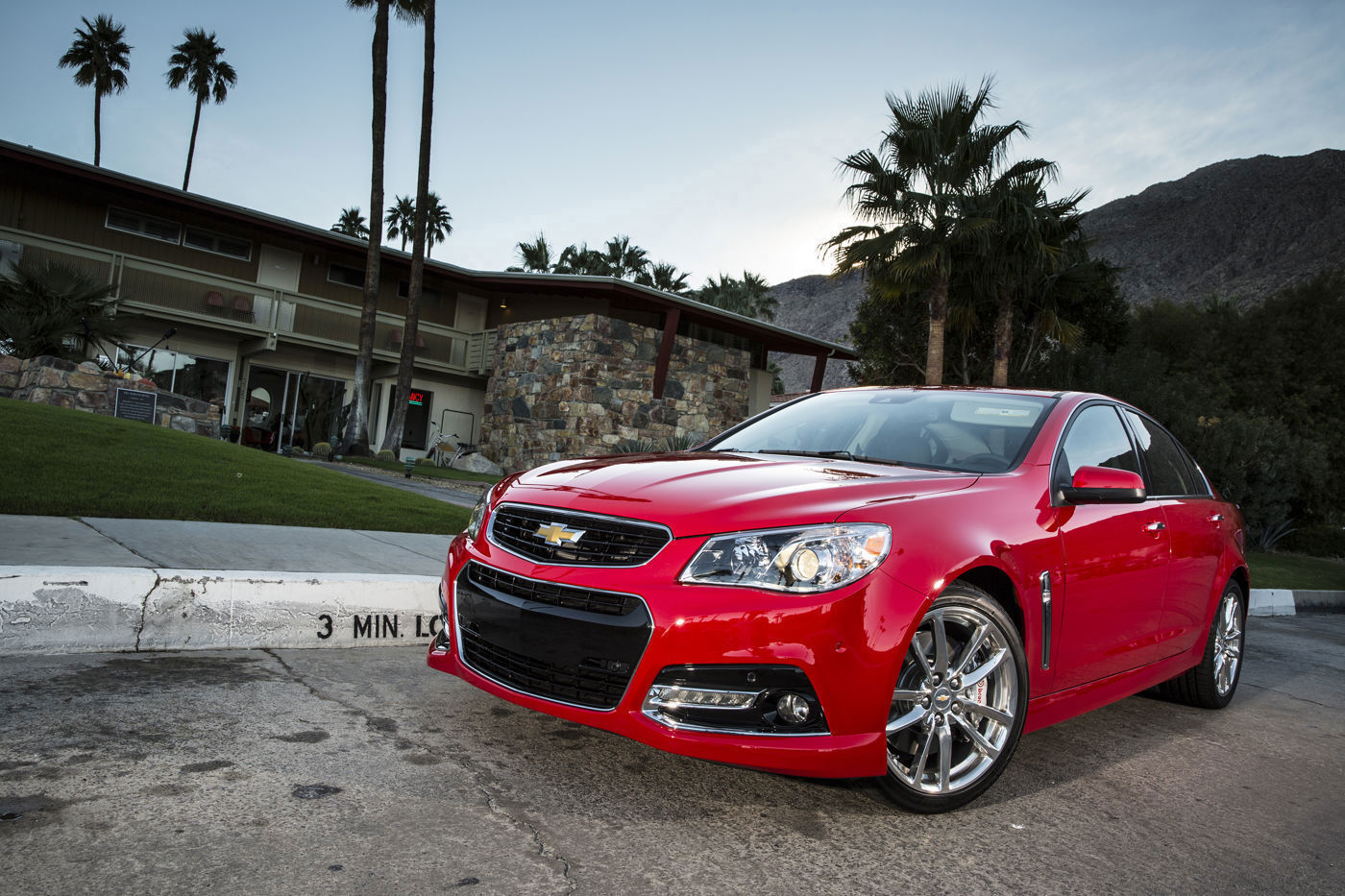
For 2015, Chevrolet added a six-speed manual to the SS sedan. The new clutch pedal changed more than driver involvement: the TR-6060 configuration carried a 3.70 limited-slip axle, while the 6L80 automatic used 3.27. Both retained the LS3 6.2-liter V-8 at 415 horsepower and 415 pound-feet. One model name now concealed two exact drivetrains.
The manual arrived beside other changes Chevrolet highlighted, including Magnetic Ride Control and rear Brembo brakes. Those features help explain why the year mattered, but they should remain attached to the documented equipment matrix. A press release can establish that they were introduced or standard; it cannot supply every calibration or component detail without the technical guide.
The buyer-request framing is useful when attributed to Chevrolet. It shows product planning responding to a perceived gap rather than a transmission appearing inevitably. Dealer orders, take rates, and owner testimony could deepen that response, but production breakdowns remain held until final accounting. Enthusiast demand is not quantified by repeating forum posts.
Australian assembly makes the SS an especially important American-performance story. The U.S.-market Chevrolet was related to Holden work and built within an Australian production system. That does not remove it from the catalog; it makes assembly origin a visible fact. “American muscle” here describes brand, market, lineage, and performance context, not a claim that every operation occurred inside U.S. borders.
The Elizabeth plant deserves people rather than scenic invention. A physical opening on the line needs a dated first-party plant record, named workers where appropriate, creator, and licensed image. Until those are acquired, the page begins with the consequential change at the pedal and explains Australian assembly without fabricating machinery sounds, shift routines, or worker reactions.
Manual and automatic remain equally legitimate SS configurations. The selector does not call the manual the real enthusiast car and reduce the automatic to an afterthought. The automatic’s 3.27 axle and 6L80 are facts, as are the manual’s TR-6060 and 3.70. Period acceleration can later become exact observations of equipped test cars rather than a moral ranking.
The Chevrolet-distributed release available in this pass is mirrored on an independent document host. Its transmission and axle mapping is useful but requires a durable first-party acquisition copy. The official brochure supplies output and broader specification context. The release can support a reviewed row with its limitation exposed while archival work continues.
The same discipline applies to curb weight and fuel economy. A brochure value, regulatory value, test-car scale weight, and derived estimate answer different questions. None should be copied across transmissions. This first selector release focuses on the clear engine, gearbox, and axle identity and leaves unsupported measurement fields absent rather than zero.
Placed beside the 2015 sedans, SS made a distinctive argument. Taurus SHO used a twin-turbo V-6, six-speed automatic, and all-wheel drive with standard or Performance Package axles. Charger ranged from R/T through Hellcat, all automatic in the supported rows. CTS-V Coupe was no longer a sedan in 2015. SS alone combined its particular naturally aspirated V-8 sedan package with a new manual.
That uniqueness does not make it a universal winner. Passenger space, origin, drive layout, transmission, axle, power delivery, chassis equipment, price, and purpose remain visible. A reader can compare manual SS to manual Mustang GT or automatic SS to Charger R/T, but the tool never pretends those bodies and missions are equivalent because horsepower can be sorted.
Corvette engine-family context belongs in a precise link. LS3 terminology can send readers toward Vette Facts’ 2015 C7 page only with a warning that engine-family labels do not establish identical generation, parts, calibration, or output. Corvette remains outside the selector. A shared GM vocabulary is a research path, not evidence substitution.
The model’s relatively short U.S. run can enter the aftermath after final accounting and plant chronology are sourced. The 2015 page should not use later discontinuation to make every car rare or turn assembly closure into an anonymous elegy. Holden and GM records, labor archives, and firsthand accounts can give the production story human shape.
Photographs of the manual shifter, pedal box, car, or Elizabeth production remain permission leads. Brochure access is evidence rather than image clearance. The private queue needs exact year and transmission depiction, creator, source, rights holder, license, crop, visible people or plates, and proposed credit before owner approval or contact.
The manual SS is a strong story because the evidence makes one small physical addition consequential. A clutch pedal altered gearbox, axle, driver interface, and the sedan’s position in the field while leaving the advertised LS3 output shared. Exact configuration lets that change register without dismissing the automatic or borrowing results from either.
The page ends where comparison begins: choose 6M and see TR-6060 with 3.70; choose 6A and see 6L80 with 3.27. Both are Australian-built U.S.-market Chevrolet SS sedans at 415/415. The distinction is not documentary trivia. It is the buyer choice Chevrolet added and the reason a model-level row would be incomplete.
The SS name itself needs context because Chevrolet used it across unrelated models and eras. A 2015 SS sedan is not a Monte Carlo SS, Impala SS, Camaro SS, or generic Super Sport package. Its canonical subject and body stay explicit, preventing search or comparison from inheriting an engine merely because two cars share the letters.
Right-hand-drive Holden relatives also remain separate market observations. Related body and assembly evidence can explain origin, but Australian engine, transmission, trim, compliance, and rating claims cannot automatically populate the U.S. Chevrolet. A complete export-change record will show what was shared and what the American-market program changed.
The manual configuration ultimately shows why listening to buyers is only the opening, not the whole story. Product planning had to authorize the choice; engineering had to integrate and validate it; the plant and suppliers had to build it; dealers had to order and service it. Those roles can become a people story once records identify participants without reducing the car to one executive decision.