1987 · Buick · United States
1987 Buick Regal Grand National and GNX: A Farewell Built to Beat the Corvette
The last rear-drive Regal year was the turbo Regal's biggest: 20,193 Grand Nationals by one count, a lighter WE4 Turbo T, and 547 McLaren/ASC-converted GNXs.
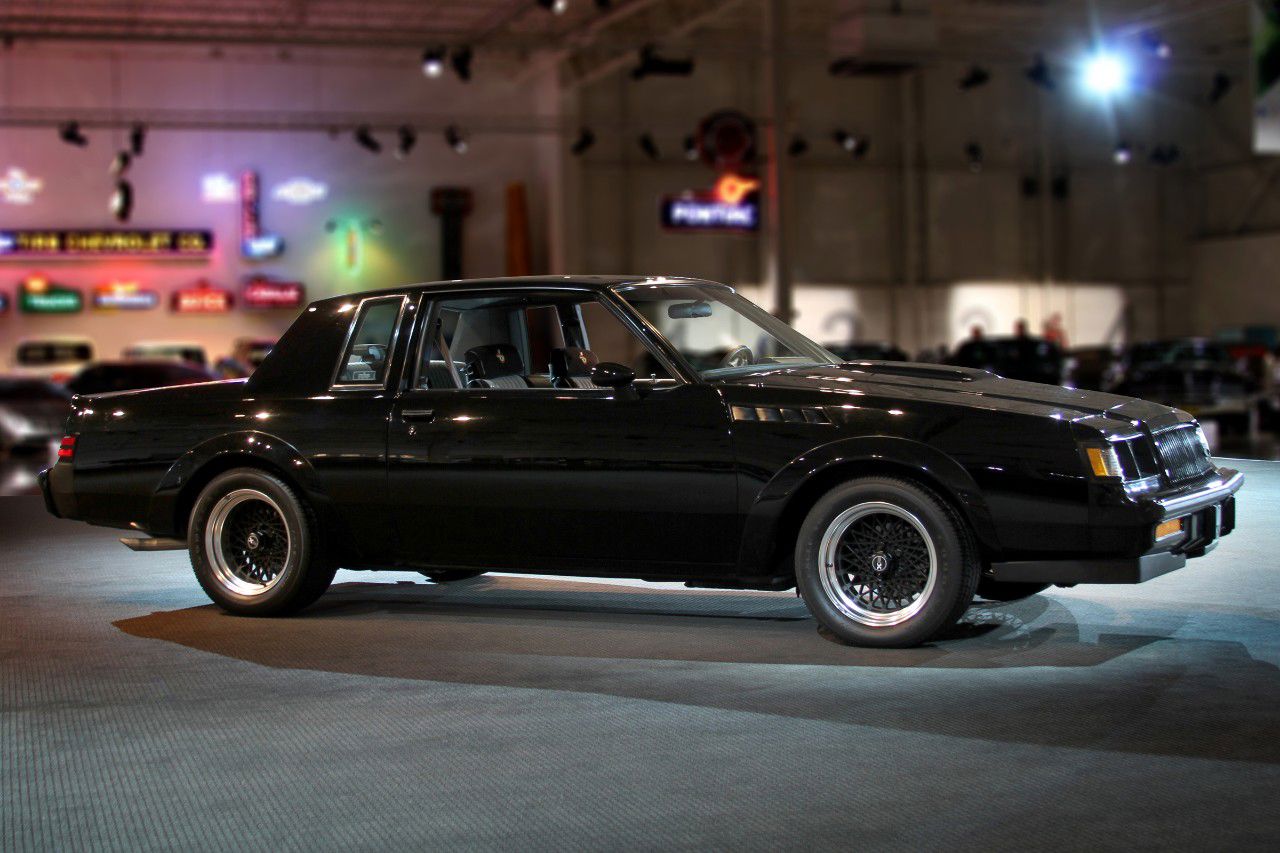
Road & Track traced the GNX to a plan hatched at the 1985 Indianapolis 500 between Buick and McLaren Engines. By the time John Lamm's report ran in June 1987, the plan had a working shape: American Sunroof Corporation, McLaren's parent company, would take Grand Nationals ordered by Buick dealers and turn them into something harder. The Buick men who told the story to Hagerty three decades later started it from the other end. Chief engineer Dave Sharpe recalled that once the rear-drive Regal was to give way to front drive, he asked, "Why don't we do something really special as a farewell?" The 1987 model year was that farewell.1,2
The car being retired was at the top of its game. For 1987 Buick rated the intercooled, sequential-fuel-injected 3.8-liter turbo V-6 at 245 hp at 4,400 rpm and 355 lb-ft at 2,800 rpm, SAE net, and fed it through a four-speed THM 200-4R automatic with a lockup converter and a 0.67 overdrive top gear. Buick built 20,193 Grand Nationals among 89,746 rear-drive Regals, a little more than one car in five. The Grand National was priced at $15,136 against $11,562 for a V-6 Regal coupe and carried a 3,385-pound shipping weight. Nobody needed a McLaren to make this car interesting; the question in 1987 was how to end it.3
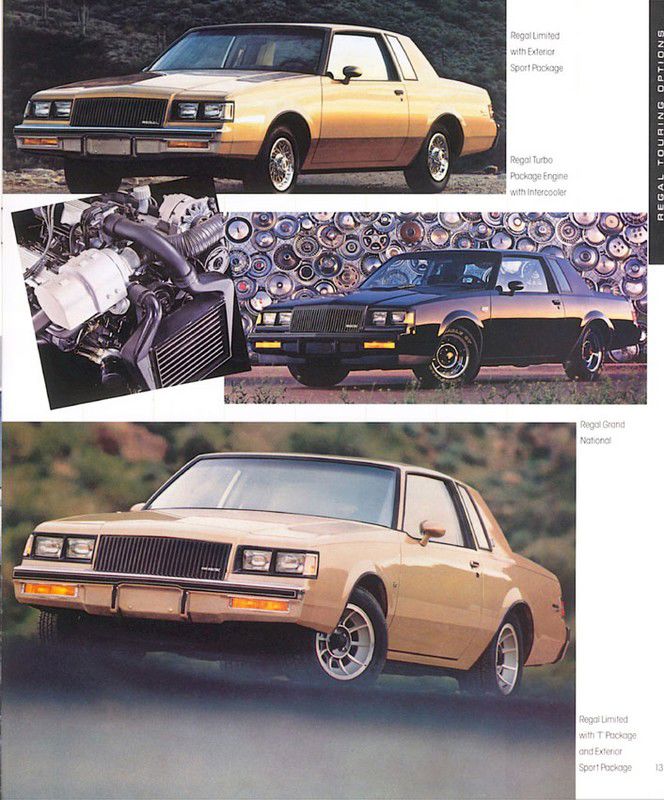
Buick's own answer for the mass of buyers was quieter than the GNX and, in its way, more revealing. A 1987 dealer brochure for the WE4 Turbo T package explains that Grand National sales volume could not exceed 33 percent of Regal turbo engine production, and that the Turbo T was created to sell turbo cars beyond that ceiling. The brochure does not say who set the cap or how it was measured. What it describes is a Regal with the turbo V-6, Gran Touring suspension, the Grand National's black appearance, gray cloth buckets, a console, a tachometer and boost gauge, T emblems on the front fenders, a 3.42 final drive, and P215/65R15 Goodyear Eagle GTs on 15x7 aluminum wheels. Buick claimed 0.84 g of lateral grip and an EPA estimate of 17 mpg city and 24 highway.
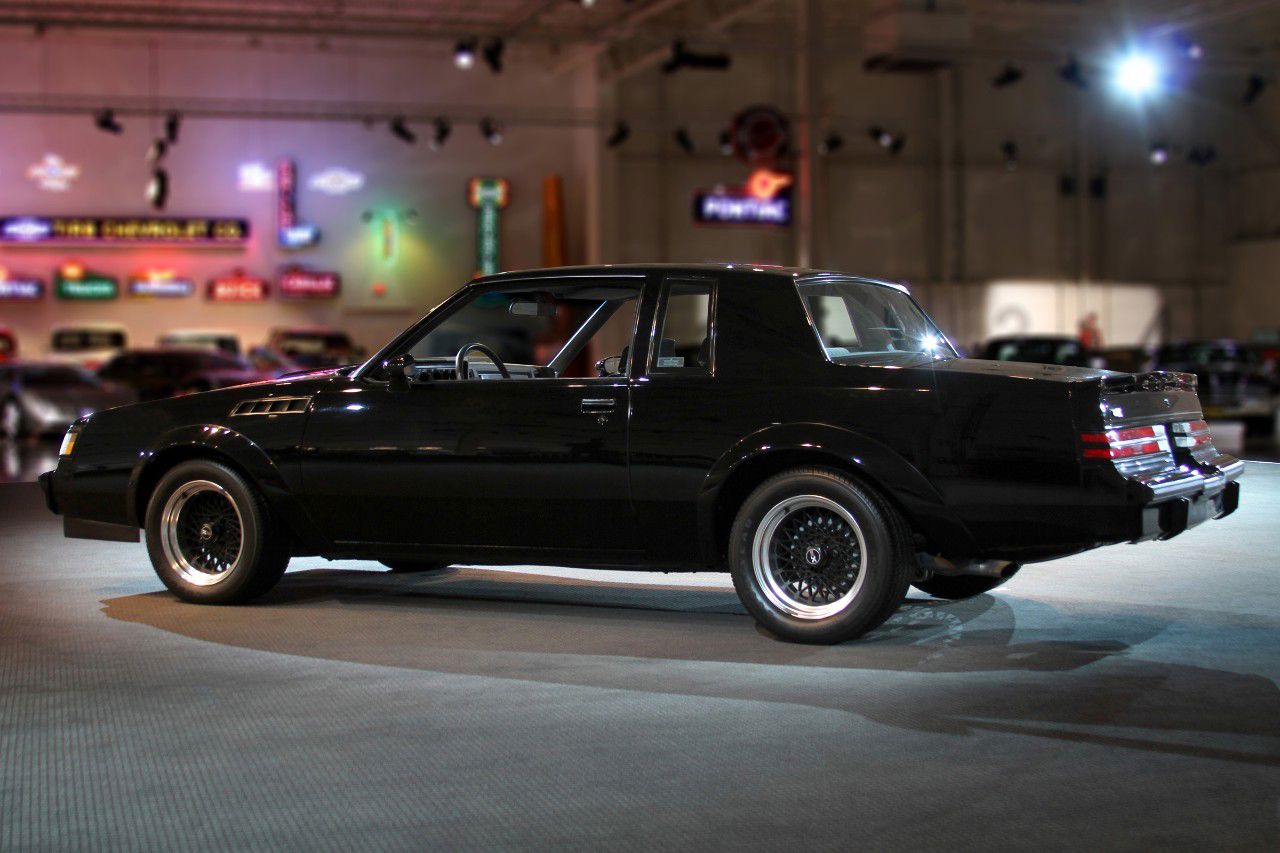
The Turbo T is where the year's counting gets difficult. Over-Drive lists the WE4 row at 3,155 pounds of shipping weight, 230 fewer than the Grand National, and its table note says 1,547 of the 4,268 turbo Regal coupes were WE4 cars. The same note says the 20,193 Grand Nationals include the 547 GNXs, and that 1,035 Regal Limiteds carried the turbo V-6. The GN/T-Type website gnttype.org, drawing on Steven Dove's facts-and-figures book, prints the same five numbers but treats the GNX and WE4 as separate lines, which yields its total of 27,590 turbo cars, the figure Wikipedia repeats. The two readings differ by exactly the 547 GNXs and 1,547 WE4s, 2,094 cars in all. Neither compilation names a Buick record behind its total, so neither can be called settled: the dispute is whether a GNX also counts as a Grand National, and whether a WE4 also counts as a turbo Regal coupe.3,4,5
The GNX itself was a small-team project, and Hagerty's account names the team rather than one inventor. Mike Doble, Buick's advanced concepts manager, remembered his boss Tim Logsdon's charge: "We want to build a Grand National to end all Grand Nationals." Don Runkle, who ran engine engineering, recalled telling his group that the turbo Regal had to beat the Corvette, and Sharpe set the target as faster than a Corvette from 0 to 60 mph and through the quarter mile. General manager Ed Mertz, whose brief was to position Buick just below Cadillac, admitted to "some consternation" over how the car fit the division's premium image. ASC and McLaren did the rear suspension, the body modifications and the die work; McLaren brought experience with the ceramic turbine.2,6
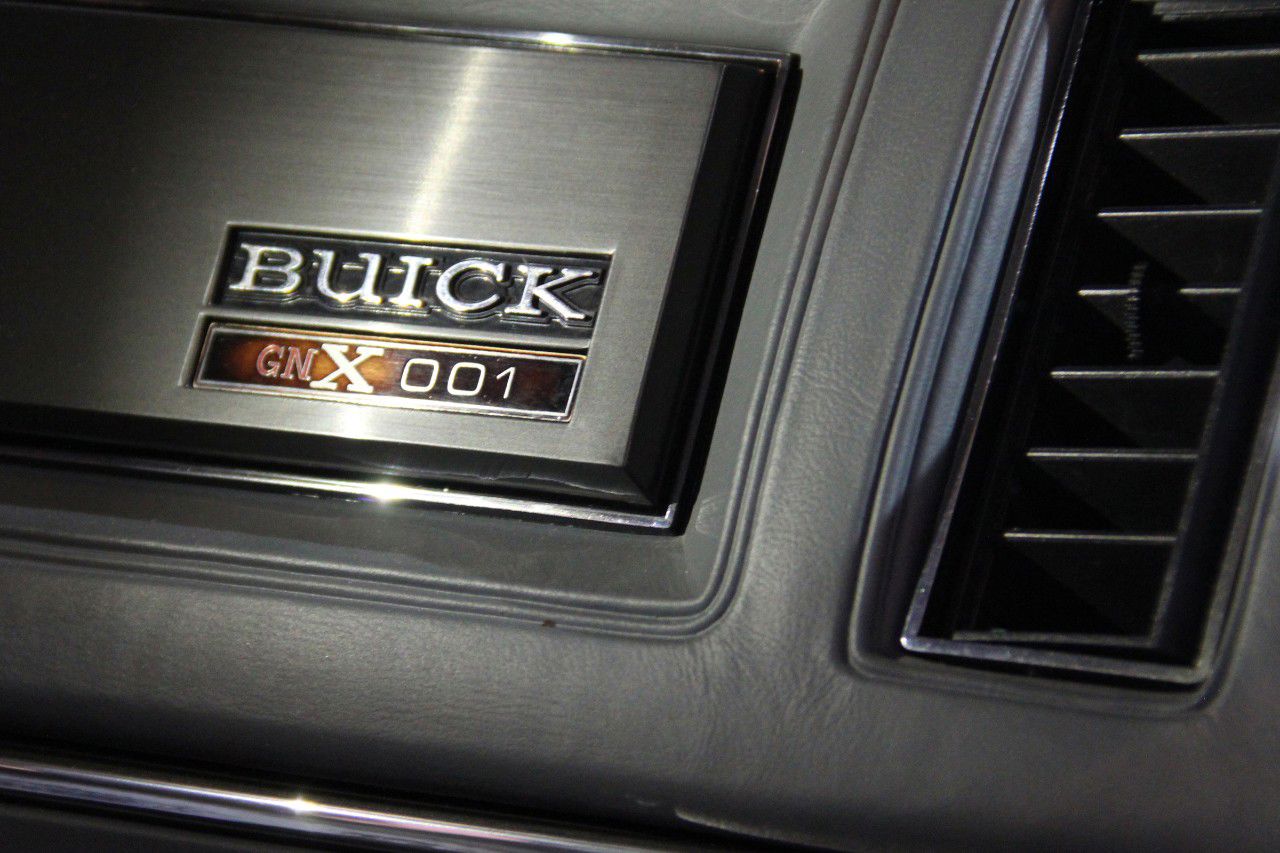
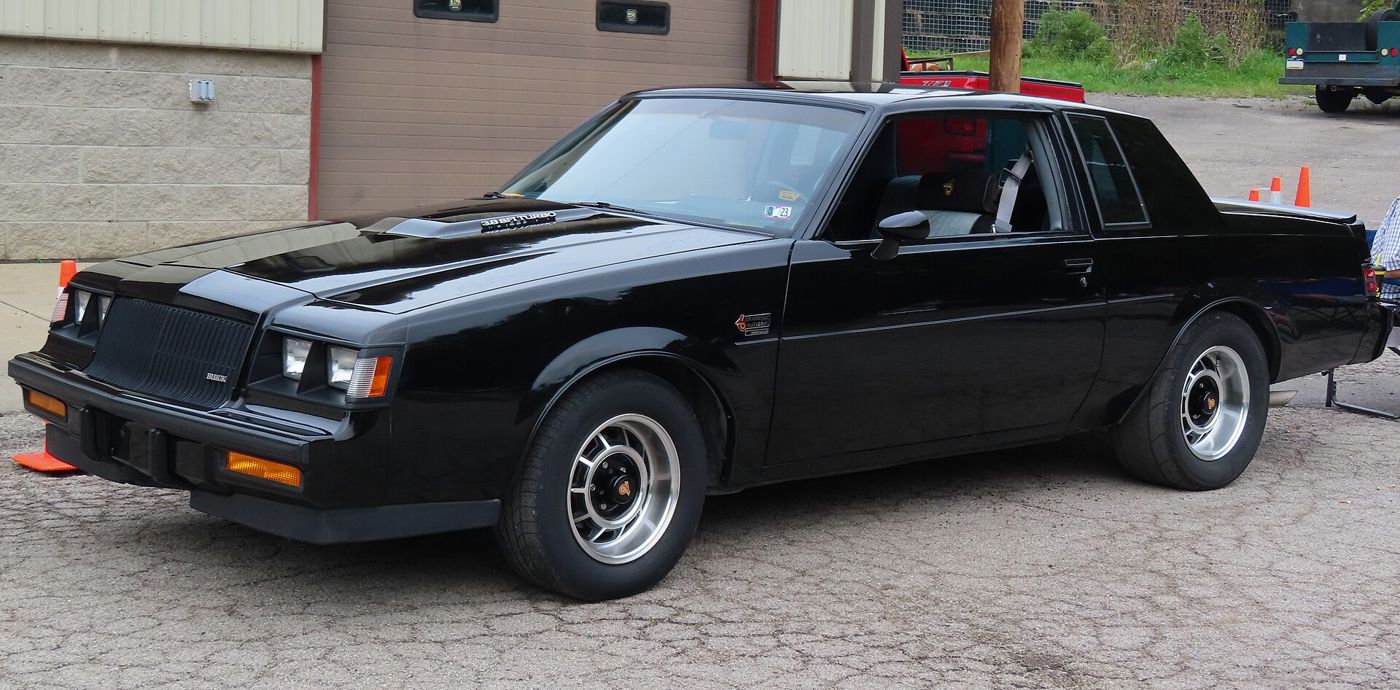
The hardware followed the brief. General Motors lists a Garrett AiResearch T-3 turbocharger, dual mufflers, a revised turbo Hydra-matic 200-4R, 16-inch black mesh wheels, a serial-numbered dash plaque and a hood with no emblem. Road & Track added the details that mattered to a driver: a ceramic turbine wheel, a revised intercooler, boost raised to 16.0 psi in first and second gears against the Grand National's 15.0, a Panhard rod and a longitudinal torque bar at the rear, Goodyear Gatorbacks listed as P245/50VR-16 front and P255/50VR-15 rear, Stewart-Warner instruments, fender vents, and all-black paint. The 124-mph rev limiter stayed.6,1
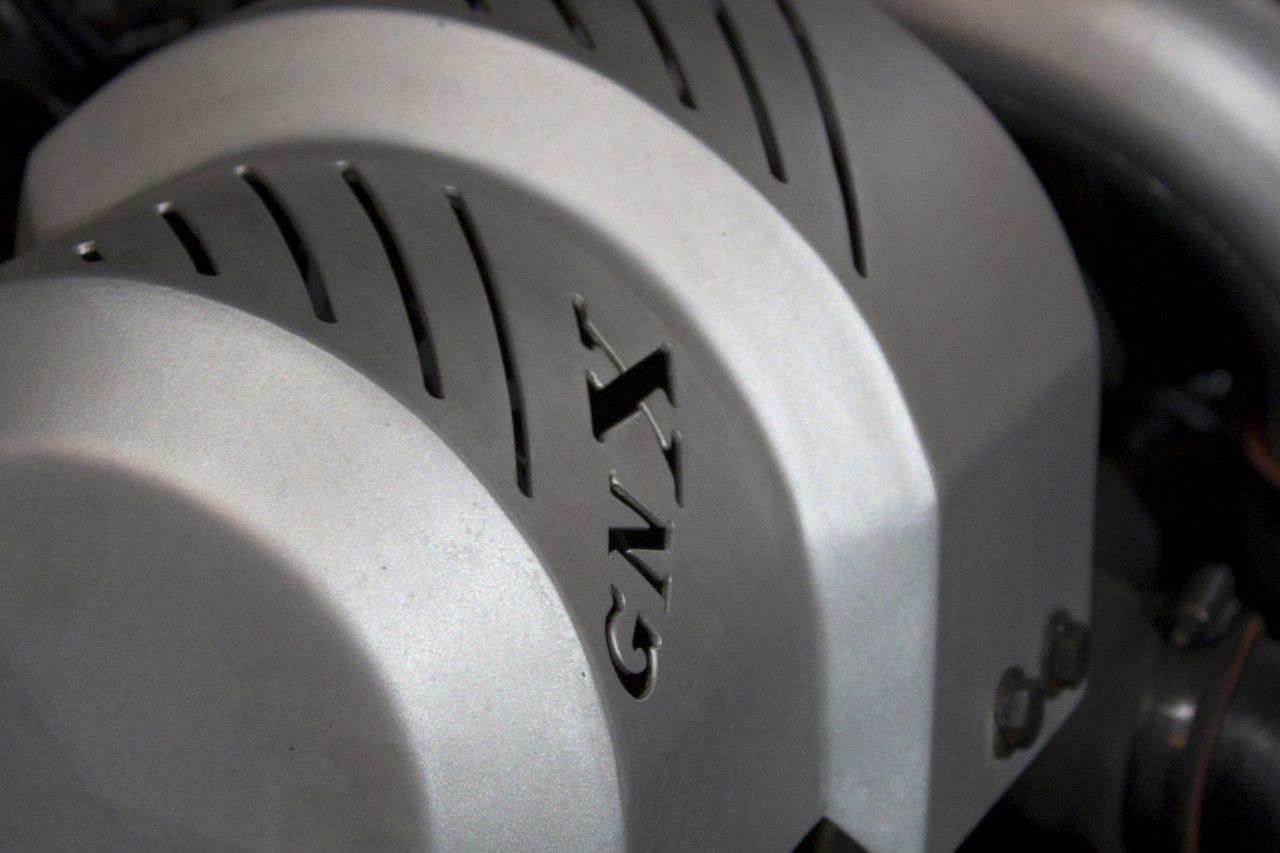
How much power it made depends on whose paper you read, and that dispute stays open. Road & Track reported figures off the dynamometer of 300 bhp at 4,400 rpm and 420 lb-ft at 2,400, which is a magazine's report, not a factory rating. Secondary sources give a rating of 276 hp but disagree on the rest: gnttype.org and Wikipedia have 360 lb-ft at 3,000 rpm, while Over-Drive has 276 hp at 5,000 rpm and 400 lb-ft. Buick's own acceleration claims were plainer: 0-60 mph in 5.4 seconds and a 13.4-second quarter mile at 104.0 mph, against 6.9 seconds and 15.7 at 97.5 mph for its Grand National figures.1,4,5,3
Road & Track suspected those claims were conservative, because its own earlier Grand National test had already run 0-60 in 6.0 seconds and the quarter in 14.7 at 94.0 mph. Its time with the GNX was informal: a well-used prototype at GM's Mesa proving ground, 5.6 to 5.7 seconds to 60 and a best quarter of 13.8 seconds, with the speedometer reading in the 104-mph range. Those numbers belong to that prototype on that day. Doble later said the GNX beat a Callaway Corvette "on every run" in straight-line and quarter-mile testing; the article prints no times, so that stays his recollection.1,2
The production figure grew in the telling, and Doble explained why. The first plan was 200 cars; Buick then chose 500, for the Indianapolis 500 and the Daytona 500. Road & Track, writing before production, still said only 500 would be built and expected a sticker of $26,000 to $28,000. Doble's account is that only 47 dealers met the performance criteria for Buick's Select 60 group in 1986, that Mertz promised each of them an extra car, and that ASC/McLaren found a way to build them. General Motors puts the final count at 547 and the original MSRP at $29,290, against $18,295 for a heavily equipped Grand National; other sources give $29,900. Measured against the 20,193 Grand Nationals, the 547 GNXs amount to under 3 percent.2,1,6,5,3
The Grand National also reached further north than its US counts suggest. Buick shipped 3,578 Regals to Canada for 1987, 1,695 of them WE2 Grand Nationals, plus 280 cars with a Canadian Y56 T package on the base coupe body. Whether the Canadian Grand Nationals are already inside the 20,193 figure is not known, so they stand as their own count rather than being added to anything.4
The GNX did what its builders said it was for. Doble recalled that every car was sold before the first was finished, so there were no press cars and the two prototypes did the press rides; he added that buyers paid $10,000 over a Grand National's sticker and that some cars later sold for $80,000 to $90,000. Sharpe summed up the purpose: "The objective was not profit but strictly to make a big splash." Lamm, in 1987, counted it among the special-interest cars of the future. The rear-drive Regal ended with its most extreme version, and nearly four decades later General Motors was still telling the GNX story and still putting the count at 547.2,6
Fact sheet · 1987 · United States
The numbers
1987 Buick Regal Grand National, Turbo T (WE4) and GNX: The last rear-drive Regal year was the turbo Regal's biggest: 20,193 Grand Nationals by one count, a lighter WE4 Turbo T, and 547 McLaren/ASC-converted GNXs.
Figures may describe different groups of cars. Add rows together only when the note says they make up a total.
Key facts
- GNX production: 547 (General Motors).6
- Grand National production 20,193 including the 547 GNX conversions, per Over-Drive's table note.3
- WE4 Turbo T: 1,547 built; brochure rating 245 hp @ 4400, 355 lb-ft @ 2800, 3.42 final drive.3
- Buick's WE4 dealer brochure says Grand National sales volume could not exceed 33% of Regal turbo engine production, which is why the lighter WE4 package was created; this is Buick's stated rationale, not a production count.
- Road & Track's informal timing of the used GNX prototype at GM's Mesa proving ground gave 0-60 mph in 5.6-5.7 s; Buick claimed 5.4 s.1
- Over-Drive: 44,844 base Regals (including over 1,000 lightweight WE4 turbos) and 4,268 base Regals with the standard turbo V-6; 20,441 Limiteds; 20,193 Grand Nationals.3
Production
| What was counted | Built |
|---|---|
| All 1987 Regal (rear-drive) production3 Regal, Regal Limited, Grand National · 2-door coupe | 89,746 |
| All turbo Regals (enthusiast total)4,5 all turbo Regals · 2-door coupe · 3.8 turbo V-6 | 27,590 |
| What was counted | Built |
|---|---|
| Regal Grand National (GJ1/J47, V-6 Turbo)3,4 Grand National (WE2) · 2-door coupe · 3.8 turbo V-6 · 4-speed automatic | 20,193 |
| Regal Limited, all engines3 Regal Limited · 2-door coupe · V-6, V-8 or turbo V-6 | 20,441 |
| Regal coupe, V-6 and V-8 (non-turbo)3 Regal · 2-door coupe · 3.8 V-6 or 5.0 V-8 | 44,844 |
| What was counted | Built |
|---|---|
| GNX (Grand National Experimental)6,3,4 GNX · 2-door coupe · 3.8 turbo V-6, GNX specification · 4-speed automatic | 547 |
| Turbo T package (WE4)3,4 Regal Turbo T (WE4) · 2-door coupe · 3.8 turbo V-6 · 4-speed automatic | 1,547 |
| What was counted | Built |
|---|---|
| Regal coupe with turbo V-6 (GJ1/J47)3,4 Regal (base) with turbo, including WE4 · 2-door coupe · 3.8 turbo V-6 | 4,268 |
| Regal Limited with turbo V-6 (GM1/M47)3,4 Regal Limited · 2-door coupe · 3.8 turbo V-6 | 1,035 |
| What was counted | Count | Counted as |
|---|---|---|
| Regals imported into Canada, all engines4 all Regal · 2-door coupe · Canada | 3,578 | shipped |
| Grand Nationals (WE2) imported into Canada4 Grand National · 2-door coupe · 3.8 turbo V-6 · Canada | 1,695 | shipped |
| Y56 'T' package, Canada (4GJ47 only)4 Regal with Y56 T package · 2-door coupe · Canada | 280 | shipped |
Prices when new
| Model | Price | Price type |
|---|---|---|
| Regal Grand National coupe3 | $15,136 | factory price, 1987 model year |
| Regal coupe with turbo V-63 | $14,857 | factory price, 1987 model year |
| Regal coupe V-6 (base)3 | $11,562 | factory price, 1987 model year |
| GNX6 | $29,290 | original MSRP, 1987 |
| Heavily equipped Regal Grand National (Buick launch comparison)6 | $18,295 | figure Buick used at GNX launch, 1987 |
Prices are the nominal dollars of the day, not adjusted for inflation.
Engines
| Engine | Factory rating | Availability | Built |
|---|---|---|---|
| LC2 · 3.8-liter SFI turbocharged intercooled V-6 231 cu in · turbocharger with air-to-air intercooler, sequential port fuel injection | 245 hp @ 4,400, 355 lb-ft @ 2,800 (SAE net (brochure 'Net/Installed')) | standard on Grand National and WE4; optional on Regal and Regal Limited | |
| GNX 3.8-liter turbo V-6 (McLaren/ASC specification)1 231 cu in · Garrett AiResearch turbocharger with ceramic turbine, enlarged intercooler, sequential port fuel injection | 300 hp @ 4,400, 420 lb-ft @ 2,400 (Road & Track dynamometer figures reported in text (not a factory rating)) | GNX only | 5476 |
Ratings are published figures, not dyno results. Gross and net ratings aren't directly comparable.
Transmissions
| Transmission | Availability |
|---|---|
| 4-speed automatic (THM 200-4R) with torque-converter clutch; ratios 2.74 / 1.57 / 1.00 / 0.67, reverse 2.07 | turbo cars |
Options and packages
| Code | Option | Price | Installed |
|---|---|---|---|
WE4RPO |
Turbo T package (turbo V-6, Gran Touring suspension, black appearance, gray cloth buckets, console, tachometer, boost gauge) | 1,5473 | |
WE2RPO |
Grand National package4 | 20,1934 | |
| Regal "T" package: Gran Touring suspension, fast-ratio power steering, gas shocks, 15-in aluminum wheels, P215/65R15 Eagle GT blackwalls, leather-wrapped sport steering wheel, "T" ornamentation3 | |||
LC2package / RPO |
Turbo package: 3.8 SFI turbocharged engine with intercooler, cluster with tachometer, boost gauge and trip odometer, turbo hood and ornamentation, acoustical insulation, 3.42 axle3,7 | ||
| Base Regal exterior molding package: wide rocker panel and belt reveal moldings (standard on Limited)3 | |||
G80RPO |
Limited-slip differential7,3 | ||
| Radio delete3 | $-56 |
Paint
| Code | Color |
|---|---|
12 |
Silver3 |
13S |
Silver3 |
14 |
Black3 |
15 |
Medium Gray3 |
19 |
Black3 |
22 |
Light Sapphire Blue3 |
24 |
Bright Blue3 |
25 |
Light Blue3 |
26 |
Light Sapphire Blue3 |
27 |
Medium Sapphire Blue3 |
28 |
Black Sapphire3 |
29 |
Dark Sapphire Blue3 |
31 |
Dark Blue3 |
33 |
Light Driftwood3 |
38 |
Sungold3 |
40 |
White3 |
41 |
Black3 |
43 |
Light Sage3 |
48 |
Black Emerald3 |
52 |
Copper Beige3 |
54 |
Yellow Beige3 |
58 |
Light Chestnut3 |
62 |
Dark Chestnut3 |
63 |
Light Driftwood3 |
64 |
Medium Copper3 |
67 |
Light Copper3 |
70 |
Carmine3 |
71 |
Medium Red3 |
76 |
Dark Garnet Red3 |
78 |
Medium Rosewood3 |
79 |
Dark Red3 |
80 |
Light Rosewood3 |
82 |
Medium Rosewood3 |
83 |
Medium Sapphire Blue Firemist3 |
84 |
Medium Gray3 |
86 |
Dark Rosewood3 |
92 |
Medium Emerald Firemist3 |
96 |
Dark Driftwood Firemist3 |
98 |
Chamois Firemist3 |
99 |
Dark Amethyst3 |
Color names are the factory's. We don't show color swatches, because a screen color is no guide for a restoration.
Interiors
| Trim |
|---|
| WE4: gray cloth reclining bucket seats with console |
| Grand National standard interior (1984-87 as a group): black and gray; some Grand Nationals received Lear Siegler leather seats in a light and dark brown combination; T-Types could have any interior colour.7 |
Specifications
| Measure | Value | Applies to |
|---|---|---|
| Final drive ratio (WE4) | 3.42 :1 | WE4 Turbo T |
| Tires (WE4) | P215/65R15 Goodyear Eagle GT on 15x7 aluminum wheels | WE4 Turbo T |
| Maximum lateral acceleration (WE4, Buick claim) | 0.84 g | WE4 Turbo T |
| EPA fuel economy estimate (WE4) | 17 city / 24 highway mpg | WE4 Turbo T |
| Shipping weight, Grand National3 | 3,385 lb | Regal Grand National |
| Shipping weight, Regal Turbo WE43 | 3,155 lb | Regal V-6 Turbo WE-4 row |
| GNX tires1 | Goodyear P245/50VR-16 front, P255/50VR-15 rear | GNX |
| Overall length / height / width, coupe3 | 200.6 / 54.6 / 71.6 in | Regal coupe |
| GNX turbo V-6 (as listed)3 | 8.5:1; 276 hp at 5000 rpm; 400 lb-ft at 3000 rpm; ceramic-impeller turbocharger, larger intercooler | GNX |
| Axle ratios (Grand National)3 | 3.42:1 standard, none optional | Grand National |
Period road tests
| Test | Car tested | Result |
|---|---|---|
| Road & Track, 1987-0610-60 mph | GNX prototype (used), GM Mesa proving ground, informal timingInformal timings of a well-used prototype; not a full road test. | 5.6-5.7 s |
| Road & Track, 1987-061Quarter mile (best) | GNX prototype (used), informal timingSpeedometer readings in the 104-mph range; informal. | 13.8 s |
| Buick (as reported by Road & Track), 1987-0610-60 mph (manufacturer claim) | GNXManufacturer claim; R&T notes these are conservative factory figures. | 5.4 s |
| Buick (as reported by Road & Track), 1987-061Quarter mile (manufacturer claim) | GNXManufacturer claim. | 13.4 s @ 104.0 mph |
A road test result belongs to the one car that was tested, with its engine, gearing, tires, and conditions. It is not a figure for every car of the year.
Identification
- GNX
- Serial-numbered dash plaque; 16-inch black mesh wheels; no hood emblem; fender vents; GNX badges on grille and trunk; Stewart-Warner instruments.6,1
- WE4 Turbo T
- Grand National-style black appearance with 'T' emblems on the front fenders; gray cloth bucket seats.
- VIN
- Example 1G4GJ117XHP400001 (1987 Grand National): 1 = USA; G = GM; 4 = Buick; G = G-body; J = Regal sales level (K, "supposed to be GN", was not used); 1 = 2-door coupe; 1 = manual belts; 7 = LC2 3.8 SFI intercooled turbo; X = check digit; H = 1987; P = Pontiac, Michigan; 400001 = serial. RPO WE2 = Grand National, WE4 = Turbo T.7
- RPO codes (turbo Regal)
- WE2 = Grand National package; WE4 = 1987 Turbo T package; LM9 = turbo 3.8 (1984-85); LC2 = intercooled turbo 3.8 (1986-87); G80 = limited-slip differential. The RPO service sticker is on the trunk lid and should carry the car's VIN.7
- Grand National authenticity marks
- Factory GNs carry GN emblems on both front fenders, one on the driver's side of the trunk lid and a smaller one on the passenger dash trim plate; 1986-87 cars add "intercooled" emblems under the fender emblems; "Buick" appears only on the dash plate and grille. All turbo Regals had a 3.42:1 axle; Positraction (G80) was optional.7
Where the sources disagree
Whether GNX and WE4 are counted inside the Grand National and base-turbo figures
GNX factory torque rating and rpm
Identification
Read a 1987 Buick VIN
The VIN decoder runs in your browser and never sends the VIN anywhere. How the factory numbered this year's cars:
Read next
The people and races behind the 1987 Buick Regal Turbo, Grand National and GNX
- 1987: When the Badge Stopped Being Enough Cross-marque story
- Every Buick Regal Turbo, Grand National and GNX year 1978–1987
Same model year
Also in 1987
- Buick Riviera Riviera sales fell to 15,223; 2,587 were T-Types.
- Chevrolet El Camino SS Final year of RPO Z15: the El Camino SS Sport listed at $10,784.00 with a fuel-injected 4.3 V6; 15,589 El Caminos built.
- Chevrolet Monte Carlo SS Aerocoupe production rises to 6,052 of 39,251 Super Sports.
- Ford Thunderbird Reskinned and intercooled: 190 hp with the five-speed, 150 hp with the automatic, and Motor Trend's Car of the Year.
- Lincoln Mark VII LSC The LSC keeps its 200-hp 5.0 for most of the year; a 225-hp H.O. version is reported to have arrived late in 1987 production.
- Mercury Cougar The 20th Anniversary Cougar in Cabernet Red, about 5,002 built, among 105,847 Cougars; the turbo XR-7 was gone.
- Oldsmobile Cutlass, 4-4-2 and Hurst/Olds The W42 4-4-2 on the rear-drive Cutlass Supreme, with a 307 V-8 and a four-speed automatic.
- Pontiac Firebird and Trans Am The GTA and the 350 arrive: a factory option printout counts 29,757 Trans Ams, one of them in paint code 84U.
- Pontiac Grand Prix The last rear-drive, V8 Grand Prix: 16,542 built.