1987 · Chevrolet · United States
1987 Chevrolet Monte Carlo SS Aerocoupe: The Homologation Special Goes on General Sale
Aerocoupe production rises to 6,052 of 39,251 Super Sports.
United States · researched through 2026-09-22
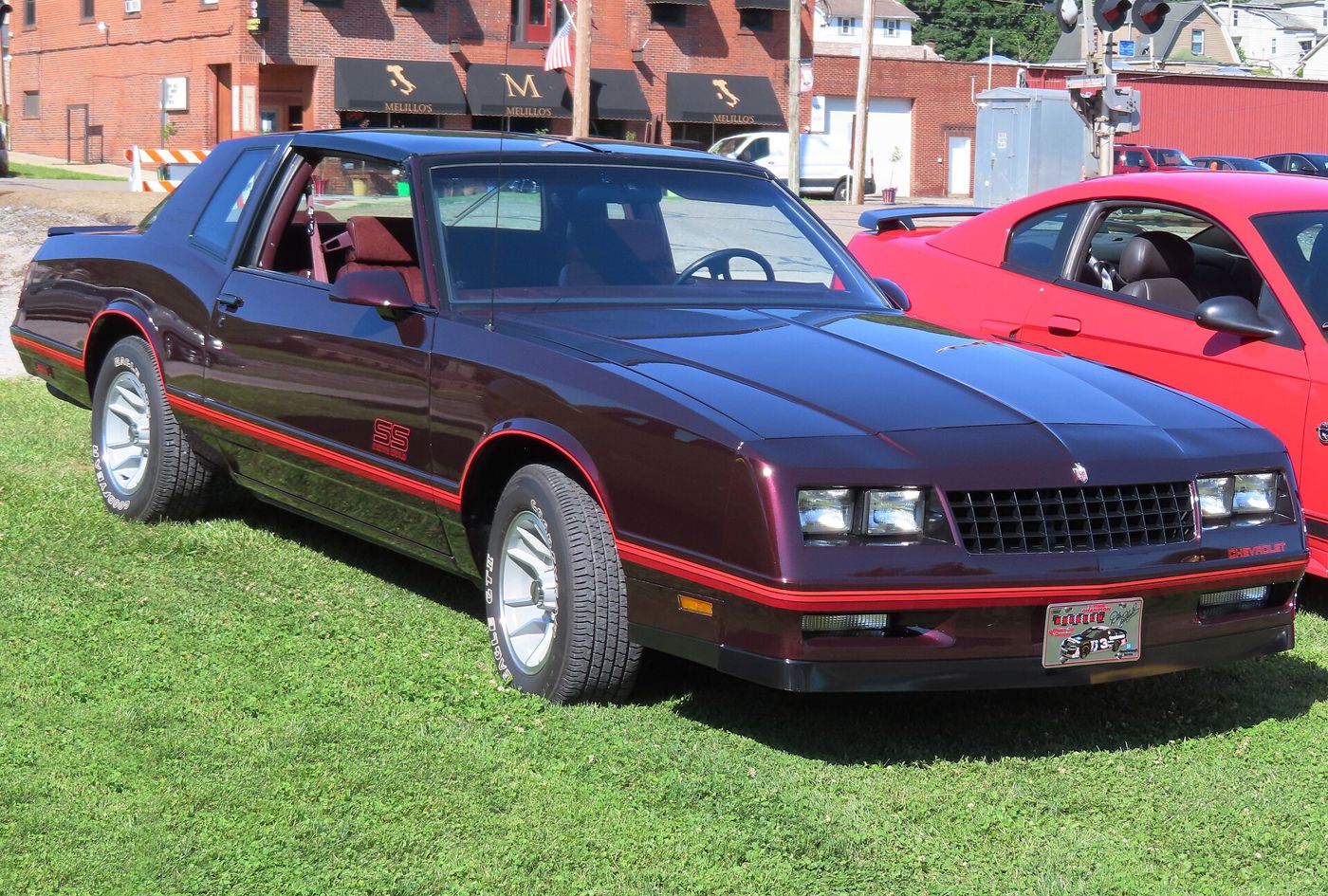
When Chevrolet decided where its first Aerocoupes would go, racing was part of the arithmetic. The MonteCarloSS.com registry of the 1986 cars, compiled from build sheets, window stickers, press releases and conversion-company correspondence, records the allocation: 70 cars each to the Jacksonville and Charlotte zones and 30 each to Atlanta and Birmingham. The shares were weighed by each region's 1985 retail Monte Carlo sales and by the number of major NASCAR speedway races held in the zone between January and July. It was a car shaped for the stock-car rulebook, and Chevrolet sent it to stock-car country. A year later, anyone could order one.1,1
The problem Chevrolet was solving lived on the superspeedways. Silodrome's history of the car says Ford's ninth-generation Thunderbird, with a drag coefficient of 0.35, had become the dominant force there. NASCAR required a production run before a road-car body feature could be raced, and Wikipedia gives that number as 200. Chevrolet built exactly 200 Aerocoupes for 1986. Every one was assembled at Arlington, Texas, as a regular notchback Monte Carlo SS, then shipped to Cars & Concepts in Brighton, Michigan, for the conversion. The registry records a 19-week run of ten cars a week, with 20 in the first week, and the MonteCarloSS.com FAQ says all 200 were white with burgundy interiors.2,3,1,4
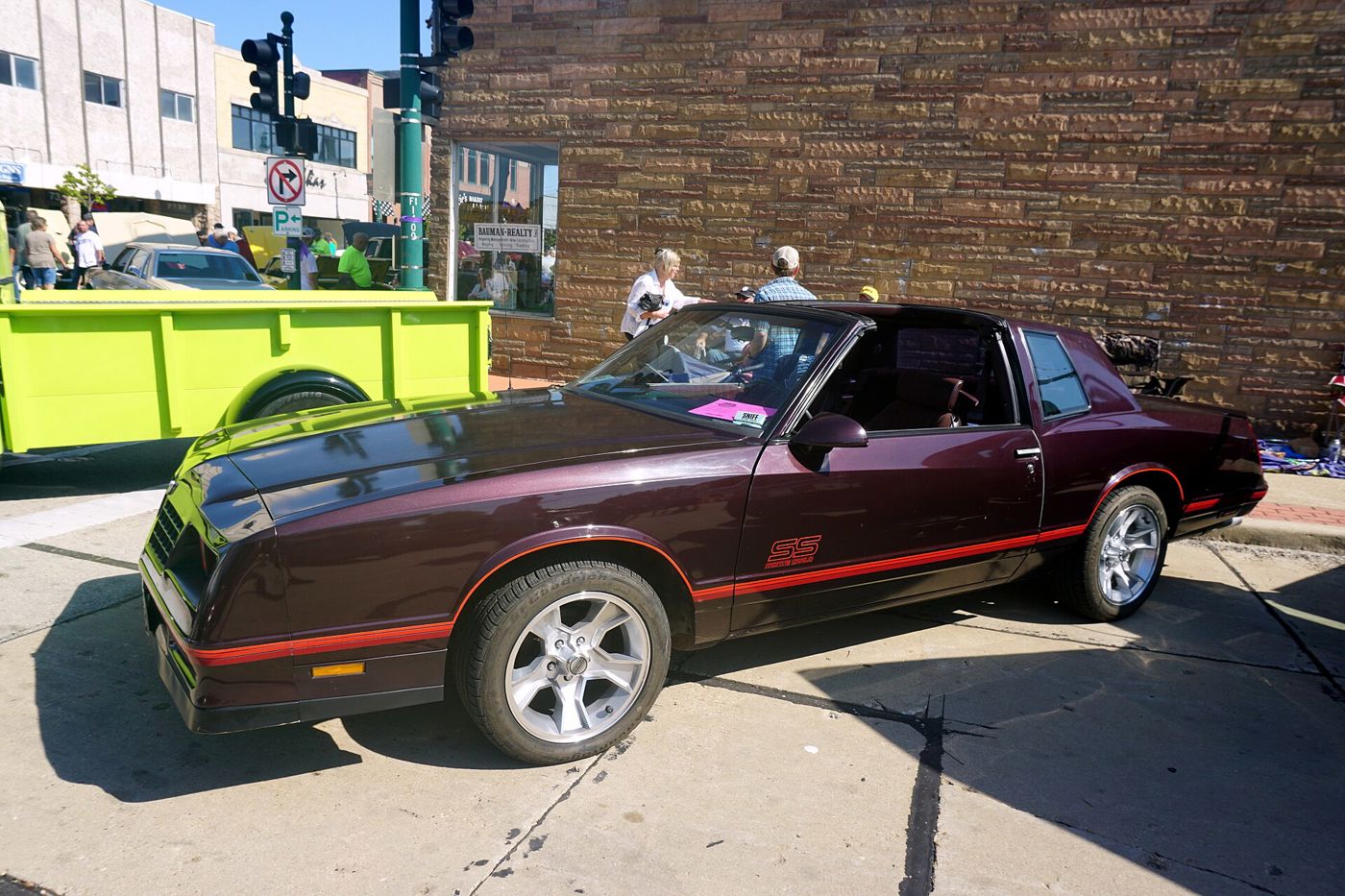
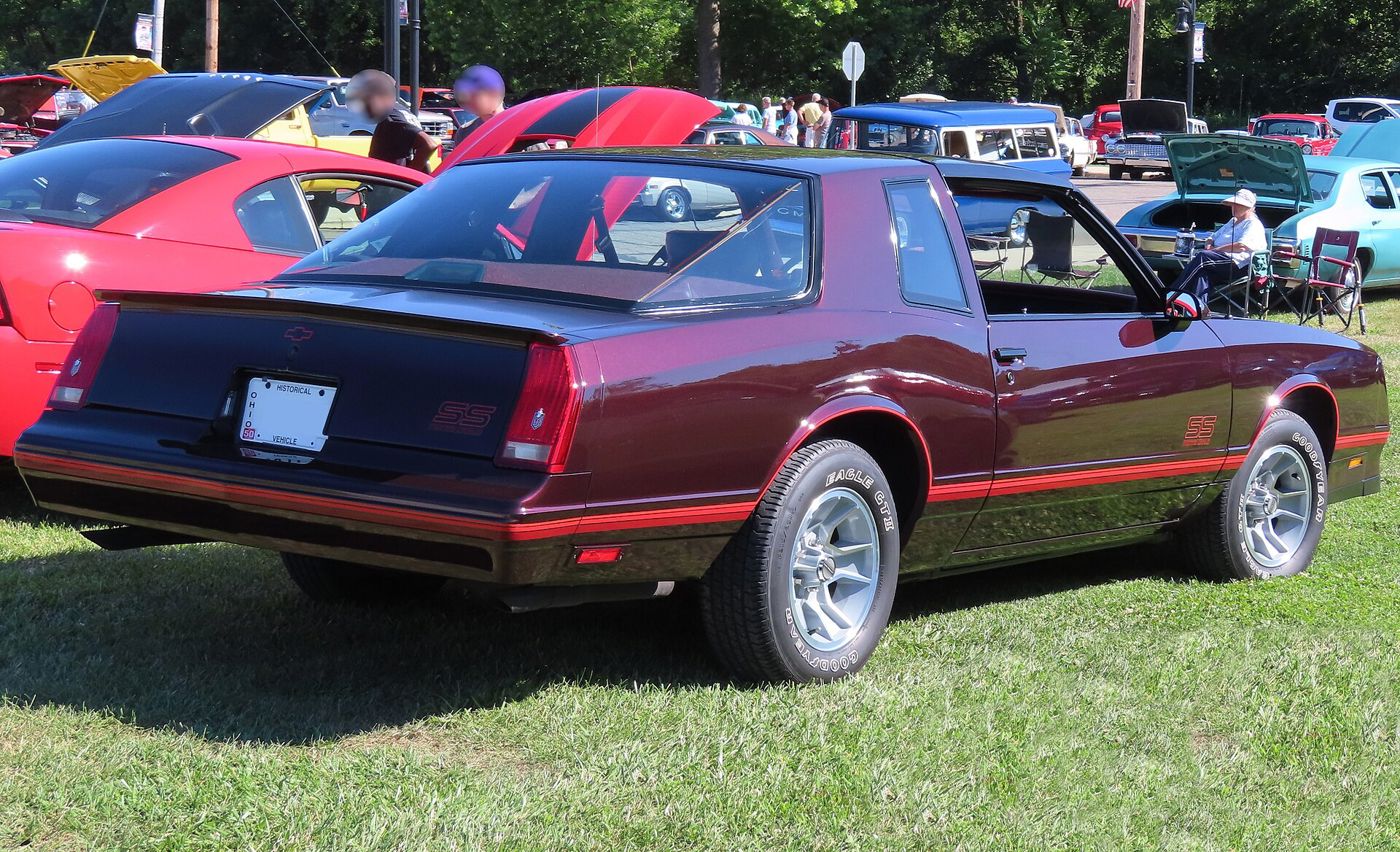
The change itself was a matter of glass and sheet metal. Wikipedia describes a more deeply sloped rear window and a shorter trunk lid carrying a lower spoiler than the notchback SS wore. Silodrome sets the new backlight at 25 degrees, with revised C-pillars, and says the work took the drag coefficient from 0.375 to 0.365. Chevrolet's own 1987 folder advertises the 0.365 figure under the heading 'Once More, Racing Improves the Breed,' and the 1987 vehicle information kit ties the showroom car's sloping rear window to the race-proven Aerocoupe on the NASCAR circuit. That is advertising, and it proves what Chevrolet claimed, not how the street car behaved.3,2
For 1987 the Aerocoupe became a regular production option, RPO Z16, replacing the 1986 code B5T. The FAQ notes that the 1987 cars were no longer identical: they could be ordered in all of the SS interior and exterior colors, and the Aerocoupe folder lists Black, Dark Maroon Metallic, Silver Metallic and White. The powertrain did not change with the roofline. Chevrolet's power-team chart gives the SS and the Aerocoupe the same B4V 305 High Output four-barrel V8, rated at 180 horsepower at 4,800 rpm and 225 lb-ft at 3,200 rpm on the SAE net standard, with a four-speed overdrive automatic and a 3.73 axle. There was no manual transmission.1,4
What the buyer paid for the shape is reported by one source. Silodrome gives the 1987 Aerocoupe a base price of $14,838 against $13,463 for the notchback SS, a premium of $1,375 for the Aerocoupe body. Chevrolet's folder steered buyers toward bundled equipment: Super Savers package C4A grouped power locks and windows, twin remote mirrors, an electronically tuned stereo cassette, a power trunk opener and halogen headlamps, and C4B added a six-way power driver's seat. The Aerocoupe rode on 15 by 7 inch aluminum wheels. The registry's 1986 window stickers ran from about $14,600 to $20,400, most near $16,325.2,1
The production figures show how far the idea travelled in a year. Wikipedia's table, citing the Standard Catalog of American Cars, counts 112,244 Monte Carlos for 1987: 72,993 coupes, 33,199 SS notchbacks and 6,052 Aerocoupes. The Aerocoupe was about 15 percent of the 39,251 Super Sports and about 5 percent of all Monte Carlos, and 30 times the 1986 run. The MonteCarloSS.com FAQ gives the same SS and Aerocoupe counts; the two share a lineage and are not independent confirmations. The FAQ adds that about 75 percent of 1987 SSs were built at Pontiac, Michigan and the rest at Arlington, which had built every SS from 1983 through 1986.3,4
The overall SS line was already past its peak. The same table shows the revived SS climbing from 4,714 cars in 1983, when it returned with a 175-horsepower 305 after a twelve-year absence, to 24,050 in 1984, 35,484 in 1985 and 41,164 notchbacks plus 200 Aerocoupes in 1986. The 1987 total of 39,251 Super Sports was a slight step down from 41,364. Wikipedia describes the 1983 revival as a package of body-color trim, a new front fascia, a rear spoiler, a performance axle, the F41 suspension and model-specific wheels and tires. The Aerocoupe arrived as a halo on a line whose sales had just begun to slip.3,4
On the track, 1987 belonged to a Monte Carlo. Silodrome places Dale Earnhardt in the No. 3 Wrangler-sponsored Monte Carlo of Richard Childress Racing, and Wikipedia records his season: eleven wins, a championship by 489 points over Bill Elliott, a modern-era record of four consecutive victories and five wins in the first seven races, following his 1986 title. NASCAR's account of that spring's all-star race, The Winston at Charlotte, has Elliott leading 121 of 135 laps before Earnhardt won, and it notes that the celebrated 'pass in the grass' was not actually a pass. The race cars were purpose-built stock cars, and none of their numbers belong to the showroom Aerocoupe.2,5,6
Ford's answer came in the form of raw speed. On April 30, 1987, Elliott qualified his Thunderbird at Talladega at 212.809 miles per hour, a figure NASCAR still lists as the track's all-time qualifying record. The aerodynamic contest that the Aerocoupe was built to join had not ended; it had simply moved to the next set of numbers. For the Monte Carlo, the season showed the limits of the form. Chevrolet's slope-backed coupe won the championship, but Elliott's Thunderbird held the stopwatch record, and the next change would come from outside the G-body altogether.7,8,5
That change arrived quickly. According to Wikipedia and Silodrome, the Aerocoupe did not return for the shortened 1988 model year because Chevrolet had announced its intention to race the new Lumina coupe in NASCAR from 1989. The registry states plainly that no 1988 Aerocoupes were made. The last G-body Monte Carlos, 30,174 of them in 1988 including 16,204 SS models, were all built at Pontiac, Michigan according to the FAQ. The 1987 Aerocoupe therefore stands as a one-year regular-production car: the moment a 200-car homologation special became something any Chevrolet dealer could order, in any SS color, 6,052 times.3,2,1,4
Fact sheet · 1987 · United States
The numbers
1987 Chevrolet Monte Carlo SS — Aerocoupe production rises to 6,052 of 39,251 Super Sports.
Coverage: Partial — researched sections are shown; missing ones are not yet sourced. Researched through 2026-09-22.
Every figure is labeled with how sure we are. Reported means a manufacturer, registry, or reference figure we cite but have not reconciled against factory records ourselves. Disputed means credible sources disagree and both are shown. Rows are separately scoped; don't add them together unless the note says they make up a total.
Key facts
Production
| What was counted | Count | Basis | Status |
|---|---|---|---|
| Monte Carlo, all models3,3 2-door coupe · not stated | 112,244 | built, model-year | Reported |
| What was counted | Count | Basis | Status |
|---|---|---|---|
| Monte Carlo coupe (non-SS)3 Sport Coupe / LS · 2-door coupe · not stated | 72,993 | built, model-year | Reported |
| What was counted | Count | Basis | Status |
|---|---|---|---|
| Monte Carlo SS notchback (excludes Aerocoupe)3,4 SS · 2-door coupe · 305 V8 · not stated Wikipedia (Standard Catalog lineage) and the MonteCarloSS.com FAQ give the same figure; independence of the two lineages is not shown. | 33,199 | built, model-year | Reported |
| Monte Carlo SS Aerocoupe4,3,3 SS Aerocoupe · 2-door coupe (sloped backlight) · 305 V8 · 4-speed automatic · not stated | 6,052 | built, model-year | Reported |
The coupe, SS and Aerocoupe columns of the cited table sum to its yearly total; the table is shown as published, not recomputed.
Figures are from Wikipedia citing Standard Catalog of American Cars 1976-1999 (3rd ed., Flammang and Kowalke, 1999); the book page was not seen directly.
Prices when new
| Model | Price | Basis |
|---|---|---|
| Base price, Monte Carlo SS (notchback, RPO Z37/Z65)2 | $13,463 | base price as reported by a secondary automotive-history source; not independently confirmed against a factory price schedule, 1987 |
| Base price, Monte Carlo SS Aerocoupe (RPO Z16)2 | $14,838 | base price as reported by a secondary automotive-history source; not independently confirmed against a factory price schedule, 1987 |
Prices are the nominal dollars of the day, not adjusted for inflation.
Engines
| Engine | Factory rating | Availability | Built |
|---|---|---|---|
| 5.0L (305) High Output 4-bbl V84 305 cu in · 4-barrel | 180 hp @ 4,800, 225 lb-ft @ 3,200 (SAE net) | standard on SS | Not yet sourced |
Ratings are the manufacturer's advertised figures under the standard shown (SAE gross before 1972, SAE net after). They are not dyno results, and gross and net ratings can't be compared directly.
Transmissions
| Transmission | Availability | Built |
|---|---|---|
| 200-4R 4-speed overdrive automatic4 | standard | Not yet sourced |
Options and packages
| Code | Option | Price | Installed |
|---|---|---|---|
Z16RPO |
SS Aerocoupe1,4 | — | 6,0521,4 Reported |
C4Apackage |
Super Savers option package (power locks, windows, twin remote mirrors, ETR stereo cassette, power trunk opener, halogen headlamps) | — | Not yet sourced |
C4Bpackage |
Super Savers package C4A plus six-way power driver seat | — | Not yet sourced |
Paint
| Code | Color | Built |
|---|---|---|
19 |
Black | Not yet sourced |
79 |
Dark Maroon Metallic | Not yet sourced |
12 |
Silver Metallic | Not yet sourced |
11 |
White | Not yet sourced |
Color names are the factory's. We don't show color swatches, because a screen color is no guide for a restoration.
Specifications
| Measure | Value | Applies to |
|---|---|---|
| Rear axle ratio4 | 3.73 :1 | SS |
| Drag coefficient (Aerocoupe, as advertised) | 0.365 Cd | SS Aerocoupe |
| Wheels (Aerocoupe) | 15 x 7 aluminum | SS Aerocoupe |
Identification
- SS paint codes (generation-wide)
- MonteCarloSS.com lists SPID paint codes for SS colors: 11U White 3967; 27U Lt. French Blue Metallic 7686; 19U Lamp Black 0848; 12U Metallic Silver 8535; 79U Burgundy Metallic 8529. Year-by-year availability in its color table could not be read reliably and is not asserted here.4
Where the sources disagree
Identification
Read a 1987 Chevrolet VIN
The VIN decoder runs in your browser and never sends the VIN anywhere. How the factory numbered this year's cars:
Same model year
Also in 1987
- Buick Regal Turbo, Grand National and GNX The last rear-drive Regal year was the turbo Regal's biggest: 20,193 Grand Nationals by one count, a lighter WE4 Turbo T, and 547 McLaren/ASC-converted GNXs.
- Buick Riviera Riviera sales fell to 15,223; 2,587 were T-Types.
- Chevrolet El Camino SS RPO Z15 SS Sport Decor trim on the fifth-generation El Camino; no production count from a verifiable source was found.
- Ford Thunderbird Reskinned and intercooled: 190 hp with the five-speed, 150 hp with the automatic, and Motor Trend's Car of the Year.
- Lincoln Mark VII LSC The LSC keeps its 200-hp 5.0 for most of the year; a 225-hp H.O. version is reported to have arrived late in 1987 production.
- Mercury Cougar Outside the muscle focus: 105,847 Cougars for 1987 per Wikipedia's table.
- Oldsmobile Cutlass, 4-4-2 and Hurst/Olds The W42 4-4-2 on the rear-drive Cutlass Supreme, with a 307 V-8 and a four-speed automatic.
- Pontiac Firebird and Trans Am The GTA and the 350 arrive: a factory option printout counts 29,757 Trans Ams, one of them in paint code 84U.
- Pontiac Grand Prix The last rear-drive, V8 Grand Prix: 16,542 built.