1975 · Buick · United States
1975 Buick Gran Sport: the option survived the big engine
Gran Sport survived as option A8 on the Century coupe, with chassis and appearance equipment, a V-6 or 350 V-8, and market-specific powertrain restrictions.
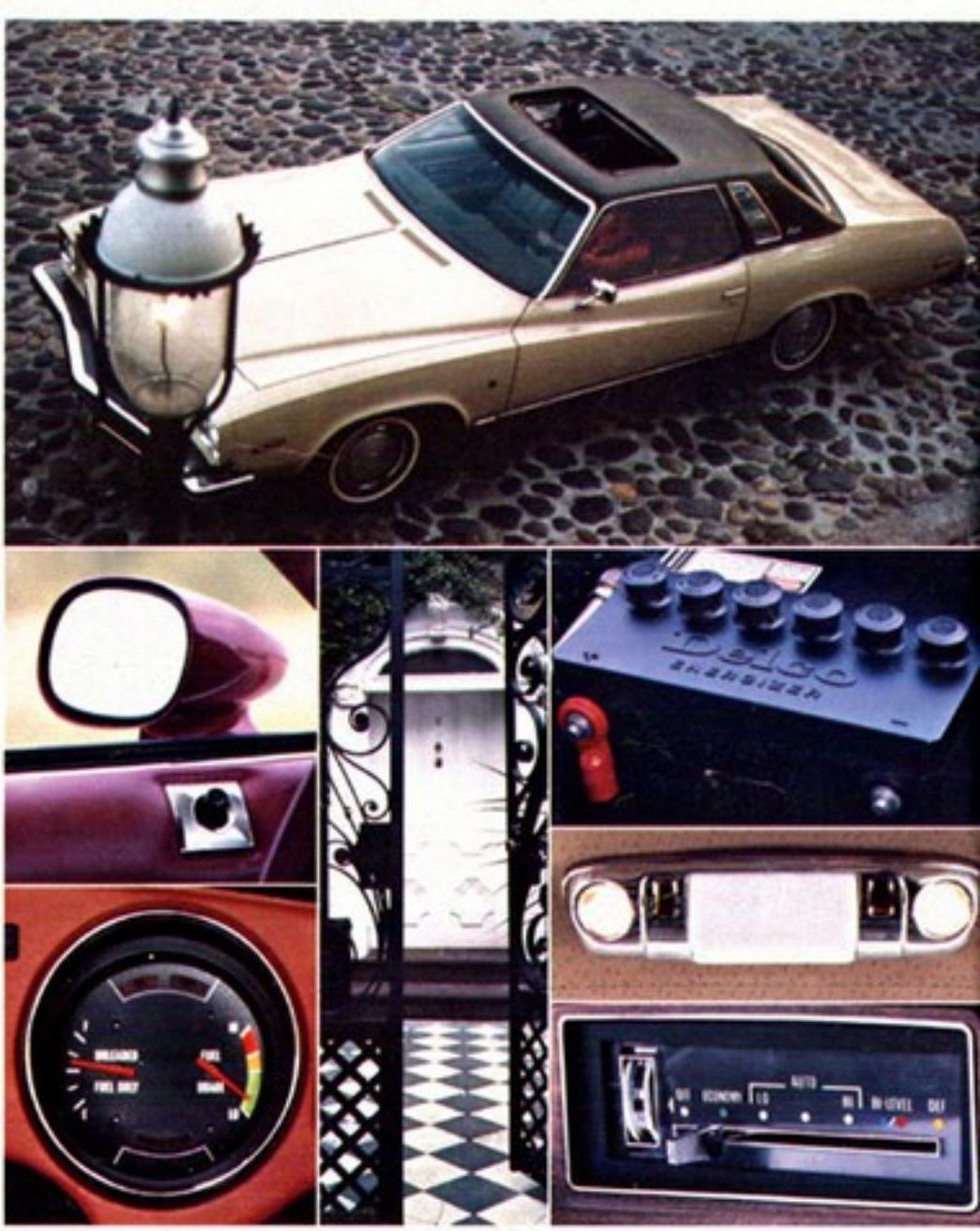
On the 1975 Century specification page, Gran Sport occupies an option entry rather than an engine column. Buick calls it A8 and attaches it to Century Coupe model 4AD37. The contents are concrete: wheel-opening moldings, gauges and an electric clock, interior lights, firm ride and handling, a particular grille and headlamp treatment, accent stripes and GS ornamentation. The engine choices sit elsewhere on the same page. That separation defines this Gran Sport: selecting the appearance and chassis package did not select a special large-displacement engine. A buyer could still order a recognizable GS, but the ordering decision now began with the ordinary Century coupe and its available powertrains.
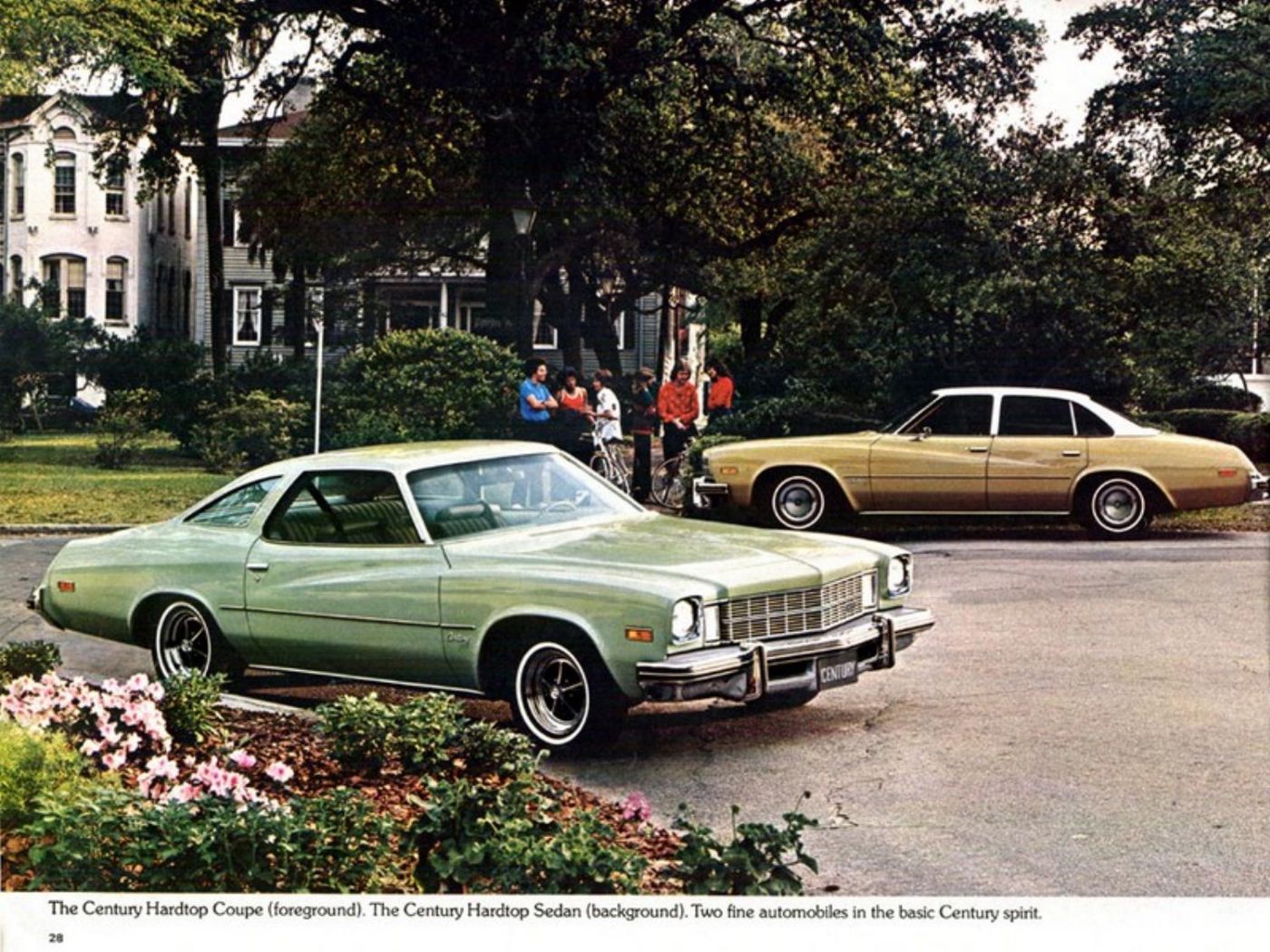
The host body matters because the brochure surrounds that option with a much larger Century family. Its model list includes coupes, sedans and wagons, with Century Custom and Regal names alongside the basic Century. The Gran Sport entry identifies the coupe rather than granting the package to every car carrying a Century badge. Buick’s photograph of the ordinary hardtop coupe shows the body on which the option was based; it does not show that car wearing the GS treatment. The coupe specification column gives a 112.0-inch wheelbase, 209.5-inch length and 79.0-inch width. The service manual gives the same values and puts the basic coupe at 53.5 inches high, distinct from Century Custom. Sedan and Regal columns remain separate, even when a shared dimension makes them look interchangeable.1
Under the hood, the standard choice was the new 3.8-liter V-6, also identified as 231 cubic inches. It breathed through a Rochester two-barrel carburetor. The optional 5.7-liter 350 V-8 appeared in two-barrel and four-barrel forms. Buick excluded the separate Century Special economy model from those V-8 options, and it marked the two-barrel V-8 unavailable in California. That distinction disappears when the year is reduced to V-6 or V-8, and it changed real cars: a California buyer and a buyer elsewhere did not receive precisely the same advertised engine menu. No 455 appears in this Century table, and the Gran Sport entry does not restore one through its package description.1
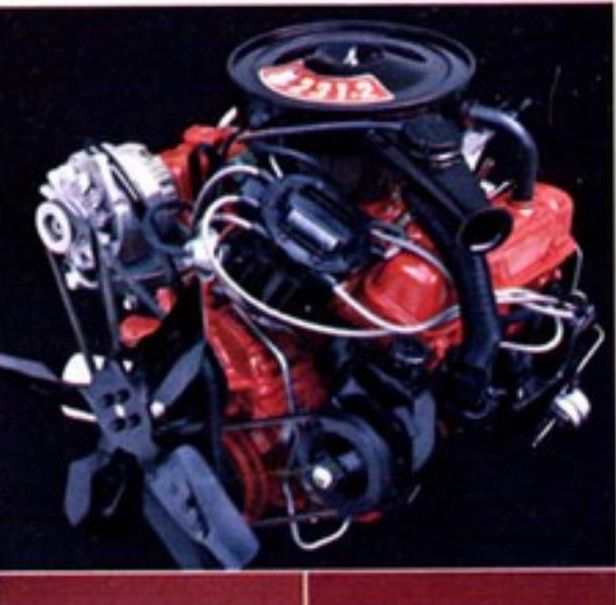
The transmission menu carries another boundary. A fully synchronized three-speed manual was standard with the V-6 only; the factory description does not offer that manual with a 350. Turbo Hydra-matic was available, and California required it. In California, then, the automatic was not merely optional, and that market restriction mattered. No Gran Sport manual-versus-automatic production split is known. The combinations describe what the catalogue offered, not how many customers ordered them. For a surviving car, an engine swap or transmission change is a separate question from this advertised menu; its present equipment cannot widen the factory’s stated availability after the fact. The axle figures disagree: the service manual’s standard V-6/manual row lists 2.93, while Aaron Severson’s later account citing MVMA sheets reports 2.73 for the Century V-6. Nothing yet settles which is right.1,2
Buick presented those powertrains within its Maximum Mileage System. The Century pages describe High Energy Ignition, a catalytic converter, steel-belted radial tires and the requirement for unleaded gasoline. The brochure also describes outside-air induction on engines other than the new V-6, so the six-cylinder did not have that feature, even though the surrounding text discusses every Buick. The company advertised advantages in economy, starting and maintenance, but those are manufacturer claims rather than an independent comparison test. The engineering story is the combination of ignition, fuel and exhaust-system requirements surrounding an ordinary production engine. A GS stripe did not make the unleaded-fuel requirement or the engine-specific induction qualification disappear.
The Gran Sport still had chassis content beyond decoration. Buick’s Century discussion specifies heavy-duty springs and shocks, stabilizer bars at both ends and GR70 steel-belted radial tires for the option. The A8 list describes its particular firm ride and handling. Those features sit above a Century chassis already advertised with front disc brakes and steel-belted radials. Power brake assistance appears among available equipment, separate from the front discs. The package description supports a handling and equipment distinction; it does not provide a measured cornering result, braking distance or acceleration time, and the brochure’s enthusiastic sales language does not supply one.
Identification separates the order from the badge. Buick’s service manual assigns fifth-position VIN letters C to the 231 two-barrel V-6, H to the 350 two-barrel and J to the 350 four-barrel. Its engine table separately gives code-letter prefixes AD, AB and AM. Those two sets of letters are not interchangeable, and neither the VIN diagram nor the engine-family prefix contains a separate A8 field. The body row identifies 4AD37 as the Century coupe; it does not certify the Gran Sport option. Stripes, gauges and clock remain useful equipment clues, but proving an individual GS still requires car-specific documentation. The all-series manual’s additional 455 and other engine entries likewise do not expand the Century menu advertised in its own brochure.1,1
Other options let the coupe lean toward comfort without becoming part of the GS package by default. The Century pages offer air conditioning, power windows, tilt steering, a six-way power seat and a sliding metal sunroof, each within its own equipment context. The same section discusses stereo and tape-player choices. A roof opening illustrated beside the Gran Sport paragraph therefore shows an available Century feature, not a standard GS roof or proof of how a photographed car was built. The same goes for the brochure’s dramatic styling images: the Regal cutaway is actually labeled Regal, while the ordinary Century coupe photograph is labeled Century. Neither one shows an identified Gran Sport.
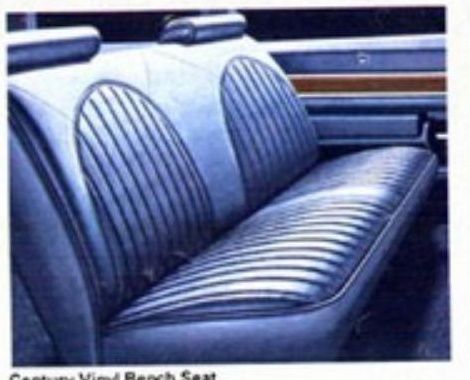
Seat choices make the same point inside the car. Buick illustrates a Century vinyl bench and a Century cloth bench, alongside notchback and bucket-seat treatments for other combinations. Its interior availability chart includes a separate Century Hardtop Coupe row. The GS option’s gauges and lights do not turn every upholstery photograph on that page into a GS-only interior. A bench-seat illustration can explain the coupe’s basic cabin without claiming that it belongs to a documented A8 car. The trim table and the actual order must supply the rest. The plain Century seat also says something about the package’s character: a specific handling and appearance option sat within a passenger-car range with several comfort and seating choices.
The 1975 package was a $171 option, ordered as A8 on the Century coupe. Century 4AD37 coupes in all trims, the host body for every Gran Sport, came to 39,556, and repeated articles report a figure of 1,288 packages. What Buick offered is clear: A8 trim and handling, a V-6 or qualified 350 menu, and market-specific transmission restrictions.3,4
Fact sheet · 1975 · United States
The numbers
1975 Buick Century Gran Sport: Gran Sport survived as option A8 on the Century coupe, with chassis and appearance equipment, a V-6 or 350 V-8, and market-specific powertrain restrictions.
Figures may describe different groups of cars. Add rows together only when the note says they make up a total.
Key facts
- Gran Sport package, option code A8, Century coupe 4AD37.
- Package price $171; engines 231 V-6 or 350 V-8 only.3
Production
| What was counted | Built |
|---|---|
| Century 2-door Colonnade coupe (4AD37), all trims (Gran Sport host body)4 Century · 2-door Colonnade coupe | 39,556 |
Engines
| Engine | Factory rating | Availability |
|---|---|---|
| AD · 3.8 liter (231 cu in) V-61 231 cu in · 2-barrel | standard, Century coupes and sedans | |
| AB · 350 V-8 2-barrel1 350 cu in · 2-barrel | optional except Century Special; unavailable in California | |
| AM · 350 V-8 4-barrel1 350 cu in · 4-barrel | optional except Century Special |
Ratings are published figures, not dyno results. Gross and net ratings aren't directly comparable.
Transmissions
| Transmission | Availability |
|---|---|
| 3-speed manual | standard, V-6 only; California requires automatic |
| Turbo Hydra-Matic automatic | available; required in California |
Options and packages
| Code | Option | Price |
|---|---|---|
A8RPO |
Gran Sport package (Century coupe 4AD37)3 | $171 |
Paint
| Code | Color |
|---|---|
11 |
Arctic White4 |
13 |
Silver Mist (iridescent)4 |
15 |
Dove Gray4 |
16 |
Pewter (iridescent)4 |
19 |
Regal Black4 |
21 |
Horizon Blue (iridescent)4 |
24 |
Glacier Blue4 |
26 |
Majestic Blue (iridescent)4 |
29 |
Indigo (iridescent)4 |
44 |
Ranch Green4 |
49 |
Verde Mist (iridescent)4 |
50 |
Sand Beige4 |
51 |
Canary Yellow4 |
53 |
Almond Mist (iridescent)4 |
55 |
Sandstone4 |
59 |
Walnut Mist (iridescent)4 |
63 |
Golden Tan (iridescent)4 |
64 |
Bittersweet (iridescent)4 |
72 |
Ruby Red4 |
74 |
Burgundy (iridescent)4 |
75 |
Apple Red4 |
79 |
Rhone Red (iridescent)4 |
80 |
Pumpkin (iridescent)4 |
Color names are the factory's. We don't show color swatches, because a screen color is no guide for a restoration.
Specifications
| Measure | Value | Applies to |
|---|---|---|
| Wheelbase | 112 in | U.S. Century hardtop coupe |
| Length | 209.5 in | U.S. Century hardtop coupe |
| Width | 79 in | U.S. Century hardtop coupe |
| Height1 | 53.5 in | Century 4AD37 coupe, factory standard-specification row; not Century Custom |
| Standard axle ratio1 | 2.93 :1 | Factory all-series standard-specification chart, Century V-6/manual row; not a claim about every GS engine, option or survivor |
Identification
- Factory VIN engine characters
- Fifth VIN character: C = 231 two-barrel V-6; H = 350 two-barrel V-8; J = 350 four-barrel V-8. These are distinct from engine code-letter prefixes AD, AB and AM. The all-series chart also lists other engines; that does not offer them in Century Gran Sport.1,1
- Factory Century body identity
- VIN name code D identifies Century; sales model 4AD37 is the 112.0-inch-wheelbase two-door Colonnade coupe. The VIN diagram has no separate A8 or Gran Sport field; it cannot authenticate the option by itself.1
- Component serial-number locations
- Figure 0A-10 illustrates separate engine, transmission and axle serial-number locations, including the grouped 231/350/455 engine illustration. A location guide is not an original-component match or GS-option authentication.1
Where the sources disagree
1975 Gran Sport production count
Identification
Read a 1975 Buick VIN
The VIN decoder runs in your browser and never sends the VIN anywhere. How the factory numbered this year's cars:
Same model year
Also in 1975
- AMC AMX No AMX was sold in the United States for 1975. The Javelin ended after 1974, and the badge returned on the 1977 Hornet.
- AMC Gremlin X and Spirit AMX Catalytic converters arrived, and steel-belted radials became standard with the X package.
- Buick Riviera Stage One dropped; the GS handling package continued on 3,101 of 17,306 cars.
- Chevrolet Chevelle and Malibu SS The Laguna Type S-3 got its aerodynamic nose; 7,788 were built, and the 454 was listed at 215 net hp.
- Chevrolet Chevy II and Nova A 262 V8 appears for one year in the source engine table; Nova LN (RPO Z11) luxury option. Enthusiast-compiled production: 272,982 cars; Super Sport 9,067.
- Chevrolet El Camino SS Colonnade-era El Camino; Chevrolet's 1975 data pages define the RPO Z15 SS option for the El Camino Classic. Team Chevelle's production totals give 33,620 El Caminos built, 3,521 of them with SS equipment.
- Dodge Dart GTS, Swinger and Demon The Dart 360 Sport continued into 1975 at $4,014, alongside 37,192 base Dart Sports.
- Ford Maverick Grabber The Grabber's last year: 8,473 by Classic Industries count, about 8,500 per Consumer Guide.
- Ford Ranchero GT A smaller year for the sporty Ranchero: 6,114 GTs among 16,441 Rancheros built.
- Ford Thunderbird Sixth-generation personal-luxury Thunderbird; the known facts are the production total and the luxury-group option prices.
- Ford Torino The last Gran Torino Sport year: 5,126 were built as Torino production fell to 195,110, with a 351 standard and automatic transmission on every car.
- Mercury Cougar A luxury hardtop with three V-8s from the standard 351 to an optional 460; 62,987 built.
- Oldsmobile Cutlass, 4-4-2 and Hurst/Olds The Hurst/Olds introduced Hurst Hatches T-tops on the Cutlass Supreme coupe; 2,535 were built, 1,293 white and 1,242 black.
- Plymouth Duster 340 and 360 Duster volume fell by more than half in 1975 and the Duster 360, now automatic-only in the brochure, to 1,421 cars, priced at $3,979.
- Plymouth Road Runner The Road Runner moved to the Fury host for one year.
- Pontiac Firebird and Trans Am The year the Trans Am took over the line: 27,274 built, more than twice the Formula.
- Pontiac Grand Am The last of the Colonnade Grand Ams: catalytic converter, a $4,887 start, and 10,679 built.
- Pontiac Grand Prix The LJ joins the line; the 455 is down to 200 hp net.
- Pontiac Tempest and LeMans Catalytic converters, standard radial tires and Radial Tuned Suspension arrive, the 455 leaves the LeMans, and the GT option becomes an automatic-only V8 package.