1975 · Plymouth · United States
1975 Plymouth Road Runner
The Road Runner moved to the Fury host for one year.
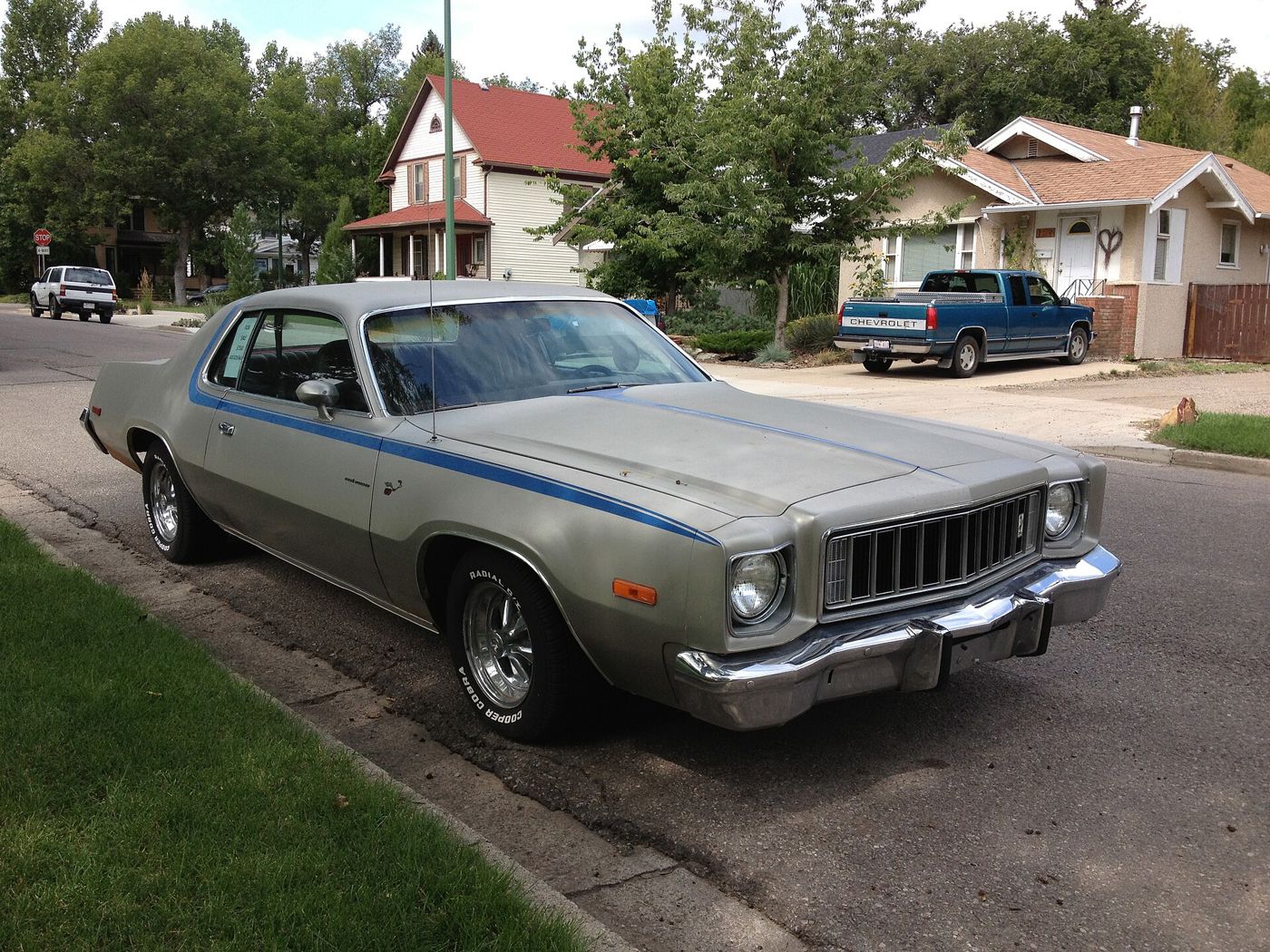

For 1975 the Road Runner name moved out of the Satellite line and into Plymouth's Fury catalogue, and the Road Runner became a Fury Coupe with its own standard features and options rather than as a distinct nameplate body. MuscleCarClub, citing the Standard Catalog of American Cars, reports 7,183 built, all of them Fury-based cars. A factory price of $3,973 is shown for the Road Runner two-door hardtop, RM21, row-aligned to that same 7,183 figure in the Standard Catalog of Chrysler.1,2
Four engines were available: a 318 V-8 with dual exhaust, standard; a 360 V-8 with single exhaust, optional; a 400 V-8 with single exhaust offered in 2-barrel or 4-barrel form, optional; and a separate 400 V-8 4-barrel with dual exhaust, also optional. Only two of the four, the standard 318 and the top 400 four-barrel, came with dual exhaust; the 360 and the other 400 ran single exhausts. A floor-mounted, fully synchronized 3-speed manual was standard, with TorqueFlite automatic optional; the Road Runner's own 8-1/4-inch rear axle carried a 3.21 ratio as standard.
Standard Road Runner equipment in the Fury catalogue ran to argent-painted 14-inch Rallye wheels with chrome hubs, body-side, roof and rear-deck tape stripes, Road Runner interior trim and ornamentation, low-restriction dual exhaust with chrome tips, and the "Beep-Beep" horn, on top of whatever the plain Fury Coupe carried. The options chart then shows two further items open only to the Road Runner within the Fury range, a performance hood treatment and a tunnel-style tape deck stripe, while the 225 Six could not be ordered on it at all. Broader Fury options extended to air conditioning, automatic speed control, a console, power windows, seats, locks, brakes and steering, a sun roof, a tachometer, and Strato ventilation, alongside a Decor Package Exterior, dual sport-styled remote-control mirrors, a choice of 14-inch chrome-styled or 15-inch styled polycast road wheels, a Tuff steering wheel or a deluxe wheel with partial horn ring, a Sure-Grip differential, a 500-ampere battery, heavy-duty shock absorbers, steel-belted radial tires, and a run of AM, AM/FM, and 8-track radio choices.
MuscleCarClub, which also supplies the year's 7,183 production figure, adds two more details: that more than half of 1975 Road Runners carried the 318, and a Car and Driver test of an E68 400-equipped car that recorded 0-60 mph in 8.1 seconds and a 121-mph top speed.1
Eighteen exterior colors were charted for the 1975 Fury range, from Powder Blue and Lucerne Blue Metallic through Rallye Red, Vintage Red Metallic, Bittersweet Metallic, Moondust Metallic, Frosty Green Metallic and Deep Sherwood Metallic to Yellow Blaze, Golden Fawn, Avocado Gold Metallic, Inca Gold Metallic, Spanish Gold Metallic, Aztec Gold Metallic, Sienna Metallic, Silver Cloud Metallic, Spinnaker White and Formal Black. The chart covered the whole Fury range, and the Road Runner, as a Fury Coupe, drew from the same eighteen shades. On the Fury's own 115-inch wheelbase, the two-door hardtop measured 213.8 in overall, 77.4 in wide and 52.6 in tall, with a 61.9-inch front track and a 62.0-inch rear track.
Fact sheet · 1975 · United States
The numbers
1975 Plymouth Road Runner: The Road Runner moved to the Fury host for one year.
Figures may describe different groups of cars. Add rows together only when the note says they make up a total.
Key facts
- Road Runner standard features in the 1975 Fury catalogue (Fury Coupe features plus): argent-painted 14-inch Rallye wheels with chrome hubs, body-side, roof and rear-deck tape stripes, Road Runner interior trim and ornamentation, a 318 dual-exhaust V-8, a floor-mounted fully synchronized three-speed manual, heavy-duty suspension with front and rear sway bars, low-restriction dual exhaust with chrome tips, an 8-1/4 in. axle with 3.21 ratio and the "Beep-Beep" horn.
- The catalogue's options chart shows a tunnel tape deck stripe and performance hood treatment available only on the Road Runner, and the 225 Six not available on it.
Production
| What was counted | Count | Counted as |
|---|---|---|
| Road Runner 19751 Road Runner · 2-door hardtop | 7,183 |
Prices when new
| Model | Price | Price type |
|---|---|---|
| Factory price, Road Runner 2-door hardtop (RM21)2 | $3,973 | factory price, 1975 model year |
Prices are the nominal dollars of the day, not adjusted for inflation.
Engines
| Engine | Factory rating | Availability |
|---|---|---|
| 318 V-8, dual exhaust 318 cu in · see note | standard | |
| 360 V-8, single exhaust 360 cu in · see note | optional | |
| 400 V-8, single exhaust, 2-bbl or 4-bbl 400 cu in · 2-barrel or 4-barrel | optional | |
| 400 V-8 4-bbl, dual exhaust 400 cu in · single 4-barrel | optional |
Ratings are published figures, not dyno results. Gross and net ratings aren't directly comparable.
Transmissions
| Transmission | Availability |
|---|---|
| 3-speed manual, floor-mounted, fully synchronized | standard |
| TorqueFlite automatic | optional |
Options and packages
| Option |
|---|
| Air conditioning; automatic speed control; console; power windows, seats, locks, brakes and steering; sun roof; tachometer; Strato ventilation |
| Performance hood treatment (Road Runner only) |
| Tape deck stripe, tunnel (Road Runner only) |
| Decor Package Exterior |
| Dual sport-styled remote-control mirrors |
| Road wheels: chrome-styled 14 in.; styled polycast 15 in. (set of 5) |
| Tuff steering wheel; deluxe steering wheel with partial horn ring |
| Sure-Grip differential; 500-ampere battery; heavy-duty shock absorbers; steel-belted radial tires |
| Radios: AM, AM/FM, AM with 8-track, AM/FM stereo, AM/FM stereo with 8-track |
Paint
| Color |
|---|
| Powder Blue |
| Lucerne Blue Metallic |
| Deep Sherwood Metallic |
| Avocado Gold Metallic |
| Frosty Green Metallic |
| Yellow Blaze |
| Golden Fawn |
| Sienna Metallic |
| Bittersweet Metallic |
| Rallye Red |
| Vintage Red Metallic |
| Moondust Metallic |
| Inca Gold Metallic |
| Spanish Gold Metallic |
| Aztec Gold Metallic |
| Spinnaker White |
| Silver Cloud Metallic |
| Formal Black |
Color names are the factory's. We don't show color swatches, because a screen color is no guide for a restoration.
Specifications
| Measure | Value | Applies to |
|---|---|---|
| Wheelbase | 115 in | Fury 2-door hardtop |
| Overall length | 213.8 in | Fury 2-door hardtop |
| Overall width | 77.4 in | Fury 2-door hardtop |
| Overall height | 52.6 in | Fury 2-door hardtop |
| Track, front | 61.9 in | Fury 2-door hardtop |
| Track, rear | 62 in | Fury 2-door hardtop |
| Rear axle ratio (standard) | 3.21 ratio | Road Runner, 8-1/4 in. axle |
Same model year
Also in 1975
- AMC AMX No AMX was sold in the United States for 1975. The Javelin ended after 1974, and the badge returned on the 1977 Hornet.
- AMC Gremlin X and Spirit AMX Catalytic converters arrived, and steel-belted radials became standard with the X package.
- Buick Riviera Stage One dropped; the GS handling package continued on 3,101 of 17,306 cars.
- Buick Skylark Gran Sport, GS and GSX Gran Sport survived as option A8 on the Century coupe, with chassis and appearance equipment, a V-6 or 350 V-8, and market-specific powertrain restrictions.
- Chevrolet Chevelle and Malibu SS The Laguna Type S-3 got its aerodynamic nose; 7,788 were built, and the 454 was listed at 215 net hp.
- Chevrolet Chevy II and Nova A 262 V8 appears for one year in the source engine table; Nova LN (RPO Z11) luxury option. Enthusiast-compiled production: 272,982 cars; Super Sport 9,067.
- Chevrolet El Camino SS Colonnade-era El Camino; Chevrolet's 1975 data pages define the RPO Z15 SS option for the El Camino Classic. Team Chevelle's production totals give 33,620 El Caminos built, 3,521 of them with SS equipment.
- Dodge Dart GTS, Swinger and Demon The Dart 360 Sport continued into 1975 at $4,014, alongside 37,192 base Dart Sports.
- Ford Maverick Grabber The Grabber's last year: 8,473 by Classic Industries count, about 8,500 per Consumer Guide.
- Ford Ranchero GT A smaller year for the sporty Ranchero: 6,114 GTs among 16,441 Rancheros built.
- Ford Thunderbird Sixth-generation personal-luxury Thunderbird; the known facts are the production total and the luxury-group option prices.
- Ford Torino The last Gran Torino Sport year: 5,126 were built as Torino production fell to 195,110, with a 351 standard and automatic transmission on every car.
- Mercury Cougar A luxury hardtop with three V-8s from the standard 351 to an optional 460; 62,987 built.
- Oldsmobile Cutlass, 4-4-2 and Hurst/Olds The Hurst/Olds introduced Hurst Hatches T-tops on the Cutlass Supreme coupe; 2,535 were built, 1,293 white and 1,242 black.
- Plymouth Duster 340 and 360 Duster volume fell by more than half in 1975 and the Duster 360, now automatic-only in the brochure, to 1,421 cars, priced at $3,979.
- Pontiac Firebird and Trans Am The year the Trans Am took over the line: 27,274 built, more than twice the Formula.
- Pontiac Grand Am The last of the Colonnade Grand Ams: catalytic converter, a $4,887 start, and 10,679 built.
- Pontiac Grand Prix The LJ joins the line; the 455 is down to 200 hp net.
- Pontiac Tempest and LeMans Catalytic converters, standard radial tires and Radial Tuned Suspension arrive, the 455 leaves the LeMans, and the GT option becomes an automatic-only V8 package.