1973 · Dodge · United States
1973 Dodge Charger: The Best-Selling Year the Original Era Ever Had
The Charger's best-selling year of the original era, 119,318 cars, came as the 440 lost its Magnum name and the car moved toward personal luxury.
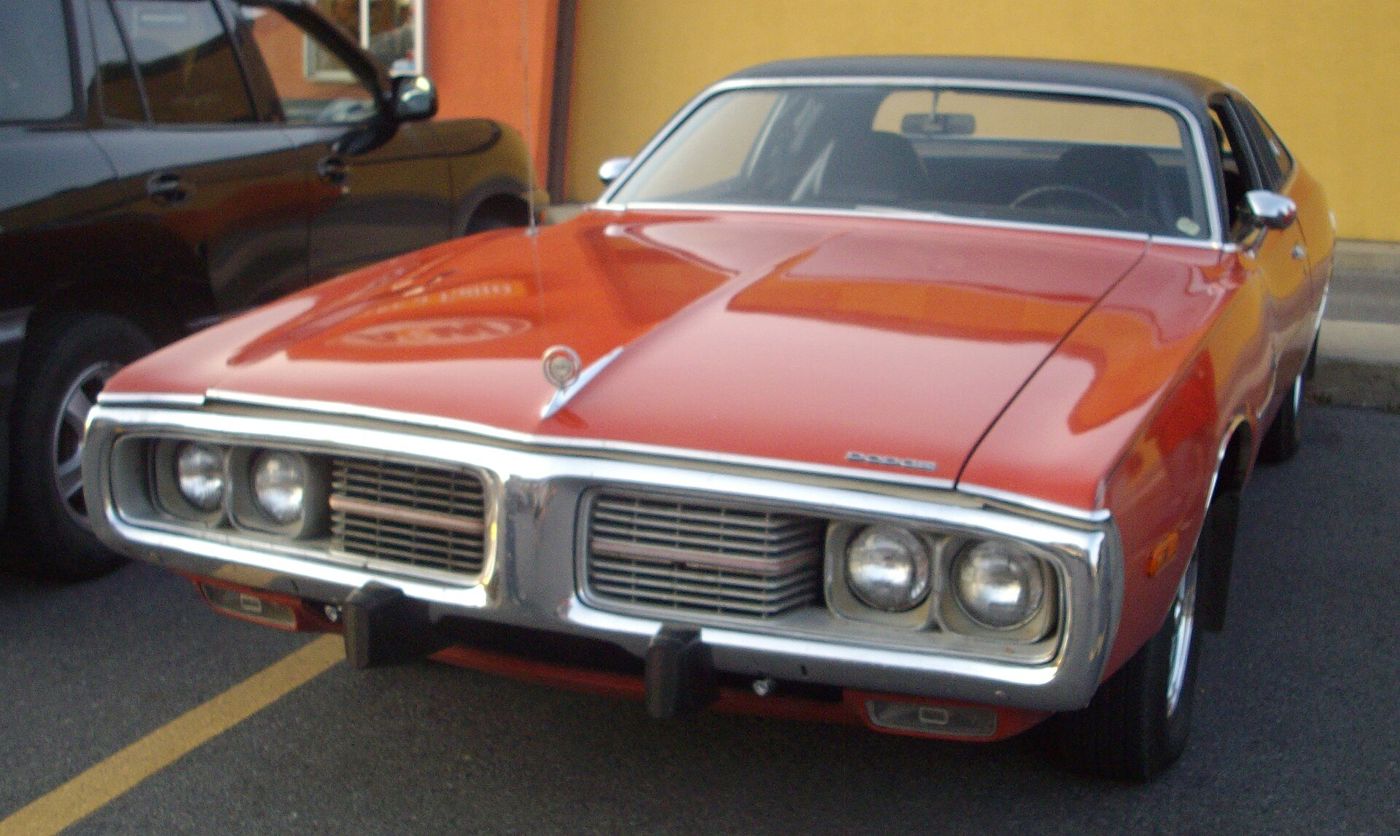

The 1973 Charger was longer and visibly revised. New rear quarter panels added seven inches to the body, while the front gained a cross-hatched grille and the rear multi-louvred tail lamps. A redesigned roof allowed movable rear-quarter windows, and Dodge offered a no-cost “halo” vinyl roof. The 440 four-barrel remained available but no longer carried the Magnum name. Engines ranged from the 105-horsepower 225 six through the 318, 340 and 400 to the 440. Stellantis later described the Charger as Dodge's second-best-selling model that year, behind the Dart. The compiled production figure marks a sharp rebound from 1972.1,2,3
Flory's table reports 119,318 Chargers for 1973, a total also given in Charles Hyde's history of Chrysler as the model's peak. The three body-style rows—11,995 coupes, 45,415 hardtops and 61,908 SEs—add exactly to that number. A separate claim puts the year at about 108,000 Chargers.2
Production for 1973 is recorded by body style, and the 119,318 total divides into coupes, hardtops and SEs rather than by Rallye package, engine or transmission. Dodge's catalogue restricted the 340 four-barrel to Rallye models and the 440 four-barrel to Rallye and SE versions. A forum discussion also mentions Rallye cars with the 400, a mention rather than a count. Those catalogue applications describe what buyers could order, not how many cars were built with each engine, and an option list is not a production figure.2,3
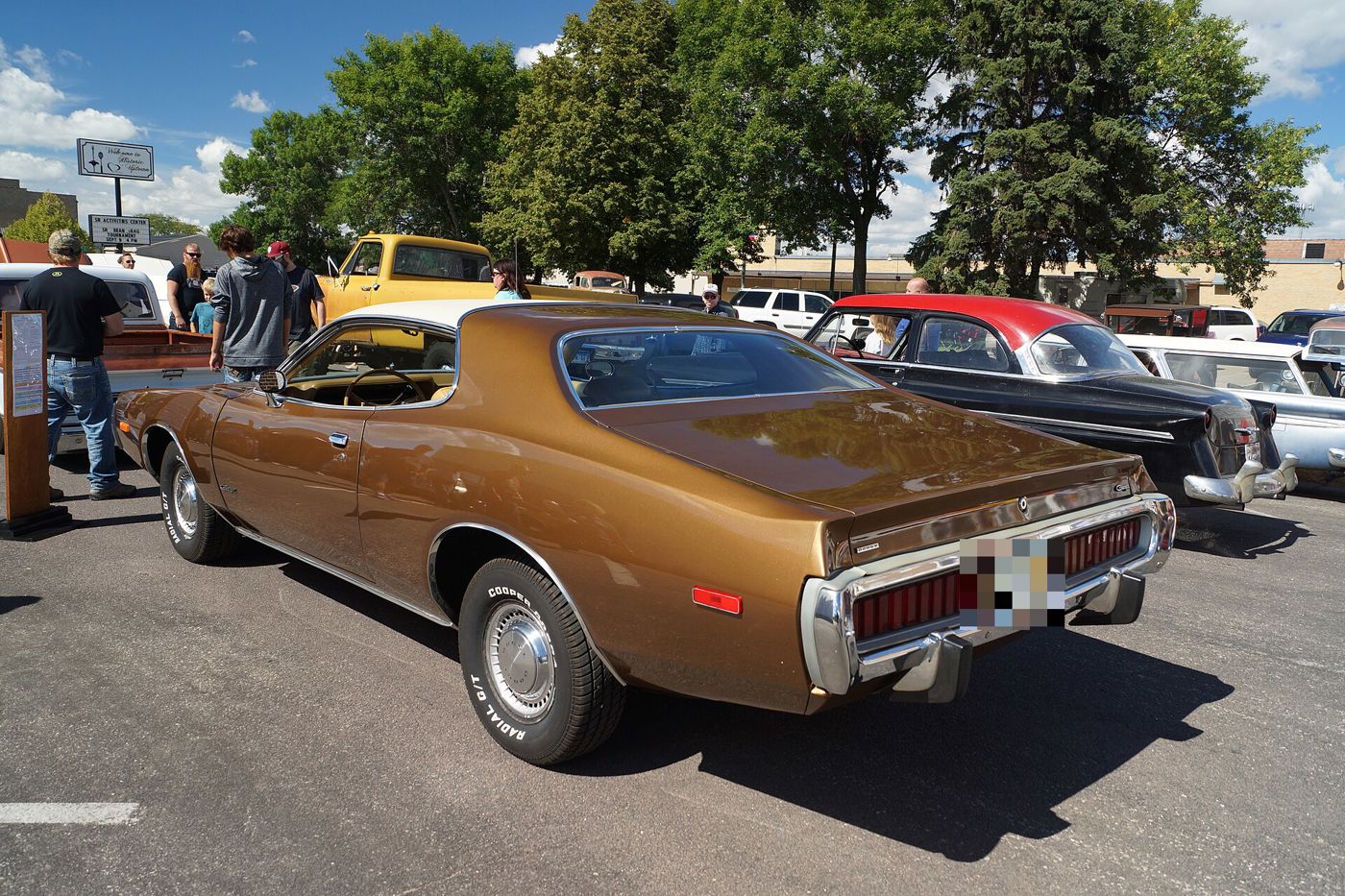

Base prices were $2,810 for the coupe, $3,060 for the hardtop and $3,375 for the SE, averaging $3,082 across those body styles. Listed shipping weights were 3,395, 3,450 and 3,540 pounds respectively for the three bodies. The engine range included a 225 six rated at 105 horsepower, a two-barrel 318, a four-barrel 340, two- and four-barrel versions of the 400, and a four-barrel 440. Those prices and weights show how the larger SE compared with the coupe in cost and in weight.2
The no-cost halo roof was one of several catalogue choices. Buyers could also order a four-speed manual with a Hurst Pistol-Grip shifter, and a special suspension with front and rear sway bars was tied to four-barrel engines and the Rallye package. Other packages included lighting and convenience equipment, while a Luxury Equipment Package was available on the hardtop and SE. The 1973 color chart lists 17 exterior colors by code, with Top Banana at extra cost. Together, the catalogue and price list offered buyers a broad range of appearance and equipment choices across all three body styles.2,1
The catalogue shows how the 1973 car was meant to be ordered. The 340 four-barrel, with bright-tip dual exhausts, came only with the Rallye Package, and the 440 four-barrel only on the Rallye and SE. The Rallye Instrument Cluster was a Rallye Package and SE item, and the Rallye also carried a 'gradated' body side tape stripe. Stellantis notes that the restyled car was 7 inches longer overall and that the 440 was no longer badged Magnum. Dodge's year-end range ran from a six-cylinder base engine to V-8 choices up to the 440.1
Fact sheet · 1973 · United States
The numbers
1973 Dodge Charger: The Charger's best-selling year of the original era, 119,318 cars, came as the 440 lost its Magnum name and the car moved toward personal luxury.
Figures may describe different groups of cars. Add rows together only when the note says they make up a total.
Key facts
Production
| What was counted | Built |
|---|---|
| Charger, all series2,3 coupe and hardtop Hyde describes the figure as sales; Flory tabulates it as production. | 119,318 |
| What was counted | Built |
|---|---|
| Charger 2-door coupe (WL21)2 Charger · 2-door coupe | 11,995 |
| Charger 2-door hardtop (WH23)2 Charger · 2-door hardtop | 45,415 |
| What was counted | Built |
|---|---|
| Charger SE 2-door hardtop (WP29)2 SE · 2-door hardtop | 61,908 |
Prices when new
| Model | Price | Price type |
|---|---|---|
| Base MSRP, Charger 2-door coupe (WL21)2 | $2,810 | base manufacturer's suggested retail price, 1973 model year |
| Base MSRP, Charger 2-door hardtop (WH23)2 | $3,060 | base manufacturer's suggested retail price, 1973 model year |
| Base MSRP, Charger SE (WP29)2 | $3,375 | base manufacturer's suggested retail price, 1973 model year |
| Average base price, all Charger styles2 | $3,082 | average base MSRP, 1973 model year |
Prices are the nominal dollars of the day, not adjusted for inflation.
Engines
| Engine | Factory rating | Availability |
|---|---|---|
| 440 4-bbl V-8 (no longer badged Magnum)1 440 cu in · 4-barrel | optional | |
| 400 V-8 (2-bbl or 4-bbl)1 400 cu in · 2-barrel or 4-barrel | optional | |
| 340 V-81 340 cu in · 4-barrel | optional | |
| 318 V-81 318 cu in · 2-barrel | optional | |
| 225 six1 225 cu in · 1-barrel | 105 hp (as stated by Stellantis retrospective (standard not named)) | base |
Ratings are published figures, not dyno results. Gross and net ratings aren't directly comparable.
Options and packages
| Option | Price |
|---|---|
| 'Halo' vinyl roof (no-cost option)1 | $0 |
| 340 4-bbl V8 with bright-tip dual exhausts (Rallye Package only) | |
| 400 2- or 4-bbl V8 | |
| 440 4-bbl V8 with bright-tip dual exhausts (Rallye and SE) | |
| 4-speed floor-mounted manual with Hurst Pistol-Grip shifter (318, 340 or 4-bbl V8) | |
| Special suspension with front and rear sway bars (4-bbl engines and Rallye Package) | |
| Rallye Instrument Cluster (Rallye Package and SE) | |
| 'Gradated' body side tape stripe (Rallye Package) | |
| Manual sun roof (requires vinyl roof) | |
| Canopy vinyl roof (coupe, hardtop) | |
| Magnum road wheels | |
| Rallye Package | |
| Light Package | |
| E-Z Order Package (TorqueFlite, power steering, AM radio, deluxe wheel covers and more) | |
| Deluxe Package (Charger coupe) | |
| Heavy-Duty Package | |
| Trailer Wiring Package and Trailer-Towing Package (heavy-duty 3.23 axle; requires automatic, power front discs, G78x14 tyres) | |
| Luxury Equipment Package (hardtop and SE) |
Paint
| Code | Color |
|---|---|
TX9 |
Black |
JA5 |
Dark Silver Metallic |
EW1 |
Eggshell White |
HL4 |
Parchment |
JY3 |
Light Gold |
HT6 |
Medium Tan Metallic |
JY6 |
Gold Metallic |
JY9 |
Dark Gold Metallic |
GK6 |
Bronze Metallic |
FY1 |
Top Banana (extra cost) |
JF1 |
Pale Green |
GF3 |
Light Green Metallic |
JF8 |
Dark Green Metallic |
HB1 |
Light Blue |
TB3 |
Super Blue |
GB5 |
Bright Blue Metallic |
FE5 |
Bright Red |
Color names are the factory's. We don't show color swatches, because a screen color is no guide for a restoration.
Interiors
| Trim |
|---|
| Bucket seats (hardtop and SE); floor console with 'Slap Stick' shifter (no extra charge on SE) |
| 'Brougham' cloth-and-vinyl center armrest seat (Charger SE, with Luxury Equipment Package) |
Specifications
| Measure | Value | Applies to |
|---|---|---|
| Overall length increase over 19721 | 7 in | all bodies (rear quarter panels) |
| Shipping weight, Charger coupe WL212 | 3,395 lb | WL21 |
| Shipping weight, Charger hardtop WH232 | 3,450 lb | WH23 |
| Shipping weight, Charger SE WP292 | 3,540 lb | WP29 |
Identification
- 1973 identifiers
- Cross-hatched grille, multi-louvred tail lamps, movable rear-quarter windows with canted louvres.1
- Style numbers
- Flory lists the 1973 Charger coupe as WL21, hardtop as WH23 and SE as WP29.2
Identification
Read a 1973 Dodge VIN
The VIN decoder runs in your browser and never sends the VIN anywhere. How the factory numbered this year's cars:
Same model year
Also in 1973
- AMC AMX The Javelin AMX's best year. 5,707 were built, a quarter of them with the 401, alongside the Trans Am Victory decal and the Pierre Cardin interior.
- AMC Gremlin X and Spirit AMX The V8 Gremlin X continued with new stripes and an available Levi's denim-look interior, on a Gremlin starting at $2,098.
- AMC Javelin The SST name dropped away and new twin 'TV-screen' taillights arrived. Javelin production reached 25,195, alongside the Trans Am Victory decal package.
- Buick Riviera Stage One (260 hp net) joined a separate GS handling package; 1,234 Stage Ones and 3,933 GS cars of 34,080.
- Buick Skylark Gran Sport, GS and GSX On the new Colonnade A-body the GS became a Century Gran Sport package; 6,637 were built, 728 with the 455 Stage 1.
- Chevrolet Chevelle and Malibu SS The Colonnade Chevelle's only SS year: RPO Z15 on the Malibu coupe and, for the first and only time, the station wagon, with a 245 net hp 454 available.
- Chevrolet Chevy II and Nova Hatchback appears in the source body table; SS offered with any engine per the source. Enthusiast-compiled production: 369,509 cars; Super Sport 35,542.
- Chevrolet El Camino SS The new Colonnade El Camino could still be ordered with RPO Z15 SS equipment and a 245 net hp 454; 59,700 Customs built.
- Dodge Challenger The six was gone: every 1973 Challenger hardtop had a V8, the 318 standard and the 340 optional, with the Rallye now sold as a package.
- Dodge Dart GTS, Swinger and Demon Renamed Dart Sport, the fastback's 340 model sold 11,315 in the 340's final year.
- Ford Maverick Grabber The 200 six became standard as the 170 was dropped; Classic Industries counts 32,350 Grabbers.
- Ford Ranchero GT The Ranchero GT's biggest year on the 1972-76 body: 15,320 GTs, alongside 25,634 Ranchero 500s and 4,787 Squires.
- Ford Thunderbird The 429 4V was standard and the 460 4V optional in the sixth generation's best-selling year.
- Ford Torino The 1973 Torino kept the 1972 body behind a heavier bumper; the Gran Torino Sport fell to 51,853 SportsRoofs and 17,090 hardtops while the 351 Cobra Jet remained the performance engine.
- Mercury Cougar The last Cougar convertible and the last 351 Cobra Jet year, with production up to 60,629 as buyers shifted to the XR-7.
- Mercury Montego GT The Montego GT fastback's second and last year; a vehicle profile reports 4,464 built.
- Oldsmobile Cutlass, 4-4-2 and Hurst/Olds On the new Colonnade Cutlass the 4-4-2 was a W-29 appearance and handling option, and the Hurst/Olds came in white or, for the first time, black: 1,097 built.
- Plymouth Barracuda and 'Cuda V8 only: the 318 became standard on both Barracuda and 'Cuda, the 340 moved to the option list, and production rose for the only time after 1970.
- Plymouth Duster 340 and 360 The 340's last year in the Duster produced 15,731 cars with power front disc brakes now standard, and the Spacemaker Pak fold-down rear seat joined the line.
- Plymouth GTX, Belvedere and Satellite For 1973 the GTX name survived only through the Road Runner's optional 440 four-barrel, which came with TorqueFlite only; Mueller's Muscle Car Source Book counts 749 of them.
- Plymouth Road Runner A secondary count puts production back up to 19,056, the highest of the 1971-1974 Satellite-based years.
- Pontiac Firebird and Trans Am The Super Duty year: 4,802 Trans Ams, 252 of them SD-455s.
- Pontiac GTO A GTO option on the new Colonnade LeMans, with the 400 standard and a 455 optional; 4,806 built.
- Pontiac Grand Am Pontiac's Colonnade GT with an Endura nose and a 400 or 455; 43,137 built, the Grand Am's best year, with 1,058 four-speeds.
- Pontiac Grand Prix The Colonnade-body Grand Prix arrives, with the 400 standard and the 455 in the SJ.
- Pontiac Tempest and LeMans The Colonnade LeMans arrives, with GTO and GT options for the two-door models and a Super Duty 455 listed for the LeMans in Pontiac's dealer book.