1973 · AMC · United States
1973 AMC Javelin: The SST Name Retires, and the 360 Gets Two Different Numbers
The SST name dropped away and new twin 'TV-screen' taillights arrived. Javelin production reached 25,195, alongside the Trans Am Victory decal package.
United States · researched through 2026-09-22
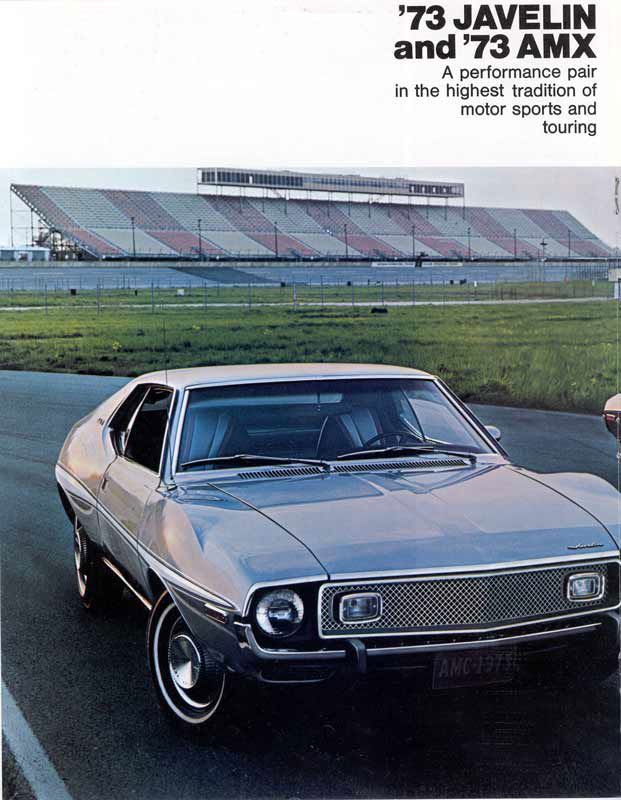
AMC dropped the SST badge for 1973, but not the equipment it had described; the single remaining Javelin trim (body 7379-7) simply carried the same SST-level content under the plain Javelin name. The enthusiast production tally counts 25,195 of them, 15,219 with the 304 V8 alone, and adding the AMX's separately recorded 5,707 cars gives a combined line total of 30,902, a figure Wikipedia's routing entry attributes to a published source (Mitchell, p. 56).1,2,3
The year's commemorative option looked backward rather than forward. The Trans Am Victory package marked AMC's 1971 and 1972 SCCA Trans-Am manufacturers' championships with a fender decal, 14-inch slot wheels, E70x14 raised-white-letter tires and a space-saver spare, a modest visual tribute to a racing program that by 1973 had already moved past its peak. Planet Houston AMX states plainly that no production count for the package is known, and that nothing in the VIN or door tag identifies a car equipped with it, so any Trans Am Victory Javelin's authenticity rests on documentation alone rather than anything a title search or a build sheet could independently confirm.1,2
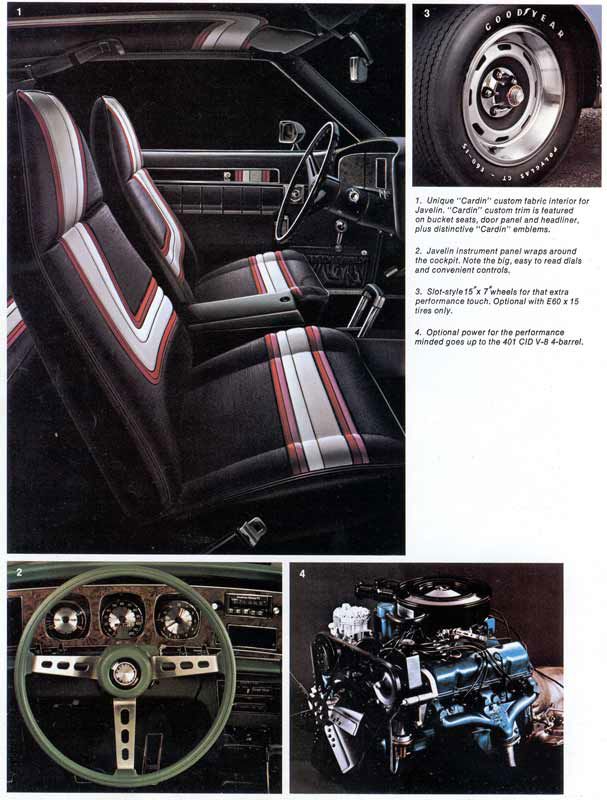
Engine popularity followed the same pattern the badge-simplified 1972 lineup had set: the 232 six found only 1,174 buyers and the 258 just 1,065, while the 304 alone outsold every other engine combined at 15,219 cars, more than the two sixes and the 360 put together. The 360 took 7,351 cars and the 401, the biggest engine on the sheet, only 386, meaning fewer than one Javelin in sixty-five left the factory with the largest available V8. A big-block 1973 Javelin was already a genuine rarity within a 25,195-car production run in which the two smallest engines, the 232 and 258 sixes, together still outsold the 401 more than five times over.1
The 360 four-barrel's own rating is where this record's sources stop agreeing. Wikipedia's routing entry, drawing on AMC's broader 1972-74 net-rating figures, gives the 360 four-barrel 195 net horsepower, matching the single-exhaust tune AMC had listed the year before. But the 1973 full-line catalog actually consulted for this record prints only one 360 four-barrel row, at 220 horsepower and 315 lb-ft, the dual-exhaust figure from 1972 with no single-exhaust alternative shown at all. Whether every US-market 1973 360 four-barrel Javelin actually made 220 horsepower, or whether a lower-output single-exhaust version remained available without appearing in this particular catalog printing, is not settled here, and no source gathered for this record resolves the question either way.3
Factory pricing opened at $2,983 for a V8 Javelin and $2,889 for the six-cylinder, both effective from the September 1972 introduction. The Go Package carried forward its 1971 structure unchanged in price, $410 with the 360 or $499 with the 401, the same figures the option had carried in 1972.1,4
Pierre Cardin's designer interior returned for a second year, now available with fabric trim across the seats, door panels and headliner plus front fender emblems marking the option, but restricted to just five specific exterior colors: Snow White, Diamond Blue Metallic, Pewter Silver Metallic, Trans-Am Red and Fresh Plum Metallic. AMC's own 1973 color chart spells out that restriction directly rather than leaving it implied, noting each Cardin-eligible color by its own paint code alongside a footnote making the pairing explicit, so a Javelin ordered in any of the other eleven 1973 exterior colors could not have left the factory with the Cardin interior regardless of what a later repaint or reupholstery might suggest.1
Beyond the five Cardin-eligible colors, 1973's exterior palette ran to sixteen choices in total, from Snow White and the two Cardin blues through Olympic Blue, Maxi Blue, three distinct greens (Grasshopper, Fairway and Tallyho), Fawn Beige, Copper Tan, Cordoba Brown, Daisy Yellow, Vineyard Burgundy and an extra-cost Classic Black, with several colors restricted to specific model combinations rather than offered across AMC's whole line; Maxi Blue and Fresh Plum, for example, were limited to Gremlin, Hornet and Javelin, while Cordoba Brown, Daisy Yellow and Vineyard Burgundy were shared only with the Matador and Ambassador. A Spanish-grain vinyl roof was a separate option in five colors of its own: black, white, blue, green or cinnamon.
A 1973 Javelin is identified by a diamond-mesh grille with rectangular parking lamps set into it, twin taillights JavelinAMX.com describes as looking like 'TV-screens' with their own inner reverse-lamp elements, and a large plastic target emblem mounted in the rear panel. The same source cautions that the 1973 and 1974 bodies are nearly identical to each other, close enough that a positive model-year identification may require decoding the VIN rather than relying on styling alone.2
Dimensionally the 1973 Javelin rode a 110-inch wheelbase, stretched to 192.31 inches overall, 75.2 inches wide, and carried a 16-US-gallon fuel tank, all figures AMC's own full-line catalog lists under a single specifications table shared with the AMX. Shipping weight ran from 2,868 pounds for a six-cylinder car to 3,104 for a V8, a gap of 236 pounds, a difference this record attributes entirely to the engine and driveline rather than to any body change, since the wheelbase, length and width figures apply equally to six-cylinder and V8 cars alike in AMC's own shared specifications table.1
For buyers who skipped the Cardin option, ordinary interior choices ran to five colors, black, blue, green, tan or white, trimmed in Uganda vinyl as standard or, on four of the five color codes, a Domino-branded fabric alternative. Between the retired SST name, the commemorative Trans Am Victory package nobody can verify from a VIN, and a 360 rating that reads differently depending on which catalog page is consulted, 1973 is a Javelin model year whose documentation is, in places, plainer to describe than it is to pin down exactly. None of those open questions changes the basic shape of the year: a single, simplified trim, a production run well down from the two-trim years earlier in the decade, and a big-block 401 engine ordered rarely enough, at just 386 cars out of 25,195, that the paperwork gaps around it may never fully close.1
Fact sheet · 1973 · United States
The numbers
1973 AMC Javelin — The SST name dropped away and new twin 'TV-screen' taillights arrived. Javelin production reached 25,195, alongside the Trans Am Victory decal package.
Coverage: Partial — researched sections are shown; missing ones are not yet sourced. Researched through 2026-09-22.
Every figure is labeled with how sure we are. Reported means a manufacturer, registry, or reference figure we cite but have not reconciled against factory records ourselves. Disputed means credible sources disagree and both are shown. Rows are separately scoped; don't add them together unless the note says they make up a total.
Key facts
Production
| What was counted | Count | Basis | Status |
|---|---|---|---|
| Javelin, body 7379-71,2 Javelin · 2-door hardtop · US production | 25,195 | built, model-year | Reported |
| What was counted | Count | Basis | Status |
|---|---|---|---|
| Javelin line including AMX3 Javelin and AMX · 2-door hardtop · US Equals 25,195 + 5,707. | 30,902 | built, model-year | Reported |
| What was counted | Count | Basis | Status |
|---|---|---|---|
| 232 six1 Javelin · 2-door hardtop · 232 six · US | 1,174 | built, model-year | Reported |
| 258 six1 Javelin · 2-door hardtop · 258 six · US | 1,065 | built, model-year | Reported |
| 304 V81 Javelin · 2-door hardtop · 304 V8 · US | 15,219 | built, model-year | Reported |
| 360 V81 Javelin · 2-door hardtop · 360 V8 · US | 7,351 | built, model-year | Reported |
| 401 V81 Javelin · 2-door hardtop · 401 V8 · US | 386 | built, model-year | Reported |
Engine rows partition 25,195 in the source.
The body and engine rows also appear on the AMC tally sheet for 1973 (Kenosha block), from which the typed table appears to be transcribed; one lineage.
Prices when new
| Model | Price | Basis |
|---|---|---|
| Javelin, V81 | $2,983 | 'factory price' as tabulated (basis not stated), 1972-09 |
| Javelin, six-cylinder1 | $2,889 | 'factory price' as tabulated (basis not stated), 1972-09 |
Prices are the nominal dollars of the day, not adjusted for inflation.
Engines
| Engine | Factory rating | Availability | Built |
|---|---|---|---|
| 232 six3 232 cu in | 100 hp @ 3,600, 185 lb-ft @ 1,800 (SAE net) | standard | 1,1741 Reported |
| 258 six3 258 cu in | 110 hp @ 3,500, 195 lb-ft @ 2,000 (SAE net) | optional | 1,0651 Reported |
| 304 V8 2-bbl3 304 cu in · 2-barrel | 150 hp @ 4,200, 245 lb-ft @ 2,500 (SAE net) | optional | 15,2191 Reported |
| 360 V8 (2-bbl or 4-bbl)3 360 cu in · 2-barrel or 4-barrel | 175 hp @ 4,000, 285 lb-ft @ 2,400 (SAE net (2-bbl)); 195 hp (SAE net (4-bbl)) | optional | 7,3511 Reported |
| 401 V8 4-bbl3 401 cu in · 4-barrel | 255 hp @ 4,600, 345 lb-ft @ 3,300 (SAE net) | optional | 3861 Reported |
Ratings are the manufacturer's advertised figures under the standard shown (SAE gross before 1972, SAE net after). They are not dyno results, and gross and net ratings can't be compared directly.
Options and packages
| Code | Option | Price | Installed |
|---|---|---|---|
|
Trans Am Victory: fender decal, 14-in slot wheels, E70x14 raised-white-letter tires, space-saver spare1 | — | Not yet sourced |
W (trim)package |
Pierre Cardin interior1 | — | Not yet sourced |
|
Go Package (see 1971)4 | $410 | Not yet sourced |
|
Vinyl-covered roof, Spanish grain: black, white, blue, green or cinnamon | — | Not yet sourced |
|
Cardin fabric trim (seats, door panels, headliner, front fender emblems); available only with the five Cardin colours (A1, E1, E5, D7, F3) | — | Not yet sourced |
Paint
| Code | Color | Built |
|---|---|---|
A1 |
Snow White | Not yet sourced |
E1 |
Diamond Blue, Metallic | Not yet sourced |
E2 |
Olympic Blue, Metallic | Not yet sourced |
F2 |
Maxi Blue | Not yet sourced |
C8 |
Grasshopper Green, Metallic | Not yet sourced |
E3 |
Fairway Green, Metallic | Not yet sourced |
E4 |
Tallyho Green, Metallic | Not yet sourced |
E5 |
Pewter Silver, Metallic | Not yet sourced |
E6 |
Fawn Beige | Not yet sourced |
E7 |
Copper Tan, Metallic | Not yet sourced |
D4 |
Cordoba Brown, Metallic | Not yet sourced |
F4 |
Daisy Yellow | Not yet sourced |
D7 |
Trans-Am Red | Not yet sourced |
F5 |
Vineyard Burgundy, Metallic | Not yet sourced |
F3 |
Fresh Plum, Metallic | Not yet sourced |
P1 |
Classic Black | Not yet sourced |
Color names are the factory's. We don't show color swatches, because a screen color is no guide for a restoration.
Interiors
| Code | Trim | Built |
|---|---|---|
41 / 43 / 44 / 46 / 48 (S, R or W) |
Black, blue, green, tan, white; S Uganda vinyl, R Domino fabric (41, 43, 44, 46), W Pierre Cardin1 | Not yet sourced |
Specifications
| Measure | Value | Applies to |
|---|---|---|
| Shipping weight, V81 | 3,104 lb | 7379-7 |
| Shipping weight, six-cylinder1 | 2,868 lb | 7379-7 six |
| Wheelbase | 110 in | Javelin and Javelin AMX |
| Overall length | 192.31 in | Javelin and Javelin AMX |
| Overall width | 75.2 in | Javelin and Javelin AMX |
| Fuel tank capacity | 16 US gal | Javelin and Javelin AMX |
Identification
- 1973–74 spotting
- Diamond-mesh grille with rectangular parking lamps, twin 'TV-screen' taillights with inner reverse lamps, and a large plastic target emblem in the rear panel. The 1973 and 1974 bodies are nearly identical and may need VIN decoding.2
Where the sources disagree
1973 360 four-barrel net rating
- 195 hp net3
- 220 hp @ 4,400, 315 lb-ft @ 3,100 (net)
Show both. The 1972 catalogue lists a 195-hp single-exhaust and a 220-hp dual-exhaust 360 4-bbl; the 1973 export catalogue prints only 220. Which ratings applied to US 1973 cars is not settled here.
Identification
Read a 1973 AMC VIN
The VIN decoder runs in your browser and never sends the VIN anywhere. How the factory numbered this year's cars:
Same model year
Also in 1973
- AMC AMX The Javelin AMX's best year. 5,707 were built, a quarter of them with the 401, alongside the Trans Am Victory decal and the Pierre Cardin interior.
- AMC Gremlin X and Spirit AMX The V8 Gremlin X continued, with new stripes and an available Levi's denim-look interior. No production split has been found.
- Buick Riviera Stage One (260 hp net) joined a separate GS handling package; 1,234 Stage Ones and 3,933 GS cars of 34,080.
- Buick Skylark Gran Sport, GS and GSX On the new Colonnade A-body the GS became a Century Gran Sport package; 6,637 were built, 728 with the 455 Stage 1.
- Chevrolet Chevelle and Malibu SS The Colonnade Chevelle's only SS year: RPO Z15 on the Malibu coupe and, for the first and only time, the station wagon, with a 245 net hp 454 available.
- Chevrolet Chevy II and Nova Hatchback appears in the source body table; SS offered with any engine per the source. Enthusiast-compiled production: 369,509 cars; Super Sport 35,542.
- Chevrolet El Camino SS The new Colonnade El Camino could still be ordered with RPO Z15 SS equipment; no El Camino SS count was found.
- Dodge Challenger The six was gone: every 1973 Challenger hardtop had a V8, the 318 standard and the 340 optional, with the Rallye now sold as a package.
- Dodge Charger The Charger's best-selling year of the original era, 119,318 cars, came as the 440 lost its Magnum name and the car moved toward personal luxury.
- Dodge Dart GTS, Swinger and Demon Renamed Dart Sport, the fastback's 340 model sold 11,315 in the 340's final year.
- Ford Maverick Grabber The 200 six became standard as the 170 was dropped; Classic Industries counts 32,350 Grabbers.
- Ford Ranchero GT The Ranchero GT continued on the 1972-76 Ranchero; 15,320 GTs were built, per reference-site counts in the Standard Catalog lineage.
- Ford Thunderbird The 429 4V was standard and the 460 4V optional in the sixth generation's best-selling year.
- Ford Torino The 1973 Torino kept the 1972 body behind a heavier bumper; the Gran Torino Sport fell to 51,853 SportsRoofs and 17,090 hardtops while the 351 Cobra Jet remained the performance engine.
- Mercury Cougar The last Cougar convertible and the last 351 Cobra Jet year, with production up to 60,629 as buyers shifted to the XR-7.
- Mercury Montego GT The Montego GT fastback's second and last year; a vehicle profile reports 4,464 built.
- Oldsmobile Cutlass, 4-4-2 and Hurst/Olds On the new Colonnade Cutlass the 4-4-2 was a W-29 appearance and handling option, and the Hurst/Olds came in white or, for the first time, black: 1,097 built.
- Plymouth Barracuda and 'Cuda V8 only: the 318 became standard on both Barracuda and 'Cuda, the 340 moved to the option list, and production rose for the only time after 1970.
- Plymouth Duster 340 and 360 The 340's last year in the Duster produced 15,731 cars with power front disc brakes now standard, and the Spacemaker Pak fold-down rear seat joined the line.
- Plymouth GTX, Belvedere and Satellite For 1973 the GTX name survived only through the Road Runner's optional 440 four-barrel, which came with TorqueFlite only; Mueller's Muscle Car Source Book counts 749 of them.
- Plymouth Road Runner A secondary count puts production back up to 19,056, the highest of the 1971-1974 Satellite-based years.
- Pontiac Firebird and Trans Am The Super Duty year: 4,802 Trans Ams, 252 of them SD-455s.
- Pontiac GTO A GTO option on the new Colonnade LeMans, with the 400 standard and a 455 optional; 4,806 built.
- Pontiac Grand Am Pontiac's Colonnade GT with an Endura nose and a 400 or 455; 43,137 built, the Grand Am's best year, with 1,058 four-speeds.
- Pontiac Grand Prix The Colonnade-body Grand Prix arrives, with the 400 standard and the 455 in the SJ.
- Pontiac Tempest and LeMans The Colonnade LeMans arrives, with GTO and GT options for the two-door models and a Super Duty 455 listed for the LeMans in Pontiac's dealer book.