1973 · Ford · United States
1973 Ford Maverick Grabber: The 200 Six and New Bumpers
The 200 six became standard as the 170 was dropped; Classic Industries counts 32,350 Grabbers.
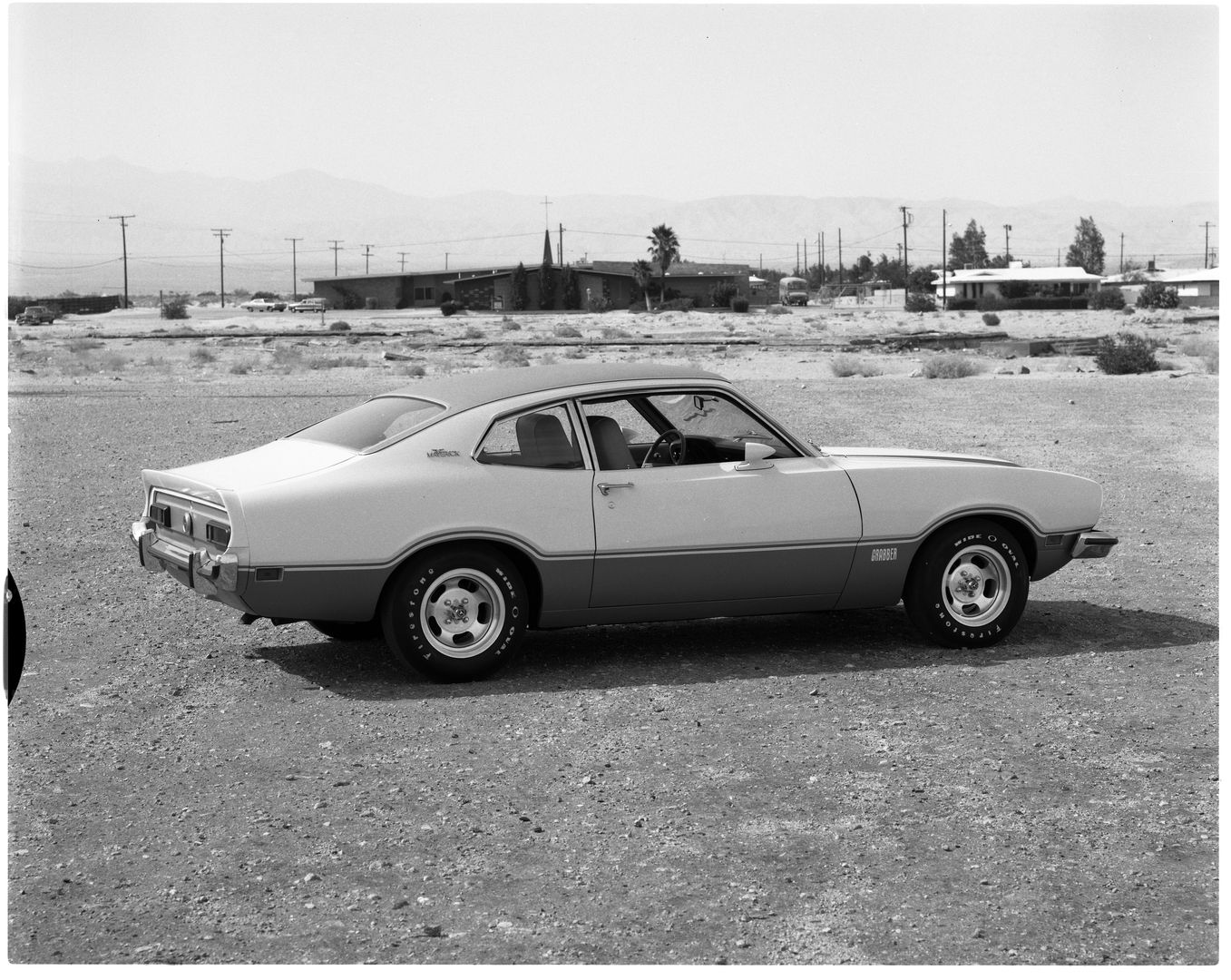
For 1973 Ford dropped the 170 six entirely, making the 200 six the Maverick's new standard engine. Ford built 32,350 Grabbers alongside 148,943 plain two-door sedans and 110,382 four-door sedans for the year. Those three rows make a 1973 Maverick total of 291,675, so the Grabber was about one Maverick in nine and roughly one two-door in six. The plain two-door was the volume Maverick at just over half of all cars built, the four-door sedan took about 38 percent, and the Grabber about 11 percent. Every Grabber was a two-door, built on the same body as the 148,943 plain sedans and dressed with its own tape, spoiler and tires.1,2,3
Factory prices for the Grabber two-door, catalogued as body 62D, ran $2,419 for the six and $2,541 for the V8. The plain two-door sedan listed at $2,240 (six) and $2,362 (V8), and the four-door sedan at $2,297 (six) and $2,419 (V8), so the six-cylinder Grabber and the V8 four-door shared the same $2,419 sticker. The Grabber package cost $179 over the plain two-door with either engine, and the V8 added $122 to every body. A V8 Grabber at $2,541 cost $301 more than the six-cylinder two-door sedan, the cheapest Maverick on the list, and $122 more than a six-cylinder Grabber. A three-speed manual was standard on the Grabber.4,5
Standard Grabber content for the year ran to the 200 six, a three-speed manual, D70x14 Wide Oval raised-white-letter tires, new federally mandated energy-absorbing bumpers, lower body side and back panel paint-and-tape treatments, hood tape with a Grabber decal, a black grille, dual racing mirrors, a deck-lid spoiler, trim rings, sound and handling packages, and vinyl seats. Options extended to forged aluminum wheels, high-back bucket seats, a leather-wrapped steering wheel, a floor-shifted three-speed manual as a separate line item, a 55-amp heavy-duty battery, and a heavy-duty suspension. The Grabber's graphics came in three separately described parts: the lower body side tape, the back panel treatment and the hood tape carrying the Grabber decal.6
Curb weight ran to 2,812 lb for the Grabber against 2,757 lb for the plain two-door sedan, a 55-pound difference, with both cars carrying the new energy-absorbing bumpers. Three optional metallic "Glow" finishes were offered for the year: Gold Glow, Ivy Glow, and Blue Glow. The Grabber carried its own body code, 62D, beside the 62A two-door sedan.6,4
The Grabber rode on D70x14 Wide Oval tires with raised white letters as standard equipment, part of the package list. Taken together, the Grabber's 1973 equipment list leaned toward safety and drivability alongside its look: energy-absorbing bumpers were a federally driven change rather than a styling choice, and the sound and handling packages named in the standard-content list sat beside the visual package of tape, spoiler, and trim rings. The heavy-duty suspension and 55-amp heavy-duty battery offered as separate options gave buyers more robust running gear than the base car provided, and the forged aluminum wheels, high-back buckets and leather-wrapped wheel let a Grabber be dressed up well beyond its vinyl-seat starting point.6
Fact sheet · 1973 · United States
The numbers
1973 Ford Maverick Grabber: The 200 six became standard as the 170 was dropped; Classic Industries counts 32,350 Grabbers.
Figures may describe different groups of cars. Add rows together only when the note says they make up a total.
Production
| What was counted | Built |
|---|---|
| All 1973 Mavericks (conceptcarz total)1 as published | 291,675 |
| What was counted | Built |
|---|---|
| Grabber2 Grabber · 2-door · as published | 32,350 |
| What was counted | Built |
|---|---|
| 2-door sedan2 Maverick · 2-door sedan · as published | 148,943 |
| 4-door sedan2 Maverick · 4-door sedan · as published | 110,382 |
Prices when new
| Model | Price | Price type |
|---|---|---|
| Factory price, Maverick Grabber two-door (six)4,5 | $2,419 | factory price, 1973 model year |
| Factory price, Maverick Grabber two-door (V-8)4 | $2,541 | factory price, 1973 model year |
| Factory price, Maverick two-door sedan (six)4 | $2,240 | factory price, 1973 model year |
| Factory price, Maverick two-door sedan (V-8)4 | $2,362 | factory price, 1973 model year |
| Factory price, Maverick four-door sedan (six)4 | $2,297 | factory price, 1973 model year |
| Factory price, Maverick four-door sedan (V-8)4 | $2,419 | factory price, 1973 model year |
Prices are the nominal dollars of the day, not adjusted for inflation.
Options and packages
| Option |
|---|
| Grabber standard content: 200 six, 3-speed manual, D70x14 Wide Oval raised-white-letter tires, new energy-absorbing bumpers, lower bodyside and back panel paint/tape, hood tape with Grabber decal, black grille, dual racing mirrors, deck-lid spoiler, trim rings, sound and handling packages, vinyl seats6 |
| Forged aluminum wheels6 |
| High-back bucket seats6 |
| Leather-wrapped steering wheel6 |
| 3-speed manual floor shift6 |
| Heavy-duty battery, 55 ampere6 |
| Heavy-duty suspension6 |
Paint
| Color |
|---|
| Gold Glow (optional metallic glow)6 |
| Ivy Glow (optional metallic glow)6 |
| Blue Glow (optional metallic glow)6 |
Color names are the factory's. We don't show color swatches, because a screen color is no guide for a restoration.
Specifications
| Measure | Value | Applies to |
|---|---|---|
| Curb weight, Grabber6 | 2,812 lb | Grabber 2-door |
| Curb weight, 2-door6 | 2,757 lb | 2-door |
Identification
Read a 1973 Ford VIN
The VIN decoder runs in your browser and never sends the VIN anywhere. How the factory numbered this year's cars:
Same model year
Also in 1973
- AMC AMX The Javelin AMX's best year. 5,707 were built, a quarter of them with the 401, alongside the Trans Am Victory decal and the Pierre Cardin interior.
- AMC Gremlin X and Spirit AMX The V8 Gremlin X continued with new stripes and an available Levi's denim-look interior, on a Gremlin starting at $2,098.
- AMC Javelin The SST name dropped away and new twin 'TV-screen' taillights arrived. Javelin production reached 25,195, alongside the Trans Am Victory decal package.
- Buick Riviera Stage One (260 hp net) joined a separate GS handling package; 1,234 Stage Ones and 3,933 GS cars of 34,080.
- Buick Skylark Gran Sport, GS and GSX On the new Colonnade A-body the GS became a Century Gran Sport package; 6,637 were built, 728 with the 455 Stage 1.
- Chevrolet Chevelle and Malibu SS The Colonnade Chevelle's only SS year: RPO Z15 on the Malibu coupe and, for the first and only time, the station wagon, with a 245 net hp 454 available.
- Chevrolet Chevy II and Nova Hatchback appears in the source body table; SS offered with any engine per the source. Enthusiast-compiled production: 369,509 cars; Super Sport 35,542.
- Chevrolet El Camino SS The new Colonnade El Camino could still be ordered with RPO Z15 SS equipment and a 245 net hp 454; 59,700 Customs built.
- Dodge Challenger The six was gone: every 1973 Challenger hardtop had a V8, the 318 standard and the 340 optional, with the Rallye now sold as a package.
- Dodge Charger The Charger's best-selling year of the original era, 119,318 cars, came as the 440 lost its Magnum name and the car moved toward personal luxury.
- Dodge Dart GTS, Swinger and Demon Renamed Dart Sport, the fastback's 340 model sold 11,315 in the 340's final year.
- Ford Ranchero GT The Ranchero GT's biggest year on the 1972-76 body: 15,320 GTs, alongside 25,634 Ranchero 500s and 4,787 Squires.
- Ford Thunderbird The 429 4V was standard and the 460 4V optional in the sixth generation's best-selling year.
- Ford Torino The 1973 Torino kept the 1972 body behind a heavier bumper; the Gran Torino Sport fell to 51,853 SportsRoofs and 17,090 hardtops while the 351 Cobra Jet remained the performance engine.
- Mercury Cougar The last Cougar convertible and the last 351 Cobra Jet year, with production up to 60,629 as buyers shifted to the XR-7.
- Mercury Montego GT The Montego GT fastback's second and last year; a vehicle profile reports 4,464 built.
- Oldsmobile Cutlass, 4-4-2 and Hurst/Olds On the new Colonnade Cutlass the 4-4-2 was a W-29 appearance and handling option, and the Hurst/Olds came in white or, for the first time, black: 1,097 built.
- Plymouth Barracuda and 'Cuda V8 only: the 318 became standard on both Barracuda and 'Cuda, the 340 moved to the option list, and production rose for the only time after 1970.
- Plymouth Duster 340 and 360 The 340's last year in the Duster produced 15,731 cars with power front disc brakes now standard, and the Spacemaker Pak fold-down rear seat joined the line.
- Plymouth GTX, Belvedere and Satellite For 1973 the GTX name survived only through the Road Runner's optional 440 four-barrel, which came with TorqueFlite only; Mueller's Muscle Car Source Book counts 749 of them.
- Plymouth Road Runner A secondary count puts production back up to 19,056, the highest of the 1971-1974 Satellite-based years.
- Pontiac Firebird and Trans Am The Super Duty year: 4,802 Trans Ams, 252 of them SD-455s.
- Pontiac GTO A GTO option on the new Colonnade LeMans, with the 400 standard and a 455 optional; 4,806 built.
- Pontiac Grand Am Pontiac's Colonnade GT with an Endura nose and a 400 or 455; 43,137 built, the Grand Am's best year, with 1,058 four-speeds.
- Pontiac Grand Prix The Colonnade-body Grand Prix arrives, with the 400 standard and the 455 in the SJ.
- Pontiac Tempest and LeMans The Colonnade LeMans arrives, with GTO and GT options for the two-door models and a Super Duty 455 listed for the LeMans in Pontiac's dealer book.