1991 · Lincoln · United States
1991 Lincoln Mark VII LSC: Two Coupes, One Engine
The LSC and Bill Blass converge: the Blass takes the LSC's suspension and wheels, and both are priced at just over $30,700.
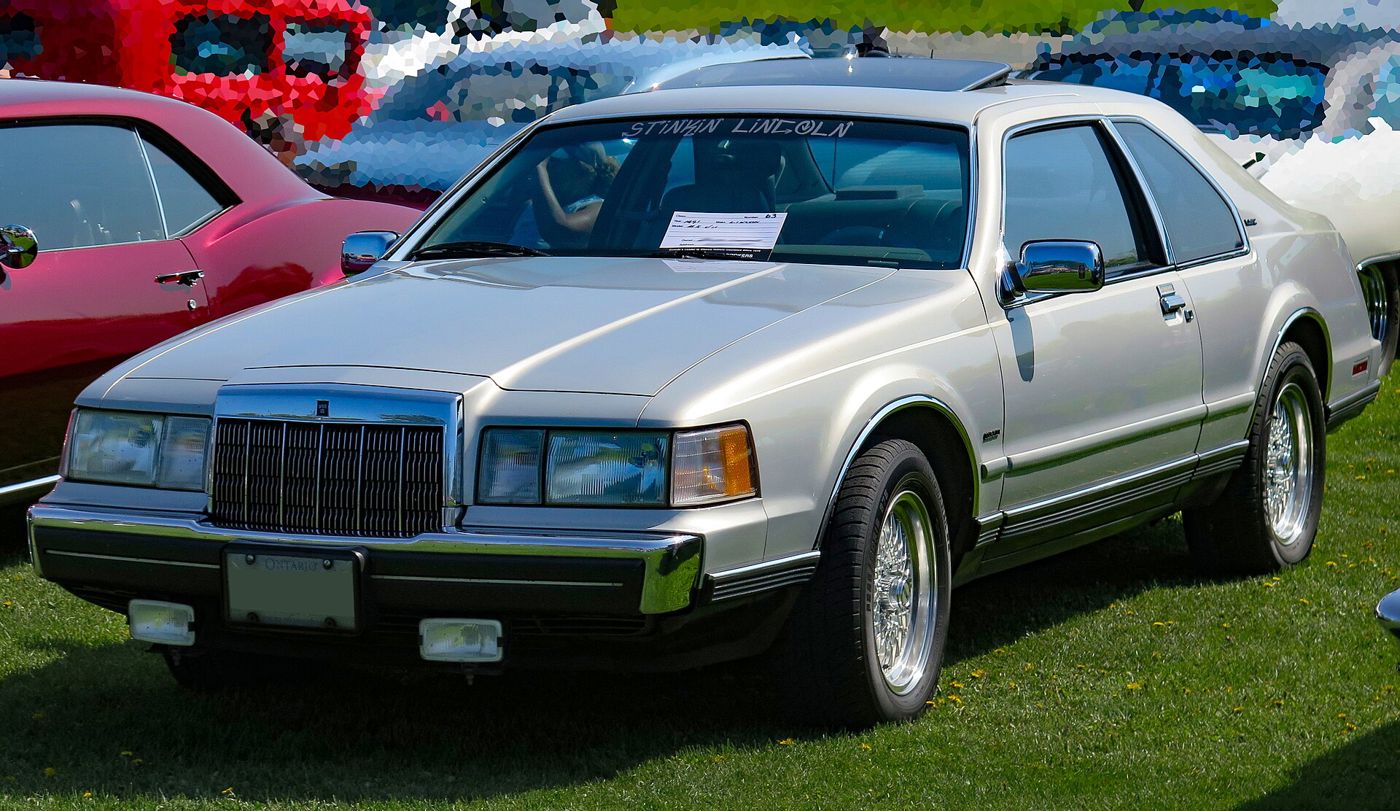

For 1991 the Mark VII line remained the LSC and the Bill Blass Edition, and the two converged mechanically: the Bill Blass adopted the LSC's own suspension and wheels for the year. The Lincoln Mark VII Club goes further, describing the 1991-92 Bill Blass as gaining the improved suspension and the high-output engine that had previously distinguished the LSC. Both cars were priced at just over $30,700. Redesigned seats with lower headrests also arrived for 1991.1,2,3
Wikipedia's production table, citing a Lincoln Mark VII Club forum post, assigns 8,880 cars to 1991 and 5,732 to 1992. Conceptcarz assigns that same 8,880 to 1992 instead and gives no separate 1991 total. The two sources put one number in two different years. Either way, the figure counts the LSC and the Bill Blass together.2,1,1
The 5.0-liter (302 cid) H.O. V8 was rated 225 hp at 4,200 rpm and 300 lb-ft at 3,200 rpm, standard on both the LSC and the Bill Blass. Those are SAE net figures. The engine had a 9.0:1 compression ratio and a 101.6 x 76.2 mm (4.0 x 3.0 in) bore and stroke, with sequential multi-port electronic fuel injection, tubular stainless steel headers, a tuned cast-aluminum intake manifold, dual exhaust and the EEC-IV engine computer. It called for 87 octane unleaded as a minimum. A four-speed automatic overdrive with a lock-up converter, with gear ratios of 2.40, 1.47, 1.00 and 0.67 and a 3.27:1 axle, was the only transmission; a Traction-Lok axle was optional on the LSC. For 1991 the Bill Blass and the LSC shared the same engine.2,3,4
Side by side, the two 1991 models, the LSC and the Bill Blass, differed in their details. On the LSC, analog instrumentation with a tachometer was standard where the Bill Blass got electronic instrumentation, fog lamps were standard, and the articulated sport seat with individual power lumbar and side bolster adjustments was the standard seat. Upper body dual band paint accent stripes were standard on the Bill Blass and left off the LSC. Both cars had a driver-side air bag, four-wheel disc anti-lock brakes, electronic air suspension with level control, a handling suspension, illuminated keyless entry, power windows and door locks, and BBS handling cast-aluminum wheels with P225/60R16 tires. The LSC had a curb weight of 3,807 lb and the Bill Blass 3,782 lb.
Ten items were optional on the LSC: the Traction-Lok axle, special edition monochromatic paint, a non-articulated seat with leather trim and a leather seat with cloth inserts (each at no extra charge), the 140-watt Ford JBL audio system, an AM/FM radio with an integral compact disc, a factory-installed cellular telephone, a power moonroof, an electrochromic automatic dimming mirror and an anti-theft alarm. The standard audio system was a High-Level AM/FM cassette with a remote 80-watt amplifier, and the cellular telephone came with an external speaker, audio mute and a 30-number memory. Lincoln's catalog closed with a notice that options may be offered only in combination with other options or subject to additional ordering requirements, and that prices and equipment may have changed after printing.
The LSC came in thirteen standard exterior colors: Medium Mocha Clearcoat Metallic, Light Mocha Pearlescent Clearcoat Metallic, Cranberry Clearcoat Metallic, Garnet Red Clearcoat Metallic, Burgundy Clearcoat Metallic, Amethyst Pearlescent Clearcoat Metallic, Crystal Blue Pearlescent Clearcoat Metallic, Regatta Blue Clearcoat Metallic, Twilight Blue Clearcoat Metallic, Midnight Black Clearcoat, Graphite Clearcoat Metallic, Titanium Pearlescent Clearcoat Metallic and Arctic White. The two Mocha colors and Regatta Blue were LSC-only. Special edition monochromatic paint, optional on the LSC only, came in Garnet Red Clearcoat Metallic or Midnight Black Clearcoat, and a photograph of an LSC in monochromatic Midnight Black Clearcoat appears in the catalog. A photograph of an LSC is captioned Medium Cranberry Clearcoat Metallic, while the color chart says only Cranberry Clearcoat Metallic. Five interior colors were offered for the LSC, Crystal Blue, Mocha, Cranberry, Ebony and Light Titanium; the first three were LSC-only, while Ebony and Light Titanium were offered on the Bill Blass as well.
Under both cars, the unitized body rode on a separate front subframe, with hybrid MacPherson struts in front and a four-bar-link rear, air springs at all four corners under microcomputer control with automatic front-to-rear and side-to-side leveling, and nitrogen gas-pressurized shock absorbers. Steering was a constant-ratio power rack-and-pinion at 14.7:1, with 2.46 turns lock to lock and a 40.1-foot turning circle. Anti-lock power disc brakes measured 10.8 inches in front and 11.3 inches at the rear. The fuel tank held 21.0 gallons and the trunk 14.2 cubic feet. Lincoln's specification table prints the wheel entry as 'cast aluminum 16x17-inch' beside a P225/60R16 tire size.2
Lincolns OnLine, a 1999 enthusiast history, sides with Wikipedia on the year, placing 8,880 Mark VIIs in 1991, worded as sales, and gives 5,439 for 1992, a third figure for the final year beside Wikipedia's 5,732 and conceptcarz's 8,880. Its same paragraph gives 22,313 for 1990, so on Lincolns OnLine's figures Mark VII sales fell from 22,313 in 1990 to 8,880 in 1991.2,5,1
Fact sheet · 1991 · United States
The numbers
1991 Lincoln Mark VII LSC: The LSC and Bill Blass converge: the Blass takes the LSC's suspension and wheels, and both are priced at just over $30,700.
Figures may describe different groups of cars. Add rows together only when the note says they make up a total.
Key facts
Prices when new
| Model | Price | Price type |
|---|---|---|
| Mark VII LSC and Bill Blass1 | $30,700 | just over $30,700, 1991 model year |
Prices are the nominal dollars of the day, not adjusted for inflation.
Engines
| Engine | Factory rating | Availability |
|---|---|---|
| 5.0-liter (302 cu in) H.O. V82,3 302 cu in · sequential multi-port electronic fuel injection | 225 hp @ 4,200, 300 lb-ft @ 3,200 (manufacturer rating as reported) | standard (LSC and Bill Blass) |
Ratings are published figures, not dyno results. Gross and net ratings aren't directly comparable.
Transmissions
| Transmission | Availability |
|---|---|
| Four-speed overdrive automatic4 | standard (only transmission) |
Options and packages
| Option | Price |
|---|---|
| Traction-Lok axle [optional on the LSC (O)] | |
| Special edition monochromatic paint, in Garnet Red Clearcoat Metallic or Midnight Black Clearcoat [optional on the LSC (O); not available on the Bill Blass] | |
| Non-articulated seat with leather trim, 'no extra charge' [optional on the LSC (O); the LSC's standard seat is the articulated sport seat] | $0 |
| Leather seat trim with cloth inserts, 'no extra charge' [optional on the LSC (O)] | $0 |
| Ford JBL Audio System, 140 watts [optional on the LSC (O); the standard system is the High-Level AM/FM cassette with a remote 80-watt amplifier] | |
| Electronic AM/FM stereo radio with integral compact disc, replacing the cassette radio [optional on the LSC (O)] | |
| Cellular telephone, factory-installed, with external speaker, audio mute and 30-number memory [optional on the LSC (O)] | |
| Power moonroof [optional on the LSC (O)] | |
| Electrochromic automatic dimming mirror [optional on the LSC (O)] | |
| Anti-theft alarm system [optional on the LSC (O)] |
Paint
| Color |
|---|
| Medium Mocha Clearcoat Metallic [LSC standard color; N/A on the Bill Blass] |
| Light Mocha Pearlescent Clearcoat Metallic [LSC standard color; N/A on the Bill Blass] |
| Cranberry Clearcoat Metallic [LSC standard color; the page 12 photo caption prints 'Medium Cranberry Clearcoat Metallic'] |
| Garnet Red Clearcoat Metallic [LSC standard color] |
| Burgundy Clearcoat Metallic [LSC standard color] |
| Amethyst Pearlescent Clearcoat Metallic [LSC standard color] |
| Crystal Blue Pearlescent Clearcoat Metallic [LSC standard color] |
| Regatta Blue Clearcoat Metallic [LSC standard color; N/A on the Bill Blass] |
| Twilight Blue Clearcoat Metallic [LSC standard color] |
| Midnight Black Clearcoat [LSC standard color] |
| Graphite Clearcoat Metallic [LSC standard color] |
| Titanium Pearlescent Clearcoat Metallic [LSC standard color] |
| Arctic White [LSC standard color] |
| Garnet Red Clearcoat Metallic, special edition monochromatic paint [optional on the LSC (O); N/A on the Bill Blass] |
| Midnight Black Clearcoat, special edition monochromatic paint [optional on the LSC (O); N/A on the Bill Blass; pictured on the LSC on printed p. 8] |
Color names are the factory's. We don't show color swatches, because a screen color is no guide for a restoration.
Interiors
| Trim |
|---|
| Crystal Blue [LSC standard interior color; N/A on the Bill Blass] |
| Mocha [LSC standard interior color; N/A on the Bill Blass] |
| Cranberry [LSC standard interior color; N/A on the Bill Blass; the printed p. 12-13 caption shows the LSC interior 'with Cranberry leather seating surfaces'] |
| Ebony [LSC standard interior color; also listed for the Bill Blass] |
| Light Titanium [LSC standard interior color; also listed for the Bill Blass] |
Specifications
| Measure | Value | Applies to |
|---|---|---|
| Vehicle type | five-passenger, two-door luxury sport coupe | Mark VII (one table printed for the LSC and Bill Blass; curb weight is split) |
| Wheelbase | 108.5 in | Mark VII (LSC and Bill Blass) |
| Track | front 58.4; rear 59.0 in | Mark VII (LSC and Bill Blass) |
| Length | 202.8 in | Mark VII (LSC and Bill Blass) |
| Width | 70.9 in | Mark VII (LSC and Bill Blass) |
| Height | 54.2 in | Mark VII (LSC and Bill Blass) |
| Curb weight | 3,807 lb | LSC (the same line prints 3,782 lb for the Bill Blass) |
| Fuel capacity | 21.0 gal | Mark VII (LSC and Bill Blass) |
| Luggage space | 14.2 cu ft | Mark VII (LSC and Bill Blass) |
| Headroom | front 37.8; rear 37.1 in | Mark VII (LSC and Bill Blass) |
| Legroom | front 42.0 (max.); rear 36.9 (min.) in | Mark VII (LSC and Bill Blass) |
| Hiproom | front 52.4; rear 55.2 in | Mark VII (LSC and Bill Blass) |
| Shoulder room | front 56.0; rear 57.8 in | Mark VII (LSC and Bill Blass) |
| Engine | 5.0-liter High-Output V-8 with EEC-IV computer; front engine, rear-wheel drive; 5.0 L / 302 cu in; bore and stroke 101.6 x 76.2 mm (4.0 x 3.0 in); compression ratio 9.0:1; 225 hp at 4,200 rpm (SAE net); 300 lb-ft at 3,200 rpm (SAE net); sequential multi-port electronic fuel injection; tubular stainless steel headers, tuned cast-aluminum intake manifold, dual exhaust (page 15 text) | Mark VII (LSC and Bill Blass) |
| Fuel requirement | 87 octane (minimum) unleaded (anti-lock index) | Mark VII (LSC and Bill Blass) |
| Transmission | 4-speed automatic overdrive with lock-up converter; gear ratios I 2.40, II 1.47, III 1.00, IV 0.67; axle ratio 3.27:1 (Traction-Lok axle optional on the LSC) | Mark VII (LSC and Bill Blass) |
| Body and suspension | unitized construction with separate front subframe; front hybrid MacPherson strut with air spring mounted on lower control arm; rear four bar link with air spring on lower arm, stabilizer bar; nitrogen gas-pressurized shock absorbers; microcomputer-controlled front and rear air springs with automatic front-to-rear and side-to-side leveling | Mark VII (LSC and Bill Blass) |
| Steering | constant-ratio power rack-and-pinion; overall ratio 14.7:1; 2.46 turns lock to lock; turning circle, curb to curb, 40.1 ft | Mark VII (LSC and Bill Blass) |
| Brakes | front 10.8-inch power-assisted disc, anti-lock; rear 11.3-inch power-assisted disc, anti-lock | Mark VII (LSC and Bill Blass) |
| Wheels and tires | cast aluminum '16x17-inch'; BBS handling cast-aluminum wheels; P225/60R16 BSW steel-belted radials | Mark VII (LSC and Bill Blass) |
Identification
- Seats
- Redesigned seats with lower headrests for 1991.2
- Instrumentation
- Analog instrumentation with tachometer is standard on the LSC; electronic (digital) instrumentation is listed as not available on the LSC and is standard on the Bill Blass.
- Fog lamps and stripes
- Fog lamps are standard on the LSC and not available on the Bill Blass; upper body dual band paint accent stripes are not available on the LSC.
- Seats and wheels
- The LSC has articulated sport seats with individual power lumbar and side bolster adjustments, and BBS handling cast-aluminum wheels; the brochure says both cars feature their own distinctively branded BBS wheels.
Where the sources disagree
Which year the 8,880 figure belongs to
Wheel size as printed in the 1991 brochure
- Chassis line 'Wheels': 'cast aluminum 16x17-inch'
- Tires: P225/60R16 BSW steel-belted radials (printed in both the Chassis line and the Tires/Wheels list)
Identification
Read a 1991 Lincoln VIN
The VIN decoder runs in your browser and never sends the VIN anywhere. How the factory numbered this year's cars:
Same model year
Also in 1991
- Buick Riviera 13,168 Rivieras with the 3800 V-6.
- Ford Taurus SHO Last year of the first-generation SHO body: still manual-only, with new Deep Emerald Green and Mocha Frost colours and a 16-inch 215/60 tire on every car.
- Ford Thunderbird A 5.0 V-8 returned to the Thunderbird line while Super Coupe volume fell to about a third of 1990's.
- Mercury Cougar The 5.0 V-8 returned at 200 hp; Wikipedia counts 60,564 Cougars, AEROCATS 63,822.
- Oldsmobile Cutlass, 4-4-2 and Hurst/Olds The front-drive Cutlass Calais Quad 442 used the 2.3 litre Quad 4 four-cylinder.
- Pontiac Firebird and Trans Am A new face and a factory convertible again: 50,454 Firebirds by one count, plus 2,915 GTAs.
- Pontiac Grand Prix The twin-cam 3.4 V6 GTP arrives at 210 hp.