Racing · Roush Racing · 2004
Kurt Busch, a Loose Wheel, and the First Chase
He lost a wheel and kept a championship, in the first season the sport decided its title with a playoff.
Story reviewed July 27, 2026
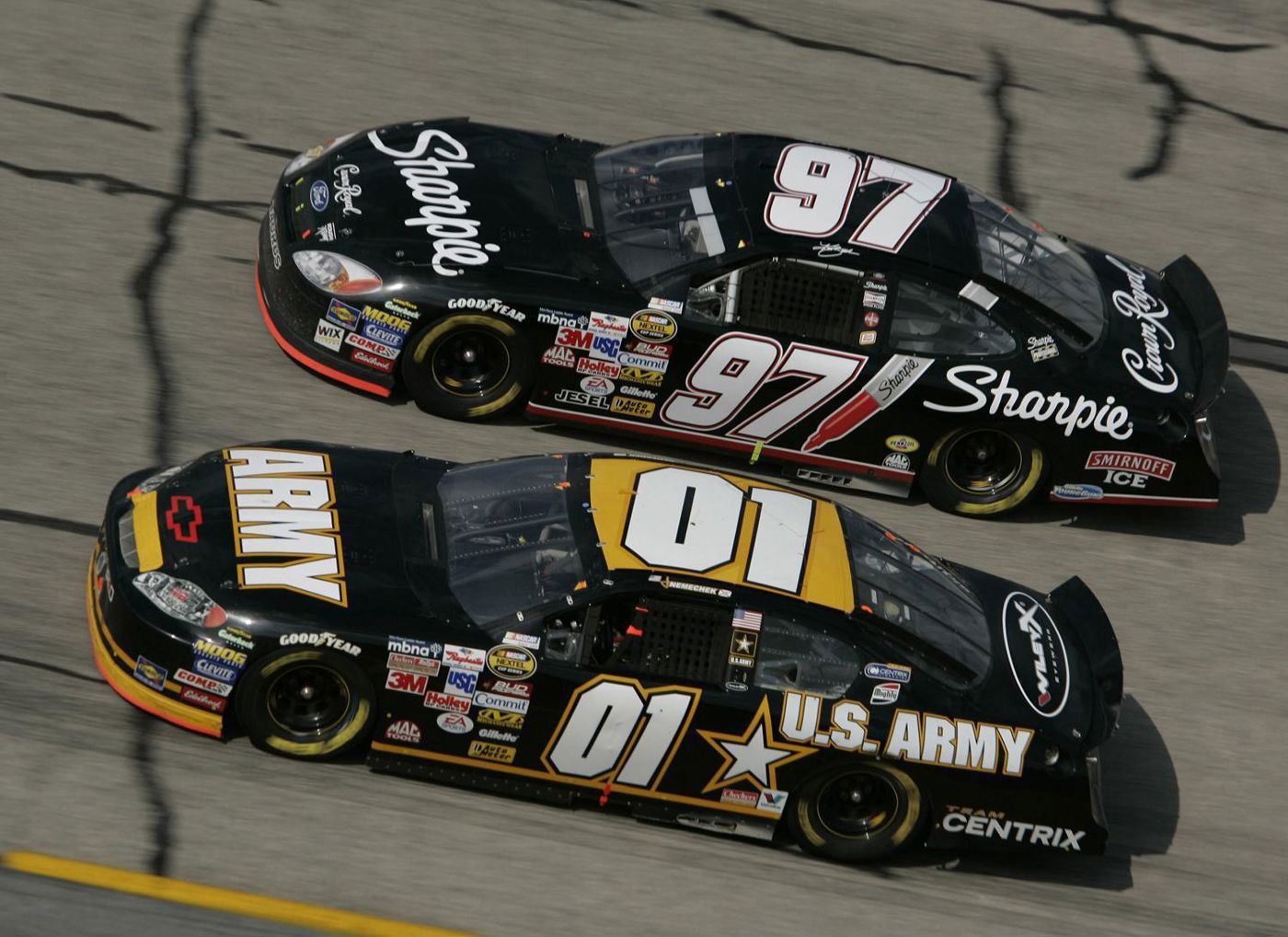
On lap 93 at Homestead, Kurt Busch turned the No. 97 Ford toward pit road as its right-front wheel left the car. The chassis dropped into sparks while the wheel continued down the frontstretch. NASCAR’s retrospective says the caution that followed helped Busch remain on the lead lap. The first championship decided under the Chase format suddenly depended on controlling a car that no longer had four wheels attached.
Five drivers had entered the finale with a mathematical chance at the title. Busch began with an 18-point lead over Jimmie Johnson and 21 over Jeff Gordon. Those gaps sound orderly before the race and fragile after the wheel departs. The new championship system had deliberately concentrated the season’s stakes, and its first finale produced an image no points model could have scripted.
Busch’s immediate work was physical and specific: keep the disabled Ford directed toward pit road without turning the failure into a larger crash. This account does not invent steering forces, radio language, or what he saw through the windshield. NASCAR supplies the sequence and consequence. An onboard record or direct recollection can later add sensation, while the official race report can settle exact caution and service timing.
The crew then had to return the car to competition. Which member performed which action remains held until a complete No. 97 roster and event records are acquired. “The Roush crew repaired it” is accurate at team level; assigning a decisive motion to a named mechanic without evidence would turn an ensemble rescue into mythology. The story treats pit work as part of the championship, not background labor.
Busch finished fifth and won the title by eight points over Johnson and sixteen over Gordon. Finish position and championship margin are different results, both necessary. The loose wheel did not hand him the title by itself, nor did the caution guarantee the remaining laps. The car had to be repaired, Busch had to keep scoring, and the points of other contenders continued to move.
The Ford was a purpose-built NASCAR Taurus, not a Mustang GT, Marauder, or road-going Taurus configuration. Its manufacturer and body name create a legitimate Ford-performance story, but its engine, chassis, transmission, weight, aerodynamics, tires, and safety equipment belong to NASCAR rules and event technical records. No street rating can describe it, and no race result should enter the showroom selector.
That boundary matters on a muscle-car site because 2004 Ford performance had several street identities. Mustang buyers could choose GT, Mach 1, or supercharged SVT Cobra. Mercury offered Marauder. Thunderbird occupied a two-seat edge. Busch’s Taurus carried another public image of Ford speed, but the connection is cultural and organizational rather than a shared configuration. Contextual links let readers travel between those worlds without merging the data.
The Chase format is also evidence context. Busch’s title was the first awarded under the new structure, so comparing its eight-point margin directly with a championship under another points system can mislead. The page explains that five drivers remained mathematically eligible and gives the entering gaps. It does not use the episode to declare whether the format was good or bad, a judgment neither the loose wheel nor the final standings can settle alone.
NASCAR’s phrase that the caution helped Busch stay on the lead lap deserves careful wording. “Helped” identifies a consequential circumstance, not intent or certainty about the counterfactual. Without the caution, another outcome may have followed, but the page does not simulate it and announce a replacement champion. The credible interpretation belongs in the story precisely because NASCAR states it, while hypothetical points remain hypothetical.
This treatment avoids another familiar simplification: luck versus skill. The timing of a caution was fortunate for Busch. Steering the three-wheeled car, the team’s repair, and the remaining race required execution. Mechanical failure was misfortune. All three can coexist. Reducing the championship to luck erases the response; reducing it to control erases the wheel rolling away.
The official race report, timing and scoring, rules packet, and crew roster are the next evidence priorities. They can show lap sequence, service time, restarts, contender positions, and named roles. Contemporary interviews can add what participants understood in the moment. Until then, later NASCAR retrospectives provide a stable narrative spine but not authority to reconstruct every second of the stop.
Photography presents an equally precise problem. The loose wheel and sparking Ford produced an unforgettable frame, likely controlled by NASCAR, an agency, team archive, or credited photographer. Display in an online gallery does not clear commercial editorial reuse. The owner must review photographer, source, rights holder, license, exact lap and car depiction, crop, credit, and visible people before any image moves from the separate licensing-review location.
The episode belongs beside Bill Elliott’s 1987 Thunderbird story because both show race identity refusing an easy summary. Elliott’s record was a qualifying measurement under one rules era; Busch’s survival was a championship sequence under a new points era. Neither can rank against a street horsepower number. Both become clearer when the site keeps sporting result, technical regime, and showroom configuration distinct.
By the finish, the mechanical failure that appeared capable of ending the title had become its defining image. Busch was fifth, not first. His margin was eight points, not comfortable. The wheel was gone, the race car returned, and the first Chase trophy was his. The story feels improbable because the verified sequence is improbable; it needs no invented villain, miracle, or radio script.
The final lesson is about consequence rather than verdict. NASCAR changed how its champion would be decided, and the first finale concentrated a season into a repairable failure at pit entrance. Busch and the team responded within that system and earned the points that remained. A loose wheel did not explain the whole year, but for a few laps it made the new championship structure visible in sparks.