1974 · AMC · United States
1974 AMC Javelin: The Last Year, Stretched Four Extra Months by an Emissions Rule
The Javelin's final year: 22,556 non-AMX cars on a production run extended into November 1974.
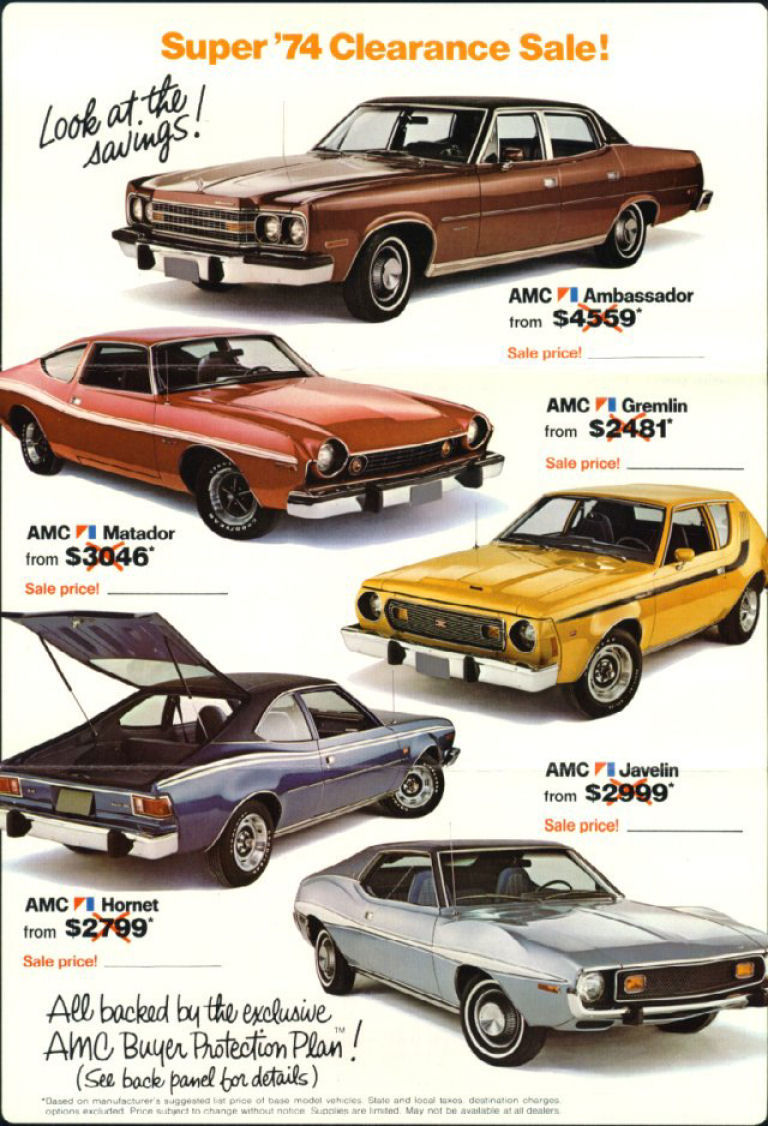
1974 was the Javelin's final model year, and two totals describe the finish line. An enthusiast body count gives 22,556 non-AMX Javelins, which with the AMX's separately tallied 4,980 cars makes 27,536 for the whole line. Wikipedia cites 27,696, 160 cars more.1,2,3
That production schedule was itself unusual. The model year's actual build run stretched from August 1, 1973 to the end of November 1974, four months longer than a normal model year, under a government extension tied to emissions regulations. A practical consequence follows directly from that extension: a Javelin built late enough in the run can carry detail changes more typically associated with the following year, so a car's exact build date matters more than usual for identifying what it should and should not have from the factory.1
Within the 22,556-car total, the engine mix leaned harder toward the sixes than in any earlier Javelin year: 2,076 cars with the 232 and 2,960 with the 258, a combined 5,036 six-cylinder Javelins against 13,826 with the base 304 V8. The 360 found 3,477 buyers and the 401, in its own final year, only 217, the smallest count for any single engine in any Javelin year, a quiet end for the engine that had once defined the Javelin's most serious performance option.1
The 401's own advertised output depends on which market's brochure is read. Wikipedia, drawing on AMC's broader 1972-74 net-rating figures, gives 255 net horsepower for the US market. The Canadian-market 1974 Javelin/AMX brochure prints a different figure entirely for the same engine: 235 horsepower at 4,600 rpm and 335 lb-ft of torque at 3,200. One rating comes from the American market and one from the Canadian, each printed for the same 401.3
Factory prices crossed a threshold worth noting on its own: $3,093 for a V8 Javelin and $2,999 for the six-cylinder, both effective from the September 1973 introduction, meaning a six-cylinder Javelin now cost within a single dollar of what a V8 car had cost just two model years earlier. The Go Package held its familiar $410-with-360 or $499-with-401 pricing, but its contents had been trimmed: the 1974 package carried the same basic specification as 1971 through 1973 minus the cowl-induction hood, a small but real reduction in what the same price bought.1,4
Transmission and axle pairings followed a straightforward logic by 1974: a three-speed manual with a 3.54 axle came standard behind the 304, itself standard equipment on the AMX; a column- or console-shifted Torque-Command automatic was optional across the range, geared at 2.87 (or 3.15) behind the 304 and 3.15 (or 3.54) behind the 360 or 401; and a floor-shifted four-speed manual, geared at 3.54, remained available only with the 360 four-barrel or the 401, keeping the true manual-transmission performance combination reserved for the two biggest engines right through the Javelin's final year.
The wider Canadian options list still ran deep for a car in its last year: a V8 Rally-Pac gauge package with ammeter, oil pressure, a combination tachometer and clock and a 140-mph speedometer; audio choices from a basic AM push-button radio up through AM/FM multiplex stereo or an 8-track player, both paired with four speakers instead of the two common on earlier Javelins; and protection options including stainless door-edge guards, color-keyed vinyl floor mats and a heavy-duty bumper system. A Bravado-grain vinyl roof came in seven colors, and tire choices ran from basic E78x14s up through FR78x14 steel-belted radials.
The sources split on whether the Pierre Cardin interior lasted into the Javelin's final year. Planet Houston AMX's own interior-code table still lists a 'W' Pierre Cardin code for 1974, implying the option remained orderable, while JavelinAMX.com's spotter's guide states flatly that all of the Javelin's special-edition models were gone by 1974.1,2
The exterior color palette shrank to thirteen choices for 1974, down from sixteen the year before: Snow White, Mellow Yellow, Trans-Am Red, Fawn Beige, Golden Tan Metallic, Sienna Orange, Copper Metallic, three greens (Silver Green, Medium Green and Dark Green, all metallic), Maxi Blue, Diamond Blue Metallic, Dark Blue Metallic and Plum Metallic, several of them restricted to the Gremlin, Hornet and Javelin trio rather than offered across AMC's full line. Notably, Classic Black, an extra-cost option on the Javelin in both 1972 and 1973, was not offered on the 1974 Javelin at all, only on the Matador and Ambassador.
A 1974 Javelin can be told from a 1973 car by two specific changes: retractable shoulder harnesses with their retractor mechanisms mounted in the rear side panels, a safety-regulation change not present on the visually similar 1973 body, and, on many 401-powered cars, '401' emblems placed behind the front side marker lights, a badge AMC had not used in 1972 or 1973. Shipping weight closed the model's run at 2,875 pounds for a six-cylinder car and 3,117 for a V8, figures within a few pounds of where the Javelin had sat since the redesigned 1972 body arrived.2,1
None of the Javelin's final-year details, the extended build schedule, the shrunken color chart, the disputed Pierre Cardin availability, the market-split 401 rating, changes the basic shape of the ending: a nameplate that had run from a 1968 launch through a factory-backed Trans-Am championship to a last model year in which six-cylinder Javelins outnumbered 401-powered ones by more than twenty to one, closing out on a production line that itself had to be legally extended just to finish the run properly.1
Fact sheet · 1974 · United States
The numbers
1974 AMC Javelin: The Javelin's final year: 22,556 non-AMX cars on a production run extended into November 1974.
Figures may describe different groups of cars. Add rows together only when the note says they make up a total.
Key facts
Production
| What was counted | Built |
|---|---|
| Javelin, body 7479-71,2 Javelin · 2-door hardtop · US production | 22,556 |
| What was counted | Built |
|---|---|
| Javelin line including AMX3 Javelin and AMX · 2-door hardtop · US | 27,696 |
| What was counted | Built |
|---|---|
| 232 six1 Javelin · 2-door hardtop · 232 six · US | 2,076 |
| 258 six1 Javelin · 2-door hardtop · 258 six · US | 2,960 |
| 304 V81 Javelin · 2-door hardtop · 304 V8 · US | 13,826 |
| 360 V81 Javelin · 2-door hardtop · 360 V8 · US | 3,477 |
| 401 V81 Javelin · 2-door hardtop · 401 V8 · US | 217 |
Prices when new
| Model | Price | Price type |
|---|---|---|
| Javelin, V81 | $3,093 | factory price, 1973-09 |
| Javelin, six-cylinder1 | $2,999 | factory price, 1973-09 |
Prices are the nominal dollars of the day, not adjusted for inflation.
Engines
| Engine | Factory rating | Availability | Built |
|---|---|---|---|
| 232 six3 232 cu in | 100 hp @ 3,600, 185 lb-ft @ 1,800 (SAE net) | standard | 2,0761 |
| 258 six3 258 cu in | 110 hp @ 3,500, 195 lb-ft @ 2,000 (SAE net) | optional | 2,9601 |
| 304 V8 2-bbl3 304 cu in · 2-barrel | 150 hp @ 4,200, 245 lb-ft @ 2,500 (SAE net) | optional | 13,8261 |
| 360 V8 (2-bbl or 4-bbl)3 360 cu in · 2-barrel or 4-barrel | 175 hp (SAE net (2-bbl)); 220 hp (SAE net (4-bbl, 1974)) | optional | 3,4771 |
| 401 V8 4-bbl3 401 cu in · 4-barrel | 255 hp (SAE net) | optional | 2171 |
Ratings are published figures, not dyno results. Gross and net ratings aren't directly comparable.
Transmissions
| Transmission | Availability |
|---|---|
| Three-speed manual, floor (304: standard on Javelin and AMX; axle 3.54) | standard |
| Torque-Command automatic, column or console (console 304: 2.87 (3.15); 360 and 401: 3.15 (3.54)) | optional |
| Four-speed manual, floor (360 4-bbl and 401; axle 3.54) | optional |
Options and packages
| Option | Price |
|---|---|
| Go Package, 1974: 1971–73 contents without cowl induction4 | $410 |
| Rally-Pac instruments (V-8): ammeter, oil pressure, tick-tach tachometer/clock, 140-mph speedometer | |
| AM push-button radio; AM/FM multiplex stereo with four speakers; 8-track with manual AM radio and 4 speakers; rear speaker (AM only) | |
| Vinyl roof; rally side stripes (Javelin only); hood T stripe (AMX only) | |
| Heavy-duty engine cooling; 70-amp battery; 600-watt block heater; handling package | |
| Protection group (stainless door edge guards, colour-keyed vinyl mats); vinyl body-side scuff molding; insulation group; heavy-duty bumper system | |
| Tires: E78x14, E78x14 white line, F70x14 white-letter (standard AMX), FR78x14 steel radials, E60x15 white-letter | |
| Vinyl-covered roof, Bravado grain: black, white, blue, green, brown, buff or copper (consult dealer for application) |
Paint
| Code | Color |
|---|---|
A1 |
Snow White |
E9 |
Mellow Yellow |
D7 |
Trans-Am Red |
E6 |
Fawn Beige |
F8 |
Golden Tan, Metallic |
G6 |
Sienna Orange |
F9 |
Copper, Metallic |
G1 |
Silver Green, Metallic |
G2 |
Medium Green, Metallic |
G3 |
Dark Green, Metallic |
F2 |
Maxi Blue |
E1 |
Diamond Blue, Metallic |
F7 |
Dark Blue, Metallic |
G4 |
Plum, Metallic |
Color names are the factory's. We don't show color swatches, because a screen color is no guide for a restoration.
Interiors
| Code | Trim |
|---|---|
41 / 43 / 44 / 46 / 48 (S, R or W) |
Black, blue, green, tan, white; S Uganda vinyl, R Domino fabric, W Pierre Cardin (per Planet Houston AMX)1 |
Specifications
| Measure | Value | Applies to |
|---|---|---|
| Shipping weight, V81 | 3,117 lb | 7479-7 |
| Shipping weight, six-cylinder1 | 2,875 lb | 7479-7 six |
Identification
- 1974 vs 1973
- 1974 cars have retractable shoulder harnesses with the retractors in the rear side panels; many 401 cars carry '401' emblems behind the front side markers (not used 1972–73).2
Where the sources disagree
1974 Javelin line total (including AMX)
1974 401 V8 net rating (market scope)
- 255 hp net (US-market figure)3
- 235 hp @ 4,600, 335 lb-ft @ 3,200 (net), Canadian brochure
Identification
Read a 1974 AMC VIN
The VIN decoder runs in your browser and never sends the VIN anywhere. How the factory numbered this year's cars:
Same model year
Also in 1974
- AMC AMX The final Javelin AMX: 4,980 built, with the Go Package's cowl induction dropped and a production run that stretched into November 1974.
- AMC Gremlin X and Spirit AMX The Gremlin X gained a 'hockey stick' stripe in the Gremlin's biggest year: 171,128 cars, 14,137 with the 304 V8.
- Buick Riviera Colonnade pillared roof; 20,129 built, 1,698 with Stage One and 4,119 with the GS handling option.
- Buick Skylark Gran Sport, GS and GSX The last year a 455 Stage 1 could be had in a Buick intermediate Gran Sport; 3,355 were built, 478 of them Stage 1.
- Chevrolet Chevelle and Malibu SS The SS was gone; the new Laguna Type S-3 coupe carried the Chevelle's performance image, with a 235 net hp 454 still on the engine list.
- Chevrolet Chevy II and Nova Spirit of America Nova (RPO Z51) offered on the Custom hatchback per the source. Enthusiast-compiled production: 390,537 cars; Super Sport 21,419.
- Chevrolet El Camino SS Colonnade-era El Camino; Chevrolet's 1974 data pages define the RPO Z15 SS option for the El Camino Classic. Team Chevelle's production totals give 51,223 El Caminos built, 4,543 of them with SS equipment.
- Dodge Challenger The last original-era Challenger shared a catalog with the Dart; the 360 replaced the 340 as the optional engine and production ended in April 1974.
- Dodge Charger The last B-body Charger before the 1975 personal-luxury redesign, with 5-mph bumpers, carried-over powertrains and an SE that accounted for 30,957 V-8 cars.
- Dodge Dart GTS, Swinger and Demon The 360 replaced the 340 in the Dart Sport, and Flory's production table counts 3,951 Dart Sport 360s at a $3,244 base price.
- Ford Maverick Grabber Grabber production fell to 23,502 by Classic Industries count.
- Ford Ranchero GT The Cobra Jet 351's last year in the Ranchero GT, with 11,328 GTs built alongside 18,447 Ranchero 500s.
- Ford Thunderbird Sixth-generation personal-luxury Thunderbird; the known facts are the production total and the luxury-group option prices.
- Ford Torino The 1974 Torino grew again and added the Gran Torino Elite; the Gran Torino Sport survived only as a formal-roof hardtop, with 23,142 built.
- Mercury Cougar An XR-7-only luxury hardtop with an opera window, a 351 V-8 standard and a 460 on the list; 91,670 built.
- Oldsmobile Cutlass, 4-4-2 and Hurst/Olds The Hurst/Olds paced the Indianapolis 500 again and offered a 350 for the first time: 1,800 coupes, 380 of them with the 455 W-30.
- Plymouth Barracuda and 'Cuda The final year: Barracuda and 'Cuda hardtops with a standard 318 and a new optional 360, and 11,734 built before the line ended.
- Plymouth Duster 340 and 360 The 245 net hp 360 replaced the 340 in the Duster's best sales year: 3,969 Duster 360s among 281,378 Dusters, with Twister, Gold Duster and Space Duster packages priced separately.
- Plymouth GTX, Belvedere and Satellite In 1974 a GTX nameplate came with the Road Runner's optional 440 four-barrel, TorqueFlite required; Mueller's Muscle Car Source Book counts 386 of them.
- Plymouth Road Runner The last Satellite-based Road Runner; production roughly halved from 1973.
- Pontiac Firebird and Trans Am A new nose and the last Super Duty: 10,255 Trans Ams, 943 with the SD-455.
- Pontiac GTO The last original GTO: a package on the compact Ventura with a 200 hp 350; 7,058 built.
- Pontiac Grand Am A revised nose and 17,083 built, only 342 with a four-speed.
- Pontiac Grand Prix The 455 remains the SJ engine as Grand Prix volume falls to under 100,000.
- Pontiac Tempest and LeMans With the GTO moved to the Ventura, the LeMans GT package became the intermediate performance choice, backed by 350, 400 and 455 V8 options.