1972 · Buick · United States
1972 Buick GS and GSX: a tested coupe and forty-four invoices
The last A-body GS year before the Colonnade Century; the GSX package, now in many colours, was invoiced on only 44 cars, most of them outside the lower 48 states.
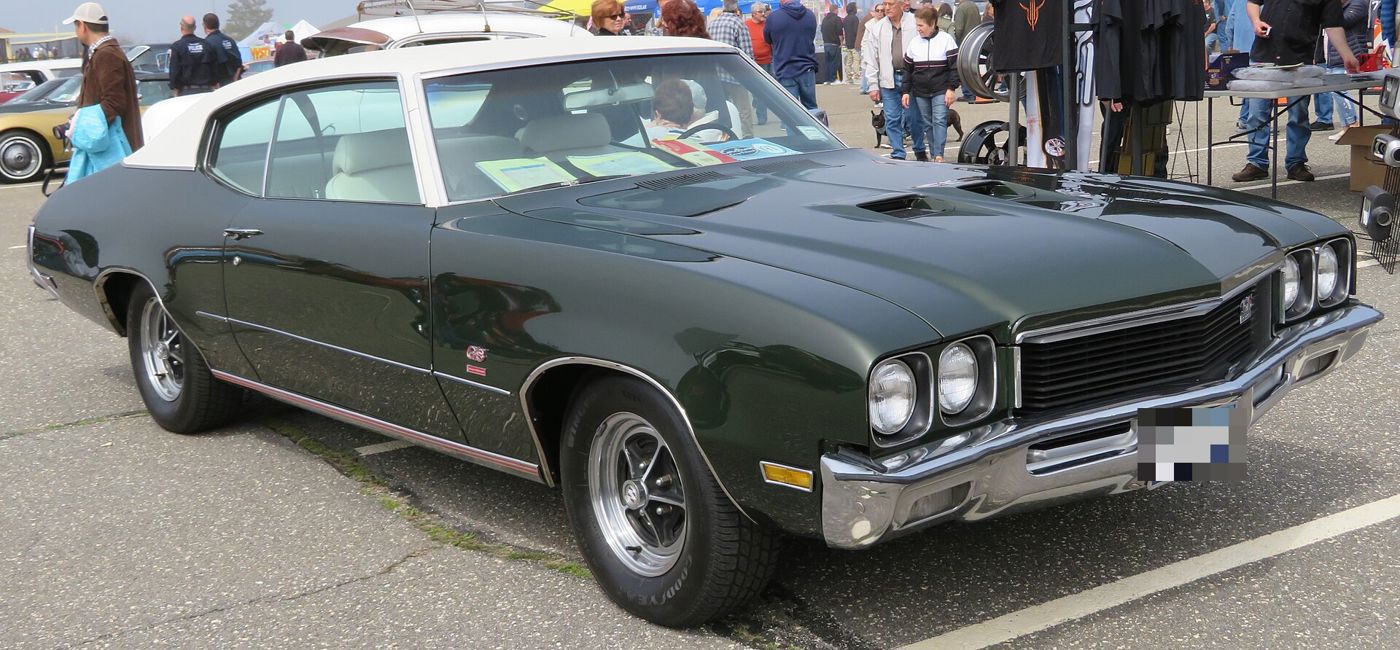

Hot Rod’s February 1972 Buick test put a heavily equipped Stage I coupe through repeated quarter miles in 14.9 seconds at more than 93 mph. Steve Kelly described a car weighing over 4,000 pounds, with air conditioning, an air-injection pump, closed exhaust and stock tires. The magazine valued its comfort as well as its acceleration. That car opens the final Skylark-based GS year better than a comparison of unlabeled horsepower numbers would. It was a particular test car, carrying its own equipment and its own test history, rather than a performance promise for every Buick wearing the badge.1
Not every run in the same article was necessarily made in untouched showroom condition. Kelly described removing the air-filter element and raising its lid, and the article does not give the intake condition for every timed run. Its reported Stage I axle was 3.42, and its quoted package price was $325.44. Those details belong with the result. They also set this test apart from the GSX appearance package, whose history comes from invoices: a tested Stage I coupe is not automatically a GSX, and a GSX count is not a count of all Stage I Buicks.1,2
The GSX registry’s 1972 breakdown sheet follows forty-four invoiced cars, with twenty-four Stage 1 455s, four ordinary 455s and sixteen 350 four-barrels. Its earliest invoice is dated September 9, 1971, and the latest July 3, 1972. Those are invoice dates, not exact assembly dates, even though they sit beneath a production-date heading. The sheet was compiled long after the cars were sold, does not reproduce the invoices behind it, and carries its own reference-only warning beside an unusually detailed table. Its figures are registry counts for a defined group of GSX cars, not a factory production ledger for the whole Buick GS line.2
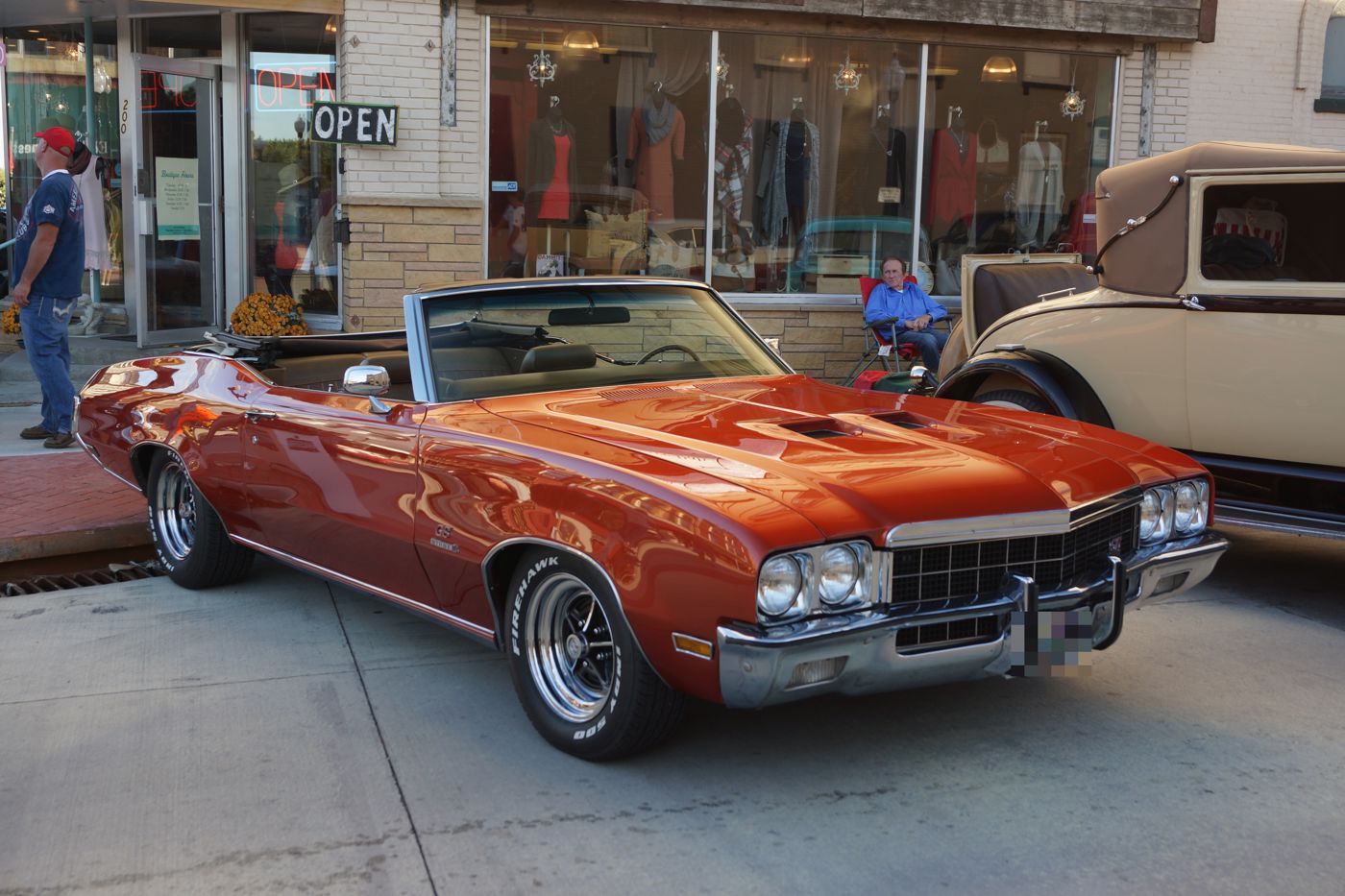

The registry’s transmission columns keep each engine group separate. Two of its twenty-four Stage 1 cars have four-speed manuals and twenty-two have Turbo Hydra-Matic 400s. One ordinary 455 has a four-speed and three have the TH400. The 350 group contains one four-speed and fifteen TH350s. Air-conditioning entries sit inside those groups: one manual Stage 1 and fourteen automatic Stage 1 cars, one manual and one automatic ordinary 455, and two automatic 350s. The air-conditioned cars are part of those groups, not additional cars. And the forty-four-car total does not describe any one transmission combination; each combination has only the count in its own row.2
Most of those forty-four cars were not sold in the mainland United States. The sheet assigns only five to its “48 States USA” category, twenty-two to Canada and seventeen to “Exported (Including Hawaii).” Hawaii stays inside that printed export category as the sheet prints it. These are the registry’s sale-location groups, not assembly plants and not where cars survive today. The GSX story extended well beyond the contiguous United States. A particular surviving Buick can be called one of the five only when its own documentation shows which group it belongs to and what the location field meant for it.2
The price range also describes invoices rather than a single showroom sticker. The registry reports a minimum invoice price of $2,855.46, a maximum of $4,500.67 and an average of $3,728.73. Those are nominal period invoice dollars, not a universal GSX retail price, an inflation-adjusted value or a cost for the package alone. The options sheet shows how differently its cars could be equipped: eighteen entries for a rear-window defroster and twenty-six for front-and-rear bumper stripes, with combinations recorded separately in other equipment families. Some sales codes were derived from ordering and assembly material with outside assistance, and the sheet warns that its information is incomplete, though the detailed codes are still useful.2
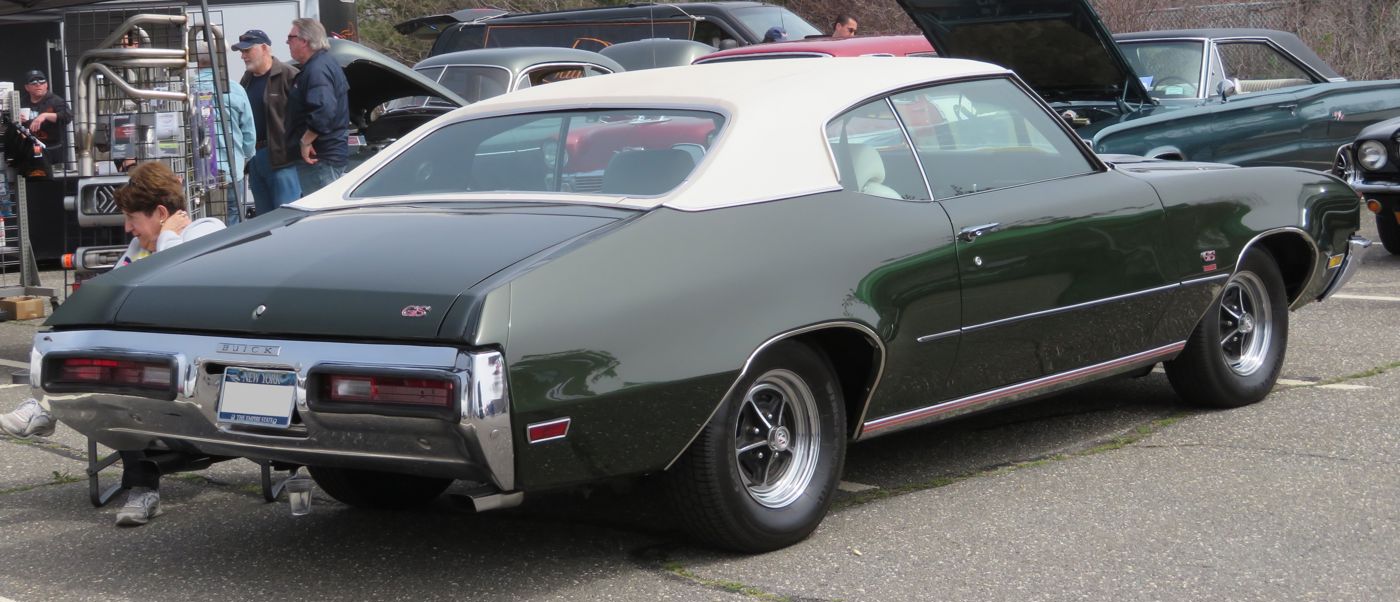

Color and seating give the invoice group a broader visual character than one familiar GSX paint scheme. The sheet lists twenty-six paint-and-vinyl-top combinations, including four Stratomist Blue cars and four Arctic White cars without a separately named top, and five Cortez Gold cars. Many combinations occur once. Its interior table includes fifteen white-vinyl bucket-seat entries, nine tan-and-black buckets and twelve black buckets, alongside bench and notchback choices. These are counts within the registry’s group of cars, not the complete Buick paint chart. A color count multiplied by an unrelated transmission percentage makes no valid rarity claim. A car's appearance today does not prove its original invoice combination.2
The wider GS totals are a different kind of count. TeamBuick lists 7,723 hardtops and 852 convertibles. MuscleCarClub supplies engine-by-body entries and a stated 8,619 total that includes a separate forty-four-car GSX line. Its engine/body entries already align with the two TeamBuick body counts; neither source explains whether the GSX cars are included in those bodies. The larger total may therefore count the package twice. The enthusiast table reports 728 Stage 1 hardtops and eighty-one Stage 1 convertibles, but names no underlying factory record. Where these secondary figures agree, they may simply be repeating one another, and the GSX line should not be added to every other total.3,4
A factory service catalogue sets out the axles on firmer ground. Its May 1972 model chart identifies GS hardtop and convertible VIN prefixes 4G37 and 4G67, both on a 112-inch wheelbase. The following axle chart lists Stage 1 with a four-speed manual or THM400 and a 3.42 ratio carrying limited-slip code LW. That is the factory specification, not proof of the parts now under a particular car. The registry’s generic open-rear-axle entry records forty cars, alongside its Stage 1 group, and nothing explains that apparent mismatch. The broad equipment entry cannot override the factory Stage 1 row, and it does not show that forty Stage 1 cars had open axles.5,2
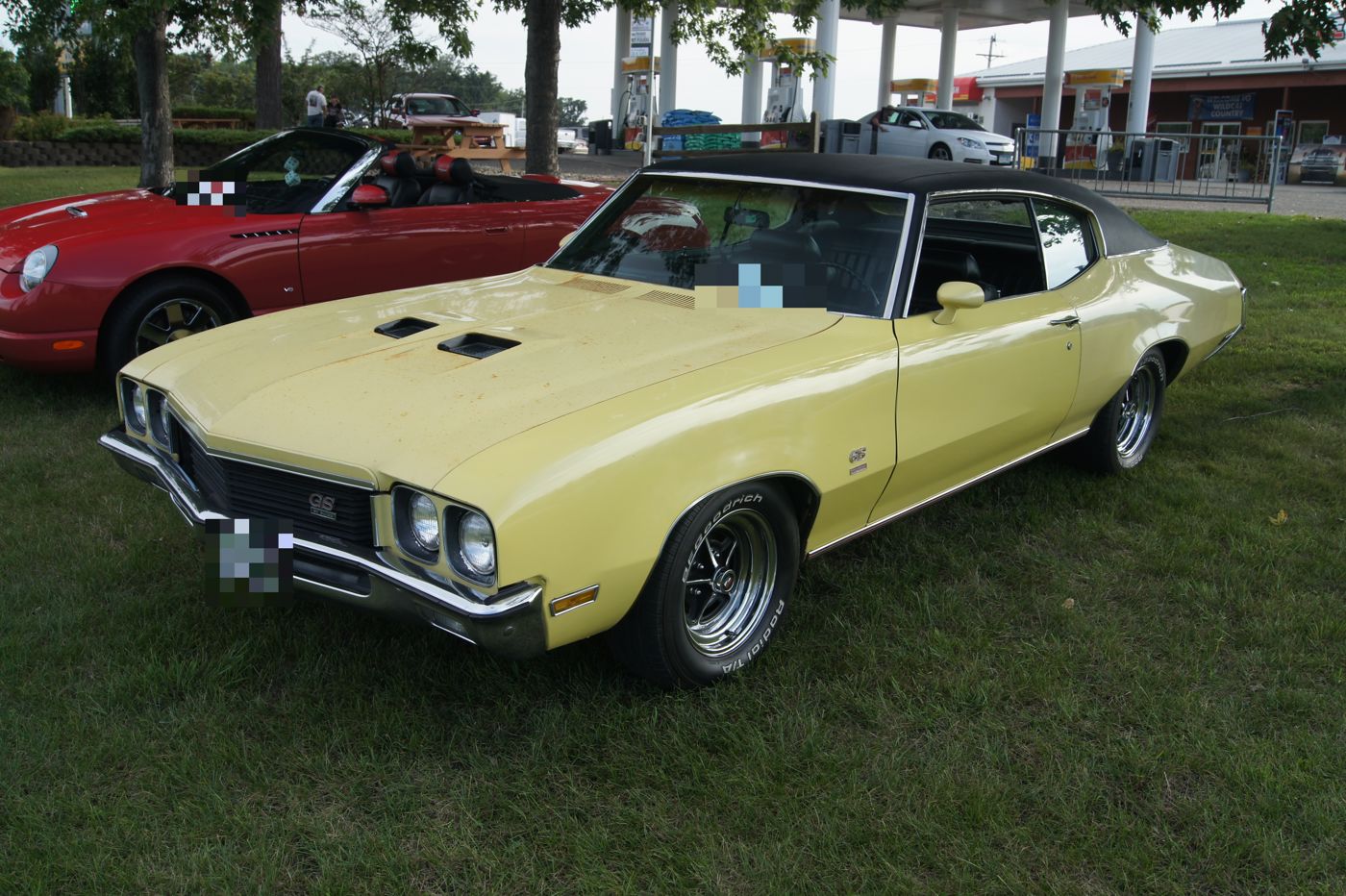

Engine codes map the GS branches. TeamBuick distinguishes WB with dual exhaust at 190 hp, WF with dual exhaust at 250 hp and WS Stage 1 at 270 hp, and identifies those branches for the GS. Its ordinary WF row lists 225 hp. The GS engine identification entry lists WB, WF and WS, so the dual-exhaust GS 455 and the Stage 1 each carried their own code.3
Buick’s own 1972 brochure places another choice above the occupants’ heads. Its sunroof discussion offers a soft folding-vinyl roof for Skylark, Skylark Custom and GS Sport Coupes, while the electrically operated steel roof is listed for larger Buick coupes. The options page restricts the named Sun Coupe treatment to the Skylark 350 Sport Coupe. The Sun Coupe and the GS sunroof were separate offerings.2,1
Fact sheet · 1972 · United States
The numbers
1972 Buick GS and GSX: The last A-body GS year before the Colonnade Century; the GSX package, now in many colours, was invoiced on only 44 cars, most of them outside the lower 48 states.
Figures may describe different groups of cars. Add rows together only when the note says they make up a total.
Key facts
Production
| What was counted | Count | Counted as |
|---|---|---|
| GSX package, all2,6 GS with GSX package · 2-door hardtop coupe · 350, 455 or 455 Stage 1 · all markets (US, Canada, export) Counted from invoices. | 44 | sold |
| What was counted | Count | Counted as |
|---|---|---|
| GSX, Stage 1 4552 GSX · 2-door hardtop coupe · 455 Stage 1 · all markets | 24 | sold |
| GSX, standard 4552 GSX · 2-door hardtop coupe · 455 · all markets | 4 | sold |
| GSX, 350 four-barrel2 GSX · 2-door hardtop coupe · 350 4-barrel · all markets | 16 | sold |
| GS 350 hardtop4 GS 350 · 2-door hardtop · 350 V-8 | 5,896 | |
| GS 455 hardtop (standard 455)4 GS 455 · 2-door hardtop · 455 V-8 | 1,099 | |
| GS 455 Stage 1 hardtop4 GS 455 Stage 1 · 2-door hardtop · 455 V-8 Stage 1 | 728 | |
| GS 350 convertible4 GS 350 · 2-door convertible · 350 V-8 | 645 | |
| GS 455 convertible (standard 455)4 GS 455 · 2-door convertible · 455 V-8 | 126 | |
| GS 455 Stage 1 convertible4 GS 455 Stage 1 · 2-door convertible · 455 V-8 Stage 1 | 81 |
| What was counted | Count | Counted as |
|---|---|---|
| GSX Stage 1, 4-speed2 GSX · 2-door hardtop coupe · 455 Stage 1 · 4-speed manual · all markets | 2 | sold |
| GSX Stage 1, Turbo Hydra-Matic 4002 GSX · 2-door hardtop coupe · 455 Stage 1 · TH400 · all markets 14 with air conditioning, 8 without. | 22 | sold |
| GSX 455, 4-speed2 GSX · 2-door hardtop coupe · 455 · 4-speed manual · all markets | 1 | sold |
| GSX 455, Turbo Hydra-Matic 4002 GSX · 2-door hardtop coupe · 455 · TH400 · all markets | 3 | sold |
| GSX 350, 4-speed2 GSX · 2-door hardtop coupe · 350 4-barrel · 4-speed manual · all markets | 1 | sold |
| GSX 350, Turbo Hydra-Matic 3502 GSX · 2-door hardtop coupe · 350 4-barrel · TH350 · all markets 2 with air conditioning, 13 without. | 15 | sold |
| What was counted | Count | Counted as |
|---|---|---|
| GSX sold in the 48 contiguous states2 GSX · 2-door hardtop coupe · 48 states | 5 | sold |
| GSX sold in Canada2 GSX · 2-door hardtop coupe · Canada | 22 | sold |
| GSX exported (including Hawaii)2 GSX · 2-door hardtop coupe · export incl. Hawaii | 17 | sold |
| What was counted | Built |
|---|---|
| GS 2-door sport coupe (43437), all engines3 GS · 2-door hardtop sport coupe | 7,723 |
| GS convertible (43467), all engines3 GS · 2-door convertible | 852 |
| What was counted | Count | Counted as |
|---|---|---|
| GS series, all, with the GSX line counted separately (MuscleCarClub total)4 GS, GS 455, GS 455 Stage 1 and GSX line as the source tabulates them · 2-door hardtop and convertible | 8,619 |
Prices when new
| Model | Price | Price type |
|---|---|---|
| GSX invoice price, minimum2 | $2,855.46 | dealer invoice price, 1971-09 to 1972-07 |
| GSX invoice price, maximum2 | $4,500.67 | dealer invoice price, 1971-09 to 1972-07 |
| GSX invoice price, average2 | $3,728.73 | dealer invoice price, 1971-09 to 1972-07 |
Prices are the nominal dollars of the day, not adjusted for inflation.
Engines
| Engine | Factory rating | Availability |
|---|---|---|
| 455 V-8 Stage 12 455 cu in · one 4-barrel | optional, GS | |
| 455 V-82 455 cu in · one 4-barrel | optional, GS | |
| 350 V-8 four-barrel2 350 cu in · one 4-barrel | standard, GS |
Ratings are published figures, not dyno results. Gross and net ratings aren't directly comparable.
Transmissions
| Transmission | Availability |
|---|---|
| Turbo Hydra-Matic 4002 | optional with 455s |
| Turbo Hydra-Matic 3502 | optional with 350 |
| 4-speed manual2 | optional |
Options and packages
| Option | Installed |
|---|---|
| GSX package (GS)2 | 442 |
| Rear window defroster (on GSX)2 | 182 |
| Soft-Ray tinted glass, all (sales code 1 group, on GSX)2 | 172 |
| Front and rear bumper stripes (on GSX)2 | 262 |
Paint
| Code | Color | Built |
|---|---|---|
BB |
Stratomist Blue2 | 42 |
BB1 |
Stratomist Blue / white vinyl top2 | 12 |
CC |
Arctic White2 | 42 |
CC2 |
Arctic White / black vinyl top2 | 12 |
FF2 |
Seamist Green / black vinyl top2 | 12 |
HH1 |
Heritage Green / white vinyl top2 | 12 |
HH2 |
Hunter Green / black vinyl top2 | 12 |
II |
Hunter Green2 | 12 |
II1 |
Hunter Green / white vinyl top2 | 12 |
II9 |
Hunter Green / green vinyl top2 | 12 |
JJ6 |
Sandalwood / tan vinyl top2 | 12 |
MM1 |
Burnished Copper / white vinyl top2 | 12 |
MM6 |
Burnished Copper / black vinyl top2 | 22 |
MM8 |
Burnished Copper / brown vinyl top2 | 12 |
QQ |
Cortez Gold2 | 52 |
QQ1 |
Cortez Gold / white vinyl top2 | 12 |
RR |
Fire Red2 | 22 |
RR1 |
Fire Red / white vinyl top2 | 22 |
VV2 |
Silver Mist / black vinyl top2 | 12 |
YY |
Sunburst Yellow2 | 32 |
YY2 |
Sunburst Yellow / black vinyl top2 | 12 |
YY8 |
Sunburst Yellow / brown vinyl top2 | 12 |
ZZ |
Flame Orange2 | 42 |
ZZ1 |
Flame Orange / white vinyl top2 | 12 |
ZZ2 |
Flame Orange / black vinyl top2 | 12 |
ZZ6 |
Flame Orange / tan vinyl top2 | 12 |
Color names are the factory's. We don't show color swatches, because a screen color is no guide for a restoration.
Interiors
| Code | Trim | Built |
|---|---|---|
126 |
Saddle brown vinyl bench2 | 12 |
128 |
Black vinyl bench2 | 32 |
245 |
White notchback2 | 12 |
246 |
Saddle notchback2 | 12 |
248 |
Black notchback2 | 22 |
365 |
White vinyl bucket2 | 152 |
367 |
Tan/black vinyl bucket2 | 92 |
368 |
Black bucket2 | 122 |
100 |
GS 2-Door HT: Green, vinyl3 | |
106 |
GS 2-Door HT: Saddle, vinyl3 | |
136# |
GS 2-Door HT: Saddle, vinyl3 | |
108 |
GS 2-Door HT: Black, vinyl3 | |
138# |
GS 2-Door HT: Black, vinyl3 | |
138* |
GS 2-Door HT: Black, vinyl3 | |
135# |
GS 2-Door HT: White, vinyl3 | |
135* |
GS 2-Door HT: White, vinyl3 | |
137* |
GS 2-Door HT: Tan Black, vinyl3 | |
130# |
GS Convertible: Green, vinyl3 | |
135# |
GS Convertible: White, vinyl3 | |
136# |
GS Convertible: Saddle, vinyl3 | |
138# |
GS Convertible: Black, vinyl3 |
Identification
- VIN
- E.g. 4G37K2H100001: 4 = Buick; series letter (G = GS); body (37 hardtop, 67 convertible); engine letter (K = 350 4-bbl dual exhaust, U/V = 455 options, W = 455 Stage I per TeamBuick's engine table); year (2); plant (H Flint; also C, G, X, Y, Z); production number from 100001.3
- Engine codes (GS)
- WB(2): 350, 190 hp net, dual exhaust; WF(1): 455, 250 hp net, dual exhaust; WS: 455 Stage 1, 270 hp net.3
Where the sources disagree
1972 GS total and GSX package overlap
1972 455 secondary rating and exhaust scope
Identification
Read a 1972 Buick VIN
The VIN decoder runs in your browser and never sends the VIN anywhere. How the factory numbered this year's cars:
Same model year
Also in 1972
- AMC AMX The first year of SAE net ratings and Chrysler-built TorqueFlite automatics. Javelin AMX production rose to 3,220, and the 304 V8 became available.
- AMC Gremlin X and Spirit AMX The first V8 Gremlin: the 304 (150 hp SAE net) in AMC's subcompact, fitted to 10,949 cars by conceptcarz's count.
- AMC Javelin The base model was dropped, so every non-AMX Javelin was an SST. This was the first year of the Pierre Cardin interior and of Chrysler-built automatics.
- Buick Riviera Net ratings only for 1972: 250 hp standard, 260 GS per ROA; 2,171 of 33,728 were GS.
- Chevrolet Chevelle and Malibu SS The last Z15 Chevelle SS of the first generation: net-rated engines, an LS5 454 at 270 net hp, and 5,333 SS 454s.
- Chevrolet Chevy II and Nova The source engine table switches to net ratings; SS and Rally Nova offered. Enthusiast-compiled production: 349,733 cars; Super Sport 12,309.
- Chevrolet El Camino SS Last year of the Chevelle-bodied El Camino SS; 50,359 V8 Malibu El Caminos were built, with the SS 454 rated 270 net hp.
- Dodge Challenger Hardtop only, with a new grille: the R/T gave way to the Challenger Rallye package, and the most powerful engine listed was the 340 four-barrel.
- Dodge Charger The R/T and Super Bee were dropped; the new Rallye package became the performance Charger, and the 440 Six Pack was cancelled after a handful of cars.
- Dodge Dart GTS, Swinger and Demon The Demon's second and final year under that name: 8,773 Demon 340s, with small Canadian and Swiss-market 340 runs counted separately.
- Ford Maverick Grabber The dual-scoop-hood Grabber in its second year as a model; Classic Industries counts 35,347.
- Ford Ranchero GT The sporty Ranchero moved to the new Torino body: 12,620 GTs, behind 23,431 Ranchero 500s and ahead of 4,283 Squires.
- Ford Thunderbird First year of the sixth-generation Thunderbird; only the whole-line production total was found.
- Ford Torino The new body-on-frame Torino sold 496,645 in 1972; the performance models were the Gran Torino Sport SportsRoof (60,794) and hardtop (31,239), with the 351 Cobra Jet and a Rallye Equipment Group on the option list.
- Mercury Cougar Net ratings arrived, the 429 was gone, and the 351 Cobra Jet became the performance Cougar engine, fitted to 3,560 cars.
- Mercury Montego GT The first year of the fastback-only Montego GT on the new split-wheelbase intermediate, with the Cyclone name reduced to a performance option that only a few dozen buyers took.
- Oldsmobile Cutlass, 4-4-2 and Hurst/Olds The 4-4-2 became a Cutlass option again, engines were rated in SAE net (W-30: 300 hp), and a Hurst/Olds paced the Indianapolis 500.
- Plymouth Barracuda and 'Cuda Hardtops only, single headlamps, four round taillamps, and a 340 four-barrel as the top engine: the 'Cuda carried it as standard.
- Plymouth Duster 340 and 360 In the first net-rating year the Duster 340's 8.5:1 340 was rated 240 net hp with electronic ignition, the Twister became order code A51, and output rose to 15,681 in both compilations.
- Plymouth GTX, Belvedere and Satellite For 1972 the GTX existed only as the 440 four-barrel option on the Road Runner hardtop; Mueller's Muscle Car Source Book counts 672 of them.
- Plymouth Road Runner The hardtop-only Road Runner took a 400 four-barrel as its advertised standard engine, and production fell again.
- Pontiac Firebird and Trans Am A strike-shortened year: 29,951 Firebirds and 1,286 Trans Ams, every one a 455 HO.
- Pontiac GTO The GTO goes back to being an option on the LeMans, with net ratings only; 5,807 were built.
- Pontiac Grand Prix A carryover year with the SJ still offered; production recovered to 91,961.
- Pontiac Tempest and LeMans The GTO becomes a LeMans option, and the LeMans gets WW4 and WW5 performance packages.