1972 · Mercury · United States
1972 Mercury Montego GT: The Fastback That Replaced the Cyclone
The first year of the fastback-only Montego GT on the new split-wheelbase intermediate, with the Cyclone name reduced to a performance option that only a few dozen buyers took.
United States · researched through 2026-09-22
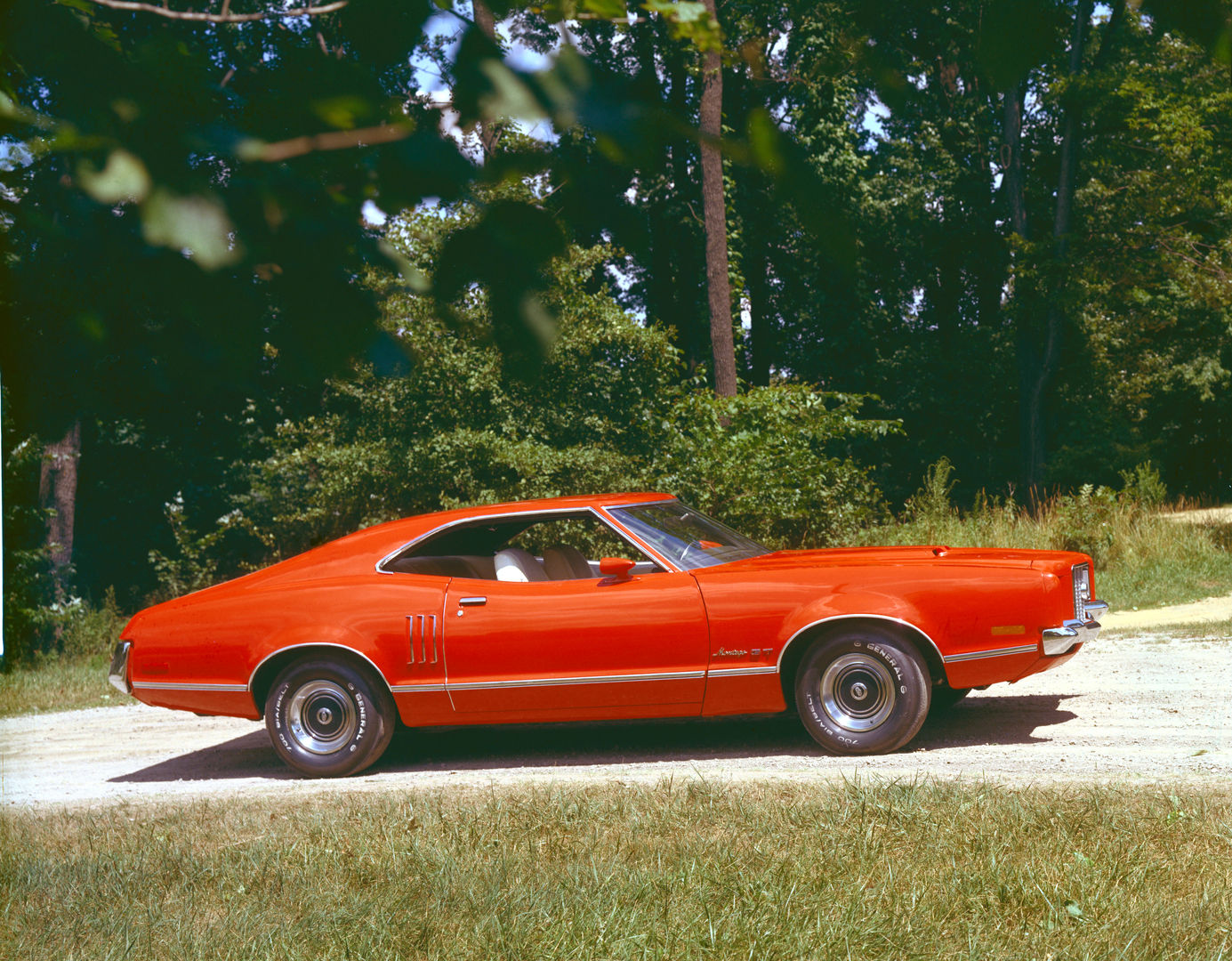
In November 1971 Ford's Lorain, Ohio, assembly plant built a Maroon Mercury Montego GT with a black knitted-vinyl bench seat and a 351 Cobra Jet. Old Cars Weekly reports that it reached its first owner at Pfeifer Lincoln-Mercury in Grand Rapids early that December. Its Elite Marti Report, as relayed by the magazine, says 14 1972 Montego GTs were painted Maroon and two had that black bench, without stating which population the counts cover. The same car also carried a C-6 automatic, the Competition Suspension and a 3.50 Traction-Lok. One documented car is a narrow window, but it shows how far a buyer could take the new GT from its standard specification.1
The GT arrived with a new car underneath it. For 1972 Ford moved its intermediates from unit construction to body-on-frame. Wikipedia's Torino history describes a perimeter frame with 14 rubber body mounts and five crossmembers, used to give a quieter, more isolated ride, with a short/long-arm front suspension on coil springs. The Montego shared the change and the split wheelbase that came with it: 114 inches for two-doors and 118 inches for four-doors and wagons. Old Cars Weekly compares the approach to General Motors' A-body intermediates. The taillamps moved into the rear bumper.2,3,1
The most consequential change for performance buyers was a name that lost its standing. The Cyclone had been a separate Mercury model through 1971. For 1972 it became an option package, and Mercury introduced the Montego GT in its place, a counterpart to Ford's Gran Torino Sport SportsRoof. Wikipedia and Old Cars Weekly both describe the GT as the Cyclone's replacement. The GT was offered only as a two-door fastback, and it lasted just two model years, 1972 and 1973.3,1,4
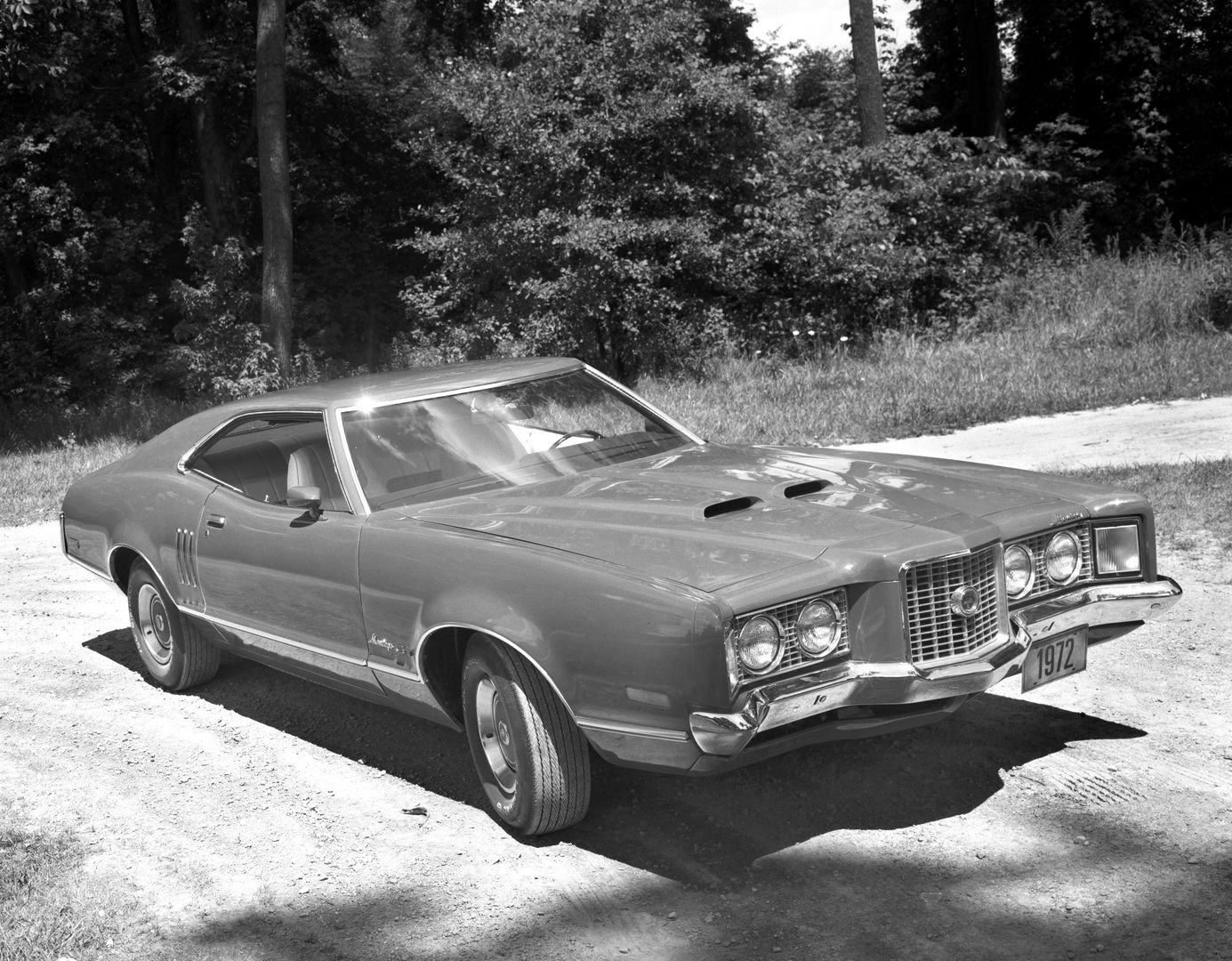
Mercury's Canadian brochure, printed in August 1971, shows how much of the GT's character came standard. Every GT had the 302-2V V8 and a three-speed manual, F78-14 white sidewall tires, a performance hood with dual scoops, dual racing mirrors, a tachometer and gauges, and a black instrument-panel applique. Hi-back bucket seats were optional at no extra cost, and the Tu-Tone Comfort Knit vinyl came in black, medium blue, medium ginger, medium green or white. Conceptcarz lists the base price at $3,350 and the 302 at 140 SAE net horsepower.4
The engine list went well beyond the 302. The brochure's power-team table offers a 351-2V, the 351-4V Cobra Jet with dual exhaust, a 400-2V and a 429-4V, which required power front disc brakes and power steering. A four-speed with Hurst shifter was listed with every V8, and the Select-Shift automatic with every engine, but the three-speed manual was not listed with the Cobra Jet. The brochure prints torque figures of 296 lb-ft for the 302, 350 for the Cobra Jet and 450 for the 429 without naming a rating standard.
The Cobra Jet's horsepower is itself in dispute. Over-Drive Magazine's engine history gives 248 SAE net horsepower for the 351 CJ in the 1972 Torino and Montego. Old Cars Weekly gives 266 net horsepower for the Cobra Jet in its featured Montego, and Wikipedia's Torino history also gives 266 for the 351-4V CJ, calling it the only performance engine Ford offered in the Torino that year. Both numbers are SAE net ratings, not measurements. Until an AMA specification sheet for the 1972 Montego is found, the two figures stand side by side, with 248 carried as the Montego-specific rating.5,1,2
The Cyclone package was what remained of Mercury's performance line. The brochure describes a functional dual hood scoop, a four-speed with Hurst shifter or Select-Shift automatic, Traction-Lok, wide-oval tires, special striping and Cyclone decals. It was available on two-door models except the Brougham, and only with the 351 CJ or the 429-4V. A brochure photograph shows it on an MX hardtop, so a Cyclone was not necessarily a GT. Old Cars Weekly and Wikipedia both report 30 built, which Wikipedia says makes it among the rarest Mercurys.1,3
The totals show how buyers answered. Conceptcarz reports 5,820 Montego GT fastbacks built for 1972, against 9,963 base Montego two-door hardtops and 8,658 base four-door sedans, and it cites no source for these figures. Ford built 496,645 Torinos that year, according to Wikipedia, making the Torino the best-selling intermediate of 1972 and the first time Ford had outsold the Chevelle. Beside that, the GT was a small specialty car, and the 30 Cyclone packages spread across every eligible two-door were a fraction of even the GT's run.4,2,1
The rest of the Montego line did well from the redesign. Wikipedia reports that Montego sales rose 136 percent over 1971, with the largest gains in the MX Brougham: 897 percent for the two-door and 1,021 percent for the four-door. Those percentages put the line's growth in its most luxurious models, not in its sporting one. The GT itself, with a 302 and a three-speed as standard, was a fastback given a performance hood, racing mirrors and gauges, sitting on a frame Ford had designed to give a quieter, more isolated ride.3,2
On the racetrack the name that meant speed was still Cyclone, and it was an older one. The Fayetteville Observer reports that David Pearson's first win for the Wood Brothers came at Darlington's Rebel 400 on April 16, 1972, and that the team raced a 1971 Mercury Cyclone, the car it now calls “The '71 Mercury.” Pearson won 19 of 36 starts in 1972 and 1973, including all 11 of his 1973 wins in that car. Under NASCAR's three-year eligibility rule it was retired on January 20, 1974.6
That leaves the showroom GT and the racing Mercury pointing in different directions. The winning car carried the Cyclone body that Mercury no longer sold as a model, while the new fastback in the showroom carried a GT badge and a standard 302-2V. Old Cars Weekly's featured owner, Jim Spieth, dates his love of the sport to races shown on ABC's Wide World of Sports and says, “Those Wood Brothers Mercurys stood out to me.” Decades later, the GT he bought was one of the Cobra Jet cars.6,1
The GT returned for 1973 and then disappeared. Its first year produced a new chassis, a fastback shared with the Gran Torino Sport, a long engine list topped by the 429 and the Cobra Jet, and a Cyclone package that printed sources count at 30 cars. The 5,820 GTs were about 31 percent of the 18,621 base Montego two-door hardtops and four-door sedans that conceptcarz lists beside them, with the MX and Brougham lines not included in that comparison. The Cyclone option, which had been Mercury's performance model a year earlier, ended the 1972 season as one of the rarest Mercurys built.3,4
Fact sheet · 1972 · United States
The numbers
1972 Mercury Montego GT — The first year of the fastback-only Montego GT on the new split-wheelbase intermediate, with the Cyclone name reduced to a performance option that only a few dozen buyers took.
Coverage: Partial — researched sections are shown; missing ones are not yet sourced. Researched through 2026-09-22.
Every figure is labeled with how sure we are. Reported means a manufacturer, registry, or reference figure we cite but have not reconciled against factory records ourselves. Disputed means credible sources disagree and both are shown. Rows are separately scoped; don't add them together unless the note says they make up a total.
Key facts
- 5,820 Montego GT fastbacks are reported built for 1972 (source not stated by the publisher).4
- The Cyclone was an option package in 1972. Printed sources give 30 built; see the conflict with the registry's 29.1,3
- An owner's Elite Marti Report, relayed by Old Cars Weekly, says 14 cars were painted Maroon and 2 had the black knitted vinyl bench seat. The article does not say which population those counts cover.1
- The Canadian brochure lists no 3-speed manual with the 351-4V CJ. The 4-speed with Hurst shifter is listed with every V-8.
Production
| What was counted | Count | Basis | Status |
|---|---|---|---|
| Montego GT 2-door fastback, all engines4,7 Montego GT · 2-door fastback (hardtop fastback) · as published No source is cited by the publisher. The Montego GT Registry's engine-code counts (unpublished lead) sum to the same 5,820. | 5,820 | built, model-year | Reported |
| What was counted | Count | Basis | Status |
|---|---|---|---|
| Cyclone option package (Montego, all eligible 2-door bodies)1,3 Cyclone option · 2-door (GT fastback or MX hardtop) · 351-4V CJ or 429-4V · as published The registry gives 29; see conflicts. Whether every Cyclone was a GT is not stated. | 30 | built, model-year | Disputed |
| What was counted | Count | Basis | Status |
|---|---|---|---|
| Montego (base) 2-door hardtop, context4 Montego · 2-door hardtop · as published Line context only; not a GT figure. | 9,963 | built, model-year | Reported |
| Montego (base) 4-door sedan, context4 Montego · 4-door sedan · as published Line context only. | 8,658 | built, model-year | Reported |
| All 1972 Montegos (host line, context)7 all series · as published Denominator for the GT; conceptcarz lists nine body/series rows summing to it (it labels the GT row "4 dr." in error). | 135,092 | built, model-year | Reported |
| Montego MX Brougham 2-door hardtop (context)7 MX Brougham · 2-door hardtop · as published | 28,417 | built, model-year | Reported |
| Montego MX 2-door hardtop (context)7 MX · 2-door hardtop · as published | 25,802 | built, model-year | Reported |
Rows are separately scoped; do not add them.
No published breakdown of GT production by engine, transmission, paint or trim was found. The Montego GT Registry's engine-code breakdown is recorded under unpublished leads because it appears only in a forum post without a cited source.
The GT fastback row and the all-Montego host-line total are both already recorded; conceptcarz's 1972 Montego page states no other family-level total, and no source seen states a GT total on a different basis. The GT row is not summed with any other row. Searched 2026-09-29: conceptcarz spec, article and profile pages already cited, Wikipedia; OpenLibrary search-inside of Heasley's Production Figure Book returned nothing for Mercury mid-size totals. A Mercury production report or the Standard Catalog of American Cars 1946-1975 would settle the basis.
Prices when new
| Model | Price | Basis |
|---|---|---|
| Base price, Montego GT 2-door fastback4 | $3,350 | base price as published by conceptcarz; basis (P.O.E. or other) not stated, 1972 model year |
Prices are the nominal dollars of the day, not adjusted for inflation.
Engines
| Engine | Factory rating | Availability | Built |
|---|---|---|---|
| F · 302-2V V-84 302 cu in · 2-barrel | 140 hp (SAE net) | standard in the GT | Not yet sourced |
| H · 351-2V V-8 351 cu in · 2-barrel | optional | Not yet sourced | |
| Q · 351-4V Cobra Jet (CJ) V-85 351 cu in · 4-barrel | 248 hp (SAE net) | optional; dual exhaust; required for 4-speed per 1973 US chart, and not listed with the 3-speed in the 1972 Canadian table | Not yet sourced |
| S · 400-2V V-8 400 cu in · 2-barrel | optional | Not yet sourced | |
| N · 429-4V V-8 429 cu in · 4-barrel | optional; power front disc brakes and power steering required (Canadian brochure) | Not yet sourced |
Ratings are the manufacturer's advertised figures under the standard shown (SAE gross before 1972, SAE net after). They are not dyno results, and gross and net ratings can't be compared directly.
Transmissions
| Transmission | Availability | Built |
|---|---|---|
| 3-speed manual | standard with the 302; not available with the 351-4V CJ (Canadian brochure) | Not yet sourced |
| Select-Shift automatic | optional with every engine | Not yet sourced |
| 4-speed manual with Hurst shifter | optional with every V-8 in the Canadian table | Not yet sourced |
Options and packages
| Code | Option | Price | Installed |
|---|---|---|---|
|
Cyclone performance option (functional dual hood scoop, 4-speed with Hurst shifter or Select-Shift, Traction-Lok, wide-oval tires, hub caps and trim rings, striping, racing mirrors, 3-spoke wheel, Cyclone decal); 2-door models except Brougham, 351-CJ or 429-4V only | — | 301,3 Disputed |
|
Hi-back bucket seats (optional at no extra cost in the GT) | — | Not yet sourced |
Paint
| Code | Color | Built |
|---|---|---|
|
Maroon1 | Not yet sourced |
Color names are the factory's. We don't show color swatches, because a screen color is no guide for a restoration.
Interiors
| Code | Trim | Built |
|---|---|---|
|
Flight Bench or Hi-back bucket seats in Tu-Tone Comfort Knit vinyl: black, medium blue, medium ginger, medium green or white. White interiors take black, medium blue, dark tobacco or medium green carpet and trim (Canadian brochure). | Not yet sourced |
|
Black knitted vinyl bench seat1 | Not yet sourced |
Specifications
| Measure | Value | Applies to |
|---|---|---|
| Wheelbase, 2-door1 | 114 in | 2-door models (4-door 118.0); Canadian brochure |
| Overall length, 2-door | 208.1 in | 2-door; Canadian brochure |
| Overall width | 78.6 in | all; Canadian brochure |
| Tread, front / rear | 62.8 / 62.9 in | all; Canadian brochure |
| Standard tires, GT | F78-14 white sidewall size | Montego GT; Canadian brochure |
| Torque as printed, 351-4V CJ | 350 @ 3800 lb-ft @ rpm | Canadian brochure power-team table; rating standard not printed |
| Torque as printed, 429-4V | 450 @ 3400 lb-ft @ rpm | Canadian brochure power-team table; rating standard not printed |
| Torque as printed, 302-2V | 296 @ 2600 lb-ft @ rpm | Canadian brochure power-team table; rating standard not printed |
Identification
- Cyclone option identification
- Cyclone cars carried a Cyclone identification decal and special striping. The option could appear on an MX 2-door hardtop as well as the GT fastback, so a Cyclone is not necessarily a GT.
Where the sources disagree
1972 Cyclone option production
- 301,3
- 29 (20 with the 429-4V, 9 with the 351 CJ, all automatic), Montego GT Registry forum post, unpublished lead1
The page shows 30 as the printed figure and notes that the Montego GT Registry gives 29 without a cited source. The two printed citations may be one lineage.
Identification
Read a 1972 Mercury VIN
The VIN decoder runs in your browser and never sends the VIN anywhere. How the factory numbered this year's cars:
Same model year
Also in 1972
- AMC AMX The first year of SAE net ratings and Chrysler-built TorqueFlite automatics. Javelin AMX production rose to 3,220, and the 304 V8 became available.
- AMC Gremlin X and Spirit AMX The first V8 Gremlin: the 304 (150 hp SAE net) in AMC's subcompact. Gremlin X production is not published in any source found.
- AMC Javelin The base model was dropped, so every non-AMX Javelin was an SST. This was the first year of the Pierre Cardin interior and of Chrysler-built automatics.
- Buick Riviera Net ratings only for 1972: 250 hp standard, 260 GS per ROA; 2,171 of 33,728 were GS.
- Buick Skylark Gran Sport, GS and GSX The last A-body GS year before the Colonnade Century; the GSX package, now in many colours, was invoiced on only 44 cars, most of them outside the lower 48 states.
- Chevrolet Chevelle and Malibu SS The last Z15 Chevelle SS of the first generation: net-rated engines, an LS5 454 at 270 net hp, and 5,333 SS 454s.
- Chevrolet Chevy II and Nova The source engine table switches to net ratings; SS and Rally Nova offered. Enthusiast-compiled production: 349,733 cars; Super Sport 12,309.
- Chevrolet El Camino SS Last year of the Chevelle-bodied El Camino SS; 50,359 V8 Malibu El Caminos were built, and the SS share is not separately published.
- Dodge Challenger Hardtop only, with a new grille: the R/T gave way to the Challenger Rallye package, and the most powerful engine listed was the 340 four-barrel.
- Dodge Charger The R/T and Super Bee were dropped; the new Rallye package became the performance Charger, and the 440 Six Pack was cancelled after a handful of cars.
- Dodge Dart GTS, Swinger and Demon The Demon's second and final year under that name: 8,773 Demon 340s, with small Canadian and Swiss-market 340 runs counted separately.
- Ford Maverick Grabber The dual-scoop-hood Grabber in its second year as a model; Classic Industries counts 35,347.
- Ford Ranchero GT The Ranchero GT continued on the 1972-76 Ranchero; 12,620 GTs were built, per reference-site counts in the Standard Catalog lineage.
- Ford Thunderbird First year of the sixth-generation Thunderbird; only the whole-line production total was found.
- Ford Torino The new body-on-frame Torino sold 496,645 in 1972; the performance models were the Gran Torino Sport SportsRoof (60,794) and hardtop (31,239), with the 351 Cobra Jet and a Rallye Equipment Group on the option list.
- Mercury Cougar Net ratings arrived, the 429 was gone, and the 351 Cobra Jet became the performance Cougar engine, fitted to 3,560 cars.
- Oldsmobile Cutlass, 4-4-2 and Hurst/Olds The 4-4-2 became a Cutlass option again, engines were rated in SAE net (W-30: 300 hp), and a Hurst/Olds paced the Indianapolis 500.
- Plymouth Barracuda and 'Cuda Hardtops only, single headlamps, four round taillamps, and a 340 four-barrel as the top engine: the 'Cuda carried it as standard.
- Plymouth Duster 340 and 360 In the first net-rating year the Duster 340's 8.5:1 340 was rated 240 net hp with electronic ignition, the Twister became order code A51, and output rose to 15,681 in both compilations.
- Plymouth GTX, Belvedere and Satellite For 1972 the GTX existed only as the 440 four-barrel option on the Road Runner hardtop; Mueller's Muscle Car Source Book counts 672 of them.
- Plymouth Road Runner The hardtop-only Road Runner took a 400 four-barrel as its advertised standard engine, and production fell again.
- Pontiac Firebird and Trans Am A strike-shortened year: 29,951 Firebirds and 1,286 Trans Ams, every one a 455 HO.
- Pontiac GTO The GTO goes back to being an option on the LeMans, with net ratings only; 5,807 were built.
- Pontiac Grand Prix A carryover year with the SJ still offered; production recovered to 91,961.
- Pontiac Tempest and LeMans The GTO becomes a LeMans option, and the LeMans gets WW4 and WW5 performance packages.