1962 · Buick · United States
1962 Buick Wildcat: Two Thousand Invictas with a Concept Car's Name
A bucket-seat, vinyl-roofed Invicta sport coupe with the 325-hp Wildcat 445 V-8 and a 3.42 axle; 2,000 built.
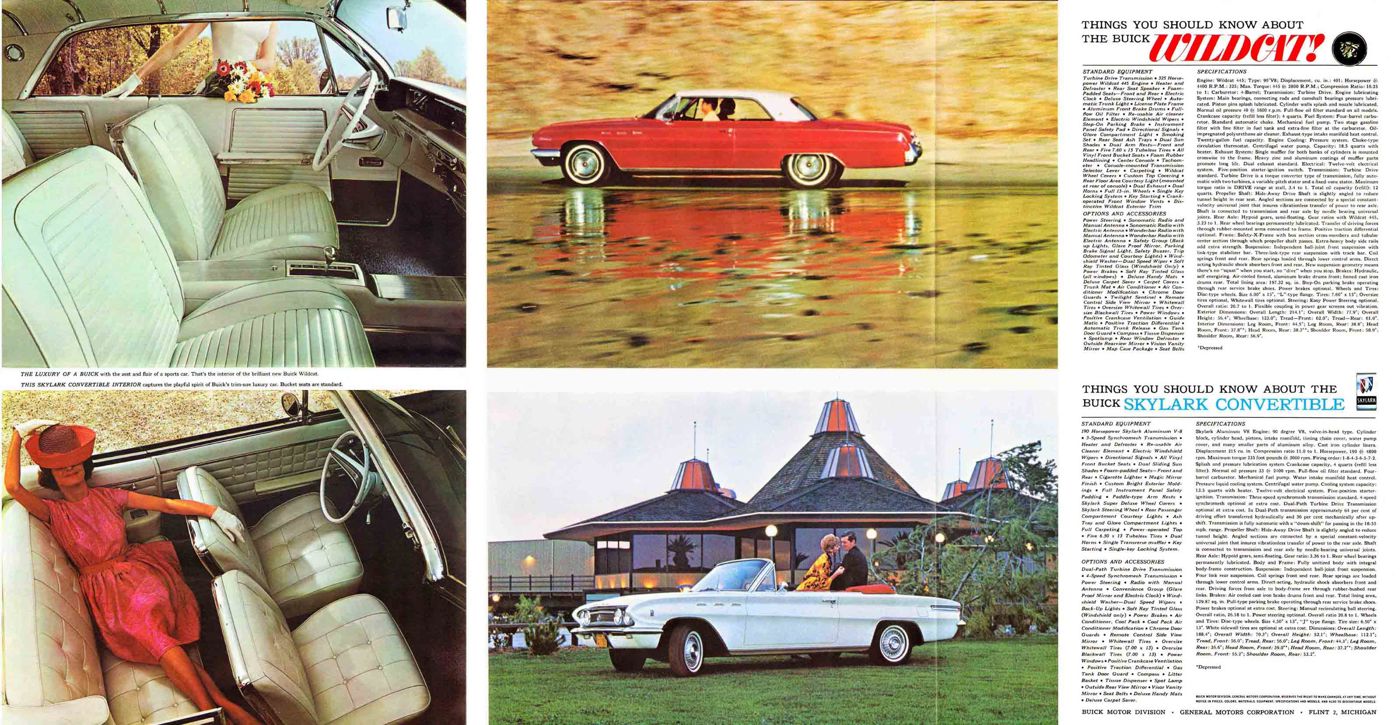
Motor Trend's Jim Wright timed his Wildcat two ways. His August 1962 test car, a fully equipped Buick hardtop, ran the quarter mile in 17.1 seconds at 87 mph as delivered. With the air conditioner's belts removed, the magazine reported, the elapsed time dropped to 16.6 seconds and the run to 60 mph improved by two-tenths of a second. It is a revealing experiment to run on a Buick. The Wildcat was a luxury car that Buick had fitted with bucket seats, a tachometer and a shorter axle, and Motor Trend published both sets of numbers.1
The name came from the show stand. Three Wildcat concept cars were designed under Harley Earl's direction during the 1950s, the 1953 Wildcat I, the 1954 Wildcat II and the 1955 Wildcat III, and the first two survive. For 1962 Buick put the name on a production car for the first time, though not on a model of its own. The Wildcat was a sub-series of the Invicta, Buick's middle full-size line. It was the Invicta's two-door hardtop, body 4647, dressed and equipped to stand apart, and its emblem was a stylized wildcat's head on each rear roof pillar.2,3
The equipment list read like a personal-luxury brochure. The Wildcat had a fabric-covered roof in black or white and an all-vinyl interior with bucket seats and a center console. The console carried a tachometer and the transmission shifter, Wildcat emblems sat on the roof quarters, and the car wore Electra 225-type taillights and special side trim. It rode the Invicta's 123-inch wheelbase and stretched 214.1 inches. The Wildcat was designed to compete with the Pontiac Grand Prix and the Oldsmobile Starfire, the two sporting full-size coupes already selling at General Motors' other middle divisions.1,3,2
Under the hood was the engine that gave the car its name's number. The 401-cubic-inch V8, rated at 325 gross horsepower at 4,400 rpm on 10.25:1 compression, was called the Wildcat 445 for its 445 lb-ft of torque at 2,800 rpm. Buick's old 364 had been quietly retired for 1962, and the 401 now came in 265-, 280- and 325-horsepower versions; the Wildcat got the strongest. The only transmission was the Turbine Drive automatic, shifted from the console. Buick changed the Wildcat's axle from the standard 3.23 to 3.42, with 3.91 and 4.45 available with positive traction.3,1
Buick charged $3,927 for the Wildcat, which made it the most expensive Invicta. The ordinary Invicta sport coupe, the same body 4647, listed at $3,733, so the Wildcat treatment cost $194 over the car it was built from. For comparison, bucket seats with a console were a $296 option elsewhere in the full-size line. Motor Trend's test car, with radio, air conditioning, power steering, power brakes and whitewall tires, came to $5,120.78 before tax and license. That was about the price of a well-optioned Riviera a year later, and a reminder that the Wildcat buyer was spending luxury-car money.3,2,1,4
The production count is short and suspiciously round. Over-Drive's table lists exactly 2,000 Wildcat sport coupes against 10,355 regular Invicta sport coupes and 56,017 Invictas of all bodies, so the Wildcat was about 3.6 percent of the series and less than 1 percent of the 245,683 full-size Buicks in the same table. There is a wrinkle in the accounting. The table's footnote describes the 2,000 as Invicta sport coupes branded Wildcat, but its series total is the sum of all rows including the Wildcat row, which implies the 2,000 were counted in addition to the 10,355. Read literally, the table counts two separate groups of cars, while the footnote reads as if they were one.3
Against its rivals, the Wildcat was a token. The Pontiac production count for 1962 was 30,195 Grand Prix hardtops at $3,490, and the Oldsmobile count was 42,762 Starfires, 34,839 of them hardtop coupes listed at $4,131. The Wildcat sat between those two on price and far below both in volume, fifteen Grand Prix for every Wildcat on those figures. At 2,000 cars it was a limited run, and the following year Buick built a whole series around the name.5,6,3
On the road, Motor Trend's car was quicker than its size suggested and no lighter than its equipment implied. At 4,272 pounds at the curb it went from rest to 30 mph in 2.9 seconds, to 45 in 5.2 and to 60 in 8.1, covered the quarter mile in 17.1 seconds at 87 mph, and reached an observed 115 mph at 4,800 rpm, with the magazine estimating 130. It stopped from 60 mph in 168 feet, and its fuel consumption ranged from 10.5 to 16 mpg. Those figures belong to one air-conditioned test car with two aboard. They describe a fast, heavy tourer, not a drag-strip weapon.1
The Wildcat arrived while Buick was rebuilding itself. Edward Rollert had taken over the division in 1959 after its sales fell below 300,000 cars a year, and his Buick won General Motors' internal contest for the car that became the Riviera in April 1961. The Riviera went on sale on October 4, 1962, as a 1963 model, with the same 325-horsepower 401 as its standard engine. The 1962 Wildcat, a bucket-seat Invicta with that engine and a Harley Earl show-car name, can be read as Buick's first small step in the same direction, a few months before the big one.7,8,2
The following year the experiment became a line. From 1963 through 1970 the Wildcat was its own series, no longer an Invicta sub-series, and it added a convertible and a four-door hardtop to the coupe. The Standard Catalog counts 35,725 Wildcats for 1963 and 84,245 for 1964, and the 1963 sport coupe listed at $3,849, less than the 1962 car had cost. The 2,000 cars of 1962 were the proof of concept: a name borrowed from a dream car, attached to a well-equipped Invicta, sold at a small premium and in numbers small enough to stay special.2,3
Fact sheet · 1962 · United States
The numbers
1962 Buick Invicta Wildcat: A bucket-seat, vinyl-roofed Invicta sport coupe with the 325-hp Wildcat 445 V-8 and a 3.42 axle; 2,000 built.
Figures may describe different groups of cars. Add rows together only when the note says they make up a total.
Key facts
Production
| What was counted | Built |
|---|---|
| Invicta "Wildcat" sport coupe (4647)3 Invicta Wildcat · 2-door hardtop sport coupe · 401 V-8 · Turbine Drive automatic | 2,000 |
| What was counted | Built |
|---|---|
| Invicta series, all bodies incl. Wildcat3 Invicta (incl. Wildcat) · all Invicta bodies | 56,017 |
| What was counted | Built |
|---|---|
| Invicta estate wagon, two seats (4635)9 Invicta · 4-door station wagon, 2 seats | 9,131 |
| Invicta 4-door hardtop (4639)9 Invicta · 4-door hardtop | 16,443 |
| Invicta estate wagon, three seats (4645)9 Invicta · 4-door station wagon, 3 seats | 4,617 |
| Invicta 2-door sport coupe body 4647, all trims (Invicta and Wildcat together)9 Invicta incl. Wildcat · 2-door hardtop sport coupe TeamBuick does not separate the Wildcat. | 12,355 |
| Invicta convertible (4667)9 Invicta · 2-door convertible | 13,471 |
Prices when new
| Model | Price | Price type |
|---|---|---|
| Wildcat sport coupe3,1,2 | $3,927 | factory price, 1962 model year |
| Motor Trend test car as tested1 | $5,120.78 | price, 1962-08 |
Prices are the nominal dollars of the day, not adjusted for inflation.
Engines
| Engine | Factory rating | Availability |
|---|---|---|
| 401 V-8 (Wildcat 445)1,3 401 cu in · 4-barrel carburetor | 325 hp @ 4,400, 445 lb-ft @ 2,800 (SAE gross) | standard (only engine) |
Ratings are published figures, not dyno results. Gross and net ratings aren't directly comparable.
Transmissions
| Transmission | Availability |
|---|---|
| Dual-Range Turbine Drive automatic, console shift1 | only transmission |
Options and packages
| Code | Option | Price |
|---|---|---|
| Bucket seats with console (coupe)3 | $296 | |
| Air conditioning3 | $430 | |
| Positive crankcase ventilation system3 | $5 | |
| Custom padded cushions3 | $23 | |
| Chrome door guards, two-door3 | $5 | |
| Posi-Traction differential3 | $48 | |
| Dual exhausts3 | $31 | |
| Tinted glass, all windows3 | $43 | |
| Tinted windshield only3 | $29 | |
| Guide-Matic automatic headlamp dimmer3 | $29 | |
| Outside remote-control rear-view mirror3 | $12 | |
| Power brakes3 | $43 | |
| Power door locks3 | $70 | |
| Power-Pak3 | $22 | |
| Power seat, six-way3 | $97 | |
| Power seat, four-way3 | $65 | |
| Power bucket seat3 | $129 | |
| Power steering3 | $108 | |
| Power trunk release3 | $10 | |
| Sonomatic radio, manual antenna3 | $90 | |
| Sonomatic radio, electric antenna3 | $116 | |
| Wonder Bar radio, manual antenna3 | $127 | |
| Wonder Bar radio, electric antenna3 | $153 | |
| Rear seat speaker3 | $17 | |
| Twilight Sentinel3 | $29 | |
06order code |
Accessory Group3 | $22 |
| Safety Options Group3 | $40 |
Paint
| Code | Color |
|---|---|
A |
Regal Black3,9 |
C |
Arctic White3,9 |
D |
Silver Cloud (metallic)3,9 |
E |
Cadet Blue (metallic)3,9 |
F |
Marlin Blue (metallic)3,9 |
H |
Glacier Blue3,9 |
J |
Willow Mist (metallic)3,9 |
M |
Cameo Cream3,9 |
N |
Burgundy (metallic)3,9 |
P |
Teal Mist (metallic)3,9 |
Q |
Aquamarine3,9 |
R |
Desert Sand3,9 |
T |
Fawn Mist (metallic)3,9 |
V |
Cardinal Red3,9 |
X |
Camelot Rose (metallic)3,9 |
Color names are the factory's. We don't show color swatches, because a screen color is no guide for a restoration.
Interiors
| Trim |
|---|
| All-vinyl bucket seats with center console, tachometer and shift lever1 |
Specifications
| Measure | Value | Applies to |
|---|---|---|
| Axle ratio (Wildcat standard)1 | 3.42 :1 | Wildcat |
| Optional axle ratios1 | 2.87, 3.07, 3.91, 4.45 :1 | Wildcat |
| Wheelbase1,3 | 123 in | Invicta/Wildcat |
| Overall length1,3 | 214.1 in | Wildcat |
| Shipping weight3 | 4,150 lb | Wildcat sport coupe |
| Curb weight (test car)1 | 4,272 lb | Motor Trend test car |
| Carburetor3 | Rochester 4GC four-barrel (7020040 or 7020041) | Wildcat 401 V-8 |
| Bore x stroke3 | 4.1875 x 3.640 in | 401 V-8 |
Period road tests
| Test | Car tested | Result |
|---|---|---|
| Motor Trend, 1962-0810-60 mph | 401/325, Turbine Drive, 3.42 axle, A/C, power accessories, two aboard | 8.1 s |
| Motor Trend, 1962-081Standing quarter mile | same16.6 s with A/C belts removed | 17.1 s, 87 mph |
| Motor Trend, 1962-081Top speed observed | sameRiverside back straight, Weston electric speedometer | 115 mph |
| Motor Trend, 1962-081Stopping distance 60-0 mph | same | 168 ft |
A road test result belongs to the one car that was tested, with its engine, gearing, tires, and conditions. It is not a figure for every car of the year.
Identification
- Exterior
- Vinyl-covered roof (black or white), Wildcat emblems on the roof quarters, Electra 225-type taillights, special side trim; body 4647.1,2,3
- VIN (serial number)
- Located on the driver's-side hinge pillar and stamped on the engine block. First symbol = series (6 = 4600 Invicta, which includes the Wildcat); second = model year (2 = 1962); third = assembly plant (1 Flint, 2 South Gate, 3 Linden, 4 Kansas City KS, 5 Wilmington, 6 Atlanta, 8 Arlington); last six = sequential production number, series mixed in production.10,9
- Engine codes (Invicta, Electra 225 and Wildcat)
- 4I: 401 cu in, 325 hp, 10.25:1, 4-barrel; L4I: 401 cu in, 315 hp, 8.75:1 (low compression), 4-barrel; both automatic.9
- Paint code
- Two letters: first = lower body colour, second = upper colour; a single-colour car repeats the letter (e.g. HH).9
Where the sources disagree
Identification
Read a 1962 Buick VIN
The VIN decoder runs in your browser and never sends the VIN anywhere. How the factory numbered this year's cars:
Same model year
Also in 1962
- Chevrolet Chevy II and Nova First Chevy II model year; the source engine table lists only the 153 four and 194 six. Enthusiast-compiled production: 326,607 cars.
- Chevrolet Impala SS 99,311 Super Sports, bucket seats and all-vinyl interiors; 15,019 409 engines across the full-size line.
- Chrysler 300 letter series Moved to the shorter 122-inch Newport-based platform without fins and overshadowed by a new non-letter 300 Sport series, the 300H had the letter cars' best power-to-weight ratio and one of their smallest runs.
- Dodge Dart 330/440, Polara and Max Wedge Dodge's downsized 116-inch-wheelbase line gained the 'Ramcharger 413', a dual-four-barrel short-ram wedge rated at 410 or 420 hp.
- Ford Fairlane The first intermediate Fairlane: 79,606 Fairlanes and 217,510 Fairlane 500s by reference-site counts, 19,628 of them bucket-seat Sport Coupes.
- Ford Galaxie The top performance engine rose from 390 to 406 cubic inches, 385 hp with a four-barrel and 405 hp with three two-barrels, and the bucket-seat Galaxie 500 XL arrived as the sport series.
- Ford Thunderbird The Sports Roadster package arrived, 1,427 were built, and about 120 of them had the 340-hp M-code tri-carb 390.
- Mercury Marauder and S-55 Mercury's first S-55 was a bucket-seat Monterey Custom hardtop and convertible, with 390 and 406 big-block options.
- Oldsmobile Starfire A hardtop coupe joined the convertible, output rose to 345 hp, and the Starfire had its best year: 42,762.
- Plymouth Savoy, Fury and Max Wedge On the downsized 116-inch Plymouth, the 'Super Stock 413' short-ram wedge was a $375 option rated at 410 or 420 hp.
- Pontiac Catalina 2+2 and Super Duty The 421 Super Duty became a catalogued $2,250 option for Catalina two-doors and the Grand Prix.
- Pontiac Grand Prix An all-new performance-luxury hardtop on the Catalina body: 303 hp, buckets, console and tachometer, and 30,195 sold.
- Pontiac Tempest and LeMans LeMans becomes the sporty Tempest Custom; 1,658 Tempests got the aluminum V8.
- Studebaker Hawk Brooks Stevens's restyle of the six-year-old Hawk body cost $400 more than the 1961 car, and production more than doubled: 9,335 in all, 8,388 of them domestic.