1962 · Chevrolet · United States
1962 Chevrolet Impala SS: The 409 Gets Its Song, and the Super Sport Gets Its Buyers
99,311 Super Sports, bucket seats and all-vinyl interiors; 15,019 409 engines across the full-size line.
United States · researched through 2026-09-22
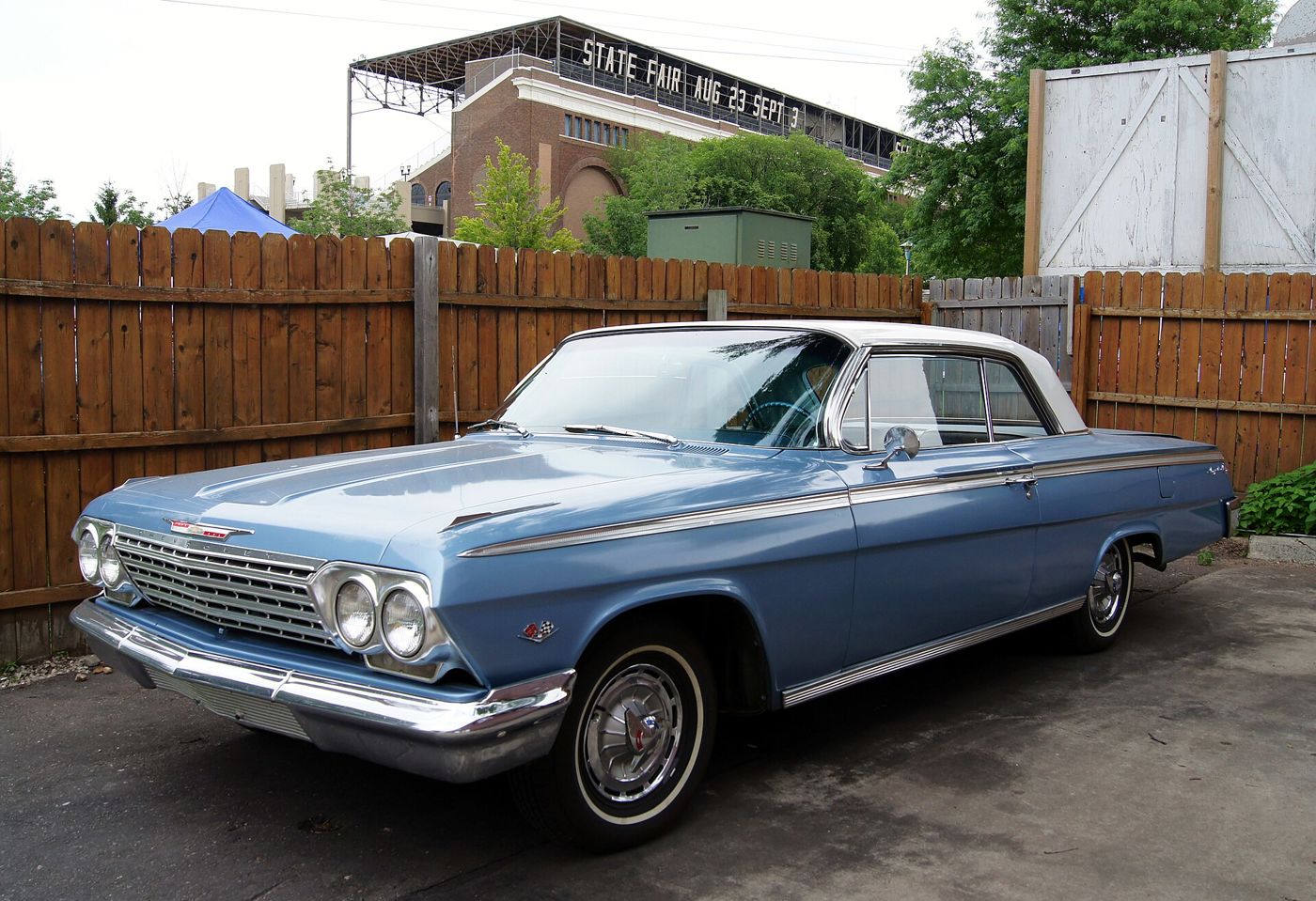
Hayden Proffitt won Stock Eliminator at the 1961 NHRA U.S. Nationals in Mickey Thompson's Pontiac, the only 12-second car in the class. A year later, NHRA's history of the 409 records, he won Stock Eliminator at the 1962 U.S. Nationals in a 409 Chevrolet. The same driver changing brands between one Nationals and the next is as neat a summary of 1962 as any. In between, the 409 went from a late, rare option to a regular sight, and the Impala Super Sport that carried it went from a few hundred cars to nearly a hundred thousand.1,2,3
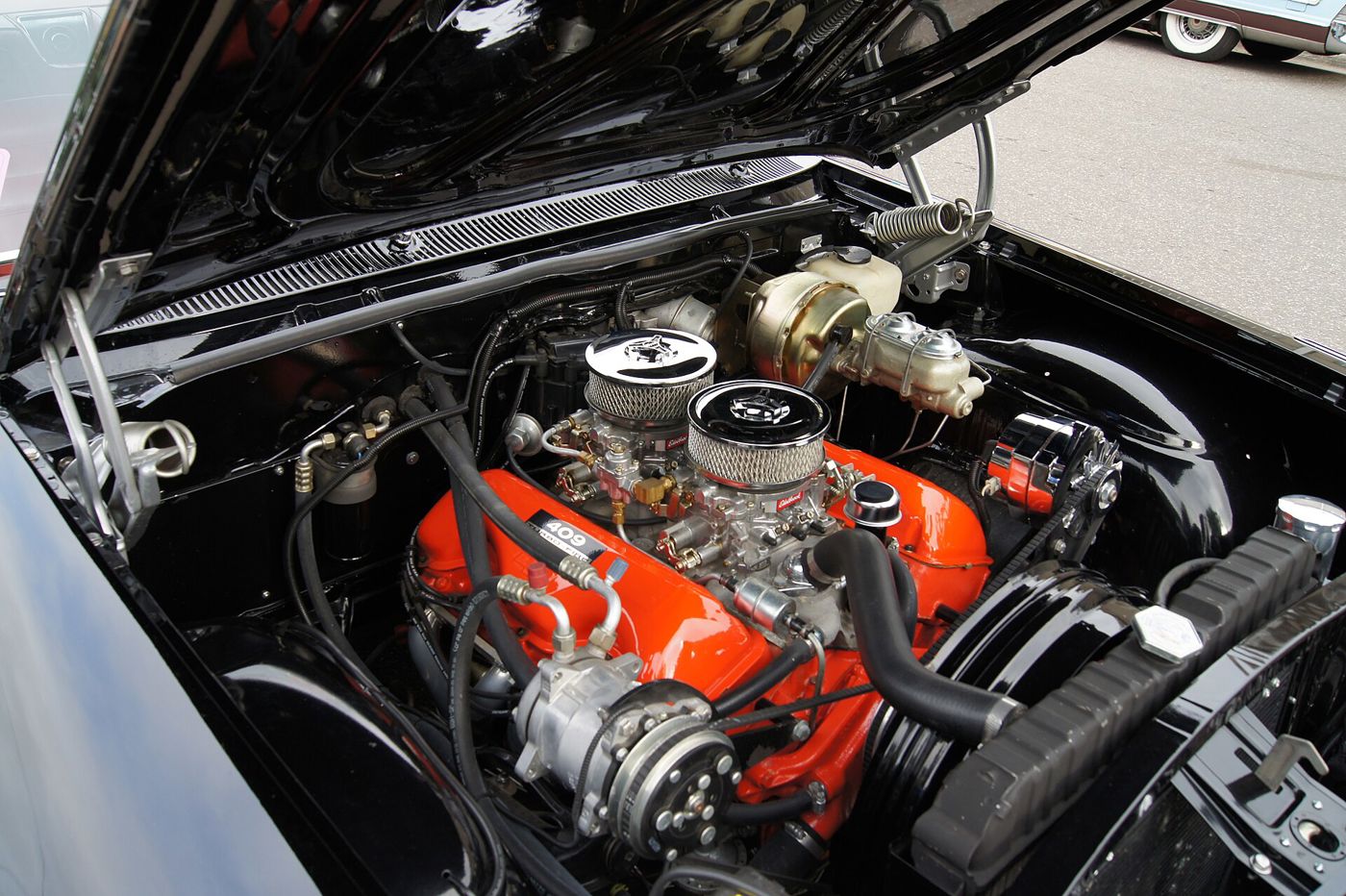
The engine now came two ways. NHRA's history lists a four-barrel 409 rated at 380 hp and a dual-quad version rated at 409 hp, the latter with larger 2.19-inch intake valves; both are advertised SAE gross figures. Wikipedia's account of the third-generation Impala notes that the 409 was available only with a manual transmission, so a Super Sport buyer who wanted an automatic had to choose a smaller engine. The engine also got a record of its own: NHRA calls the 409 the engine that inspired a song, the Beach Boys' '409' of 1962, and a legion of drag racers; its history names Dave Strickler, in a car prepared for Bill Jenkins, and Don Nicholson among them.2,4
The Super Sport changed character to match. Where the 1961 kit had been a handling-and-appearance package tied to the 348 and 409, the 1962 SS became, in Wikipedia's words, an appearance package limited to the hardtop coupe and the convertible. The Impala SS Registry lists what that meant inside: bucket seats and all-vinyl upholstery, with separate trim codes for each color on the sport coupe and the convertible. Any engine could be ordered, six or V-8. The 327 and 409 engines came with a tachometer as standard, other V-8 buyers could add one as RPO 331, and the SS wheel cover was unique, without the emblem hole of the regular cover.4,5,5
The rest of the car was refreshed around it. Wikipedia notes new C-pillar styling for 1962 on every model except the four-door hardtop, and a new small-block: the 283 was enlarged to 327 cubic inches, offered in the full-size line at 250 and 300 hp. That gave a Super Sport buyer a middle ground between a six and a 409. The 1962 price of the SS package has not been documented in the sources found, and the 1961 kit price is not a substitute for it.4,6
The numbers show what happened when the package became easy to buy. The Classic Industries chart counts 99,311 Super Sports for 1962, against 453 the year before. Measured against the chart's 704,900 Impalas, about one Impala in seven was an SS. The chart counts 15,019 409 engines across the whole full-size line, against the registry's 142 for 1961. The 409 row is not an SS-only count, and the chart warns that its figures have not been verified by the factory, so the two numbers cannot be combined into an SS 409 total. Across all full-size Chevrolets the chart lists 323,427 sport coupes and 75,719 convertibles, the two bodies the Super Sport could now wear.3,5
The racing 409s went further than any showroom car. RM Sotheby's catalogue for a 2014 sale describes a 1962 program in which the steel hood, fenders, inner wheelwells, bumpers, brackets and related pieces were replaced with aluminum, trimming 120 pounds from a 3,500-pound car. The catalogue says only 18 Impala SSs received the aluminum components in 1962 and names racers who ran lightweight Impalas, among them Don Nicholson, Dave Strickler, Buddy Martin, Dick Harrell and John Zintsmaster. That count comes from an auction house, not from a Chevrolet record, and it stands as the catalogue's figure.7
Nicholson was the man to beat. NHRA describes him as the 1962 Winternationals champion, and when Chrysler's Ramchargers took their new 413 Max Wedge Dodge Dart sedan to Detroit Dragway for its first public test, a best-of-five match race, the opponent was Nicholson's 409 Chevrolet. NHRA says Dodge did not win. The account gives no date, elapsed times or round scores. It is enough that the new Chrysler engine's first public measuring stick was a Chevrolet with a 409 under the hood.8
Pontiac had not gone away. For 1962 it catalogued the 421 Super Duty as a $2,250 option for Catalina two-doors and the Grand Prix, rated at 405 hp. Motor Trend's May 1962 test of a 421 Catalina hardtop with a four-speed and 4.30 gears ran the quarter mile in 13.9 seconds at 107 mph. On the NASCAR side, the NASCAR Hall of Fame records 22 Pontiac wins in 1962 and the make's only manufacturers' championship. The 409 was fighting on two fronts against a division of its own corporation, while Chrysler's new 413 pressed from outside.9,10,11,8
The scale of the two programs was very different, and the numbers say so. Chevrolet's 409 was a regular option, and the Classic Industries chart counts 15,019 of them in 1962 full-size cars. Pontiac's Super Duty was a racer's engine at racer's prices, and its production is disputed: Over-Drive's fact sheet says 1,514 cars were built with the 421 Super Duty, while Pontiac historian Rocky Rotella gives documented production of 155 Catalinas and 16 Grand Prix. Either way, Chevrolet sold its big engine in the thousands to ordinary buyers, and Pontiac's, by either count, went to far fewer.3,9,12,2
The 1962 Impala SS set the pattern for the rest of the decade. The package that had been a $53.80 dealer kit on 453 cars became a trim level buyers chose by the tens of thousands, and the 409 became an engine people sang about. For 1963 the chart counts 153,271 Super Sports, now RPO Z03, and Chevrolet took the 409 idea to its limit with the Z11, a 427-cubic-inch version for the drag strip. Pontiac's side of the fight changed abruptly: a divisional bulletin of January 24, 1963 cancelled new orders for Super Duty engines. The Super Sport's first full-scale year was 1962, and its 99,311 buyers turned a rarity into a fixture of the Impala line.13,3,5,2,14
Fact sheet · 1962 · United States
The numbers
1962 Chevrolet Impala Super Sport — 99,311 Super Sports, bucket seats and all-vinyl interiors; 15,019 409 engines across the full-size line.
Coverage: Partial — researched sections are shown; missing ones are not yet sourced. Researched through 2026-09-22.
Every figure is labeled with how sure we are. Reported means a manufacturer, registry, or reference figure we cite but have not reconciled against factory records ourselves. Disputed means credible sources disagree and both are shown. Rows are separately scoped; don't add them together unless the note says they make up a total.
Key facts
- Super Sport production 1962: 99,311.3
- Chevrolet's 1962 specifications book lists Super-sport RPO 240 for the Impala sport coupe and convertible (17-1847, 67) with bucket seats, a console 'gadget box', wheel discs with spinners and a 4-speed trim plate, and offers the 409 in 380-hp (RPO 580) and dual-four-barrel 409-hp (RPO 587) forms.
Production
| What was counted | Count | Basis | Status |
|---|---|---|---|
| Impala Super Sport3 Super Sport · sport coupe and convertible · not stated | 99,311 | built, model-year | Reported |
| What was counted | Count | Basis | Status |
|---|---|---|---|
| Impala Super Sport total production3 Super Sport · sport coupe and convertible · not stated The Classic Industries chart carries a single unpartitioned Super Sport figure for 1962 (no body or engine split), so it already is the year's whole total; same value and source as the 'ss' row above, added as its own row per the site's total-row convention. | 99,311 | built, model-year | Reported |
| What was counted | Count | Basis | Status |
|---|---|---|---|
| 409 V8 engines, full-size line3 all full-size (source row "409") · 409 V8 · not stated Row is labelled only "409" in a chart of all full-size Chevrolets; not an SS-only count. | 15,019 | built, model-year | Reported |
| What was counted | Count | Basis | Status |
|---|---|---|---|
| Impala series, all bodies3 all full-size · not stated | 704,900 | built, model-year | Reported |
| Convertible, all full-size3 all full-size · not stated | 75,719 | built, model-year | Reported |
| Sport coupe, all full-size3 all full-size · not stated | 323,427 | built, model-year | Reported |
Classic Industries says its chart is believed correct but has not been verified by the factory. Chart rows mix series, body and engine scopes and are not additive.
Best missing primary source: the GM Heritage vehicle information kit for this year (gm.com returned 403).
Prices when new
| Model | Price | Basis |
|---|---|---|
| Impala 2-door hardtop, list price (Impala SS test car, before extra-cost options)15 | $2,669 | manufacturer list price, base 2-door hardtop configuration per Car Life's specifications panel, 1962-03 |
| Impala SS 2-door hardtop, price as tested (409/380, 4-speed, Positraction and options)15 | $3,795 | list price plus extra-cost options on Car Life's test car, 1962-03 |
| Impala Super Sport equipment package (RPO 240)16 | $53.80 | retail option price, 1962 |
Prices are the nominal dollars of the day, not adjusted for inflation.
Engines
| Engine | Factory rating | Availability | Built |
|---|---|---|---|
| 409 V86 409 cu in | 380 hp (SAE gross) | optional | Not yet sourced |
| 409 V86 409 cu in | 409 hp (SAE gross) | optional | Not yet sourced |
| 327 V86 327 cu in | 250 hp (SAE gross) | optional | Not yet sourced |
| 327 V86 327 cu in | 300 hp (SAE gross) | optional | Not yet sourced |
Ratings are the manufacturer's advertised figures under the standard shown (SAE gross before 1972, SAE net after). They are not dyno results, and gross and net ratings can't be compared directly.
Options and packages
| Code | Option | Price | Installed |
|---|---|---|---|
240RPO |
Super-sport equipment for models 17-1847 and 1867 (sport coupe and convertible): instrument panel assist bar, wheel discs and spinners, ornaments, emblems and moldings, bucket seats, 4-speed transmission trim plate, gadget box | — | Not yet sourced |
300RPO |
327 cu in V8, 250 hp | — | Not yet sourced |
397RPO |
327 cu in V8 high performance, 300 hp | — | Not yet sourced |
580RPO |
409 cu in V8, 380 hp | — | Not yet sourced |
587RPO |
409 cu in V8 dual 4-barrel, 409 hp | — | Not yet sourced |
331RPO |
Tachometer (12-16-1800) | — | Not yet sourced |
Interiors
| Code | Trim | Built |
|---|---|---|
812/815 |
Black SS bucket-seat trim (sport coupe/convertible codes where two are given)5 | Not yet sourced |
827/821 |
Green SS bucket-seat trim (sport coupe/convertible codes where two are given)5 | Not yet sourced |
843/831 |
Blue SS bucket-seat trim (sport coupe/convertible codes where two are given)5 | Not yet sourced |
854/845 |
Aqua SS bucket-seat trim (sport coupe/convertible codes where two are given)5 | Not yet sourced |
867/856 |
Fawn SS bucket-seat trim (sport coupe/convertible codes where two are given)5 | Not yet sourced |
875/879 |
Red SS bucket-seat trim (sport coupe/convertible codes where two are given)5 | Not yet sourced |
891/890 |
Gold SS bucket-seat trim (sport coupe/convertible codes where two are given)5 | Not yet sourced |
Identification
- SS contents and engines
- Registry: bucket seats and all-vinyl interiors with SS-unique trim codes; any six or V8 could be ordered; all 327 and 409 engines came with a tachometer (RPO 331 optional with other V8s); unique SS wheel cover without the emblem hole.5
Identification
Read a 1962 Chevrolet VIN
The VIN decoder runs in your browser and never sends the VIN anywhere. How the factory numbered this year's cars:
Same model year
Also in 1962
- Buick Wildcat A bucket-seat, vinyl-roofed Invicta sport coupe with the 325-hp Wildcat 445 V-8 and a 3.42 axle; 2,000 built.
- Chevrolet Chevy II and Nova First Chevy II model year; the source engine table lists only the 153 four and 194 six. Enthusiast-compiled production: 326,607 cars.
- Chrysler 300 letter series Moved to the shorter 122-inch Newport-based platform without fins and overshadowed by a new non-letter 300 Sport series, the 300H had the letter cars' best power-to-weight ratio and one of their smallest runs.
- Dodge Dart 330/440, Polara and Max Wedge Dodge's downsized 116-inch-wheelbase line gained the 'Ramcharger 413', a dual-four-barrel short-ram wedge rated at 410 or 420 hp; no sourced count of Ramcharger-equipped cars was found.
- Ford Fairlane The first intermediate Fairlane: 79,606 Fairlanes and 217,510 Fairlane 500s by reference-site counts, 19,628 of them bucket-seat Sport Coupes.
- Ford Galaxie The top performance engine rose from 390 to 406 cubic inches, 385 hp with a four-barrel and 405 hp with three two-barrels, and the bucket-seat Galaxie 500 XL arrived as the sport series.
- Ford Thunderbird The Sports Roadster package arrived, 1,427 were built, and about 120 of them had the 340-hp M-code tri-carb 390.
- Mercury Marauder and S-55 Mercury's first S-55 was a bucket-seat Monterey Custom hardtop and convertible, with 390 and 406 big-block options.
- Oldsmobile Starfire A hardtop coupe joined the convertible, output rose to 345 hp, and the Starfire had its best year: 42,762.
- Plymouth Savoy, Fury and Max Wedge On the downsized 116-inch Plymouth, the 'Super Stock 413' short-ram wedge was a $375 option rated at 410 or 420 hp; body-style production is known, Super Stock production is not.
- Pontiac Catalina 2+2 and Super Duty The 421 Super Duty became a catalogued $2,250 option for Catalina two-doors and the Grand Prix.
- Pontiac Grand Prix An all-new performance-luxury hardtop on the Catalina body: 303 hp, buckets, console and tachometer, and 30,195 sold.
- Pontiac Tempest and LeMans LeMans becomes the sporty Tempest Custom; 1,658 Tempests got the aluminum V8.
- Studebaker Hawk Brooks Stevens's restyle of the six-year-old Hawk body cost $400 more than the 1961 car, and production more than doubled: 9,335 in all, 8,388 of them domestic.