1962 · Dodge · United States
1962 Dodge Dart and Polara 500: The Year Dodge Named an Engine After Its Weekend Racers
Dodge's downsized 116-inch-wheelbase line gained the 'Ramcharger 413', a dual-four-barrel short-ram wedge rated at 410 or 420 hp; no sourced count of Ramcharger-equipped cars was found.
United States · researched through 2026-09-23
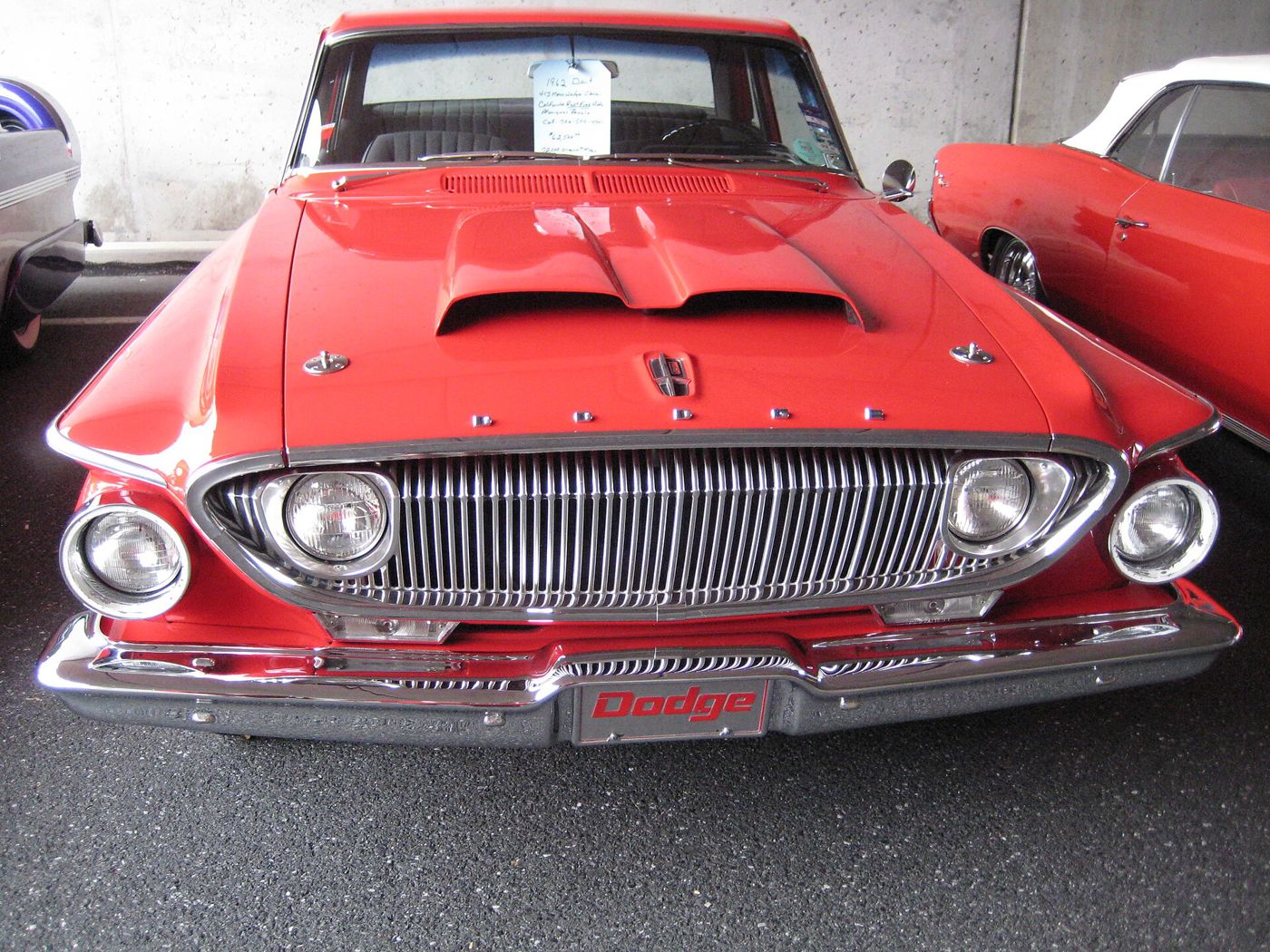
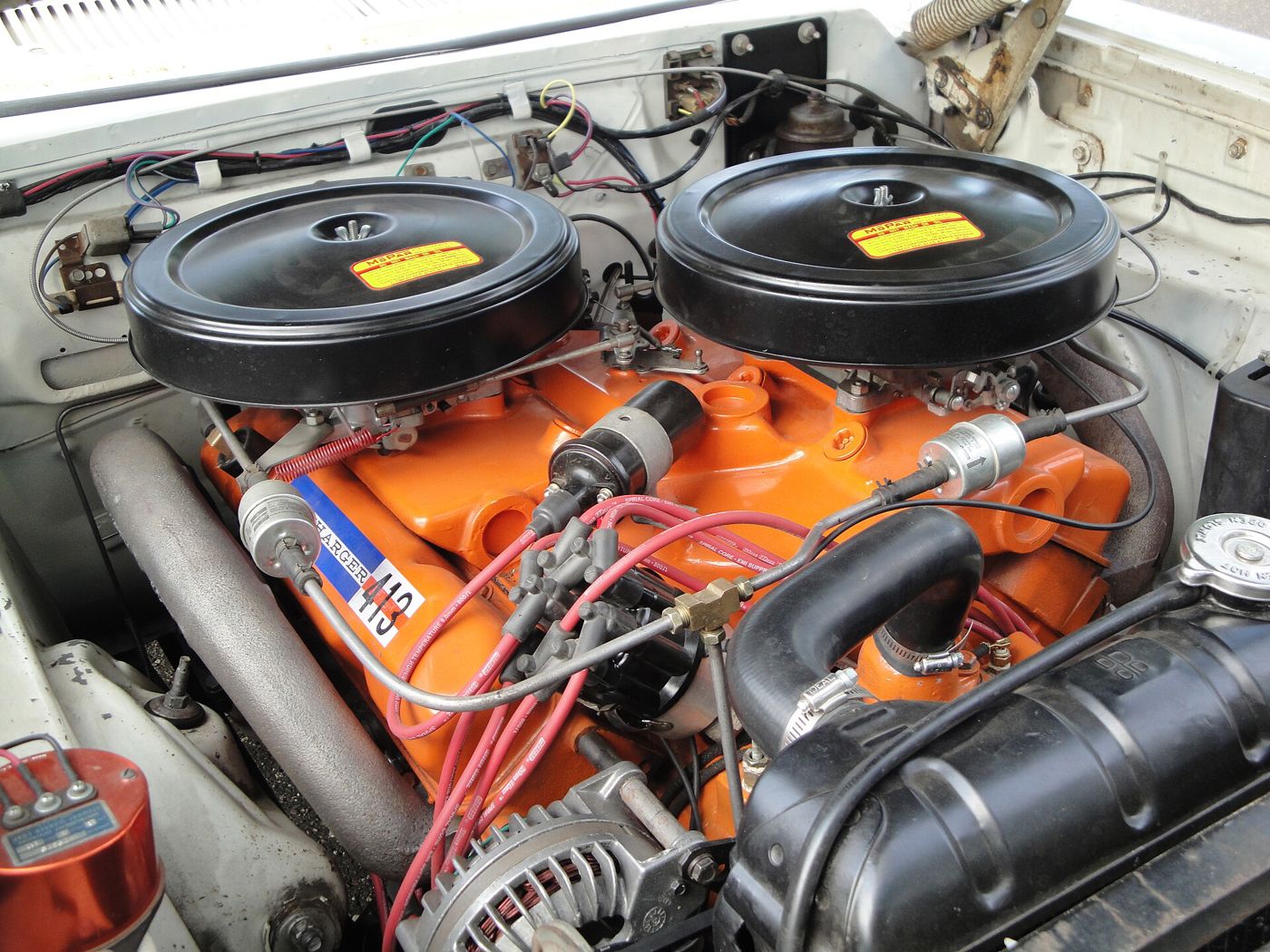
The 1962 Dodge that the Ramchargers took delivery of was ordered the way the club wanted it: white paint, red interior, and, in the team's own telling, the first Dodge Super Stock car ever built. When the members opened the hood they found orange valve covers carrying decals that read RAMCHARGER 413. Dodge had put the name of a club of young Chrysler engineers who raced on their own time onto its most powerful passenger-car engine. The club's history is not shy about what that meant to them. Its verdict on the decals is three words long: "What an honor."1,2
The Ramchargers were not a factory team, and NHRA's history is careful to say so. National Dragster editor Phil Burgess describes a confederation of individuals that formed an NHRA-sanctioned hot rod club in 1958 and 1959, and he stresses that it stayed free-standing, financially and operationally, from Chrysler even while its members' day jobs came to involve the corporation's race development. The roster reads like an engineering department after hours: Tom Hoover, later called the father of the 426 Hemi; Dan Mancini on carburetion and the dynamometer; Dick Maxwell, who built the club's first car; and drivers Jim Thornton, Herman Moser and Mike Buckel.3
That first car, the High and Mighty, was a 1949 Plymouth business coupe with a 354 Hemi, and NHRA credits it with C/Altered records of 109.75 mph and 12.62 seconds over its two seasons. By 1962 the club's attention had moved to Dodge's new showroom car, and the timing was good. Dodge had made what Over-Drive calls a surprise move for 1962, cutting the wheelbase of its standard line from 118 inches to 116 and taking almost 150 pounds out of the average car. The Dart, Dart 330, Dart 440 and Polara 500 all shared that shorter chassis, which put a big-block engine into a noticeably lighter package than the year before.3,2
The ladder of engines Dodge offered on that chassis shows how far up the new option sat. The Polara 500, the line's sporting flagship with bucket seats, carpeting and dual exhausts, came standard with a 361-cubic-inch V8 rated at 305 horsepower. Above it the fact sheet lists 383s at 330 and 335 horsepower and ordinary 413s at 365 and 385. The Ramcharger 413 replaced the older high-output 413 and 383 long- and short-ram engines. Its bore and stroke were 4.1875 by 3.75 inches, and it breathed through an integral 15-inch short-ram intake carrying two Carter four-barrels, AFB-2903S as standard or AFB-3447S as an option.2
Dodge published two ratings. On 11.0:1 compression the Ramcharger 413 was listed at 410 horsepower at 5,400 rpm; on 13.5:1 it was listed at 420. These are Dodge's advertised figures, not dynamometer readings from any particular engine, and the fact sheet does not state the rating basis. The high-compression version carried a telling bureaucratic history: Over-Drive notes that it was first listed as dealer installed and later amended to optional. The 410-horsepower engine was a $400 option. Plymouth sold its twin, the Super Stock 413, on the same 116-inch-wheelbase platform with the same two ratings at $375, so the two divisions were offering one engineering answer under two names.2,4
The competition it was built to meet was already on the strip. NHRA's account of the 1961 season reproduces Pontiac's offer of a 421-cubic-inch high-performance engine to qualified drivers and a National Dragster report of an August 1961 Pomona meet in which Hayden Proffitt, in Mickey Thompson's Pontiac, beat Don Nicholson's 409 Chevrolet in the Super Stock final. By the spring of 1962 Nicholson was the Winternationals champion. NHRA records that the first public test of the 413 Max Wedge was a best-of-five match race at Detroit Dragway between the Ramchargers' Dart and Nicholson's 409, and it states plainly that the contest did not end in Dodge's favor.5,6
The Winternationals did deliver a Dodge wedge headline, but not in a sedan. NHRA credits Jim Nelson's Dragmaster Dart, a dragster powered by a supercharged 413, with the first major win for a Dodge wedge-headed engine in any dragster. The Dragmaster connection had its own paper trail: NHRA, citing Hot Rod, says Dodge asked Wally Parks in 1961 whom to support on the West Coast, and that truckloads of engines, transmissions and rear ends then went to the Carlsbad shop, enough to need a second 6,000-square-foot building. Nelson's car and the Ramchargers' Dart shared an engine family and nothing else; one was a blown dragster, the other a showroom sedan.6
The Ramchargers' own account of the season is a development diary. The car arrived with a long-ram manifold because, the club says, the cross-ram manifold that later Max Wedge lightweights wore was not yet finished; it got one from Chrysler when they became available. Meanwhile the team swapped in the shortened long-ram pieces it had used on its 1961 car, having found they suited the manual transmission better. The planned debut at the February 1962 Winternationals was delayed by rain, so Buckel took his wife on an overdue honeymoon in the new Dart, found another track, and, by the club's account, ran the first 12-second pass ever made by a Super Stock car.1
That 12-second claim comes from the team, and no timing slip, track name or date accompanies it, so it stands as the Ramchargers' record of their own car rather than an NHRA result. The same history is candid about what went wrong. Traction problems and failures of the Borg-Warner three-speed manual plagued the car through the first half of 1962, and the team replaced it with a TorqueFlite automatic, after which, the club says, the Dart was faster and easier to drive. The automatic had been on Dodge's list from the start: the specifications give the TorqueFlite 2.45, 1.45 and 1.00 ratios, 3.91 gearing for manual-transmission 413 cars, and dealer ratios from 2.76 to 6.17.1,2
The Stock Eliminator trophy at the Nationals went to Chevrolet. NHRA's memorial list for Hayden Proffitt records that his 1962 Bel Air 409 won Stock Eliminator at the U.S. Nationals, the only NHRA national event title of his career. For Dodge the harder question is how many buyers followed the Ramchargers' lead. No Dodge document yet located gives a count of 1962 cars built with the Ramcharger 413. Over-Drive's fact sheet links a 1962 Dodge production-figure document that could not be read, and the Plymouth sheet's body-style totals, such as 5,086 Belvedere hardtops and 4,039 Sport Fury hardtops, count every engine rather than the Super Stock option. The number stays unknown.7,2,4
What 1962 led to is better documented than what it produced. A Chrysler technical bulletin dated June 13, 1963 opens by presenting the 426 as the successor to the 1962 413 programs, naming them Ramcharger for Dodge and Super Stock for Plymouth. At the 1963 Nationals Herman Moser won Stock in the club's Max Wedge Dart, and Buckel later recalled that NHRA inspected the engine every night and then sealed it. Hoover went on to be remembered as the father of the 426 Hemi. The weekend club whose name went onto a Dodge valve cover in 1962 had become the people Chrysler's racing engines were built around.8,3
Fact sheet · 1962 · United States
The numbers
1962 Dodge Dart and Polara 500 with the Ramcharger 413 — Dodge's downsized 116-inch-wheelbase line gained the 'Ramcharger 413', a dual-four-barrel short-ram wedge rated at 410 or 420 hp; no sourced count of Ramcharger-equipped cars was found.
Coverage: Partial — researched sections are shown; missing ones are not yet sourced. Researched through 2026-09-23.
Every figure is labeled with how sure we are. Reported means a manufacturer, registry, or reference figure we cite but have not reconciled against factory records ourselves. Disputed means credible sources disagree and both are shown. Rows are separately scoped; don't add them together unless the note says they make up a total.
Key facts
Production
| What was counted | Count | Basis | Status |
|---|---|---|---|
| Dodge Dart (base series), all engines, rounded2 Dart · sedans · not stated Host-series context for the Ramcharger 413, not a count of Ramcharger cars. | 48,200 | built, model-year | Reported |
| Dodge Dart 330, all engines, rounded2 Dart 330 · sedans and hardtop · not stated Host-series context. | 25,500 | built, model-year | Reported |
| Dodge Dart 440, all engines, rounded2 Dart 440 · sedans, hardtops, convertible · not stated Host-series context. | 37,800 | built, model-year | Reported |
| Dodge Polara 500, rounded2 Polara 500 · hardtops and convertible · not stated Host-series context. | 12,500 | built, model-year | Reported |
| What was counted | Count | Basis | Status |
|---|---|---|---|
| Full-size (116-in) Dodges, exact model-year output as stated2 all 116-in Dodges · not stated The same table's rounded series rows total 148,400; the note's 165,861 is a different figure (it may include the Custom 880, which the table does not list). Not a Ramcharger count. | 165,861 | built, model-year | Disputed |
No sourced production figure for 1962 Ramcharger 413 Dodges, or for Dart/Polara 500 by body style, was found. The fact sheet's linked production-figure PDF was later read from its page image; it gives only rounded series totals (see the host-series rows).
Over-Drive's production PDF gives no count of Ramcharger 413 cars; the series rows are host-model context only.
Prices when new
| Model | Price | Basis |
|---|---|---|
| Base price, Dart two-door sedan, six-cylinder2 | $2,297 | base price as printed by the fact sheet (context only; not a performance car), 1962 model year |
| Base price, Dart 2-door sedan V-8 (SD2 511)2 | $2,348 | base price as tabulated by Over-Drive, 1962 model year |
| Base price, Dart 330 2-door sedan V-8 (SD2-M 521)2 | $2,482 | base price as tabulated by Over-Drive, 1962 model year |
| Base price, Polara 500 2-door hardtop (SD2-P 542)2 | $2,960 | base price as tabulated by Over-Drive, 1962 model year |
Prices are the nominal dollars of the day, not adjusted for inflation.
Engines
| Engine | Factory rating | Availability | Built |
|---|---|---|---|
| Ramcharger 413, dual 4-bbl short ram, 410 hp2,9 413 cu in · 2 x 4-barrel on integral 15 in short-ram intake (Carter AFB-2903S standard, AFB-3447S optional) | 410 hp (manufacturer published (basis not stated)); 410 hp @ 5,400, 460 lb-ft @ 4,400 (SAE gross (AMA high-performance options sheet)) | optional | Not yet sourced |
| Ramcharger 413, dual 4-bbl short ram, 420 hp (13.5:1)2,9 413 cu in · 2 x 4-barrel on integral 15 in short-ram intake | 420 hp (manufacturer published (basis not stated)); 420 hp @ 5,400, 470 lb-ft @ 4,400 (SAE gross (AMA high-performance options sheet)) | optional | Not yet sourced |
| 413 4-bbl V-8, 365 hp9 413 cu in · 4-barrel | 365 hp @ 4,600, 460 lb-ft @ 2,800 (SAE gross (AMA high-performance options sheet)) | high-performance option (Dart, Dart 330, Dart 440, Polara 500) | Not yet sourced |
| 413 2x4-bbl long-runner V-8, 385 hp9 413 cu in · two 4-barrel, long runner | 385 hp @ 5,200, 455 lb-ft @ 3,600 (SAE gross (AMA high-performance options sheet)) | high-performance option | Not yet sourced |
| 383 2x4-bbl long-runner V-8, 335 hp9 383 cu in · two 4-barrel, long runner | 335 hp @ 5,200, 420 lb-ft @ 3,600 (SAE gross (AMA high-performance options sheet)) | high-performance option | Not yet sourced |
| 361 2x4-bbl long-runner V-8, 310 hp9 361 cu in · two 4-barrel, long runner | 310 hp @ 5,200, 390 lb-ft @ 3,400 (SAE gross (AMA high-performance options sheet)) | high-performance option | Not yet sourced |
Ratings are the manufacturer's advertised figures under the standard shown (SAE gross before 1972, SAE net after). They are not dyno results, and gross and net ratings can't be compared directly.
Transmissions
| Transmission | Availability | Built |
|---|---|---|
| Three-speed manual2 | available with 413 | Not yet sourced |
| TorqueFlite automatic (2.45 / 1.45 / 1.00)2 | available | Not yet sourced |
Options and packages
| Code | Option | Price | Installed |
|---|---|---|---|
|
'Ramcharger 413' 413 CID 410 hp V82 | $400 | Not yet sourced |
Paint
| Code | Color | Built |
|---|---|---|
A |
Flax2 | Not yet sourced |
B |
Silhouette Black2 | Not yet sourced |
C |
Powder Blue2 | Not yet sourced |
D |
Medium Blue2 | Not yet sourced |
E |
Cobalt Blue2 | Not yet sourced |
F |
Light Green2 | Not yet sourced |
G |
Glade Green2 | Not yet sourced |
H |
Emerald2 | Not yet sourced |
M |
Pearl Gray2 | Not yet sourced |
P |
Vermilion2 | Not yet sourced |
R |
Dusty Rose2 | Not yet sourced |
S |
Deep Cordovan2 | Not yet sourced |
T |
Buff2 | Not yet sourced |
W |
Polar White2 | Not yet sourced |
Y |
Nutmeg Brown2 | Not yet sourced |
Color names are the factory's. We don't show color swatches, because a screen color is no guide for a restoration.
Specifications
| Measure | Value | Applies to |
|---|---|---|
| Wheelbase2 | 116 in | Dart/Polara 500 passenger cars |
| Overall width2 | 76.6 in | as printed |
| Tread, front / rear2 | 59.4 / 57.5 in | as printed |
| Rear axle ratio with 4132 | 3.91:1 with manual transmissions (as printed); dealer ratios 2.76 to 6.17 | 413 cars |
| Shipping weight, Dart 2-door sedan V-82 | 3,135 lb | SD2 511 |
| Tyres with high-performance options9 | 7.00 x 14 standard; 7.50 x 14 front and 9.00 x 14 rear optional | all Dart, Dart 330, Dart 440 and Polara 500 with high-performance V-8s |
Identification
- Serial number car line
- In 1962 Chrysler serial numbers, car-line digit 5 is Dodge Dart V8.10
- Applicable models
- The 1962 AMA high-performance options sheet says its data apply to all Dodge Dart, Dart 330, Dart 440 and Polara 500 models.9
Identification
Read a 1962 Dodge VIN
The VIN decoder runs in your browser and never sends the VIN anywhere. How the factory numbered this year's cars:
Same model year
Also in 1962
- Buick Wildcat A bucket-seat, vinyl-roofed Invicta sport coupe with the 325-hp Wildcat 445 V-8 and a 3.42 axle; 2,000 built.
- Chevrolet Chevy II and Nova First Chevy II model year; the source engine table lists only the 153 four and 194 six. Enthusiast-compiled production: 326,607 cars.
- Chevrolet Impala SS 99,311 Super Sports, bucket seats and all-vinyl interiors; 15,019 409 engines across the full-size line.
- Chrysler 300 letter series Moved to the shorter 122-inch Newport-based platform without fins and overshadowed by a new non-letter 300 Sport series, the 300H had the letter cars' best power-to-weight ratio and one of their smallest runs.
- Ford Fairlane The first intermediate Fairlane: 79,606 Fairlanes and 217,510 Fairlane 500s by reference-site counts, 19,628 of them bucket-seat Sport Coupes.
- Ford Galaxie The top performance engine rose from 390 to 406 cubic inches, 385 hp with a four-barrel and 405 hp with three two-barrels, and the bucket-seat Galaxie 500 XL arrived as the sport series.
- Ford Thunderbird The Sports Roadster package arrived, 1,427 were built, and about 120 of them had the 340-hp M-code tri-carb 390.
- Mercury Marauder and S-55 Mercury's first S-55 was a bucket-seat Monterey Custom hardtop and convertible, with 390 and 406 big-block options.
- Oldsmobile Starfire A hardtop coupe joined the convertible, output rose to 345 hp, and the Starfire had its best year: 42,762.
- Plymouth Savoy, Fury and Max Wedge On the downsized 116-inch Plymouth, the 'Super Stock 413' short-ram wedge was a $375 option rated at 410 or 420 hp; body-style production is known, Super Stock production is not.
- Pontiac Catalina 2+2 and Super Duty The 421 Super Duty became a catalogued $2,250 option for Catalina two-doors and the Grand Prix.
- Pontiac Grand Prix An all-new performance-luxury hardtop on the Catalina body: 303 hp, buckets, console and tachometer, and 30,195 sold.
- Pontiac Tempest and LeMans LeMans becomes the sporty Tempest Custom; 1,658 Tempests got the aluminum V8.
- Studebaker Hawk Brooks Stevens's restyle of the six-year-old Hawk body cost $400 more than the 1961 car, and production more than doubled: 9,335 in all, 8,388 of them domestic.