1962 · Chrysler · United States
Lighter, Faster, Overshadowed
Moved to the shorter 122-inch Newport-based platform without fins and overshadowed by a new non-letter 300 Sport series, the 300H had the letter cars' best power-to-weight ratio and one of their smallest runs.
United States · researched through 2026-09-22
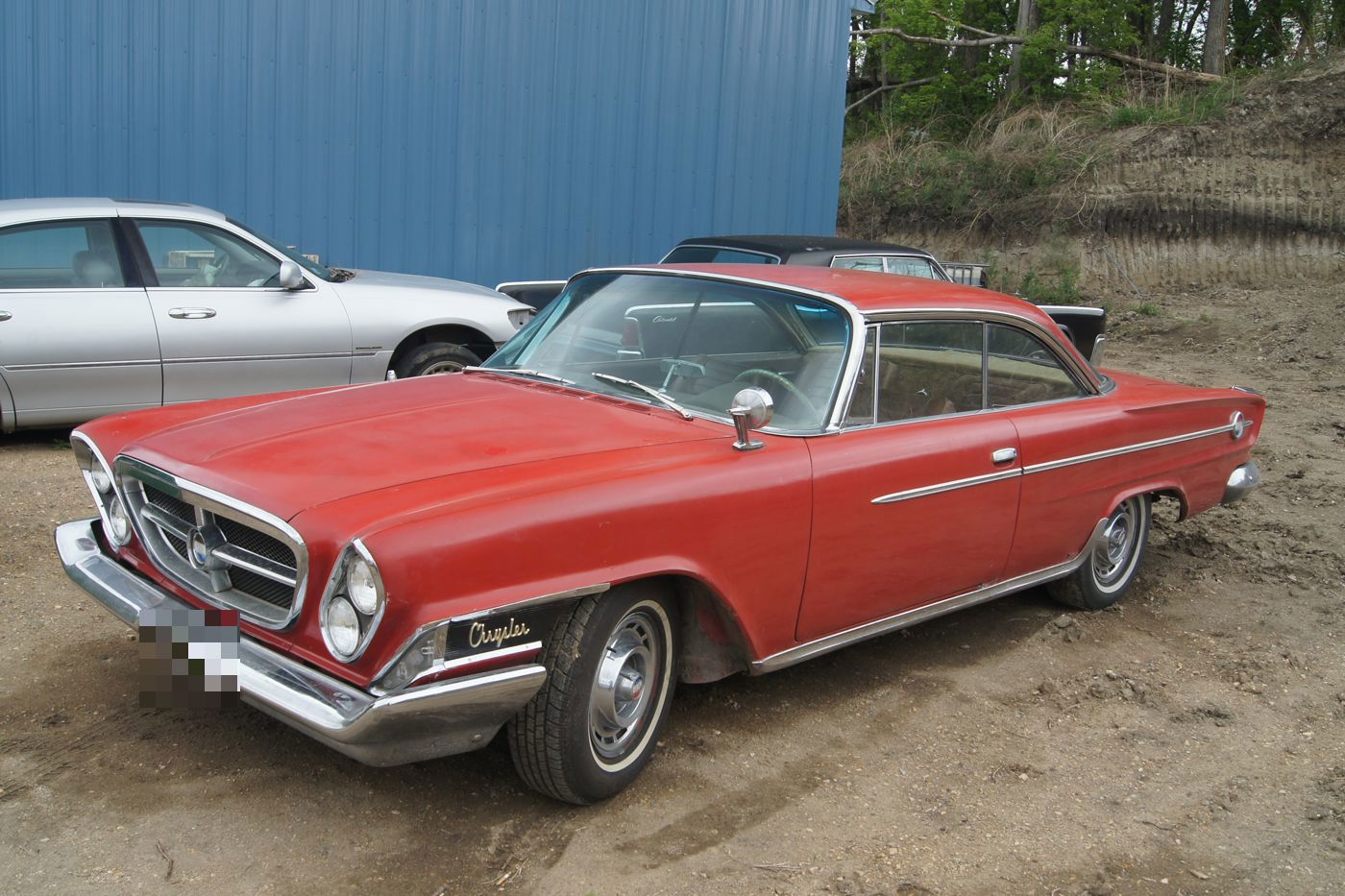
The 300H, series SC3-M, moved to the shorter 122-inch-wheelbase Newport-based platform and dropped the fins, a roughly 300-pound weight saving that, combined with a 5 hp increase, the Chrysler 300 Club credits with giving the H the best power-to-weight ratio of the letter series. The standard 413 returned to in-line dual four-barrels rated 380 hp at 5,200 rpm, with an optional short-ram cross-ram version on 11.0:1 compression rated 405 hp at 5,400 rpm; TorqueFlite was standard and a three-speed manual optional. Base prices ran $5,090 for the hardtop and $5,461 for the convertible, and tan leather bucket seats front and rear with a full-length console were standard, the dashboard now color-matched to the leather and carpet.1,2,3
Convertible production is disputed between the Chrysler 300 Club's 123 and Over-Drive's own fact sheet figure of 135, though Over-Drive's separate compiled production table agrees with the club at 123, so this record leads with 123 while showing the fact sheet's 135 as disputed. The combined total of 558 (435 hardtops plus 123 convertibles) is confirmed by two independent lineages, but the club's own separate production-dates table carries its own caveat that 1962 records for the H "may not be accurate," a limitation this record passes on rather than resolving.2,1,4,5
A factory high-performance AMA supplement, applying to both the letter-series 300H and the non-letter 300, lists engines well beyond the two catalogued in the standard engine table: a 413 four-barrel large-bore rated 365 hp, a 426 four-barrel large-bore rated 373 hp at 11.0:1 or 385 hp at 12.0:1, and a 426 dual-four-barrel ram version rated 413 hp at 11.0:1 or 421 hp at 12.0:1. None of these were advertised, and Hot Rod's own test reports that Chrysler would first try to talk a buyer out of ordering the high-performance option rather than promote it; no source consulted states how many letter cars, if any, left the factory with either 426.6,7
A Car Life comparison table published in May 1963 alongside that magazine's 300J test reprints an earlier 300H result: a 16.0-second quarter-mile at 88.5 mph and a 7.7-second 0-60 time, on a 380-hp car at 4,220 lb; the original March 1962 Car Life test was not read in this pass, so this record carries only the reprinted comparison figures. Hot Rod's own February 1962 piece, read directly, printed no instrumented 300H figures at all; its one drag-strip time, 14.28 seconds at 100.11 mph, belonged to a non-letter 300 hardtop with the 405-hp engine and is accordingly not attached to this 300H record.8,7
The three-speed manual's own gear ratios are disputed: Over-Drive's fact sheet gives 2.17/1.43/1.00, while Hot Rod's test instead reports a 2.55 low and 1.49 second gear on a Power Pak car with an 11-inch clutch; this record keeps the Over-Drive figures in the primary transmission row while showing both. The 300H's suspension ran a 1.010-inch front torsion bar against the plain 300's 0.990 in, an extra-leaf rear spring rated 160 lb per inch against 135 for the 300, and a link-type stabilizer bar standard on the H alone; it also rode on 15-inch wheels with nylon Goodyear Blue Streak tires against the plain 300's 14-inch rayon-cord tires, with 12-inch, 251-sq-in power-assisted drum brakes standard.1,7
Fact sheet · 1962 · United States
The numbers
1962 Chrysler 300H — Moved to the shorter 122-inch Newport-based platform without fins and overshadowed by a new non-letter 300 Sport series, the 300H had the letter cars' best power-to-weight ratio and one of their smallest runs.
Coverage: Partial — researched sections are shown; missing ones are not yet sourced. Researched through 2026-09-22.
Every figure is labeled with how sure we are. Reported means a manufacturer, registry, or reference figure we cite but have not reconciled against factory records ourselves. Disputed means credible sources disagree and both are shown. Rows are separately scoped; don't add them together unless the note says they make up a total.
Key facts
Production
| What was counted | Count | Basis | Status |
|---|---|---|---|
| Chrysler 300H, two-door hardtop2,1 300H · 2-door hardtop · not stated | 435 | built, model-year | Reported |
| Chrysler 300H, convertible2,3 300H · convertible · not stated Over-Drive gives 135; see conflicts. | 123 | built, model-year | Disputed |
| What was counted | Count | Basis | Status |
|---|---|---|---|
| Chrysler 300H, all bodies5,4 300H · not stated Two independent lineages agree on 558 (435 hardtop + 123 convertible). The club's own separate 'Letter Car Production Dates' table carries an explicit caveat on the 300H ('We don't have all of the records for the H. For that reason, this information may not be accurate.'), which this record passes on rather than resolving. | 558 | built, model-year | Reported |
Letter-car 300H only; the non-letter 300 Sport series is excluded.
Over-Drive's 1962 production table prints 435 hardtops (body 23) and 123 convertibles (body 27), total 558, within 127,678 Chryslers; this agrees with the club's 123 convertibles and not with Over-Drive's own fact-sheet 135.
The Chrysler 300 Club's own registry notes that its 1962 (300H) records are incomplete and may be inaccurate; see the total row's note.
Prices when new
| Model | Price | Basis |
|---|---|---|
| Base price, 300H hardtop1,4 | $5,090 | base price as printed by the fact sheet, 1962 model year |
| Base price, 300H convertible1,4 | $5,461 | base price as printed by the fact sheet, 1962 model year |
Prices are the nominal dollars of the day, not adjusted for inflation.
Engines
| Engine | Factory rating | Availability | Built |
|---|---|---|---|
| 413 wedge V8, in-line dual 4-bbl, 380 hp1 413 cu in · 2 x 4-barrel in line (Carter AFB 3258S front, 3259S rear) | 380 hp @ 5,200, 450 lb-ft @ 3,600 (manufacturer published (basis not stated)) | standard | Not yet sourced |
| 413 wedge V8, short-ram cross-ram, 405 hp1 413 cu in · 2 x 4-barrel on 15 in cross-ram manifold (Carter AFB 3084S) | 405 hp @ 5,400, 473 lb-ft @ 3,600 (manufacturer published (basis not stated)) | optional | Not yet sourced |
Ratings are the manufacturer's advertised figures under the standard shown (SAE gross before 1972, SAE net after). They are not dyno results, and gross and net ratings can't be compared directly.
Transmissions
| Transmission | Availability | Built |
|---|---|---|
| TorqueFlite three-speed automatic (2.45 / 1.45 / 1.00), heavy-duty aluminum case1,2 | standard | Not yet sourced |
| Three-speed manual (2.17 / 1.43 / 1.00)1 | optional | Not yet sourced |
Options and packages
| Code | Option | Price | Installed |
|---|---|---|---|
|
413 short-ram 405 hp high-performance engine (2 x 4-bbl ram, 11.0:1, 284-degree mechanical camshaft, special heads, larger exhaust manifolds); not advertised, hand-built6,7 | — | Not yet sourced |
|
413 4-bbl large-bore engine (365 hp at 4,800; 11.0:1), high-performance option listed for 300 and 300H6 | — | Not yet sourced |
|
426 4-bbl large-bore (373 hp at 4,800 with 11.0:1; 385 hp with 12.0:1) and 426 2 x 4-bbl ram (413 hp at 5,400 with 11.0:1; 421 hp with 12.0:1) high-performance options listed for 300 and 300H6 | — | Not yet sourced |
|
Sure-Grip limited-slip differential (all ratios); optional gear sets through Chrysler parts departments as low as 4.897 | — | Not yet sourced |
|
Optional tires 9.00 x 14, 9.50 x 14 and 7.60 x 15 (high-performance engines)6 | — | Not yet sourced |
Paint
| Code | Color | Built |
|---|---|---|
BB-1 |
Formal Black1,9 | Not yet sourced |
PP-1 |
Festival Red1,9 | Not yet sourced |
WW-1 |
Oyster White1,9 | Not yet sourced |
ZZ-1 |
Caramel1,9 | Not yet sourced |
Color names are the factory's. We don't show color swatches, because a screen color is no guide for a restoration.
Interiors
| Code | Trim | Built |
|---|---|---|
|
Tan leather; bucket seats front and rear with full-length console; four passengers1 | Not yet sourced |
|
Top-grain leather in Saddle Tan, the only color offered for the 300H; four bucket seats with dividing console housing a mechanical tachometer, ashtrays, power-window buttons and armrest-glove boxes; front seat belts standard7 | Not yet sourced |
|
Painted interior: instrument panel, defrost outlets and radio grille Medium Tan metallic gloss; lower cowl side panels Medium Tan semi-gloss (club substitute Ditzler 22091)9 | Not yet sourced |
Specifications
| Measure | Value | Applies to |
|---|---|---|
| Wheelbase1,3 | 122 in | all bodies |
| Overall length1,3 | 215.3 in | all bodies |
| Overall width1,3 | 79.4 in | all bodies |
| Overall height1 | 55.5 (hardtop) / 55.7 (convertible) in | by body |
| Tread, front / rear1 | 61.1 / 60.0 in | all bodies |
| Tires1 | 7.60 x 15 Blue Streak | 300H |
| Rear axle ratio, TorqueFlite1 | 3.23:1 standard; optional 2.93, 3.15, 3.58, 3.73 | TorqueFlite |
| Suspension7 | Torsion bars 1.010 in diameter (300: .990); front rate 130 lb per in at the wheel; rear leaf springs with an extra leaf, 160 lb per in at the wheel (300: 135); link-type stabilizer bar standard on the 300H only | 300H |
| Wheels and tires7 | 15 in wheels with 7.60 x 15 nylon Goodyear Blue Streaks (300: 14 in rayon) | 300H |
| Brakes7 | 12 in centerplane drums, 2½ in lining, 251 sq in; power assist standard on the 300H | 300H |
| 380 hp engine camshaft7,6 | Mechanical, 268 deg duration; intake valves 2.08 in, exhaust 1.60 in; two Carter four-barrels on a runner-type dual intake (ram induction dropped) | 300H standard engine |
| Power steering7 | Standard; 19.2:1, 3.5 turns lock to lock; turning circle 42.7 ft | 300 and 300H |
Period road tests
| Test | Car tested | Result |
|---|---|---|
| Car Life, 1963-058Standing quarter mile | 300H (380 hp, runner manifold), curb weight 4,220 lb; transmission and body not stated in the comparison tableCar Life's own earlier 300H result reprinted in its May 1963 300-J comparison table; also 0-40 4.3, 0-60 7.7, 0-80 13.0, 0-100 21.0 s. The original March 1962 Car Life test was not read. | 16.0 s at 88.5 mph |
A road test result belongs to the one car that was tested, with its engine, gearing, tires, and conditions. It is not a figure for every car of the year.
Identification
- Series
- Series SC3-M.1
- Serial number
- 1962-1965 Chrysler serial numbers carry a model digit; a club decoding table lists the letter car under model digit 4 (300H in 1962).10
Where the sources disagree
300H convertible production
Club figure leads as disputed; Over-Drive's fact sheet shown. Over-Drive's own production table also prints 123.
Identification
Read a 1962 Chrysler VIN
The VIN decoder runs in your browser and never sends the VIN anywhere. How the factory numbered this year's cars:
Same model year
Also in 1962
- Buick Wildcat A bucket-seat, vinyl-roofed Invicta sport coupe with the 325-hp Wildcat 445 V-8 and a 3.42 axle; 2,000 built.
- Chevrolet Chevy II and Nova First Chevy II model year; the source engine table lists only the 153 four and 194 six. Enthusiast-compiled production: 326,607 cars.
- Chevrolet Impala SS 99,311 Super Sports, bucket seats and all-vinyl interiors; 15,019 409 engines across the full-size line.
- Dodge Dart 330/440, Polara and Max Wedge Dodge's downsized 116-inch-wheelbase line gained the 'Ramcharger 413', a dual-four-barrel short-ram wedge rated at 410 or 420 hp; no sourced count of Ramcharger-equipped cars was found.
- Ford Fairlane The first intermediate Fairlane: 79,606 Fairlanes and 217,510 Fairlane 500s by reference-site counts, 19,628 of them bucket-seat Sport Coupes.
- Ford Galaxie The top performance engine rose from 390 to 406 cubic inches, 385 hp with a four-barrel and 405 hp with three two-barrels, and the bucket-seat Galaxie 500 XL arrived as the sport series.
- Ford Thunderbird The Sports Roadster package arrived, 1,427 were built, and about 120 of them had the 340-hp M-code tri-carb 390.
- Mercury Marauder and S-55 Mercury's first S-55 was a bucket-seat Monterey Custom hardtop and convertible, with 390 and 406 big-block options.
- Oldsmobile Starfire A hardtop coupe joined the convertible, output rose to 345 hp, and the Starfire had its best year: 42,762.
- Plymouth Savoy, Fury and Max Wedge On the downsized 116-inch Plymouth, the 'Super Stock 413' short-ram wedge was a $375 option rated at 410 or 420 hp; body-style production is known, Super Stock production is not.
- Pontiac Catalina 2+2 and Super Duty The 421 Super Duty became a catalogued $2,250 option for Catalina two-doors and the Grand Prix.
- Pontiac Grand Prix An all-new performance-luxury hardtop on the Catalina body: 303 hp, buckets, console and tachometer, and 30,195 sold.
- Pontiac Tempest and LeMans LeMans becomes the sporty Tempest Custom; 1,658 Tempests got the aluminum V8.
- Studebaker Hawk Brooks Stevens's restyle of the six-year-old Hawk body cost $400 more than the 1961 car, and production more than doubled: 9,335 in all, 8,388 of them domestic.